
Kenya’s electric vehicle story is entering a new phase.
For years, the conversation around electric mobility has largely focused on charging infrastructure, battery prices and whether Kenyan motorists are ready to move away from petrol and diesel vehicles.
But California-based mobility startup Bingo Technologies is approaching the question from a different direction.
Instead of asking whether Kenyan consumers are ready to buy electric cars, Bingo is asking a more commercially important question:
Can an electric vehicle help a ride-hailing driver spend less, stay on the road longer and earn more?
That distinction explains why the company chose Kenya as one of the first markets for its new Bingo E2.
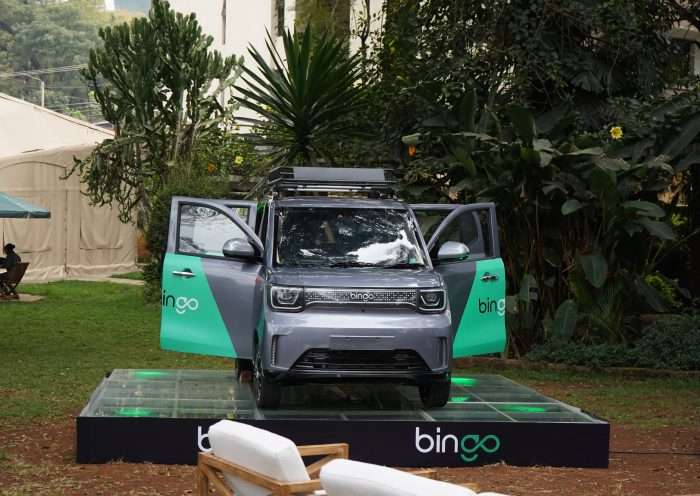
The company unveiled the E2 in Nairobi in July 2026, positioning the vehicle as an electric car designed specifically for high-utilisation commercial mobility rather than as a conventional passenger EV. Kenyan media reported that Bingo selected the country because of its growing ride-hailing industry, relatively high fuel costs and supportive electric-mobility environment.
And that could make Bingo’s Kenya strategy more interesting than another EV launch.
Kenya’s ride-hailing market presents a very different EV opportunity
Ride-hailing vehicles are not ordinary cars.
A privately owned vehicle might spend several hours a day parked. A ride-hailing car can spend most of the day moving passengers, covering hundreds of kilometres and generating revenue.
For the driver or fleet owner, therefore, the most important question is not necessarily how sophisticated the vehicle looks.
It is:
How much does it cost to keep the vehicle earning money?
Fuel, maintenance, financing, insurance and downtime can determine whether a ride-hailing vehicle is profitable.
This is where Bingo believes an electric vehicle can have a particularly strong advantage.
The company’s own research and market positioning focus heavily on the economics of operating the E2 rather than simply its environmental credentials. Bingo says its vehicle can reduce energy costs compared with petrol-powered alternatives and is designed around the high-utilisation requirements of professional drivers.
That is a significant change in how EVs are marketed in Africa.
The pitch is no longer simply:
“Buy an electric car because it is cleaner.”
It becomes:
“Use an electric car because it could make your business more efficient.”
The Bingo E2 is built around uptime
One of the biggest challenges facing electric vehicles in commercial transport is downtime.
A petrol car can stop at a fuel station, refuel and continue its journey within minutes.
Charging an EV can take considerably longer depending on the vehicle and charging system.
For a ride-hailing driver, every minute spent waiting can potentially mean another trip that was not completed.
Bingo’s answer is its dual-battery architecture.
The E2 combines a built-in battery with additional swappable batteries. According to Bingo’s product catalogue, the system provides up to 440 kilometres of combined range, comprising approximately 310 kilometres from the built-in battery and 130 kilometres from the swappable batteries.
The company says a swappable battery can be exchanged in about two minutes.
That concept could be particularly relevant to Nairobi’s ride-hailing economy.
Instead of waiting for the entire vehicle to recharge, a driver could potentially replace a depleted swappable battery and get back onto the road.
For a commercial vehicle, that is not merely a convenience.
It is a productivity feature.
Bingo is targeting the economics of the driver
Perhaps the most interesting aspect of Bingo’s Kenya strategy is that it is not positioning the E2 purely as a technology product.
The company is building an ecosystem around the vehicle.
Bingo’s model includes fleet operators, drivers, battery infrastructure and software.
Its website describes a “Cloud Fleet OS” that allows vehicle owners and operators to monitor vehicle location, battery status, utilisation, maintenance information and earnings. It also features an AI-powered fleet assistant called MAYA.
This is where the vehicle starts to look less like a traditional car and more like a connected business asset.
For fleet owners, knowing where a vehicle is, how it is being used and how much revenue it is generating can be just as important as the vehicle itself.
That could become particularly important in Kenya, where fleet-based ride-hailing is already a significant part of the mobility ecosystem.
The $12,000 question
Bingo currently lists the E2 at $12,000 and has opened reservations, with production vehicles expected to ship from the third quarter of 2026.
That price puts the vehicle in a very different conversation from premium electric cars.
It is still a significant investment for an individual Kenyan driver, particularly when converted into Kenyan shillings and compared with the incomes of many ride-hailing operators.
That is why Bingo’s fleet model could be just as important as the vehicle itself.
Rather than requiring every driver to purchase an E2 outright, the company is developing leasing and rental programmes in Nairobi.
Its website describes a model where vehicle owners can purchase E2s and have them leased to professional ride-hailing drivers, with the vehicle generating lease revenue. Bingo currently estimates that a $12,000 vehicle could generate up to $400 per month in lease revenue under its stated Nairobi market assumptions. The company also explicitly notes that these are projections and not guaranteed returns.
That approach potentially creates a different route into EV ownership.
The person who drives the vehicle does not necessarily have to be the person who owns it.
For Kenya’s ride-hailing market, that distinction could prove important.
Why Kenya makes sense for Bingo
Bingo’s decision to enter Kenya is not accidental.
The company describes Nairobi as its initial market and identifies the city’s concentrated ride-hailing activity as one of the reasons for choosing Kenya.
Kenya also has something that many emerging EV markets do not yet have at the same scale: an established digital mobility ecosystem.
Drivers already use smartphones to accept trips, navigate cities, communicate with customers and receive digital payments.
Ride-hailing platforms have also created a large ecosystem of independent drivers and fleet operators.
Bingo therefore does not need to build a new ride-hailing platform from scratch.
Instead, it can attempt to place its vehicle underneath an existing mobility ecosystem.
That is a smart distinction.
As Bingo’s Co-founder and CRO Alex Nesic explained in an interview, the company sees the opportunity as upgrading the vehicle and infrastructure underneath existing ride-hailing demand rather than trying to compete with platforms such as Uber and Bolt.
Kenya’s fuel economics could strengthen the case for EVs
The economics of transportation matter enormously in Kenya.
When fuel prices rise, ride-hailing drivers cannot always increase fares by the same amount without risking lower demand.
That creates a squeeze.
The driver still needs to cover fuel, maintenance, insurance, financing and platform-related costs while earning enough to take home a reasonable income.
Bingo’s argument is that electricity can change that equation.
The company says energy costs in its target markets can be substantially lower than equivalent petrol costs and estimates that an E2 driver could save around $11 per day on energy under its target-market assumptions.
Those figures should ultimately be tested against real-world Kenyan driving conditions.
Electricity tariffs, charging availability, battery-swapping availability, traffic, vehicle utilisation and maintenance costs will all determine the actual savings a driver achieves.
But the underlying business question is compelling:
If an EV can reduce the cost of every kilometre driven, what happens to a driver’s monthly income when that vehicle is working six or seven days a week?
That is the experiment Bingo is now bringing to Kenya.
Battery swapping could be Bingo’s biggest differentiator
Kenya is already familiar with battery swapping through the electric motorcycle market.
That could give Bingo an advantage when introducing the concept to four-wheeled commercial mobility.
The idea is straightforward.
Instead of treating the battery as something that must remain inside the vehicle while it charges, a depleted swappable battery can be exchanged for a charged one.
Bingo says its E2 can use up to four swappable batteries, while its fixed battery can also be charged through conventional charging infrastructure.
The combination gives the E2 two energy-replenishment options.
For a driver with time to charge, conventional charging remains available.
For a driver who needs to get back onto the road quickly, battery swapping is designed to reduce downtime.
That flexibility may ultimately matter more than the headline range figure.
But Bingo still has to prove the model
The opportunity is significant, but Kenya will also test whether the model works outside a presentation or launch event.
The biggest questions are practical.
Will enough battery-swap stations be available?
How quickly can Bingo build infrastructure across Nairobi?
Will drivers accept the vehicle’s size and performance?
Will the economics remain attractive after financing, insurance, maintenance and platform costs?
How will the E2 perform on Nairobi’s roads under heavy commercial use?
And perhaps most importantly:
Can Bingo scale beyond a relatively small initial fleet?
These questions matter because EV adoption in commercial transport is ultimately an infrastructure problem as much as it is a vehicle problem.
A great EV with nowhere to charge or swap batteries will not keep a driver earning.
Bingo appears to understand this.
Its strategy combines the vehicle with software, fleet operators and energy infrastructure rather than treating the car as a standalone product.
The bigger opportunity may be beyond Nairobi
If the E2 succeeds in Nairobi, the implications could extend beyond Kenya’s capital.
Ride-hailing is expanding across African cities, while fuel costs remain a major operating expense for commercial drivers.
Bingo’s website identifies Kenya and South Africa as its initial deployment markets and says it plans to expand into additional emerging markets.
That gives Kenya an interesting role.
The country could become more than a sales market.
It could become a testing ground for a new model of electric commercial transportation designed around African operating conditions.
If Bingo can demonstrate that an affordable EV can survive high daily utilisation, reduce operating costs and maintain driver productivity, other African cities could become natural expansion targets.
Kenya could be the proving ground for a different EV future
The biggest lesson from Bingo’s entry into Kenya may not be about one particular electric car.
It may be about how the next generation of EV companies approaches Africa.
Instead of taking expensive consumer EVs designed primarily for wealthier markets and trying to sell them in Africa, Bingo is attempting to start with a very specific commercial problem:
How do you help a driver who spends most of the day on the road make more money?
That leads to a very different vehicle.
It leads to battery swapping.
It leads to fleet-management software.
It leads to vehicle leasing.
It leads to remote monitoring.
And it leads to a business model where the car is treated as an income-generating asset.
That is arguably the most interesting part of Bingo’s Kenyan strategy.
The company’s real bet is not simply that Kenyans will buy electric cars.
Its bet is that Kenya’s ride-hailing economy is ready for an EV designed around earning money.
And if Bingo gets that equation right, Nairobi could become an important case study for how electric commercial mobility develops across Africa.
What happens next?
The next stage will be less about launch presentations and more about real-world performance.
Kenyan drivers and fleet operators will ultimately judge the Bingo E2 on the things that matter most to them: cost per kilometre, uptime, reliability, comfort, maintenance, financing and daily earnings.
If those numbers work in the real world, Bingo may have found something more valuable than a market for its electric car.
It may have found a blueprint for commercial EV adoption in Africa.
For Bingo Technologies, Kenya is therefore not simply another country on its expansion map. It is a test of whether a purpose-built electric vehicle can turn the economics of ride-hailing in Africa on their head.
