
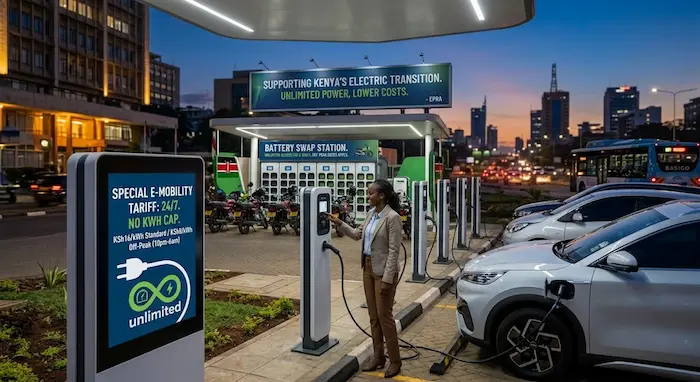

Kenya has removed the 15,000 kilowatt-hour (kWh) monthly ceiling that previously limited access to the country’s special electricity tariff for electric-mobility charging stations.
The change was introduced by the Energy and Petroleum Regulatory Authority (EPRA) through an amendment to the 2023 electricity tariff schedule published in the Kenya Gazette on September 18, 2026.
Under the revised arrangement, e-mobility customers can continue accessing the preferential tariff framework beyond the previous 15,000 kWh ceiling. The tariff is KSh16 per kWh, with a lower KSh8 per kWh rate during the designated off-peak period of 10pm to 6am, according to reporting on the Gazette amendment.
For charging-station and battery-swapping operators, the change removes a constraint that had become more significant as electricity consumption at busy facilities increased.
What Has Changed With Kenya’s EV Charging Tariff?
When EPRA introduced the special e-mobility electricity tariff, charging stations and battery-swapping facilities were subject to a 15,000 kWh monthly consumption threshold.
Once consumption went beyond that level, operators could face a different tariff structure, increasing the cost of electricity used for charging.
The September 2026 amendment removes that ceiling from the e-mobility tariff framework.
The change means high-volume EV charging and battery-swapping facilities have more room to consume electricity without losing access to the special e-mobility tariff structure.
EPRA’s existing e-mobility guidelines provide for the tariff to apply to both EV charging stations and battery-swapping stations.
How Much Is the EV Charging Tariff in Kenya?
The special e-mobility tariff provides two important rates:
| Period | Electricity tariff |
|---|---|
| Standard period | KSh16 per kWh |
| Off-peak: 10pm–6am | KSh8 per kWh |
The off-peak rate is half the standard KSh16/kWh tariff.
The tariff applies to electricity supplied to qualifying e-mobility customers, rather than meaning every EV driver automatically pays exactly KSh16 or KSh8 per kWh at every charging station.
Charging operators can have their own customer pricing structures. EPRA’s EV charging guidelines state that public charging is a commercial service and that charging-point operators must clearly display applicable price components to customers.
Why the 15,000 kWh Limit Mattered
A charging station does not consume electricity in the same way as an ordinary household.
A busy station serving electric buses, motorcycles, cars or other vehicles can consume thousands of kilowatt-hours as charging activity increases.
For example, an operator consuming:
10,000 kWh per month
would remain below the former 15,000 kWh ceiling.
But an operator consuming:
25,000 kWh per month
would have exceeded the previous threshold.
That became increasingly relevant as charging networks expanded and individual stations handled more vehicles.
The removal of the ceiling therefore addresses a potential cost problem for high-volume charging infrastructure.
What Does the Change Mean for EV Charging Companies?
The immediate impact is on the economics of charging infrastructure.
Operators can plan for higher electricity consumption without having to build their business model around a 15,000 kWh ceiling.
This could matter particularly to:
- Electric-bus charging operators
- Electric-motorcycle charging networks
- Battery-swapping companies
- Public EV charging companies
- Fleet operators
- Commercial EV depots
Kenya’s EV charging guidelines already recognize both public charging stations and battery-swapping stations within the e-mobility electricity framework.
BasiGo and Spiro Among Operators Affected by the Previous Ceiling
The previous limit became particularly relevant to operators running high-volume networks.
Reporting following the Gazette amendment said BasiGo had 17 charging stations in Kenya, with most exceeding the previous threshold, while more than 20 of Spiro’s battery-swapping stations had also been affected.
For operators with growing networks, the economics of electricity consumption become increasingly important.
A station serving a small number of vehicles may remain below a consumption threshold.
A busy charging or swapping facility can move beyond it much faster.
Kenya’s Electric Vehicle Market Is Growing
The tariff change comes as Kenya’s electric-mobility market continues to expand.
EPRA’s energy statistics have separately tracked the growth of electricity consumption by the e-mobility customer category, alongside other electricity customer groups.
The country is also seeing growing adoption of electric motorcycles, which account for a large share of registered EVs.
According to figures cited in recent reporting, Kenya had 35,661 registered electric vehicles as of January 2026, including:
- 33,374 electric motorcycles
- 1,065 electric three-wheelers
- 98 electric buses
The same reporting cited electricity consumption for EV charging rising from 2.9 million kWh in 2024 to 8.43 million kWh in 2025.
These figures illustrate why the economics of charging infrastructure are becoming increasingly important as more vehicles move from petrol and diesel to electricity.
The KSh8 Night Rate Could Matter Even More
One of the most important parts of Kenya’s e-mobility tariff is the KSh8 per kWh off-peak rate between 10pm and 6am.
For operators that can schedule charging during these hours, the difference is significant.
Consider a simplified example.
If a charging facility uses 10,000 kWh during the standard period:
10,000 × KSh16 = KSh160,000
If the same amount were consumed at the KSh8 off-peak rate:
10,000 × KSh8 = KSh80,000
That is a KSh80,000 difference in the electricity component in this simplified example.
Actual charging businesses have additional costs, and the timing and tariff treatment of their electricity consumption matter. The calculation therefore illustrates the tariff difference rather than predicting an operator’s final electricity bill.
What Does This Mean for Electric Motorcycles?
Electric motorcycles are particularly important to Kenya’s EV transition because motorcycles make up a large share of registered electric vehicles.
Lower and more predictable charging costs can matter to riders and fleet operators because electricity is one of the recurring costs of operating an electric motorcycle.
For a rider covering the same daily distance, the relevant comparison is not simply:
Petrol price vs electricity price.
It should include:
- Energy consumption
- Daily distance
- Charging efficiency
- Electricity tariff
- Charging fees
- Battery costs
- Maintenance
- Financing
- Downtime
This is why the tariff change is primarily an infrastructure and operating-cost development, rather than an immediate reduction in the retail price of every electric motorcycle.
Will EV Drivers Immediately Pay Less?
Not necessarily.
This distinction is important.
EPRA’s change affects the electricity tariff available to e-mobility consumers and charging infrastructure, but the price an EV driver pays at a public charging station can include other components.
EPRA’s guidelines state that public charging is a commercial service and require charging operators to clearly display relevant pricing components, including the price per kWh, price per minute and price per charging session where applicable.
Therefore, the removal of the 15,000 kWh ceiling does not automatically mean every Kenyan EV owner will see an immediate KSh8 or KSh16 charging price.
The effect depends on how charging operators structure and pass through their costs.
What the Change Could Mean for Charging Infrastructure
The bigger question is whether Kenya can build enough charging infrastructure to support a growing EV fleet.
EPRA’s EV charging guidelines provide a framework for charging-point deployment, safety, accessibility, metering and payment. They also provide for charging infrastructure along highways and in urban areas.
The tariff change removes one economic constraint, but it does not solve every infrastructure challenge.
Operators still need to deal with:
- Land and site costs
- Grid connections
- Equipment costs
- Maintenance
- Network availability
- Demand from different vehicle types
- Payment systems
- Safety
- Customer demand
- Geographic coverage
Nairobi Still Has a Major Role in Kenya’s EV Charging Network
Much of Kenya’s private EV charging infrastructure remains concentrated around Nairobi and nearby urban areas.
That creates an important next step for the industry.
A growing EV fleet needs charging infrastructure beyond the capital.
For electric buses, motorcycles and commercial fleets, reliable charging along major transport corridors can be particularly important.
Removing the consumption ceiling can make high-volume sites easier to operate economically, but expanding the network will still require investment in physical infrastructure.
What About Battery-Swapping Stations?
The change is also relevant to battery-swapping businesses.
Instead of waiting for an electric motorcycle battery to charge, a rider can exchange a depleted battery for a charged one.
The depleted battery can then be recharged at the swapping facility.
That means electricity consumption is an important operating cost for battery-swapping networks.
EPRA’s guidelines explicitly state that the e-mobility electricity tariff applies to Battery Swapping Stations (BSS) as well as EV charging stations.
For a network with many busy swapping stations, the removal of the 15,000 kWh ceiling can therefore have a direct bearing on operating economics.
Why This Matters as Petrol Prices Rise
The economics of electric mobility are influenced by both electricity and petroleum prices.
When petrol and diesel become more expensive, businesses and riders have greater reason to examine alternatives.
But the decision to switch to electric mobility depends on the complete cost of ownership.
For an electric motorcycle, that includes:
Purchase price + financing + electricity + maintenance + battery + charging/swapping costs.
For a fleet operator, the calculation can be even more detailed.
This is why electricity tariffs are an important part of Kenya’s EV transition.
What Happens Next?
The removal of the 15,000 kWh ceiling addresses one specific barrier facing high-consumption e-mobility facilities.
The next challenge is infrastructure.
Kenya needs charging and battery-swapping networks that can support:
- Motorcycles
- Cars
- Buses
- Tuk-tuks
- Commercial fleets
The country also needs charging infrastructure in more towns and along major transport corridors.
The tariff change does not guarantee that this expansion will happen automatically.
It does, however, change one part of the operating environment for businesses investing in charging infrastructure.
Frequently Asked Questions
What is Kenya’s EV charging tariff?
The special e-mobility electricity tariff is KSh16 per kWh, with a KSh8 per kWh off-peak rate between 10pm and 6am, according to the September 2026 tariff amendment and reporting on the Gazette notice.
What was the 15,000 kWh EV charging limit?
The previous framework placed a 15,000 kWh monthly ceiling on the special e-mobility tariff. EPRA’s September 2026 amendment removed that ceiling from the e-mobility tariff framework.
Does the change mean EV owners will pay KSh8 per kWh?
Not necessarily. The KSh8 rate applies to the designated off-peak tariff period. Public charging operators may also have commercial pricing components. EPRA requires charging operators to display applicable charges to customers.
Does the EV tariff apply to battery swapping?
Yes. EPRA’s e-mobility guidelines state that the electricity tariff for EV charging stations also applies to battery-swapping stations.
Why is the tariff change important?
It removes a consumption ceiling that could increase electricity costs for high-volume charging and battery-swapping facilities. This can make it easier for operators to plan for increased electricity consumption as their networks grow.
When did Kenya remove the EV charging tariff ceiling?
The amendment was published in the Kenya Gazette on September 18, 2026, amending the 2023 electricity tariff schedule.
Conclusion
Kenya’s decision to remove the 15,000 kWh monthly ceiling from the special e-mobility electricity tariff changes an important part of the economics of EV charging.
Charging stations and battery-swapping facilities can now operate beyond the former consumption ceiling while remaining within the revised e-mobility tariff framework.
The KSh16 per kWh standard rate and KSh8 per kWh off-peak rate give operators a clearer electricity-cost framework, while the removal of the ceiling gives high-volume facilities more room to grow.
But the tariff change is only one part of Kenya’s electric-mobility story.
The country still needs more charging infrastructure, wider geographic coverage, reliable electricity connections and commercially sustainable charging networks.
For Kenyan EV users, the important question now is not simply how many electric vehicles are on the road.
It is whether the charging infrastructure can grow quickly enough to support them.
