
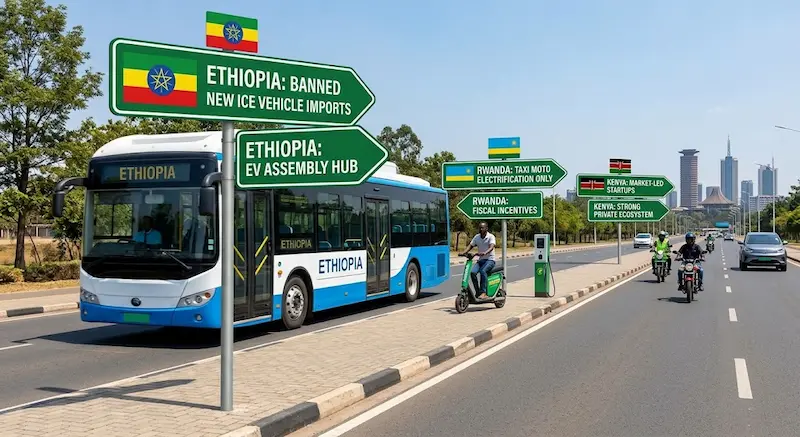

Electric mobility is developing rapidly across East Africa, but the regional race is no longer as straightforward as it once appeared.
Kenya has built one of the region’s most visible electric-vehicle ecosystems, particularly around electric motorcycles, battery swapping, electric buses and local EV startups. However, Ethiopia and Rwanda are now gaining ground rapidly, driven by more aggressive government policies and, in Ethiopia’s case, restrictions on conventional vehicle imports.
The three countries are taking very different approaches.
Ethiopia is pushing a broad transition away from petrol and diesel vehicles. Rwanda has focused heavily on electric motorcycles and public transport. Kenya, meanwhile, has developed a strong private-sector ecosystem and has now introduced a national electric mobility policy designed to accelerate adoption.
So, is Kenya actually falling behind?
The answer depends on how electric mobility is measured. But one thing is clear: Ethiopia and Rwanda have demonstrated how strong government intervention can rapidly change the direction of a transport market.
Ethiopia’s aggressive shift to electric vehicles
Ethiopia has emerged as one of Africa’s fastest-growing electric-vehicle markets.
The country’s strategy is closely connected to its dependence on imported petroleum and its relatively large renewable-energy resource base.
Ethiopia introduced restrictions on the importation of new petrol- and diesel-powered vehicles in 2024, effectively making electric vehicles a much more important alternative for new vehicle purchases.
The impact has been significant.
Ethiopia’s Ministry of Transport and Logistics has reported rapid growth in EV adoption. The country’s electric-mobility strategy says more than 115,000 EVs could be on Ethiopian roads by the end of 2026, compared with only about 7,000 in 2023.
Other reporting has also highlighted the speed of Ethiopia’s transition. EVs accounted for around 60% of vehicle imports in 2024, according to data cited by The Reporter Ethiopia.
That is a dramatic change for a country where electric vehicles were previously a relatively small part of the automotive market.
Why Ethiopia is moving so quickly
One major reason is that Ethiopia has treated electric mobility as more than an environmental issue.
It is also an energy-security strategy.
The Ethiopian government wants to reduce its dependence on imported fuel while using electricity generated domestically.
Ethiopia’s e-mobility strategy notes that the country has substantial renewable electricity resources and is seeking to use those resources to reduce the financial burden associated with imported petroleum.
The country has also been developing charging infrastructure and local vehicle assembly capacity.
Its strategy identifies more than 460 charging stations in Addis Ababa, including around 100 ultrafast charging facilities, while local manufacturing and assembly capacity is being developed across several vehicle categories.
The Ethiopian model is therefore relatively simple:
Reduce the availability of new ICE vehicles + encourage EV imports and assembly + expand charging infrastructure + use domestic electricity.
That combination can accelerate adoption much faster than relying entirely on consumer choice.
Rwanda’s electric motorcycle strategy
Rwanda has taken a different route.
Instead of attempting to electrify every part of the transport system simultaneously, the country has focused heavily on motorcycle taxis.
That is strategically important because motorcycles are a major part of urban mobility in Rwanda and across East Africa.
Rwanda has also been developing its electric-mobility framework for several years. The government has promoted investment in electric cars and motorcycles while introducing fiscal and non-fiscal incentives to encourage the transition.
More recently, Rwanda took an even stronger regulatory step.
In January 2025, the government confirmed that new petrol-powered taxi motorcycles would no longer receive operating permits. The restriction applies to new motorcycles entering the professional transport market, while existing motorcycle operators can continue operating their vehicles.
That creates a powerful market signal.
If a new motorcycle is going to be used as a commercial taxi, an electric motorcycle increasingly becomes the logical option.
Why Rwanda’s strategy matters
Electric motorcycles can make particular economic sense for commercial riders.
A motorcycle taxi travels much more frequently than a privately owned motorcycle. That means fuel costs become a significant part of the rider’s operating expenses.
Electric motorcycles can potentially reduce energy and maintenance costs, particularly when combined with battery swapping.
Rwanda’s government has also highlighted the potential economic benefit. It previously estimated that switching motorcycle taxis to electric motorcycles could save the economy around Rwf23 billion, or approximately US$22 million, in fuel imports each year.
Rwanda’s approach is therefore focused on creating a market where electric motorcycles are not simply an environmental alternative but a commercially viable transport solution.
Where Kenya stands in the electric mobility race
Kenya should not be described as an EV failure.
In fact, Kenya remains one of East Africa’s most important electric-mobility markets.
The country has a particularly strong ecosystem around electric motorcycles, battery swapping, electric buses, local assembly and EV startups.
Kenya also benefits from a power system with a high share of renewable electricity, making the electrification of transport particularly attractive.
However, Kenya’s transition has historically been more market-led and fragmented than Ethiopia’s and Rwanda’s.
That is now changing.
In February 2026, Kenya officially launched its National Electric Mobility Policy, creating a national framework covering EV adoption, charging infrastructure, local manufacturing and investment.
The government has also introduced fiscal incentives covering areas such as electric buses, electric bicycles, electric motorcycles and lithium-ion batteries.
The policy is designed to address some of the problems that have slowed the market, including the high upfront cost of EVs, inadequate charging infrastructure and the need for stronger local manufacturing.
Kenya’s government has also proposed measures around charging infrastructure. New commercial developments are expected to allocate at least 5% of parking space for EV charging infrastructure, alongside measures designed to encourage charging during off-peak electricity periods.
The country is now moving from simply encouraging electric mobility to building a more coordinated national ecosystem.
Why Ethiopia and Rwanda appear to be moving faster
The biggest difference is the strength and direction of government intervention.
Kenya has allowed a significant private-sector EV ecosystem to develop.
Companies have experimented with electric motorcycles, battery swapping, buses, financing models and charging networks.
Ethiopia and Rwanda have gone further by using regulation to actively reshape the market.
Ethiopia: change what consumers can buy
Ethiopia’s restrictions on conventional vehicle imports create an immediate incentive to consider electric alternatives.
Instead of waiting for petrol and diesel vehicles to gradually lose their appeal, the government is reducing the supply of new conventional vehicles.
Rwanda: change what commercial riders can use
Rwanda is taking a more targeted approach.
By restricting permits for new petrol-powered motorcycle taxis, the government is directly influencing one of the country’s most important transport sectors.
Kenya: build the ecosystem
Kenya’s model has been more focused on creating the conditions for private-sector investment.
That has produced an impressive ecosystem, but it also means adoption depends heavily on affordability, financing, infrastructure and consumer confidence.
The new national policy could change that balance.
Kenya’s biggest advantage may actually be its private sector
Despite the headline that Ethiopia and Rwanda are moving ahead, Kenya has an important advantage: a relatively mature private-sector e-mobility ecosystem.
Kenya has attracted companies working on electric motorcycles, battery swapping, buses, charging infrastructure and fleet electrification.
That experience matters.
An EV market is not created simply by importing vehicles.
It requires:
- Charging infrastructure
- Battery-swapping networks
- Affordable financing
- Local technicians
- Spare parts
- Battery management
- Vehicle servicing
- Standards and regulations
- Insurance
- Consumer education
- End-of-life battery management
Kenya already has companies and investors working across many of these areas.
That means Kenya may not need to build an EV ecosystem from scratch.
Instead, it needs to scale what already exists.
The affordability problem remains
One of the biggest obstacles facing all three countries is the upfront price of electric vehicles.
An electric motorcycle may offer lower running costs than a petrol motorcycle, but the purchase price can still be difficult for a low-income commercial rider.
This is why financing could become as important as vehicle technology.
Battery-as-a-service models and battery swapping can also help because they separate the battery cost from the motorcycle itself.
For a boda boda rider, the most important question may not be:
“Is this motorcycle electric?”
It may be:
“How much will I spend every day to operate it?”
That is where electric motorcycles can become particularly competitive.
Charging infrastructure could determine the next phase
Range anxiety is often discussed in relation to electric cars, but infrastructure is an even broader issue.
A country can import thousands of EVs, but adoption will eventually slow if drivers cannot conveniently charge or swap batteries.
Ethiopia has been expanding charging infrastructure, particularly in Addis Ababa.
Rwanda has also been expanding charging infrastructure alongside its electric-mobility push.
Kenya’s national policy now explicitly identifies charging infrastructure as a key part of the transition. The government says implementation will involve investment in charging infrastructure and stronger coordination across the sector.
This means the next stage of the regional EV competition may not simply be about who sells the most electric vehicles.
It could be about who builds the most convenient EV ecosystem.
Kenya is now trying to close the policy gap
Kenya’s position could change significantly if its new electric-mobility policy is implemented effectively.
In August 2026, the State Department for Transport signed a cooperation agreement with the International Finance Corporation to support implementation of the National Electric Mobility Policy.
The partnership includes work on an Electric Mobility Bill and regulations, long-term targets, fiscal incentives, investment, charging infrastructure and local EV manufacturing.
That is significant because Kenya’s challenge is increasingly about implementation rather than simply recognising the opportunity.
The country already has many of the ingredients required for a successful EV market.
What it needs now is scale.
What Kenya can learn from Ethiopia and Rwanda
Kenya does not necessarily need to copy either country.
Instead, it can learn from both.
From Ethiopia: use policy to create demand
Ethiopia demonstrates that strong government action can quickly change the vehicle market.
Kenya could use carefully designed incentives and procurement policies to accelerate the transition without unnecessarily disrupting consumers.
From Rwanda: target high-use vehicles first
Rwanda demonstrates the value of targeting commercial motorcycles.
Kenya has an even larger boda boda economy, making electric motorcycles one of the most practical entry points for mass EV adoption.
From its own ecosystem: scale private innovation
Kenya already has companies developing battery swapping, electric motorcycles, buses and other technologies.
The government can focus on making it easier for these companies to scale.
Is Kenya really losing the electric mobility race?
Not necessarily.
It would be misleading to say that Ethiopia and Rwanda are ahead of Kenya in every aspect of electric mobility.
Each country is pursuing a different strategy.
Ethiopia has moved fastest through aggressive vehicle-import policies and a push toward electrification.
Rwanda has built a strong policy-driven electric motorcycle transition.
Kenya has developed one of the region’s strongest private-sector e-mobility ecosystems and is now strengthening its national policy framework.
The competition is therefore not simply about who has the largest number of EVs.
It is about who can build a sustainable market where electric vehicles are affordable, easy to finance, easy to charge or swap, easy to repair and economically attractive.
Kenya still has the opportunity to lead.
But the country’s early advantage cannot be taken for granted.
What the East African EV race means for consumers
For consumers and businesses, increased competition between Kenya, Rwanda and Ethiopia could be positive.
More EV adoption could bring:
- More affordable electric motorcycles
- Greater battery-swapping availability
- More charging stations
- More financing options
- More EV models
- Better after-sales support
- More local assembly
- New jobs in EV servicing and manufacturing
Competition could also encourage manufacturers to design vehicles specifically for East African conditions.
That could be more important than simply importing global EV models.
The winning vehicles in East Africa will need to handle long working hours, rough roads, high passenger loads, limited charging access and price-sensitive consumers.
The next battleground: electric motorcycles
Electric cars attract much of the attention, but electric motorcycles could have the biggest immediate impact on East Africa’s transport system.
Motorcycles are relatively inexpensive compared with cars, consume less energy and are heavily used for commercial transport.
Kenya, Rwanda and Uganda are therefore particularly important markets for electric two-wheelers.
Battery swapping could further accelerate adoption because commercial riders cannot afford to spend hours waiting for a battery to charge.
Instead, a rider can potentially exchange a depleted battery for a charged one and return to work.
That transforms charging from a long waiting period into something closer to refuelling.
Kenya’s opportunity is still large
The regional electric-mobility race is far from over.
Ethiopia has shown how quickly government policy can transform a vehicle market.
Rwanda has shown how targeted regulation can accelerate electric motorcycles.
Kenya has shown that a strong private-sector ecosystem can develop around electric mobility.
The next phase will determine which model produces the most sustainable results.
For Kenya, the priority should be clear: turn its existing private-sector advantage into mass adoption.
That means implementing the National Electric Mobility Policy, expanding charging and battery-swapping infrastructure, improving financing, supporting local assembly and making EVs affordable for ordinary consumers and commercial operators.
If Kenya can do that, the country’s early lead in electric motorcycles and EV innovation could become an advantage again.
Frequently Asked Questions
Is Kenya behind Ethiopia and Rwanda in electric mobility?
Kenya is not behind in every aspect of electric mobility. Ethiopia has achieved very rapid EV adoption through aggressive government policies, while Rwanda has strongly targeted electric motorcycles. Kenya has a comparatively strong private-sector e-mobility ecosystem and is now implementing a national electric mobility policy.
Why is Ethiopia adopting electric vehicles so quickly?
Ethiopia has restricted new petrol and diesel vehicle imports while promoting EV adoption, local assembly and charging infrastructure. The transition also helps reduce dependence on imported petroleum by making greater use of domestic electricity.
Why is Rwanda focusing on electric motorcycles?
Motorcycle taxis are an important part of Rwanda’s transport system. The government has restricted operating permits for new petrol-powered taxi motorcycles, encouraging the adoption of electric alternatives.
What is Kenya doing to increase EV adoption?
Kenya launched its National Electric Mobility Policy in February 2026. The policy supports EV adoption, charging infrastructure, local manufacturing, investment and fiscal incentives.
Which country is leading electric mobility in East Africa?
There is no single leader across every measure. Ethiopia has experienced very rapid growth in EV adoption, Rwanda has been particularly aggressive with electric motorcycles and policy, while Kenya has a strong and increasingly mature private-sector e-mobility ecosystem.
Will electric motorcycles become more common in Kenya?
Electric motorcycles are likely to become increasingly common as battery-swapping infrastructure, financing and government incentives expand. Kenya’s national policy specifically supports the development of the wider electric-mobility ecosystem.
Conclusion
The electric-mobility race in East Africa is entering a new phase.
Kenya helped establish the region as an important market for electric motorcycles, battery swapping and clean transport. But Ethiopia’s aggressive shift away from petrol and diesel vehicles and Rwanda’s targeted electric-motorcycle policies have changed the competitive landscape.
For Kenya, this should be a wake-up call rather than a defeat.
The country still has a strong EV ecosystem, renewable electricity resources, technology companies and a large commercial motorcycle market.
The challenge now is to convert those advantages into faster, broader and more affordable adoption.
The next winner of East Africa’s electric-mobility race may not simply be the country with the most EVs.
It may be the country that makes electric transport the easiest and most economical choice for ordinary people.
