
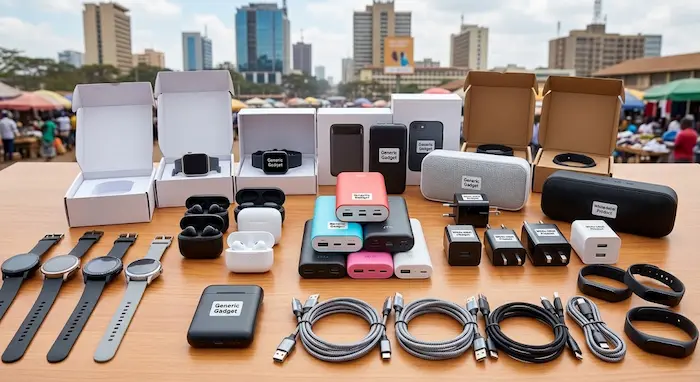

Walk into an electronics shop in Nairobi, browse an online marketplace or scroll through social media, and you will quickly notice something about Kenya’s gadget market: there are a lot of products you may have never heard of before.
Smartwatches come with unfamiliar names. Wireless earbuds look almost identical but carry different logos. Bluetooth speakers promise impressive sound at surprisingly low prices. Power banks advertise enormous capacities. Chargers and cables are available in dozens of variations.
Some are legitimate low-cost products.
Others are white-label products manufactured for different sellers.
And some may be counterfeit or fail to meet the quality and safety standards consumers expect.
This raises an important question:
Why are there so many generic gadgets in Kenya?
The answer is a combination of international manufacturing, import-driven retail, price-sensitive consumers, online commerce and relatively low barriers to creating a consumer-electronics brand.
But there is another important issue.
Consumers do not always know the difference between a generic product, a private-label product, a lesser-known brand and a counterfeit product.
Understanding that difference can help Kenyan buyers make better decisions.
What is a generic gadget?
A generic gadget is typically a product sold without the recognition or established reputation associated with major consumer-electronics brands such as Samsung, Apple, Xiaomi, Anker or JBL.
However, being generic does not automatically mean the product is fake.
A small electronics company can legally source a product from an original equipment manufacturer, put its own branding on it and sell it under its own name.
This is commonly associated with OEM, ODM and white-label manufacturing.
For example, one factory may produce a particular type of smartwatch for several businesses. Each business could order the device with different packaging, colours, software branding or logos.
The result is a market where two apparently different gadgets can sometimes have very similar designs and specifications.
That helps explain why Kenyan shoppers frequently encounter products that look familiar but carry completely different names.
Why generic gadgets are so common in Kenya
1. Most consumer electronics are imported
Kenya’s consumer-electronics market relies heavily on imported products.
This creates an opportunity for traders to source gadgets from international manufacturers and bring them into the local market without having to establish a manufacturing operation in Kenya.
Importers can target different price points.
One company may sell premium branded headphones while another sells a much cheaper unbranded or lesser-known alternative.
The lower-cost product can still find customers because the market contains consumers with very different budgets.
Kenya’s import-control system is designed to ensure imported goods meet applicable standards. The Kenya Bureau of Standards says products that fail to comply with relevant Kenyan standards should not be sold in the local market.
But the existence of standards does not mean every product a consumer encounters will necessarily be high quality.
Market surveillance and enforcement remain important.
2. Chinese manufacturing makes private-label electronics accessible
China’s electronics manufacturing ecosystem has made it possible for relatively small businesses to create consumer-electronics brands without owning factories.
A trader can work with an OEM or ODM manufacturer, select an existing product, specify branding and packaging, and bring the finished product to market.
This model is not unique to Kenya.
It is common throughout global consumer electronics.
The important point is that an unfamiliar brand is not automatically a bad brand.
A small Kenyan distributor may be selling a perfectly legitimate product from a manufacturer that simply does not have the marketing budget of a global electronics company.
The bigger question is whether the seller can provide reliable specifications, warranty support and evidence that the product meets applicable requirements.
3. Kenyan consumers are highly price conscious
Price is one of the biggest drivers of the generic-gadget market.
Consider a consumer looking for wireless earbuds.
They might find:
- A globally recognised brand costing several thousand shillings
- A lesser-known brand costing a fraction of that
- An unbranded option costing even less
For someone who primarily wants Bluetooth connectivity, music playback and a charging case, the cheaper option can be attractive.
The same applies to smartwatches, speakers, phone accessories and other electronics.
This creates a large market for products that offer basic functionality at a low price.
The Anti-Counterfeit Authority’s research has identified consumer demand for cheaper products and economic pressures among factors contributing to counterfeit activity in Kenya.
That does not mean every inexpensive gadget is counterfeit.
It does mean that price creates strong demand for products operating at the lower end of the market.
4. Social media has changed how gadgets are sold
Kenya’s gadget market is no longer dependent on traditional electronics shops.
Sellers can advertise products through:
- TikTok
- Local e-commerce platforms
- Their own websites
The Anti-Counterfeit Authority reported in 2025 that electronics had relatively high e-commerce adoption among surveyed firms, at 42%. It also found that counterfeit distribution increasingly involves online platforms and social media.
This has lowered the barrier to entry for electronics sellers.
A trader does not necessarily need a large physical shop to reach thousands of potential customers.
A product video, attractive photographs and a WhatsApp contact can be enough to generate sales.
That has increased consumer choice — but it has also made it harder for buyers to determine who is behind a product.
5. The same hardware can appear under different names
This is one of the most confusing aspects of the generic-gadget market.
Imagine a factory produces a basic smartwatch.
Importer A buys 500 units and sells them as Brand A.
Importer B buys 1,000 units and sells essentially the same device as Brand B.
Importer C may sell the same underlying hardware without a prominent brand.
To consumers, these may appear to be competing products.
But internally, they could share many of the same components.
This does not necessarily make the products fraudulent.
It does mean that the logo alone may not tell you much about the actual hardware.
Buyers should therefore look beyond the product name.
Generic is not the same as counterfeit
This distinction is extremely important.
Generic or lesser-known
A legitimate product sold under a lesser-known brand.
Private label
A product manufactured by one company and sold under another company’s brand.
White label
A product that can be branded and sold by different businesses, often with relatively small changes to packaging or branding.
Counterfeit
A product deliberately made or presented to imitate another protected brand or product.
The Anti-Counterfeit Authority defines counterfeiting broadly around the unauthorised imitation of protected goods, including issues involving trademarks, industrial designs and related intellectual-property rights.
Therefore, a smartwatch from an unfamiliar company is not automatically counterfeit.
Likewise, a cheap pair of earbuds is not automatically fake.
The problem arises when a seller falsely presents a product as something it is not.
Why some gadget specifications should raise questions
One of the biggest problems in the low-cost electronics market is specification credibility.
A product may advertise an impressive number without giving consumers enough information to verify what that number actually means.
This is particularly common with:
- Power-bank capacity
- Battery capacity
- Camera resolution
- Speaker power
- Storage capacity
- Charging speed
- Bluetooth range
- Smartwatch health features
- Waterproofing claims
For example, a power bank advertised as having an extremely large capacity at an unusually low price should make a buyer stop and investigate.
The same applies to a very cheap device claiming premium features.
A large number printed on a box does not automatically make it true.
Power banks and batteries deserve extra attention
Consumers should be particularly careful with products containing lithium-ion batteries.
Poor-quality batteries can fail prematurely, swell or overheat. The Anti-Counterfeit Authority’s consumer research specifically identifies counterfeit batteries as a concern because of risks including overheating and explosions.
That does not mean inexpensive power banks are inherently dangerous.
Instead, buyers should pay more attention to:
- Manufacturer information
- Rated capacity
- Input and output specifications
- Safety markings
- Warranty
- Seller reputation
- Product documentation
- Whether the product complies with applicable standards
A power bank is not simply an accessory.
It contains a high-energy battery that can potentially create a safety hazard if poorly manufactured or damaged.
Chargers and cables are another area of concern
A cheap charging cable may appear harmless.
But chargers and electrical accessories can have more serious consequences when poorly designed or manufactured.
Consumers should avoid choosing a charger purely because it is the cheapest option.
Look for clear information about:
- Input voltage
- Output voltage
- Output current
- Supported charging standards
- Manufacturer
- Model number
- Warranty
The same principle applies to extension cables, adapters and other mains-powered accessories.
Kenya’s standards system exists partly to ensure products sold in the country meet applicable safety and quality requirements.
Why some generic gadgets are actually good value
It would be unfair to portray the entire generic-gadget market negatively.
Some inexpensive products can provide excellent value.
A consumer may not need to spend a premium amount on a smartwatch if all they want is:
- Notifications
- Basic activity tracking
- Alarm functions
- Bluetooth connectivity
- Basic fitness information
Similarly, someone who wants a Bluetooth speaker for occasional use may not need a premium model.
The key is matching the product to the intended use.
A generic gadget can make sense when the consequences of failure are relatively low and the product has reasonable quality, specifications and seller support.
Where buying cheap can become expensive
The biggest problem with very cheap electronics is not always the initial purchase price.
It can be the total cost of ownership.
Suppose a cheap pair of earbuds lasts three months and a better product lasts two years.
Buying the cheaper product repeatedly may eventually cost more.
The same applies to:
- Chargers
- Power banks
- Smartwatches
- Bluetooth speakers
- Computer accessories
- Storage devices
A product that fails quickly can also cause inconvenience and, in some cases, damage to other equipment.
This is why buyers should consider value rather than simply price.
Warranty is one of the biggest differences between sellers
Two identical-looking gadgets can have completely different ownership experiences depending on who sells them.
A reputable seller should be able to explain:
- How long the warranty lasts
- What the warranty covers
- Where repairs are handled
- Whether replacement is available
- What happens if the product arrives defective
A seller who cannot explain what happens when a product fails should make a buyer cautious.
For relatively expensive electronics, warranty and after-sales support can be almost as important as the product’s specifications.
How Kenyan buyers can identify a questionable gadget
Before purchasing an unfamiliar gadget, ask several basic questions.
Check the manufacturer
Can you identify who actually made the product?
If the box only contains vague claims and no meaningful manufacturer or importer information, investigate further.
Check the model number
Search the exact model number rather than relying only on the product’s marketing name.
The model number can reveal whether the device exists elsewhere and whether the specifications are consistent.
Compare specifications
If several sellers advertise the same product, compare their specifications.
Major differences between supposedly identical products can be a warning sign.
Look for proper documentation
Products should come with appropriate instructions and product information.
For electrical products, pay particular attention to safety and technical specifications.
Check the seller
A seller with a physical presence, clear return policy, warranty and established reputation generally gives consumers more protection than an anonymous account that only accepts payment through a personal number.
Be suspicious of extraordinary claims
If a product appears dramatically better than competing products at a tiny fraction of the price, investigate before buying.
A low price is not proof of a scam.
But an unbelievable combination of price and specifications deserves scrutiny.
What KEBS marks mean for consumers
The Kenya Bureau of Standards has an Import Standardization Mark system for imported products intended for sale in Kenya.
KEBS says importers of products covered by the system are required to obtain the relevant Import Standardization Mark and that the system includes mechanisms for consumers to authenticate the validity of certification.
Consumers should therefore avoid assuming that a sticker, logo or printed certification claim automatically proves a product is genuine.
Where applicable, buyers should use official verification mechanisms rather than relying solely on what appears on packaging.
KEBS also operates market-surveillance systems for products sold in Kenya and provides channels for reporting non-compliant products.
The rise of online gadget shopping makes verification more important
Online shopping has made electronics more accessible to Kenyan consumers.
But it also means buyers can encounter products without physically examining the packaging or device before paying.
The Anti-Counterfeit Authority has warned that counterfeit trade has increasingly moved onto digital platforms, including social media and online marketplaces.
That means consumers should treat online gadget purchases with the same caution they would apply to a physical shop.
Before paying, check:
- Seller identity
- Product model
- Warranty
- Return policy
- Reviews from credible buyers
- Product specifications
- Manufacturer information
- Applicable certification or standards information
What this means for Kenya’s gadget market
The large number of generic gadgets is not necessarily a sign that Kenya has a poor technology market.
In some ways, it demonstrates the opposite.
Kenyan consumers have access to a huge range of inexpensive technology, while importers can respond quickly to new trends.
But the market’s rapid growth creates another responsibility.
Consumers need better information.
A buyer should be able to distinguish between an affordable legitimate product and a product that is misleadingly marketed, counterfeit or potentially unsafe.
Retailers also have an important role to play.
Selling an inexpensive product is not the problem.
The problem is making claims that cannot be supported or failing to provide adequate information when a product has safety or performance implications.
Kenya’s generic-gadget market is likely to remain strong
There is little reason to expect generic electronics to disappear from Kenya.
As global manufacturing becomes more accessible and e-commerce continues to expand, consumers will continue to see new brands and unfamiliar products.
The market will probably become even more crowded.
That is not necessarily bad.
Competition can lower prices and give consumers more choices.
The challenge is ensuring that low price does not come at the expense of safety, transparency and consumer rights.
For Kenyan consumers, the smartest approach is not to automatically buy the most expensive brand.
It is to understand exactly what they are buying.
Frequently Asked Questions
Why are generic gadgets so common in Kenya?
Kenya relies heavily on imported consumer electronics, while global OEM and ODM manufacturing allows smaller businesses to sell products under their own brands. Price-sensitive consumers and the growth of online shopping have also increased demand for affordable gadgets.
Are generic gadgets in Kenya fake?
No. A generic or lesser-known gadget is not automatically counterfeit. A legitimate product can be manufactured by an OEM or ODM and sold under a smaller brand. Counterfeiting involves unauthorised imitation or representation of protected products or brands.
Are cheap gadgets safe to use?
Not necessarily. Price alone does not determine safety, but buyers should pay particular attention to chargers, batteries, power banks and mains-powered electronics. Look for reliable manufacturer information, appropriate standards or certification information and a reputable seller.
Why do different gadgets look almost identical?
Many electronics are manufactured by the same OEM or ODM factories. Different businesses can purchase similar hardware and sell it under different brands or packaging.
Should I avoid generic electronics?
Not necessarily. Generic gadgets can offer good value when the product is suitable for your needs and comes from a reputable seller with clear specifications, warranty and after-sales support.
How can I check whether a gadget is genuine?
Check the exact model number, manufacturer information, seller reputation, warranty and product specifications. For products covered by applicable Kenyan standards or import requirements, consumers should also use official verification mechanisms provided by the relevant authorities.
What gadgets require the most caution?
Consumers should be particularly careful with products involving electricity or high-energy batteries, including chargers, power banks, batteries, adapters and extension cables. Storage devices can also require caution because exaggerated capacity claims can lead to data loss.
Conclusion
Kenya’s abundance of generic gadgets is the result of several forces working together: global electronics manufacturing, imports, private-label business models, intense price competition and the growth of online commerce.
For consumers, the important lesson is simple:
Unknown does not mean bad, and cheap does not automatically mean fake.
But neither should a low price or attractive specification be accepted without questions.
Before buying a gadget, look beyond the logo. Check the manufacturer, model number, specifications, warranty, seller and relevant quality or safety information.
As Kenya’s electronics market continues to grow, the biggest advantage will belong not necessarily to the consumer who finds the cheapest gadget, but to the consumer who knows what they are actually paying for.
