
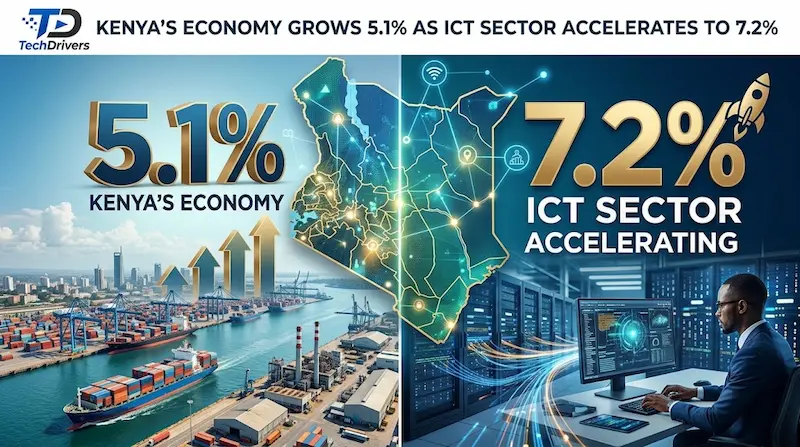

Kenya’s Economy Expands as ICT Growth Strengthens
Kenya’s economy grew by 5.1% in the second quarter of 2026, up from 4.9% during the same period in 2025, according to the Kenya National Bureau of Statistics (KNBS).
The latest figures point to an economy expanding at a faster pace than a year earlier, with several sectors recording growth. Information and communication technology (ICT) grew by 7.2%, compared with 5.9% in the second quarter of 2025.
The figures are significant for Kenya’s technology industry because ICT supports businesses ranging from mobile network operators and digital payment providers to software developers, cloud-service companies and online platforms.
However, faster sector growth does not automatically translate into higher profits for every technology company or more money in every household. Understanding what the figures mean requires looking at the industries involved and the economic activities behind their performance.
For technology businesses, the latest economic data provides a useful starting point for assessing opportunities in digital payments, telecommunications, business software and other technology-enabled services.
Kenya Economic Growth Q2 2026: Key Figures
The following table summarises the sector growth figures supplied for the second quarter of 2026 and the corresponding period in 2025.
| Economic sector | Q2 2026 growth | Q2 2025 growth |
|---|---|---|
| Overall economy | 5.1% | 4.9% |
| ICT | 7.2% | 5.9% |
| Electricity and water | 7.7% | 6.5% |
| Manufacturing | 2.2% | 1.3% |
| Construction | 6.0% | 7.3% |
| Transportation and storage | 4.4% | 3.3% |
| Hospitality | 7.4% | 12.8% |
| Financial and insurance services | 6.1% | 7.1% |
| Agriculture | 3.5% | 4.0% |
Source: Sector figures supplied from the KNBS Q2 2026 economic release. Growth rates are year-on-year comparisons.
The figures reveal a mixed picture. ICT, manufacturing, electricity and water, and transportation and storage recorded faster growth than in the corresponding quarter of 2025. Agriculture, construction, hospitality, and financial and insurance services recorded slower growth.
The overall economy nevertheless expanded at a faster rate than a year earlier.
It is important to distinguish between a sector’s growth rate and its contribution to total GDP. A sector growing quickly is not necessarily the largest contributor to overall economic expansion. Its size and the change in its economic output also matter.
ICT Growth Reaches 7.2%: What Does It Mean for Kenya?
ICT growth increased from 5.9% in Q2 2025 to 7.2% in Q2 2026, an acceleration of 1.3 percentage points.
The increase indicates faster growth in the sector’s measured economic activity. It does not, by itself, identify which companies or services generated that growth.
For Kenya’s digital economy, several areas are worth watching.
1. Telecommunications and internet services
Mobile networks and internet connectivity provide infrastructure for much of Kenya’s digital economy.
Consumers use mobile data to communicate, access online services, stream content, make payments and operate businesses. Companies also rely on connectivity for cloud applications, remote work, online sales and communication with customers.
If demand for digital services continues to expand, telecommunications operators and internet providers may find opportunities to develop new products and serve more customers.
However, subscriber growth, data consumption, revenue and profitability are different measures. The GDP figure alone does not establish how any particular telecommunications company performed.
For consumers, the practical questions remain whether connectivity is reliable, affordable and available where they need it.
2. Digital payments and fintech
Kenya’s mobile-money ecosystem provides a clear example of how technology supports everyday economic activity.
Small retailers, online sellers, transport operators and service businesses use digital payments to receive money from customers and settle transactions.
The expansion of digital financial services also creates opportunities for payment gateways, business software providers, financial technology startups and companies developing tools for merchants.
TechDrivers previously examined the scale of this market in Kenya’s mobile-money subscriptions: 54 million as M-PESA holds 88.8% share.
That article provides additional context on mobile-money subscriptions and market concentration. The subscription figures should not be confused with the ICT sector’s GDP growth rate, since they measure different aspects of the economy.
For fintech businesses, the opportunity is not limited to transferring money. Digital tools can also support merchant payments, business records, financial management and access to regulated financial services.
3. Software and digital services for businesses
Kenyan businesses increasingly use software to manage sales, payments, inventory, customer relationships and daily operations.
A retailer may use a digital point-of-sale system to track transactions. A distributor may use inventory software to monitor stock. A professional-services company may use cloud tools to collaborate with employees and clients.
These are practical examples of how ICT can support productivity across different industries.
For software providers, opportunities may arise when businesses need affordable systems that solve specific problems. However, adoption depends on customers’ budgets, digital skills, internet access and the value they receive from the product.
Faster ICT growth does not guarantee that every startup will attract customers or secure investment. Companies still need sustainable business models and products that solve real problems.
4. Artificial intelligence and business automation
Artificial intelligence and automation are creating additional opportunities for businesses seeking to improve how they operate.
Kenyan companies may use these tools to assist with customer support, document processing, data analysis, marketing workflows and other repetitive tasks.
TechDrivers has explored this shift in its article on AI automation in Kenya: How businesses can turn saved time into growth.
The practical business case for automation depends on whether a tool improves a process enough to justify its cost. Businesses must also consider accuracy, data protection, staff training and the risks of relying on automated systems.
The latest ICT growth figure offers economic context, but it does not establish how much AI contributes to Kenya’s GDP. That would require more detailed sector data.
Financial Services Grow 6.1% as Digital Banking Evolves
Financial and insurance services expanded by 6.1% in Q2 2026, down from 7.1% in the corresponding quarter of 2025.
The sector continued to grow, although at a slower rate than a year earlier.
For technology-focused financial institutions, the figures provide a useful backdrop to changes in how Kenyans access banking and payment services.
Mobile applications, internet banking, digital lending platforms and electronic payments have made it possible for customers to complete many transactions without visiting a physical branch.
Banks are also investing in technology to improve transaction processing, customer service, fraud monitoring and operational efficiency.
In Kenyan Banks Turn to Digital Banking as Interest Rates Fall, TechDrivers examined how digital channels are becoming increasingly important to financial institutions.
The broader trend matters to fintech companies because banks can build technology internally, partner with specialist providers or purchase software and infrastructure from external suppliers.
Yet slower financial-sector growth does not necessarily mean digital banking is declining. Digital adoption and the overall value added by the financial sector are different measures.
The latest figures do not establish whether digital banking transactions increased or decreased during the quarter. Separate banking and payment statistics would be needed to answer that question.
Manufacturing Growth Improves to 2.2%
Manufacturing grew by 2.2% in Q2 2026, compared with 1.3% in Q2 2025.
Although growth remained relatively modest compared with some other sectors, the increase indicates a faster pace of expansion than in the same period a year earlier.
Technology can support manufacturing through inventory management, digital payments, equipment monitoring, automated processes and improved supply-chain coordination.
For example, a Kenyan manufacturer may use software to monitor raw materials, track orders and reduce delays between production and delivery. A business supplying several counties may use digital systems to coordinate stock and customer payments.
These applications demonstrate how ICT can create value beyond the technology industry itself.
However, the manufacturing growth figure does not identify which industries or technologies drove the change. More detailed KNBS data would be required to determine the performance of individual manufacturing subsectors.
Electricity and Water Grow 7.7%: Why Infrastructure Matters
Electricity and water recorded growth of 7.7%, up from 6.5% in Q2 2025, making it the fastest-growing sector among the industries listed in the supplied figures.
Reliable electricity is important for businesses operating computers, telecommunications equipment, data centres, manufacturing machinery and other digital infrastructure.
Water and electricity services also support households, commercial premises and industrial activity.
For technology businesses, infrastructure reliability can influence operating costs and the quality of services they provide. Power interruptions, for example, can affect connectivity equipment, retail systems and online services unless suitable backup arrangements are available.
Nevertheless, the sector’s growth rate should not be interpreted as proof that electricity prices fell, outages declined or every business received a more reliable supply.
Those outcomes require separate evidence.
Transportation and Storage Growth Accelerates to 4.4%
Transportation and storage expanded by 4.4%, compared with 3.3% in Q2 2025.
This sector supports the movement and storage of goods, making it relevant to manufacturers, retailers, logistics companies and online businesses.
Technology can help transport and logistics operators coordinate deliveries, monitor vehicles, manage warehouses and communicate with customers.
For an online retailer in Nairobi selling products to customers in other counties, digital order management and delivery tracking can improve visibility throughout the fulfilment process.
However, better technology does not automatically eliminate transport costs or delivery delays. Road conditions, fuel prices, warehouse capacity, staffing and other operational factors also influence performance.
The sector’s faster growth provides a useful economic signal, but it does not establish that all logistics companies experienced increased revenue or profitability.
Agriculture and Hospitality Grow More Slowly
Agriculture expanded by 3.5%, down from 4.0% in Q2 2025, while hospitality grew by 7.4%, compared with 12.8% a year earlier.
Both sectors continued to grow, but their rates of expansion slowed.
For technology businesses, these industries remain important potential customers.
Agricultural enterprises can use digital tools for payments, logistics, record-keeping and market information. Hotels, restaurants and tourism operators can use online booking systems, digital marketing, customer-management software and electronic payments.
A slower growth rate does not necessarily mean output declined. In these cases, the reported growth rates remained positive.
The figures also do not explain why growth slowed. Factors such as weather, demand, input costs, visitor activity and other economic conditions would need to be examined separately before drawing conclusions about the causes.
What Does the Latest GDP Report Mean for Kenyan Startups?
The latest economic figures provide context for entrepreneurs, but they should not be treated as a direct measure of startup success.
A growing economy can create opportunities when households and businesses have more demand for goods and services. Yet individual companies still face challenges involving customer acquisition, financing, competition, operating costs and product development.
For technology startups in Kenya, several practical considerations stand out.
Build for a clear customer problem. A business software product should address a measurable need, such as reducing administrative work or improving stock management.
Understand the customer’s budget. Small businesses may want digital tools but struggle to pay large upfront fees. Flexible pricing may make adoption easier, provided the provider can still operate sustainably.
Measure actual results. Companies should track customer retention, revenue, operating expenses and product usage rather than relying on general economic growth figures.
Protect customer data. Digital platforms need appropriate security controls and responsible data handling, particularly when processing personal or financial information.
Avoid assuming that market growth guarantees investment. Investors assess individual businesses, their prospects, financial performance, management and risks. National GDP growth is only one part of the wider economic picture.
For readers interested in Nairobi’s wider startup environment, TechDrivers has also published Why Nairobi Became East Africa’s Technology Hub — And What Comes Next.
Does 5.1% Economic Growth Mean Kenyans Are Better Off?
Economic growth means the measured value of economic output increased compared with the corresponding period in the previous year.
It does not automatically mean every Kenyan experienced an increase in income or purchasing power.
The benefits of economic expansion can differ across households, industries and regions. A business may increase production without hiring more employees, while a household may continue to face pressure from rent, food prices, transport expenses or debt repayments.
To assess living standards, GDP growth should be considered alongside indicators such as inflation, employment, wage growth, household consumption and the cost of essential goods and services.
The Q2 2026 growth figure is therefore an important measure of economic activity, but it is not a complete assessment of the financial wellbeing of Kenyan households.
Kenya’s Economic Outlook: What to Watch Next
The latest figures show that economic growth accelerated modestly, while performance differed across sectors.
For the technology industry, the next step is to examine more detailed data on telecommunications, digital payments, financial services, business investment and household spending.
Several indicators will help clarify the direction of the digital economy:
- Telecommunications performance: Changes in connectivity, service adoption and industry revenue.
- Digital payments: Transaction volumes, values and merchant adoption.
- Business investment: Spending on software, connectivity, automation and other productive assets.
- Employment and wages: Whether economic growth is accompanied by improved job opportunities and household incomes.
- Inflation and consumer spending: Whether businesses and households can afford to increase spending on products and services.
- Sector-level output: More detailed information about the activities driving ICT growth.
The next quarterly GDP release will also help establish whether the faster growth recorded in Q2 2026 continues.
Until then, it is important to avoid assuming that one quarter’s results establish a long-term trend.
Frequently Asked Questions
1. How much did Kenya’s economy grow in Q2 2026?
Kenya’s economy grew by 5.1% year-on-year in Q2 2026, compared with 4.9% in Q2 2025, according to the KNBS figures reported in October 2026.
2. How fast did Kenya’s ICT sector grow in Q2 2026?
The ICT sector grew by 7.2% in Q2 2026, up from 5.9% in the same quarter of 2025. This represents an acceleration of 1.3 percentage points.
3. Which listed sector recorded the fastest growth?
Electricity and water recorded the highest growth rate among the listed sectors at 7.7%, followed by hospitality at 7.4% and ICT at 7.2%.
4. Does faster ICT growth mean Kenyan technology companies are making more profit?
Not necessarily. GDP measures economic activity, while company profits depend on revenue, costs, competition, investment and other business-specific factors.
5. What does ICT growth mean for fintech companies in Kenya?
It provides context for the wider digital economy in which fintech companies operate. Potential opportunities include digital payments, merchant services, financial software and other technology-enabled products. However, the GDP figure alone does not establish the performance of individual fintech businesses.
6. Why did Kenya’s overall economic growth improve?
The reported figures show faster growth in several sectors, including ICT, manufacturing, electricity and water, and transportation and storage. Reuters also reported that transportation and storage, accommodation and food services supported the expansion. The precise contribution of each sector should be assessed using the full KNBS report.
7. Does 5.1% GDP growth mean the cost of living has fallen?
No. GDP growth and inflation measure different things. Economic output can increase while prices remain high or continue rising. Inflation and household income data are needed to assess changes in purchasing power.
8. Where can I find the official Q2 2026 GDP report?
The report is available through the Kenya National Bureau of Statistics’ Quarterly GDP publications.
Conclusion: ICT Is an Important Part of Kenya’s Economic Growth Story
Kenya’s economy grew by 5.1% in Q2 2026, compared with 4.9% a year earlier, while ICT growth accelerated to 7.2%.
The figures highlight the importance of technology within an economy that also depends on agriculture, manufacturing, transport, financial services, hospitality and other industries.
For Kenyan technology businesses, the opportunity lies in solving practical problems: helping merchants manage payments, giving businesses better digital tools, improving connectivity and developing services that customers can afford and use reliably.
However, the figures should be interpreted carefully. Faster ICT growth does not prove that every technology company is profitable, that more jobs have been created or that consumers have greater purchasing power.
Those questions require additional evidence from company results, employment statistics, inflation data and sector-specific reports.
For TechDrivers readers, the key takeaway is that Kenya’s digital economy is part of a wider economic picture. Understanding where growth is occurring—and where businesses and households continue to face challenges—offers a more useful guide to the country’s technology opportunities than relying on a single headline figure.
Editorial note: This article analyses the Q2 2026 economic figures published by KNBS. Sector rates are presented as reported in the supplied figures. Readers should consult the original statistical release for detailed tables, definitions and revisions.
