
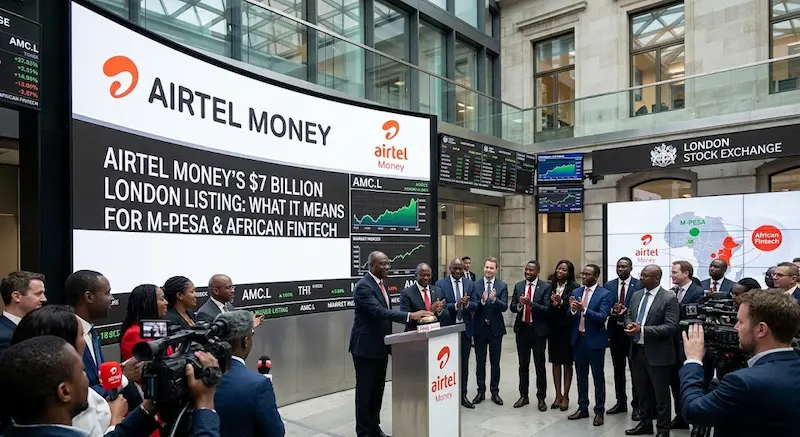

Africa’s mobile-money industry has reached an important milestone. Airtel Money, the financial services business operated by Airtel Africa, has begun trading on the London Stock Exchange at a valuation of approximately $7 billion.
The listing gives international investors a more direct way to invest in a business built around mobile payments, money transfers and digital financial services across African markets.
For Kenya, where M-PESA has become an integral part of everyday financial transactions, the development raises an important question: could mobile money become one of Africa’s most valuable technology businesses?
The answer depends on more than the number of people using mobile wallets. Revenue growth, customer activity, merchant payments, regulation and the ability to expand beyond basic transfers will determine how much these platforms are ultimately worth.
Airtel Money’s London listing: What happened?
Airtel Money began conditional trading on the London Stock Exchange on 9 October 2026 under the ticker AMC.L.
The offer price was set at £1.96 per share, implying a market valuation of approximately £5.3 billion, equivalent to about $7 billion.
The offering involved 270 million existing shares, with an additional 27 million shares potentially available through an over-allotment option. Reuters reported that the initial sale raised approximately $703 million for selling shareholders.
Despite strong demand for the shares, Airtel Money closed its first trading session at £1.93, slightly below the £1.96 offer price.
The distinction matters: strong demand for an IPO does not automatically translate into an increase in the share price once trading begins.
The listing also does not mean Airtel Money has replaced its parent company. Airtel Africa remains a long-term strategic shareholder, while Airtel Money gains a separate public-market valuation.
Because the offer primarily involves existing shares, the proceeds are mainly directed to selling shareholders rather than being fresh capital raised directly by Airtel Money through the sale of newly issued shares.
Why investors are paying attention to mobile money
Mobile money has grown beyond a simple alternative to cash.
Customers can use digital financial platforms to send and receive money, pay bills, purchase goods, access credit and make payments to businesses. Depending on the market and provider, additional services can include savings, insurance, investment products and international transfers.
Airtel Money operates across 13 African countries and serves approximately 53 million monthly active users, according to the London Stock Exchange’s listing announcement.
Its parent company’s 2026 annual report provides further evidence of the business’s scale.
For the financial year ended 31 March 2026, Airtel Africa reported:
- Mobile-money revenue of $1.355 billion, up 36.3% in reported currency.
- Approximately 54.1 million mobile-money customers.
- Total processed transaction value of $195.9 billion.
- Underlying EBITDA of $689 million, with a margin of 50.8%.
These figures show why mobile money is attracting attention as a standalone financial-services business rather than merely an additional feature of a telecommunications company.
The distinction between transaction value and revenue is particularly important. The $195.9 billion represents the value processed through the platform, not the amount Airtel Money earned. Its revenue comes from monetising services and transactions.
Source: Airtel Africa’s 2026 annual report on mobile money.
What does the listing mean for M-PESA?
Kenya provides a useful comparison because M-PESA has developed into a much broader financial-services ecosystem than a basic person-to-person transfer service.
Safaricom’s audited results for the financial year ended 31 March 2026 reported M-PESA revenue of KSh182.73 billion, an increase of 13.4% year on year.
That figure demonstrates the financial scale of mobile money in Kenya. However, it should not be compared directly with Airtel Money’s dollar-denominated revenue without accounting for differences in reporting periods, exchange rates, accounting treatment and the geographical scope of each business.
The two platforms also operate in different competitive environments.
M-PESA benefits from its established position in Kenya, a large merchant and agent ecosystem, and integration with Safaricom’s telecommunications services. Airtel Money has the opportunity to grow across multiple African markets, including Kenya, where it competes for customers and transactions.
The London listing does not establish that one platform is more valuable or more successful than the other. It gives Airtel Money an independently traded valuation that analysts and investors can examine alongside its financial performance.
For M-PESA, the development highlights the importance of continuing to expand the services built around its payments network.
Three lessons for Kenya’s mobile-money industry
1. Payments are becoming the foundation for broader financial services
A mobile wallet can serve as an entry point to a wider range of financial products.
Merchant payments, business collections, international transfers, digital credit and other services can create additional opportunities to generate revenue from existing customers.
For Kenyan providers, the challenge is to expand these services while maintaining affordability, reliability and consumer trust.
2. Distribution and customer activity matter as much as registration numbers
A large customer base is valuable, but registered accounts do not necessarily represent people who transact regularly.
Investors need to examine active users, transaction frequency, revenue per customer, customer retention and the cost of serving each market.
A platform that attracts many users but struggles to generate sustainable revenue may not justify the same valuation as one with stronger customer activity and profitability.
3. Competition could benefit merchants and consumers
Competition between M-PESA, Airtel Money, banks and other payment providers can encourage new products, better business-payment tools and more convenient digital services.
However, the benefits depend on how effectively providers improve interoperability, fees, reliability and access for underserved customers.
For small businesses, the practical question is whether digital payments become easier and less expensive to accept, reconcile and use for day-to-day operations.
What investors should understand about Airtel Money
A $7 billion valuation is a market price, not a guarantee of future returns.
Investors assessing the business should consider several factors.
Revenue growth and profitability: Airtel Money’s reported growth is significant, but investors must determine whether it can sustain that performance while investing in expansion.
Valuation: A growing company can still be an expensive investment if its share price already reflects optimistic expectations. Investors should examine the valuation against earnings, cash flow and future growth prospects.
Currency exposure: Airtel Money operates across multiple African economies. Exchange-rate movements can affect reported financial results and the value of earnings translated into other currencies.
Regulation: Mobile-money providers must comply with financial-services rules, anti-money-laundering requirements, consumer-protection obligations and data-protection laws across their markets.
Competition: Banks, telecom operators, payment companies and fintech startups are all seeking a larger share of digital transactions.
Share-price volatility: Airtel Money’s first-day close below its offer price illustrates why investors should not assume that an oversubscribed IPO guarantees an immediate gain.
Investors should also examine the prospectus, ownership structure, dividend policy and the conditions attached to the offering before making investment decisions.
What does this mean for Kenyan businesses?
The implications extend beyond the stock market.
Small businesses increasingly depend on digital payments to collect money, pay suppliers and keep transaction records. As mobile-money providers expand their business services, merchants may gain access to more integrated payment tools and financial products.
Fintech startups could also find opportunities in merchant software, payment reconciliation, fraud prevention, business analytics and services that connect different financial systems.
For consumers, the outcome will depend on whether competition produces better services, wider access and reasonable fees.
Kenya’s experience with M-PESA shows that mobile money can become essential infrastructure for the wider economy. Airtel Money’s listing places a public-market spotlight on the potential of similar platforms to scale across African markets.
Frequently asked questions
How much is Airtel Money worth?
Airtel Money’s offer price of £1.96 per share implied a valuation of approximately £5.3 billion, or $7 billion, at the time of its October 2026 listing.
Is Airtel Money listed on the London Stock Exchange?
Yes. Conditional trading began on 9 October 2026 under the ticker AMC.L, with unconditional dealings expected to commence on 14 October 2026.
How does Airtel Money compare with M-PESA?
Both provide mobile payments and related financial services. Airtel Money operates across multiple African markets, while M-PESA has an established position in Kenya and a broader regional presence through Safaricom’s operations. Their financial performance should be compared using consistent reporting periods and definitions.
Does Airtel Money’s listing mean its share price will rise?
No. An IPO valuation is not a guarantee of future share-price performance. Returns depend on business results, investor expectations, market conditions and the price paid for the shares.
Why is mobile money important to Africa’s digital economy?
Mobile money enables individuals and businesses to transfer funds and make payments using digital platforms. It can support financial inclusion, merchant transactions and access to additional financial services, although affordability, consumer protection and reliable access remain important.
Conclusion: Africa’s mobile-money opportunity is evolving
Airtel Money’s London listing is more than a corporate milestone. It provides a public-market reference point for a major African digital financial-services business.
Its customer growth, revenue and transaction volumes demonstrate the scale mobile money has achieved. But the next phase will depend on turning that scale into sustainable revenue, expanding useful services and maintaining customer trust.
For Kenya, the development is especially relevant because M-PESA has already demonstrated how deeply mobile payments can become embedded in everyday economic activity.
The broader question is whether African mobile-money platforms can continue evolving into profitable, trusted financial ecosystems that serve consumers and businesses across the continent.
That is the opportunity investors are being asked to evaluate—and the challenge that Airtel Money, M-PESA and their competitors must continue to address.
TechDrivers will continue tracking the companies, technologies and financial trends shaping Kenya’s digital economy.
