
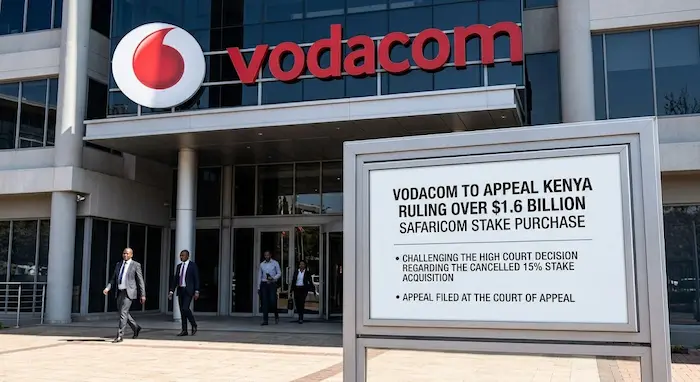

South African telecommunications company Vodacom is appealing a Kenyan High Court ruling that cancelled its acquisition of an additional 15% stake in Safaricom from the Kenyan government.
The transaction, valued at about KSh204.3 billion ($1.6 billion), was completed in June 2026 and increased Vodacom’s effective interest in Safaricom to 55%.
However, on September 15, 2026, a three-judge High Court bench nullified the transaction and ordered the 15% stake to be restored to the Kenyan government.
The court found that the process did not meet constitutional and legal requirements, including requirements relating to public participation and disclosure of material information.
Vodacom has said it will challenge the decision at the Court of Appeal and seek a stay of enforcement while the appeal proceeds. The Kenyan government has also filed a notice of appeal, maintaining that the divestiture was lawful.
This means the final ownership position of one of Kenya’s most important companies remains unresolved.
What Happened to the Vodacom-Safaricom Deal?
The Kenyan government agreed to sell an additional 15% of its Safaricom stake to Vodacom for approximately KSh204.3 billion.
The transaction was announced in December 2025 and completed on June 30, 2026, after the lifting of earlier conservatory orders by the Court of Appeal.
Following completion, Vodacom’s effective interest in Safaricom increased from approximately 40% to 55%, while the Kenyan government’s direct holding fell from 35% to 20%.
The transaction therefore went beyond simply changing the percentage of shares held by two major shareholders. It also changed the balance of control within Safaricom.
The High Court later examined the wider structure of the transaction and concluded that the arrangement effectively gave Vodacom control of Safaricom.
Why Did the High Court Cancel the Safaricom Stake Sale?
The court’s decision centred on the process through which the government disposed of its shares.
According to the judgment reported by Daily Nation, the judges found shortcomings involving public participation, disclosure of material information, pricing, competition issues and national-security considerations.
One major issue was the information made available to the public during the consultation process.
Although parliamentary hearings were conducted across 30 counties, the court found that important transaction documents were not adequately provided to the public, including the share purchase agreement and an agreement concerning future dividend rights.
The court said public participation must be meaningful and informed rather than simply consisting of meetings or hearings.
The Court Questioned More Than a 15% Share Sale
Another important part of the ruling concerned the nature of the transaction itself.
The government had presented the arrangement as a partial divestiture of its Safaricom shares.
However, the court examined the wider corporate structure and concluded that the transaction effectively resulted in Vodacom gaining control of Safaricom.
Vodacom’s effective interest rose to 55%, while Vodacom also acquired full ownership of Vodafone Kenya under the arrangement.
The court therefore treated the transaction as involving a broader corporate takeover rather than simply the disposal of a 15% government stake.
That distinction is important because it affects how such a transaction is assessed under Kenya’s legal and regulatory framework.
How Much Did Kenya Receive From the Transaction?
The 15% Safaricom stake was sold for approximately KSh204.3 billion, equivalent to KSh34 per share.
The government also received about KSh40.7 billion through the sale of future dividend rights associated with its remaining 20% stake, according to reporting on the court judgment.
That means the transaction was significant not only because of its effect on Safaricom’s ownership structure but also because of the amount of money involved.
For Kenya’s government, the proceeds were linked to its wider plans to raise funds through the disposal of selected state assets.
Why Safaricom Is Strategically Important to Kenya
Safaricom is not an ordinary listed company.
It is Kenya’s largest telecommunications operator and the company behind M-Pesa, which plays a major role in the country’s digital payments and financial-services ecosystem.
Safaricom also operates extensive telecommunications infrastructure used by millions of customers and businesses.
That strategic importance was part of the debate surrounding the government stake sale.
The High Court said the government had not adequately addressed national-security considerations before transferring effective control of the company to a foreign investor.
For Kenya, therefore, the dispute involves more than the financial value of 15% of Safaricom.
It also raises questions about how the government should handle strategic companies that support critical communications and digital infrastructure.
What Happens to Vodacom’s 55% Safaricom Stake?
For now, the ownership structure is subject to the ongoing legal process.
The High Court ordered the 15% stake to be restored to the Kenyan government. However, Vodacom is challenging that decision through the Court of Appeal and has sought a stay of enforcement.
The Kenyan government has also filed an appeal.
The important point for investors and the public is that the High Court ruling does not necessarily represent the final outcome of the dispute.
The Court of Appeal will have to consider the challenges brought against the High Court decision, alongside any applications concerning enforcement.
What Does This Mean for Safaricom Customers?
For ordinary Safaricom customers, the immediate issue is different from the ownership dispute.
Safaricom has said it is reviewing the High Court judgment and its implications while the legal process continues.
The court case does not by itself mean that customers should expect M-Pesa, voice, data or other Safaricom services to stop operating.
The dispute is primarily about ownership, control and the legality of the government’s share-sale process.
Customers should therefore distinguish between the corporate ownership dispute and the day-to-day operation of Safaricom’s services.
What Does the Ruling Mean for Kenya’s State Asset Sales?
The Safaricom case could have wider implications for future government asset sales.
Kenya has been pursuing the disposal of selected state assets as part of efforts to raise funds and manage public finances.
The court’s decision highlights the importance of following constitutional and statutory requirements when the government sells significant public assets.
The case also demonstrates that parliamentary approval or completion of a commercial transaction does not necessarily prevent later legal challenges to the process.
This could become an important consideration for future transactions involving strategic government assets.
Kenya’s Public Participation Question
Public participation has become a recurring issue in major government decisions in Kenya.
In the Safaricom case, the court found that holding public hearings was not enough because participants also needed access to relevant information about the transaction.
The distinction matters.
For a transaction involving billions of shillings and a company considered strategically important to the country, members of the public need enough information to understand what is being sold, to whom, at what price and under what conditions.
The High Court’s finding therefore places transparency at the centre of the dispute.
Why the Safaricom Deal Matters to Investors
Safaricom is listed on the Nairobi Securities Exchange (NSE), meaning significant changes in the company’s ownership structure can attract attention from investors.
The court dispute creates uncertainty around the eventual shareholding structure.
Before the disputed transaction, the government held 35% while Vodacom had an effective interest of about 40%.
After the transaction, Vodacom’s effective interest rose to 55% and the government’s direct stake fell to 20%.
If the High Court ruling ultimately stands, the 15% stake would be restored to government ownership.
If Vodacom succeeds on appeal, the completed transaction could remain in place.
The final position will therefore depend on the outcome of the appellate process and related court orders.
Vodacom’s Appeal Is Now the Next Major Step
Vodacom’s decision to appeal means the legal dispute is moving to the next stage.
The company is seeking to protect the transaction while challenging the High Court’s findings.
At the same time, the Kenyan government has indicated that it will also appeal the ruling, arguing that the sale was conducted lawfully.
Safaricom has meanwhile said it is reviewing the judgment and its implications.
This leaves several important questions to be resolved through the courts:
- Will the Court of Appeal uphold or overturn the High Court decision?
- Will enforcement of the judgment be stayed during the appeal?
- What will happen to the 15% stake while the case continues?
- Will Vodacom retain effective control of Safaricom?
- How will the ruling affect future government asset sales?
Kenya’s Safaricom Ownership Battle Is Not Over
The $1.6 billion Safaricom stake transaction has now become a significant legal and corporate dispute.
What began as a government sale of a 15% stake resulted in Vodacom gaining an effective 55% interest in Safaricom before the High Court later nullified the transaction.
The court’s concerns focused on the legality and transparency of the process, including public participation and disclosure of information.
Vodacom and the Kenyan government are now pursuing appeals, meaning the final ownership structure remains uncertain.
For Kenya, the case is also bigger than Safaricom.
It raises important questions about how public assets are sold, how citizens are involved in major government transactions and what legal safeguards should apply when a strategic company changes control.
Frequently Asked Questions
Why is Vodacom appealing the Safaricom ruling?
Vodacom is challenging the High Court decision that cancelled the government’s sale of an additional 15% Safaricom stake and ordered the shares returned to the state.
How much did Vodacom pay for the Safaricom stake?
The government sold the 15% stake for approximately KSh204.3 billion, equivalent to about $1.6 billion.
How much of Safaricom does Vodacom own?
The transaction increased Vodacom’s effective interest in Safaricom from approximately 40% to 55%.
How much of Safaricom does the Kenyan government own?
Following completion of the transaction, the government’s direct stake fell from 35% to 20%.
Why did the High Court cancel the transaction?
The court found that the divestiture process breached constitutional and legal requirements, including shortcomings relating to public participation and disclosure of material information. It also raised concerns involving pricing, competition and national-security considerations.
Will Safaricom services be affected?
The court dispute concerns ownership and the legality of the share transaction. Safaricom has said it is reviewing the judgment and its implications while the legal process continues.
What happens next?
Vodacom and the Kenyan government are pursuing appeals. Applications concerning a stay of enforcement will also determine how the High Court orders are handled while the case proceeds.
Conclusion
Vodacom’s appeal has opened a new chapter in the dispute over Kenya’s KSh204.3 billion sale of a 15% Safaricom stake.
The High Court found significant problems with the process used to complete the transaction and ordered the shares returned to the government.
However, the legal battle is continuing.
Vodacom is challenging the ruling, while the Kenyan government has also filed an appeal. Safaricom is reviewing the judgment as the parties await further developments in court.
The eventual decision will determine more than who holds the disputed 15% stake. It could also influence how Kenya approaches the sale of strategic public assets in the future.
