
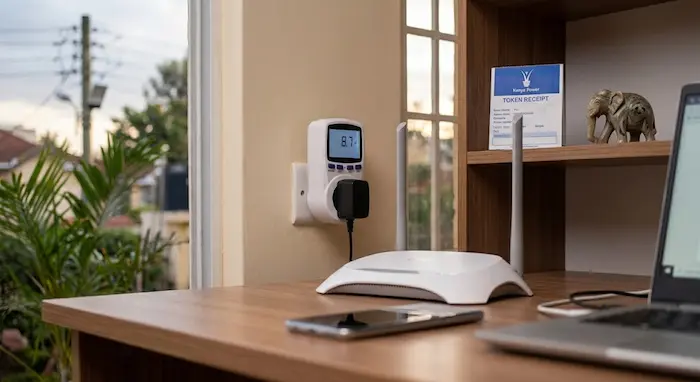

Your home Wi-Fi router is probably one of the smallest electrical devices in your house.
It may consume only a few watts while connecting your phone, laptop, smart TV, CCTV system and other devices to the internet.
But there is one thing that makes the router different from many other gadgets:
It often stays switched on 24 hours a day.
That raises an interesting question for Kenyan households:
How much electricity does your home Wi-Fi actually use, and how much does it cost to keep the router running all year?
The answer is smaller than many people might expect.
However, because routers operate continuously, even a low-power device can accumulate dozens of kilowatt-hours over a year.
The exact amount depends on the router or fibre equipment you have, its actual power draw and how long it remains switched on.
How Much Power Does a Wi-Fi Router Use?
A useful way to estimate router electricity consumption is to start with its power rating.
For example, suppose a router uses 10 watts (W) continuously.
The calculation is:
10W ÷ 1,000 = 0.01 kilowatts (kW)
If it runs for 24 hours:
0.01 kW × 24 hours = 0.24 kWh per day
Over 30 days:
0.24 × 30 = 7.2 kWh
Over one year:
0.24 × 365 = 87.6 kWh
So a device drawing 10W continuously would use approximately 87.6 kWh per year.
That does not mean every router uses exactly 10W. It is simply an example that shows how continuous operation adds up.
The U.S. Department of Energy has used a 12W average-power assumption in one older analysis of routers operating continuously, illustrating the same principle: low-power network equipment can accumulate meaningful annual energy use when it operates 8,760 hours a year.
Router Electricity Consumption at Different Power Levels
Here is what continuous operation looks like at different power levels.
| Average power | Daily use | Monthly use | Annual use |
|---|---|---|---|
| 5W | 0.12 kWh | 3.6 kWh | 43.8 kWh |
| 8W | 0.19 kWh | 5.76 kWh | 70.08 kWh |
| 10W | 0.24 kWh | 7.2 kWh | 87.6 kWh |
| 12W | 0.29 kWh | 8.64 kWh | 105.12 kWh |
| 15W | 0.36 kWh | 10.8 kWh | 131.4 kWh |
| 20W | 0.48 kWh | 14.4 kWh | 175.2 kWh |
Figures are calculated assuming the device draws the stated average power continuously for 24 hours a day.
Real-world consumption can be lower or higher because the router’s power draw may change depending on its hardware, Wi-Fi activity, USB features, Ethernet connections and other functions.
What Does That Mean for a Kenyan Household?
This is where the calculation becomes more useful.
EPRA’s latest published FY2025/26 statistics report lists domestic base energy charges of KSh12.14/kWh for 0–30 kWh, KSh16.50/kWh for 30–100 kWh, and KSh18.57/kWh above 100 kWh, using the December 2025 figures in the report.
But these are base energy charges, not a promise that your Kenya Power token will effectively cost exactly that amount per unit.
Kenya’s electricity price also includes pass-through components such as the Fuel Energy Charge, foreign-exchange adjustment, levies, inflation adjustments and taxes. EPRA explicitly distinguishes these charges from the base tariff.
Therefore, the cleanest way to estimate router cost is to show the energy consumption first, then use a tariff assumption for illustration.
Example: A 10W Router
A 10W router operating continuously uses approximately:
87.6 kWh per year
If you simply multiply that by the three domestic base-energy rates, the annual energy component would be approximately:
- At KSh12.14/kWh: KSh1,063 per year
- At KSh16.50/kWh: KSh1,445 per year
- At KSh18.57/kWh: KSh1,626 per year
That works out to roughly:
KSh89–KSh136 per month for the base-energy component under those illustrative rates.
Again, this is not a prediction of the exact amount that will appear on a Kenya Power bill or token. Your actual effective electricity cost depends on your household’s consumption band and the applicable charges.
A 5W Router Uses Much Less
Suppose your router averages only 5W.
At 24 hours a day:
5W × 24 × 365 ÷ 1,000 = 43.8 kWh per year
Using the same illustrative base-energy rates:
- KSh12.14/kWh → about KSh532 per year
- KSh16.50/kWh → about KSh723 per year
- KSh18.57/kWh → about KSh813 per year
That is approximately KSh44–KSh68 per month for the base-energy component.
This is why the label on your router’s power adapter matters.
A 5W device and a 15W device may both be described casually as “just a Wi-Fi router,” but their electricity consumption can be very different over 365 days.
Your Fibre ONT May Also Be Using Electricity
There is another detail Kenyan fibre users should consider.
What people call the “Wi-Fi router” may actually be a combination of devices.
A fibre installation can include an ONT/ONU that converts the fibre signal into an Ethernet connection, alongside a separate Wi-Fi router.
Some installations combine these functions into one box.
Others use separate equipment.
If you have two powered networking devices, you should consider the consumption of both rather than looking at the router alone.
Example
Imagine:
- Fibre ONT: 6W
- Wi-Fi router: 10W
Combined:
16W
At continuous operation:
16 × 24 × 365 ÷ 1,000 = 140.16 kWh per year
That is considerably more than a single 5W router.
The same calculation applies to additional networking equipment such as:
- Wi-Fi extenders
- Mesh nodes
- Ethernet switches
- CCTV network equipment
- Access points
A home with several always-on networking devices can therefore consume more electricity than someone looking only at the main router might expect.
How Much Does Leaving Wi-Fi On 24/7 Really Cost?
Many people switch off lights, TVs and chargers when they aren’t using them.
The router is different because turning it off also turns off the internet connection for the home.
For a household that works remotely, uses security cameras, receives internet calls or needs connected devices to remain online, switching the router off every night may not be practical.
The better question is:
How much energy am I actually saving by switching it off?
Suppose a 10W router is switched off for eight hours every night.
Instead of operating 8,760 hours per year, it would operate for approximately:
16 hours × 365 = 5,840 hours
Annual consumption becomes:
10W × 5,840 ÷ 1,000 = 58.4 kWh
Compared with 87.6 kWh for continuous operation, that saves:
29.2 kWh per year.
So switching off a 10W router for eight hours every night does save electricity.
But the financial saving depends on your effective electricity cost.
That is why consumers should calculate the actual power draw before assuming that switching off the router will produce large savings.
Does Wi-Fi Data Usage Increase Electricity Consumption?
Not necessarily by a huge amount.
A router can consume electricity simply because it is powered on, even when there is little internet activity.
However, its actual power draw can change depending on the equipment and what it is doing.
For example, a router serving:
- One smartphone
- A laptop
- A smart TV
- Several cameras
- Multiple Wi-Fi devices
may behave differently from an idle router with almost no connected devices.
The key distinction is:
Internet usage is not the same thing as electricity usage.
Streaming a four-hour movie doesn’t mean the router suddenly consumes four times as much electricity as it would while idle.
The connected devices themselves — especially a television, laptop or desktop computer — can consume much more power than the router.
Your Router Is Probably Not the Biggest Electricity User
This is important.
A household may spend time worrying about a router using 10W while overlooking appliances drawing hundreds or thousands of watts.
Consider the difference between:
10W router
and:
2,000W electric kettle
If the kettle operates for 10 minutes:
2,000W × 0.167 hours ≈ 0.33 kWh
A 10W router running for 24 hours uses:
0.24 kWh
So one short period of high-power appliance use can consume more electricity than the router uses in an entire day.
This does not make router efficiency irrelevant.
It simply puts the consumption into perspective.
How to Find Your Router’s Actual Power Consumption
The easiest method is to look at the power adapter.
You may see something like:
Input: 100–240V
Output: 12V ⎓ 1A
The maximum output rating would be:
12V × 1A = 12W
But there is an important warning:
The adapter’s maximum rating is not necessarily the router’s actual electricity consumption.
A 12V/1A adapter can be capable of supplying up to 12W without the router constantly consuming 12W.
For a more accurate measurement, use a plug-in electricity meter that measures watts and kilowatt-hours.
The U.S. Department of Energy’s guidance on measuring standby power notes that actual energy consumption can be measured with appropriate power-measurement equipment rather than relying only on a device’s label.
The Best Way to Measure a Router at Home
If you want a more accurate number, a plug-in power meter can tell you:
- Current watts
- Voltage
- Energy consumed
- Sometimes daily or cumulative kWh
Plug the router’s power supply into the meter, then connect the meter to the wall socket.
Leave it running for several hours or, ideally, a full day.
If the meter reports 0.24 kWh over 24 hours, the average consumption is approximately:
0.24 kWh ÷ 24 = 0.01 kW
or:
10W average power.
A longer measurement can be more useful because router power draw may fluctuate.
How to Calculate Your Own Router’s Electricity Cost
Use this simple formula:
Step 1: Find average watts
For example:
10W
Step 2: Convert watts to kilowatts
10 ÷ 1,000 = 0.01 kW
Step 3: Multiply by hours
For 24/7 operation:
0.01 × 24 × 365 = 87.6 kWh per year
Step 4: Multiply by your effective electricity cost
If your assumed effective cost is KSh20 per kWh:
87.6 × 20 = KSh1,752 per year
That is about:
KSh146 per month.
This KSh20 figure is simply an example for the calculation. It should not be interpreted as the current universal residential Kenya Power rate.
Why Your Actual Kenya Power Cost Can Be Different
Electricity pricing in Kenya is more complicated than multiplying every unit by one flat number.
EPRA says pass-through charges cover costs not included in the base tariff. These include the Fuel Energy Charge, foreign-exchange adjustment, Water Resource Authority levy, inflation adjustments and taxes and levies.
Kenya Power also explains that domestic customers are assigned tariff categories based on consumption history, and customers can check their tariff through its customer channels.
This means two households can have different effective electricity costs for an additional unit of consumption.
For a TechDrivers article, therefore, it is better to say:
“The router uses approximately X kWh.”
Then:
“Its estimated electricity cost depends on the household’s effective tariff.”
That is more accurate than publishing one fixed “Kenya router cost.”
What If You Have a Wi-Fi Extender?
A Wi-Fi extender is another small device that can stay powered continuously.
Suppose:
- Router = 10W
- Extender = 5W
Combined consumption:
15W
Annual consumption:
15 × 24 × 365 ÷ 1,000 = 131.4 kWh
If you add another 5W mesh node:
20W total
Annual consumption becomes:
175.2 kWh.
This is why larger homes using mesh Wi-Fi should consider the electricity consumption of the whole network, not just the primary router.
Should You Switch Off Your Router Every Night?
There is no universal requirement to switch it off every night.
It depends on how you use your internet.
Keeping it on makes sense when:
- You work from home
- You use internet-connected security cameras
- You need remote access
- You have smart-home devices
- You need overnight downloads or updates
- Your household relies on constant connectivity
Switching it off may make sense when:
- Nobody needs internet overnight
- You want to reduce standby electricity use
- You are away from home
- The router manufacturer recommends a restart for a specific issue
- You are troubleshooting the network
For a low-power router, the savings from switching it off may be relatively modest.
But if you have several networking devices, the savings can become more noticeable.
Does Restarting the Router Save Electricity?
Not in any meaningful long-term way.
Restarting a router means turning it off temporarily and powering it back on.
It can sometimes help resolve:
- Connection problems
- Temporary software issues
- Performance problems
- DHCP or network glitches
But restarting it for a few minutes is not an energy-saving strategy.
If your objective is to reduce electricity consumption, reducing the number of hours the equipment remains powered matters more than simply rebooting it.
What About Leaving the Router On During a Power Outage?
A router cannot continue operating indefinitely without an electricity source.
Some Kenyan households use:
- UPS units
- Power banks designed for routers
- DC backup systems
- Solar systems
- Inverters
A backup system introduces another layer of energy consumption because energy is being converted and stored.
If your router is connected to a UPS, remember that the electricity used by the router is only part of the system’s energy demand.
The UPS itself has conversion and standby losses.
A Kenyan Home Internet Example
Consider a typical Nairobi apartment with:
- Fibre ONT: 6W
- Wi-Fi router: 10W
- Wi-Fi extender: 5W
Total:
21W
Continuous annual consumption:
21 × 24 × 365 ÷ 1,000 = 183.96 kWh
That’s nearly 184 kWh per year just for the networking equipment.
Now remove the extender:
16W × 24 × 365 ÷ 1,000 = 140.16 kWh
Remove the ONT as well because the router combines the required functions:
10W × 24 × 365 ÷ 1,000 = 87.6 kWh
The lesson is simple:
The equipment configuration matters.
Two households paying for the same fibre internet package can have different electricity consumption because their networking setups are different.
How to Reduce Your Home Wi-Fi Electricity Use
You don’t need to make dramatic changes.
1. Find the actual power draw
Don’t guess.
Check the specifications or measure it.
2. Remove unnecessary networking equipment
If you have an old extender that is no longer needed, unplugging it can eliminate its continuous consumption.
3. Use a timer where appropriate
If nobody needs Wi-Fi overnight, a properly configured timer or smart plug can turn the network equipment off during those hours.
However, don’t do this if important connected equipment depends on the internet.
4. Replace inefficient or failing equipment
Old equipment isn’t automatically inefficient, but damaged or poorly functioning hardware can behave unpredictably.
5. Avoid unnecessary always-on devices
A home network can gradually accumulate:
Router → extender → second extender → switch → access point → old router.
If everything is powered 24/7, the combined consumption can become much larger than that of the primary router.
6. Don’t sacrifice reliability for tiny savings
If switching off your router causes missed work, disconnected security devices or other problems, the small electricity saving may not be worth it.
What About Mobile Wi-Fi Routers?
4G and 5G home routers can have different power requirements from traditional fibre routers.
A mobile router may also contain:
- Cellular modem
- Wi-Fi radio
- Ethernet hardware
- Internal cooling
- External antennas
- Battery in some models
The best approach is the same:
Check the actual power specification or measure it.
Don’t assume that every “Wi-Fi router” consumes the same amount of electricity.
Does a Faster Router Use More Electricity?
Potentially, but not necessarily by a large amount.
A newer or more capable router may contain:
- More powerful processors
- Multiple Wi-Fi radios
- More antennas
- Higher-speed Ethernet
- Additional networking features
Those components can affect power consumption.
However, you should compare the actual specifications or measured power draw of the devices rather than assuming that a newer router automatically uses more electricity.
The Bigger Electricity Lesson
The router is a good example of how small power consumption becomes significant when a device runs continuously.
A 10W device doesn’t look impressive.
But:
10W × 24 hours × 365 days = 87.6 kWh
That same principle applies to many other always-on devices:
- Wi-Fi routers
- Fibre ONTs
- CCTV systems
- Network switches
- Smart speakers
- Set-top boxes
- Computers left on overnight
- Chargers and power adapters
Individually, each device may use relatively little electricity.
Together, they become part of a household’s baseline electricity consumption.
Frequently Asked Questions
How many watts does a Wi-Fi router use?
There is no single number for every router. Power consumption varies by model and configuration. For illustration, this article uses 5W, 8W, 10W, 12W, 15W and 20W scenarios. The actual figure should be checked from the equipment specifications or measured with a power meter.
How much electricity does a 10W router use?
A 10W router running continuously for a year would consume approximately 87.6 kWh.
How much does a Wi-Fi router cost to run in Kenya?
It depends on the router’s actual power consumption and the household’s effective electricity cost. A 10W router uses about 87.6 kWh annually. Applying different illustrative electricity rates will produce different costs, while the actual Kenya Power bill also includes applicable pass-through charges and taxes.
Does leaving Wi-Fi on all night use a lot of electricity?
A typical low-power router uses relatively little electricity compared with high-power household appliances, but it still consumes energy continuously. A 10W router left on for eight hours overnight uses about 0.08 kWh per night.
Should I switch off my router when I sleep?
You can if nobody needs the connection overnight, but the electricity saving from a single low-power router may be modest. Households with multiple networking devices may save more by reducing unnecessary always-on equipment.
Does a fibre ONT use electricity?
Yes. A fibre ONT or combined fibre router requires electrical power to operate. If your installation has a separate ONT and router, consider the consumption of both devices.
Does internet speed affect electricity consumption?
Not directly in a simple one-to-one relationship. Power use depends more on the equipment, hardware configuration and operating conditions than simply the internet speed of your connection.
How can I find my router’s exact electricity consumption?
Check the router’s specifications and power adapter first. For a more accurate real-world measurement, use a plug-in electricity meter capable of measuring watts and kWh. The U.S. Department of Energy describes measurement procedures for determining standby and low-power consumption.
Is a Wi-Fi extender expensive to run?
Usually it is another relatively small electrical load, but because it can remain powered 24/7, its annual consumption adds to that of the main router. Check its rated or measured power draw.
Is switching off the router every night worth it?
It depends on the equipment and your electricity costs. For a 10W router switched off for eight hours every night, the theoretical saving is about 29.2 kWh per year compared with continuous operation.
Does a router use electricity when nobody is using Wi-Fi?
Yes. A powered router normally continues consuming electricity even when there is little or no active internet traffic.
Conclusion
Your home Wi-Fi router may be a small electrical load, but it is also one of the devices that can quietly remain powered for thousands of hours each year.
A 10W router running continuously uses about 87.6 kWh annually.
A 5W device uses about 43.8 kWh, while a 20W setup could use approximately 175.2 kWh under the same 24/7 assumption.
For Kenyan households, the actual cost depends on the equipment’s power consumption and the household’s effective electricity tariff. EPRA’s FY2025/26 figures show different domestic base-energy charges by consumption band, while additional pass-through charges and taxes mean the base tariff alone does not represent the final electricity cost.
The most useful thing you can do is therefore not panic about the router.
Find out how many watts it actually uses.
Then calculate:
Watts × hours × days ÷ 1,000 = kWh
Once you know that number, you can see exactly how much your home network contributes to your electricity consumption.
And if your house has a router, fibre ONT, extender, mesh nodes and other networking equipment, don’t look at each device in isolation.
Your real Wi-Fi electricity cost is the combined cost of keeping the whole network powered.
Related TechDrivers Articles
If you’re interested in the hidden costs of everyday technology, TechDrivers has also looked at the Kenyan refurbished electronics economy, including how used phones and laptops move through the market.
You can also read our guide on what happens to old smartphones in Kenya, including repair, resale, recycling and e-waste.
For another look at the long-term cost of buying cheap technology, see The Hidden Cost of Cheap Smartphones in Kenya: What You Pay Later.
Editorial note: Electricity consumption varies by router model, network configuration, operating conditions and connected equipment. Kenya Power and EPRA tariff structures can change, and pass-through charges can affect the final effective price per kWh. The calculations in this article are estimates based on stated power assumptions and should not be treated as a Kenya Power bill or token-price quotation.
