
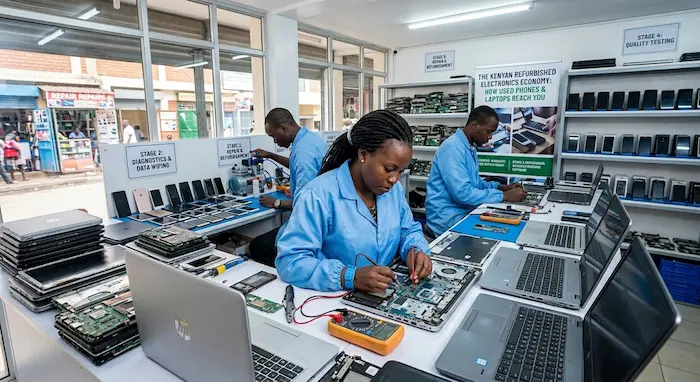

Kenya’s electronics market has a side that is easy to overlook.
Walk into an electronics shop in Nairobi, search for a laptop online or visit a phone dealer and you will find plenty of devices described as used, refurbished, renewed, pre-owned or ex-UK.
For a buyer, these terms can be confusing.
Where did the device actually come from? Who tested it? Was anything replaced? Is it genuinely refurbished, or is it simply a used phone that has been cleaned and put back in a box?
These questions matter because the refurbished electronics economy has become an important route to affordable technology.
Recent reporting indicates that demand for used goods in Kenya is rising, with Jiji reporting a 70% year-on-year increase in searches for used goods in the first quarter of 2026. Electronics were among the categories attracting strong interest.
At the same time, Kenya’s government is dealing with the other side of the equation: what happens when these devices eventually become electronic waste.
So how does the refurbished electronics market in Kenya actually work?
What Is the Refurbished Electronics Market?
At its simplest, the market takes devices that have already been used and gives them another opportunity to serve a consumer.
The process can look something like this:
Previous owner → exporter/trader → importer → refurbisher/technician → retailer → Kenyan buyer
But not every device follows exactly the same route.
Some are traded directly between consumers.
Others come through specialised refurbishers.
Some are imported in bulk and inspected in Kenya.
Others may arrive already refurbished overseas.
This is why the word refurbished should not automatically be treated as a guarantee of quality.
The quality depends on what was actually done to the device before resale.
Where Do Used Phones and Laptops in Kenya Come From?
A significant part of Kenya’s second-hand electronics supply comes from international markets.
Kenya’s National Environment Management Authority (NEMA) has guidelines specifically addressing importers of used electrical and electronic equipment, including requirements concerning remaining lifespan, records and end-of-life responsibilities.
In the Kenyan market, buyers commonly encounter devices described as ex-UK, ex-US or imported used units.
These descriptions generally refer to the previous market or country of use rather than a particular quality grade.
For example, an “ex-UK” laptop could previously have been used by:
- A company
- A school
- A government organisation
- An individual
- A business employee
- A leasing customer
The device’s previous owner therefore tells you little about its current condition.
What Does “Ex-UK” Actually Mean?
This is one of the most misunderstood phrases in Kenya’s used-electronics market.
Ex-UK does not automatically mean refurbished.
It generally describes a device that previously belonged to or was used in the UK market before being sold elsewhere.
A laptop can be ex-UK and still have:
- An ageing battery
- Scratches
- Keyboard wear
- A worn charging port
- A damaged screen
- Original components
- Replacement components
Another ex-UK laptop may have been professionally tested and had several components replaced.
The buyer needs to establish what happened to the individual machine.
That is why condition matters more than the label.
Used vs Refurbished vs Renewed: What’s the Difference?
These terms are often used interchangeably in everyday conversations, but they can describe different things.
Used
A used device has previously belonged to someone else.
It may be sold exactly as it was, with little or no refurbishment.
Refurbished
A refurbished device has generally undergone some form of inspection, testing, cleaning or repair before being resold.
However, there is no single universal level of refurbishment across every seller.
One seller may replace a battery and thoroughly test the phone.
Another may simply confirm that the device switches on and make minor repairs.
Renewed
“Renewed” is often used by sellers or platforms to describe devices that have been restored or prepared for another customer.
The exact process varies.
Repaired
A repaired device simply means that one or more faults were fixed.
A repaired phone is not necessarily comprehensively refurbished.
This distinction is important because consumers should ask what was actually done to the device rather than relying on a marketing label.
Why Are Refurbished Electronics Popular in Kenya?
Price is a major factor.
A new smartphone or laptop can be beyond the budget of a student, freelancer, small-business owner or first-time buyer.
A used or refurbished device can provide access to higher specifications at a lower upfront price.
Research published by GSMA on smartphone adoption in Kenya found that 60% of respondents preferred second-hand phones because they were more affordable and offered better functionality and features. The report recommended developing a more trusted refurbished-phone market with quality standards and warranties.
This helps explain why the market exists.
For some buyers, the choice isn’t simply:
New phone vs used phone.
It is:
Affordable refurbished smartphone vs no smartphone or a much lower-spec new device.
Why Business Laptops Are Common in the Refurbished Market
The same logic applies to laptops.
Large organisations frequently purchase computers in batches.
When companies upgrade their fleets, older machines can enter secondary markets.
Business-class laptops can therefore become attractive refurbished products because they may have:
- Better build quality
- More ports
- Upgradeable components
- Business-oriented security features
- Higher-end processors than entry-level new laptops
This is one reason a refurbished business laptop can sometimes compete with a cheaper new consumer laptop.
TechDrivers recently tested this idea with a KSh20,000 refurbished NEC VersaPro laptop, examining its SSD, battery, display, thermals and everyday performance.
The important lesson from that test was that the age of a device does not tell the entire story.
What Happens to a Used Phone Before It Reaches a Kenyan Buyer?
The process can vary significantly.
A phone may go through some combination of:
- Data wiping
- Physical inspection
- Diagnostic testing
- Screen inspection
- Battery testing
- Charging-port testing
- Camera testing
- Network testing
- Replacement of damaged components
- Cleaning
- Cosmetic grading
- Packaging
- Resale
But not every seller performs every step.
That is why consumers should ask specific questions.
Instead of asking:
“Is this phone refurbished?”
ask:
“What was tested or replaced?”
What Components Are Commonly Replaced?
Depending on the device and its condition, technicians may replace components such as:
- Batteries
- Screens
- Charging ports
- Keyboards
- Laptop batteries
- SSDs
- Hard drives
- Speakers
- Cameras
- Housing components
The replacement component also matters.
A device fitted with a high-quality replacement part may perform very differently from one fitted with a poor-quality component.
For example, a phone can look almost perfect externally while having a low-quality replacement display or battery.
Why Two Identical Used Phones Can Have Different Prices
Imagine two sellers offering the same smartphone model.
Seller A asks KSh25,000.
Seller B asks KSh19,000.
It is tempting to assume the cheaper phone is automatically the better deal.
But the devices could differ in:
- Battery health
- Storage capacity
- Screen condition
- Originality of components
- Cosmetic condition
- Repair history
- Warranty
- Network compatibility
- Accessories
- Software condition
The cheaper phone may ultimately cost more if it immediately requires a battery or screen replacement.
This is why comparing price alone can be misleading.
How Nairobi Fits Into the Refurbished Electronics Economy
Nairobi is a major centre for Kenya’s electronics trade.
The city’s central business areas contain large numbers of phone, laptop and electronics dealers, repair businesses and wholesalers.
Recent reporting by Vellum Kenya described a Nairobi electronics business importing close to 2,000 second-hand devices a month, mostly from the UK, while also repairing, reusing components and finding alternative uses for unsold functional equipment.
This illustrates that the market isn’t simply:
Import → sell → forget.
There is also an ecosystem around:
- Repair
- Testing
- Parts
- Resale
- Wholesale
- Recycling
- Component recovery
That ecosystem creates work for technicians and traders while giving consumers more affordable routes to technology.
How a Refurbished Laptop Can Move Through the Market
Consider a business laptop originally purchased by a company in Europe.
After several years, the company upgrades its computers.
The older laptop is sold into the secondary market.
It may then pass through several businesses before reaching Kenya.
Once imported, a Kenyan seller or technician might:
- Clean it
- Test the motherboard
- Check the SSD
- Test the battery
- Replace worn components
- Install or verify the operating system
- Test the display
- Check the keyboard
- Grade its physical condition
It is then offered to a Kenyan customer.
The buyer may pay a fraction of the laptop’s original retail price.
This is one of the main reasons refurbished electronics can be attractive.
But Not Every Used Device Is Properly Refurbished
This is the consumer-protection side of the story.
Some devices are sold with little testing.
Others may have cosmetic repairs that make them look newer than they actually are.
There can also be uncertainty about:
- Battery health
- Replacement parts
- Previous repairs
- Water damage
- Device locks
- Ownership history
- Warranty
That does not mean every used device is problematic.
It means buyers should verify before paying.
The Rise of Online Used-Electronics Sales
The market is no longer limited to physical electronics shops.
Consumers can discover devices through:
- Online marketplaces
- Social media
- Dealer websites
- Classified advertisements
- WhatsApp sellers
- Facebook Marketplace
This has expanded consumer choice, but it has also created additional risks.
A photograph cannot tell you whether a laptop battery is healthy.
A seller’s description cannot prove that a phone has its original display.
And a very attractive price can make it easier for buyers to overlook basic verification.
For online purchases, TechDrivers’ guide on Facebook Marketplace scams in Kenya provides additional safety tips.
Why Refurbished Electronics Can Be Good for Digital Access
There is another side to the market beyond price.
A refurbished smartphone can put internet access into the hands of someone who cannot afford a new device.
A refurbished laptop can allow a student to complete assignments.
A small business can acquire several computers without paying full new-device prices.
A freelancer can start working without spending their entire budget on hardware.
This makes the secondary electronics market relevant to Kenya’s broader digital economy.
GSMA’s Kenya smartphone-adoption research specifically identified an authentic refurbished-phone market as one potential way to improve smartphone adoption among people who cannot afford brand-new devices.
The Environmental Side of the Refurbished Market
There is another reason extending the life of electronics matters.
Every device that remains useful for another few years is a device that does not immediately become waste.
NEMA describes e-waste as discarded electrical and electronic equipment that has ceased to be of value to its owners and provides guidance covering collection, sorting, recycling and disposal.
Kenya’s Ministry of Information, Communications and the Digital Economy launched national e-waste guidelines and an implementation framework in 2025, aimed at improving collection, recycling and safe disposal while clarifying responsibilities across the sector.
That makes refurbishment part of a bigger conversation:
How can Kenya keep electronics useful for longer while ensuring devices that reach the end of their lives are handled responsibly?
What Happens When a Device Cannot Be Refurbished?
Not every phone or laptop can economically be repaired.
A device may have:
- A damaged motherboard
- Severe liquid damage
- A destroyed display
- A failed storage component
- A badly degraded battery
- Missing parts
At that point, the device may become a source of spare parts or e-waste.
Technicians can sometimes recover useful components.
Other materials may need to enter formal recycling or disposal systems.
NEMA’s e-waste guidance covers the identification, collection, sorting, recycling and disposal of electronic waste.
Kenya’s E-Waste Problem Is Growing Alongside Electronics Access
This creates a difficult balance.
More affordable electronics can increase digital access.
But more devices entering the country eventually means more devices reaching the end of their useful lives.
NEMA’s 2025 regulatory impact statement estimated that Kenya generates approximately 51,300–53,559 metric tonnes of e-waste annually, while noting that only a small proportion is formally recycled. These are estimates presented in the regulatory impact statement rather than a direct measurement of every device entering the market.
The same document links rising e-waste to increased electronics adoption, shorter product lifespans and imports of used equipment.
This is why Kenya’s refurbished-electronics economy cannot be discussed separately from e-waste management.
What Should You Check Before Buying a Refurbished Phone?
Before paying, check:
Battery health
Find out how much capacity the battery retains.
Display
Look for dead pixels, lines, burn-in, cracks and uneven brightness.
Cameras
Test every camera.
Charging
Test the charging port and charging speed.
Network
Confirm that the phone connects properly to mobile networks.
IMEI
Verify the device’s IMEI and make sure the device is not reported as lost or stolen.
Software
Check the Android version and available security updates.
Biometrics
Test fingerprint or face-unlock features where applicable.
Speakers and microphones
Make a test call and play audio.
Warranty
Ask what happens if the device develops a fault after purchase.
For more detail, see TechDrivers’ How to Check a Used Phone Before Buying in Kenya.
What Should You Check Before Buying a Refurbished Laptop?
For laptops, check:
- Exact processor model
- RAM
- SSD health
- Battery health
- Display
- Keyboard
- Trackpad
- USB ports
- HDMI
- Wi-Fi
- Bluetooth
- Webcam
- Microphone
- Speakers
- Charging port
- Hinges
- Operating-system activation
- Warranty
TechDrivers has already published a dedicated refurbished laptop buying guide for Kenya covering these checks.
You can also read our hands-on article, Can a KSh20,000 Laptop Really Replace a New One?, for a real-world look at what a budget refurbished machine can actually handle.
What Should a Seller Tell You?
A good transaction should leave the buyer with enough information to understand what they are purchasing.
Ask:
Is it used or refurbished?
What components were replaced?
Has the battery been tested?
Is the screen original?
How long is the warranty?
What happens if the device develops a fault?
Can I test it before paying?
Do you provide a receipt?
A seller who cannot answer basic questions about the device should make you more cautious.
Is Buying Refurbished Always Cheaper?
Not necessarily.
A refurbished device is often cheaper than an equivalent new product, but the actual price difference varies by model, condition, seller and market.
The important comparison is total value, not simply the sticker price.
A KSh20,000 laptop that requires a KSh8,000 battery and repair soon after purchase is very different from a KSh20,000 machine that works reliably for years.
Where the Kenyan Refurbished Electronics Economy Is Heading
The market sits at the intersection of several trends:
Affordability.
Consumers want capable technology without paying full new-device prices.
Digital adoption.
More people need smartphones and computers for work, education, finance and communication.
Repair.
Technicians extend the useful lives of devices.
E-commerce.
Online marketplaces make used devices easier to discover.
E-waste.
Eventually, every device reaches the end of its useful life.
Kenya’s 2025 e-waste policy work also shows that the government is increasingly focused on how electronics are collected, recycled and disposed of responsibly.
The future of the refurbished market therefore isn’t just about selling cheaper devices.
It is also about building trust, testing, warranties, repairability and responsible end-of-life management.
Frequently Asked Questions
Where do refurbished phones in Kenya come from?
They can originate from several international secondary markets and supply chains, including devices previously owned by individuals, businesses and organisations. Some are imported as used units and subsequently tested or repaired before resale.
Is an ex-UK phone the same as a refurbished phone?
No. “Ex-UK” generally describes a device’s previous market or origin. It does not by itself confirm that the device has undergone a professional refurbishment process.
Are refurbished phones safe to buy?
They can be, provided the individual device is properly inspected and the buyer understands its condition, repair history and warranty.
Why are refurbished phones cheaper?
They have already been used and therefore generally do not carry the same new-product pricing. Their condition, age, specifications and refurbishment work also affect the price.
Why are refurbished laptops popular in Kenya?
They can provide access to business-class hardware at lower prices than many new machines, making them attractive to students, freelancers, small businesses and other budget-conscious users.
Can a refurbished phone have replacement parts?
Yes. Depending on its history, a refurbished device may have had components such as the battery, display, charging port or other parts replaced.
Is every second-hand phone refurbished?
No. A second-hand phone may simply be sold in its existing condition without comprehensive testing or repairs.
What happens to electronics that cannot be repaired?
Some can be dismantled for usable components. Devices that have reached the end of their useful life should enter appropriate e-waste collection, recycling or disposal channels.
Does buying refurbished help reduce e-waste?
Extending the useful life of a device can delay the point at which it becomes waste. However, refurbishment does not eliminate e-waste; devices eventually require responsible end-of-life handling.
Should I buy a refurbished phone instead of a new one?
The choice depends on your budget, the device’s condition, warranty and the features you need. A buyer should compare the actual condition and total value rather than choosing based solely on whether a device is new or used.
Conclusion
Kenya’s refurbished electronics economy is much bigger than a shop selling “ex-UK” phones or laptops.
Behind that device is a chain involving previous owners, exporters, importers, wholesalers, technicians, repair shops, retailers and finally consumers.
The system exists because there is a real demand for affordable technology.
For a Kenyan student, freelancer, entrepreneur or family, a refurbished phone or laptop can provide access to technology that might otherwise be too expensive.
But affordability needs to be balanced with quality and trust.
A buyer should know what they are getting, what has been repaired, how healthy the battery is, whether the device is legitimate and what happens if it fails.
There is also a wider environmental responsibility.
The longer a usable device stays in service, the longer its useful life can be extended. But when electronics can no longer be repaired or reused, Kenya needs effective systems for collection, recycling and safe disposal.
The refurbished market is therefore not simply about old electronics becoming cheap electronics.
It is an important part of Kenya’s technology economy—and its future will depend on making the market more transparent, reliable and responsible.
Editorial note: Terms such as “used,” “refurbished,” “renewed” and “ex-UK” are not interchangeable descriptions of a device’s condition. Buyers should ask sellers what testing, repairs and component replacements were actually performed. Prices and availability vary by device, seller, condition and location. Kenya’s e-waste regulatory framework is also evolving, so current requirements should be confirmed with the relevant authorities.
