
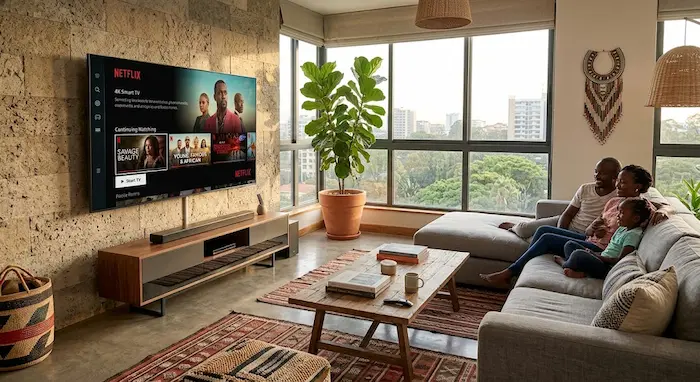

A Smart TV advertised at KSh 20,000, KSh 30,000 or KSh 50,000 can look like a one-time purchase.
It isn’t.
The moment that TV enters your house, it can start generating other costs: electricity, internet, streaming subscriptions, accessories, repairs and eventually replacement.
That is why the price printed on the box does not tell the full story.
For Kenyan households, the real question should not simply be:
“How much does this Smart TV cost?”
It should be:
“How much will this TV cost me to own every month and over several years?”
Smart TV prices in Kenya: the first cost
The Kenyan Smart TV market now covers everything from inexpensive entry-level sets to premium large-screen models.
Current listings show 32-inch and 43-inch Smart TVs selling at under KSh 20,000 in some cases, while 43-inch 4K models can sit around KSh 30,000 and 55-inch 4K models around KSh 47,000–60,000 depending on brand and model. Premium sets can cost considerably more.
For example, current TCL Kenya listings include a 32-inch QLED TV around KSh 19,999, a 43-inch 4K model around KSh 29,999 and a 55-inch QLED model around KSh 47,999.
That gives Kenyan buyers a rough starting point:
| TV category | Illustrative price range |
|---|---|
| 32-inch entry-level Smart TV | KSh 12,000–25,000 |
| 43-inch Smart TV | KSh 18,000–35,000+ |
| 50-inch 4K Smart TV | KSh 30,000–45,000+ |
| 55-inch 4K Smart TV | KSh 40,000–60,000+ |
| 65-inch Smart TV | KSh 60,000–100,000+ |
| Premium 75-inch+ TVs | KSh 100,000+ |
These are market examples rather than fixed national prices. Retailer promotions, brand, panel technology, warranty and availability can move prices significantly.
And this is where the ownership calculation begins.
1. Electricity becomes a monthly Smart TV expense
A television consumes electricity every time it is running.
The amount depends on:
- Screen size
- Display technology
- Brightness
- Picture settings
- Hours of use
- Energy efficiency
- Standby consumption
A useful way to estimate the TV’s energy consumption is:
Power in kW × hours used × number of days = monthly kWh
For example, imagine a television that averages 100 watts, or 0.1kW, while operating.
If a household watches it for four hours every day:
0.1 × 4 × 30 = 12kWh per month
If it is used for six hours daily:
0.1 × 6 × 30 = 18kWh per month
That is the TV’s estimated operating consumption before considering standby or other connected equipment.
But don’t multiply this by one fixed Kenya Power rate
Kenya’s electricity bill is more complicated than simply multiplying units by a single headline number.
Domestic customers fall into different consumption categories, while fuel, foreign-exchange, water-resource and other pass-through charges can change over time.
EPRA’s recent statistics show that domestic electricity tariffs have varied across consumption categories, while monthly pass-through costs can also move.
In September 2026, for example, three additional charges added a combined KSh4.1591 per kWh to electricity consumed during the month, according to reporting based on EPRA’s Gazette notices.
So the best approach is to use your actual electricity cost per unit when calculating your household’s Smart TV expense.
2. Your TV may increase the electricity bill more than you expect
Let’s use a simple example.
Suppose a household has a 100W TV and watches it for six hours every day.
Monthly consumption:
0.1kW × 6 × 30 = 18kWh
Over one year:
18 × 12 = 216kWh
Over five years:
216 × 5 = 1,080kWh
That means a TV operating at that average power level for six hours every day would consume approximately 1,080kWh over five years.
The actual cost depends on the household’s applicable electricity charges during those five years.
This is why the TV’s power rating matters.
3. Internet is another Smart TV cost
A Smart TV without internet can still be useful.
You can connect:
- A decoder
- Gaming console
- Laptop
- Blu-ray player
- USB storage
- Antenna
But the internet is what unlocks much of the Smart TV experience.
You may use it for:
- YouTube
- Netflix
- Live streaming
- Music
- Sports
- Social platforms
- Cloud-connected applications
- Screen casting
That means your internet bill becomes part of the TV’s ownership cost.
If you already pay for home fibre, the TV may not create a separate internet bill.
But if the household relies on mobile data, streaming can dramatically increase data consumption.
4. Streaming can become more expensive than the TV itself
This is one of the easiest costs to overlook.
A Smart TV may come with Netflix, YouTube and other apps already installed.
That does not mean all the content is free.
Netflix’s Kenya website currently lists plans ranging from KSh200 to KSh1,100 per month, depending on the plan.
Even a modest subscription can become a significant five-year expense.
For example:
KSh500 × 12 months = KSh6,000 per year
Over five years:
KSh6,000 × 5 = KSh30,000
At KSh1,100 per month:
KSh1,100 × 60 = KSh66,000
And that is just one subscription.
Add another streaming service and the cost climbs further.
The subscription problem
The issue is rarely one subscription.
It is the combination.
A household could have:
- Netflix
- Another movie/TV service
- Sports streaming
- Music
- YouTube Premium
- Other paid applications
Individually, each payment may seem manageable.
Together, they can become a significant annual entertainment expense.
5. Mobile data can make Smart TV ownership expensive
This is particularly important for Kenyan households that do not have fixed broadband.
Streaming video can consume significantly more data than messaging, browsing or ordinary app use.
That connects directly with our recent TechDrivers breakdown of how much data WhatsApp, TikTok, YouTube, Instagram, Facebook, Maps and banking apps can use.
Read the TechDrivers guide to mobile app data usage
Now imagine moving that video consumption from a phone to a large television.
A household watching three hours of streaming every evening would accumulate:
3 hours × 30 days = 90 hours per month
If the average streaming consumption were approximately 1GB per hour, that would represent about:
90GB per month
That is only an illustration. Actual consumption varies significantly with resolution, compression, streaming platform and content.
The important point is that video quality matters.
6. 4K looks better — but it can demand more data
A 4K Smart TV can produce a much sharper picture than a lower-resolution television.
But higher-quality streaming generally requires more bandwidth and can increase data consumption.
Before paying extra for a 4K television, therefore, ask:
Do I have an internet connection capable of delivering the experience I am paying for?
If your connection regularly struggles with HD streaming, buying a premium 4K screen will not automatically solve the problem.
You may simply own a better television that you cannot consistently use at its full potential.
7. A Smart TV can require extra accessories
The advertised TV price may not include everything you want for your setup.
Possible additional purchases include:
- Wall mount
- HDMI cables
- Surge protection
- Extension cable
- TV stand
- Soundbar
- External streaming device
- Ethernet cable
- Replacement remote
Wall mounting is another cost worth considering.
For example, one Nairobi Smart TV retailer currently advertises wall-mount installation from around KSh3,500, although installation prices vary by provider, wall type and TV size.
You may not need all these accessories.
But they can increase the real amount you spend after buying the television.
8. Repairs can change the economics completely
A television can work perfectly for years.
Or it can develop a fault shortly after the warranty period.
Potential problems include:
- Screen damage
- Backlight failure
- Power-board problems
- Mainboard failure
- HDMI problems
- Remote failure
- Wi-Fi problems
- Software issues
The screen is particularly important.
A cracked or seriously damaged panel can be expensive to replace.
That is why warranty and after-sales support should be part of the purchase decision.
A KSh20,000 TV with poor support and difficult-to-find replacement parts may not necessarily provide the same long-term value as a more expensive model with better support.
9. Smart TV software can become outdated
There is another cost that is harder to measure.
Your television may still display a perfect picture while its software becomes outdated.
Smart TVs depend on operating systems and applications.
Over time:
- Apps can change.
- Requirements can increase.
- Software support can end.
- Older processors can feel slower.
- Some services may eventually stop supporting older platforms.
This does not mean every older Smart TV becomes useless.
An external streaming device can sometimes extend the useful life of a television by providing a newer software platform.
But that becomes another expense.
10. A KSh30,000 TV can become a much bigger five-year expense
Let’s build a realistic illustrative example.
Suppose you buy a Smart TV for:
KSh30,000
Then assume:
- Electricity attributable to TV: KSh400/month
- Streaming subscriptions: KSh1,000/month
- Additional internet/data allocation: KSh500/month
Over five years:
TV
KSh30,000
Electricity
KSh400 × 60 months:
KSh24,000
Streaming
KSh1,000 × 60:
KSh60,000
Internet/data allocation
KSh500 × 60:
KSh30,000
Five-year illustrative total
KSh144,000
The television itself represents only KSh30,000 of that hypothetical KSh144,000 total.
That does not mean every Kenyan household will spend KSh144,000 owning a Smart TV.
Some households already pay for internet, do not subscribe to streaming services, watch television for fewer hours or use cheaper plans.
Others may spend considerably more.
The calculation demonstrates the central point:
The purchase price is only one part of the cost.
11. The internet cost may not actually be an extra cost
There is an important distinction here.
Suppose your household already pays KSh3,000 per month for home fibre.
You use that same connection for:
- Phones
- Laptops
- Smart TV
- Work
- School
- Other devices
It would be misleading to attribute the entire KSh3,000 to the television.
Instead, think about the TV as contributing to your overall internet consumption.
The same applies to electricity.
Your household is already paying for power.
The question is how much additional consumption comes from the TV.
This makes a marginal-cost calculation more useful than simply adding every household bill to the TV.
12. How much does a Smart TV really cost per month?
Let’s use the earlier KSh30,000 example.
If you spread the purchase price over five years:
KSh30,000 ÷ 60 = KSh500 per month
Then add the hypothetical running costs:
- TV purchase allocation: KSh500
- Electricity: KSh400
- Streaming: KSh1,000
- Additional internet/data: KSh500
Total:
KSh2,400 per month
Again, this is an illustration, not a universal Kenyan Smart TV cost.
But it provides a better way of thinking about ownership.
Instead of seeing the television as a KSh30,000 purchase, you can think of it as a device with a monthly ownership and usage cost.
13. How to make your Smart TV cheaper to own
You do not have to stop using the TV.
A few changes can reduce the long-term cost.
Choose the right screen size
Don’t automatically buy the largest television you can afford.
A 43-inch TV may make more sense for a small living room than a 75-inch model.
Compare electricity consumption
Look at the manufacturer’s power specifications rather than guessing.
Avoid unnecessary subscriptions
If you only use one streaming service regularly, you may not need four.
Use Wi-Fi for heavy streaming
If you have home fibre, use it for large video sessions instead of mobile data where practical.
Reduce streaming quality when necessary
If data is limited, lower video quality can significantly reduce consumption.
Use sleep timers
If you regularly fall asleep while watching TV, a sleep timer can prevent unnecessary hours of electricity consumption.
Protect the television
A suitable surge-protection solution can help protect electronics from some electrical disturbances.
Check warranty and service support
Before buying, find out where the TV can be repaired and how long the warranty lasts.
14. What should you check before buying a Smart TV in Kenya?
Don’t look at the price alone.
Use this checklist:
| Question | Why it matters |
|---|---|
| How much is the TV? | Initial purchase cost |
| How many watts does it use? | Helps estimate electricity consumption |
| What is the warranty? | Protects against certain failures |
| Where can it be repaired? | Important after the warranty |
| Which operating system does it use? | Determines app ecosystem |
| How long is software support expected? | Affects useful life |
| Does it support 4K? | Important for high-resolution content |
| Do you have enough internet speed? | Determines streaming experience |
| Do you need a wall mount? | Adds installation cost |
| Which subscriptions will you pay for? | Creates recurring costs |
| Will you use mobile data? | Can significantly increase monthly data spending |
This checklist can prevent a common mistake:
Buying the TV first and calculating the running costs later.
Smart TV vs ordinary TV: which is cheaper?
An ordinary TV can have lower upfront and running complexity because it does not necessarily require the same software ecosystem or internet connectivity.
But the difference depends on how you use it.
If you already own a decoder, gaming console or streaming stick, a non-Smart display can still provide much of the functionality you want.
On the other hand, a Smart TV can eliminate the need for a separate streaming device and make services such as YouTube and Netflix easier to access.
The right choice depends on the household’s existing equipment and viewing habits.
The real Kenyan Smart TV calculation
For a Kenyan household, the most useful formula is:
Total ownership cost = Purchase price + electricity + internet/data + subscriptions + accessories + repairs − resale value
The final figure will be different for every household.
Someone who watches free-to-air television for two hours a day will have a completely different cost profile from a household streaming Netflix and YouTube for six hours every evening.
That is why there is no single answer to:
“How much does a Smart TV cost?”
There is only:
“How much will this particular Smart TV cost this particular household?”
FAQs
How much does a Smart TV cost in Kenya?
Prices vary widely by brand, size and specifications. Current listings show some entry-level 32-inch and 43-inch models below KSh20,000, while mainstream 55-inch 4K models can cost around KSh47,000–60,000 or more. Premium models can cost substantially more.
How much electricity does a Smart TV use?
It depends on the model, screen size, display technology, brightness and hours of use. A 100W television operating for six hours daily would consume about 18kWh in a 30-day month.
Does a Smart TV use a lot of internet data?
It can, especially when streaming HD or 4K video for several hours. The actual amount depends on the streaming service, resolution, compression and viewing habits.
Is Netflix included with a Smart TV?
Having the Netflix app on a Smart TV does not normally mean the content is permanently free. Netflix currently lists several paid plans for Kenya, ranging from KSh200 to KSh1,100 per month.
Is buying a 4K Smart TV worth it in Kenya?
It depends on your viewing habits, internet connection, content availability and budget. If you regularly watch high-resolution content and have adequate connectivity, 4K can be useful. If your internet or content is mostly lower resolution, you may not benefit as much.
Can a Smart TV increase my monthly expenses?
Yes. Apart from the purchase price, you may spend more on electricity, internet, streaming subscriptions, accessories and repairs.
What is the biggest hidden cost of owning a Smart TV?
There is no universal answer. For some households it may be subscriptions; for others, internet/data, electricity, repairs or accessories. The key is to calculate the costs based on your actual usage.
Conclusion: The TV price is only the beginning
A KSh20,000 or KSh30,000 Smart TV can look affordable when you are standing in a shop.
But five years later, the television may have cost you much more than the original purchase price.
Electricity adds up.
Internet adds up.
Streaming subscriptions add up.
Accessories and repairs can appear unexpectedly.
And if your household depends on mobile data for streaming, your data bill can become another major part of the equation.
The smartest way to buy a Smart TV in Kenya is therefore not to ask:
“Which TV is cheapest?”
Ask:
“Which TV gives me the features I need at a total cost I can comfortably afford?”
That is the real price of owning a Smart TV.
Editorial Note
Prices and subscription charges can change. Retail TV prices cited in this article are market examples rather than fixed national prices, while electricity calculations are illustrative. Always check the current retailer, manufacturer, service provider and EPRA information before making a purchase or calculating household costs.
