
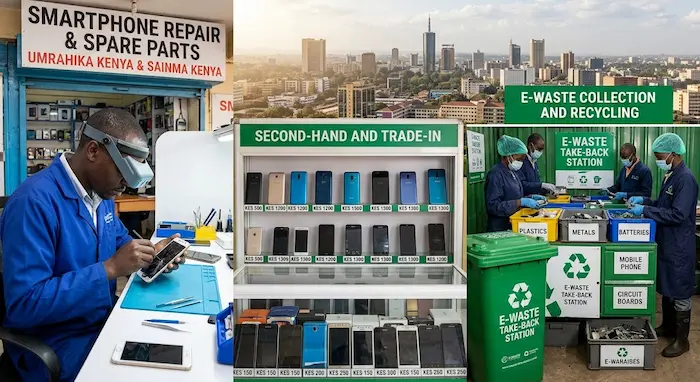

Your old smartphone does not simply disappear when you replace it.
A phone that has stopped working may end up in a repair shop, be sold as a second-hand device, passed to another user, stripped for spare parts or eventually enter the e-waste stream.
For millions of Kenyan smartphone users, this raises a practical question: what actually happens to an old phone after it leaves your hands?
The answer depends on its condition, age, resale value, repairability and whether it reaches a formal collection or recycling channel.
Kenya’s National Environment Management Authority (NEMA) says the country generates about 51,300 tonnes of e-waste annually, with only about 5% formally recycled, according to its recent e-waste guidelines. NEMA also warns that much e-waste is handled through unsafe informal practices.
That makes the smartphone sitting unused in a drawer more than just an old gadget. It can still have economic value, recoverable materials and, if poorly handled, environmental consequences.
What happens when you stop using an old smartphone?
There are several possible paths.
1. It gets repaired
The first destination for a damaged smartphone in Kenya is often a repair shop.
A phone with a broken screen, charging port, battery, speaker, camera or software problem may still have years of useful life left.
A technician may replace a component and return the phone to its owner—or the repaired device may be sold to another buyer.
This is one reason repair shops are an important part of the smartphone ecosystem.
Instead of immediately becoming waste, a damaged phone can become a working phone again.
2. It gets sold as a second-hand phone
An older smartphone that still works may be sold through:
- Phone shops
- Second-hand dealers
- Online marketplaces
- Social media
- Friends and family
- Trade-in arrangements
The original owner gets some money back while another user gets a cheaper device.
This extends the useful life of the phone.
However, buyers need to be careful with older devices. Before purchasing a used smartphone, check the battery, display, charging port, cameras, storage, network compatibility, IMEI status and software support.
TechDrivers has already covered the broader issue of the real cost of buying budget smartphones in Kenya.
Related: Cheap Smartphones in Kenya: The Hidden Costs You Pay Later
3. The phone may be refurbished
Some old smartphones are not simply resold.
They can be refurbished.
A refurbishment process may involve:
- Testing the phone
- Diagnosing faults
- Replacing damaged components
- Cleaning the device
- Testing the battery and charging system
- Resetting the software
- Checking connectivity and other functions
- Reselling the phone
The quality of refurbishment can vary considerably.
A professionally refurbished phone with tested components and a warranty is very different from a phone that has simply been cleaned and placed back on a shelf.
For Kenyan buyers, asking what was actually replaced or tested is more useful than relying only on the word “refurbished.”
4. It becomes a source of spare parts
What looks like a useless phone to one person may still be valuable to a repair technician.
A damaged smartphone can contain working components such as:
- Cameras
- Speakers
- Microphones
- Buttons
- Charging assemblies
- Screens
- Motherboards
- Housing components
- Connectors
A technician may recover usable parts from one damaged device and use them to repair another.
This keeps some components in circulation for longer.
However, not every component can or should be reused. Severely damaged batteries and other hazardous components require appropriate handling.
5. Some phones simply stay in drawers
This is one of the easiest outcomes to overlook.
Many people keep old smartphones because they:
- Want a backup phone
- Have personal memories stored on the device
- Think they may need it later
- Do not know where to dispose of it
- Are worried about losing their data
- Believe the phone has no resale value
The problem is that a drawer is not necessarily a permanent solution.
An unused phone still contains electronic components and a battery. If you eventually decide to dispose of it, it should be treated as electronic waste rather than ordinary household rubbish.
What happens to a completely dead smartphone?
This is where the story becomes more complicated.
A phone that cannot economically be repaired may enter the e-waste chain.
NEMA’s e-waste guidelines describe a management chain involving collection, sorting, recycling and disposal. The guidelines also assign roles to consumers, repairers, collectors, transporters and recycling facilities.
A simplified journey can look like this:
Old phone → collection → sorting → testing/dismantling → material recovery → recycling or controlled disposal
The exact route depends on where the device is taken and which components can be recovered.
What can be recovered from an old phone?
Smartphones contain a mixture of materials and components.
Depending on the device, recycling and recovery processes can potentially separate materials such as:
- Plastics
- Glass
- Aluminium
- Copper
- Other metals
- Electronic components
- Battery materials
This is why an old smartphone should not automatically be viewed as worthless rubbish.
It contains materials that can potentially return to manufacturing and recycling streams.
But recovering those materials safely requires appropriate equipment and processes.
Why throwing phones into ordinary rubbish is a problem
An old smartphone is not the same as a plastic bottle or piece of ordinary household waste.
It contains electronic components and a rechargeable battery.
NEMA has warned that e-waste can be mixed with municipal waste and end up at dumpsites, where unsafe practices such as open burning can release hazardous substances.
This creates both environmental and worker-safety concerns.
The safest approach is therefore to keep electronic devices separate and use appropriate collection, repair, take-back or recycling channels.
The battery is one of the most important parts
A smartphone’s battery deserves particular attention when the device reaches the end of its useful life.
Lithium-ion batteries can be damaged by crushing, puncturing, overheating or inappropriate handling.
That is one reason you should avoid:
- Burning an old phone
- Breaking open the battery
- Throwing damaged batteries into ordinary rubbish
- Deliberately puncturing the device
- Storing a severely swollen battery indoors indefinitely
If the phone has a swollen, leaking or physically damaged battery, do not attempt a DIY battery extraction.
Instead, seek advice from an appropriate repair or e-waste handling facility.
What happens to the data on an old smartphone?
There is another important problem that has nothing to do with recycling.
Your data.
An old phone may contain:
- Photos
- WhatsApp conversations
- Emails
- Contacts
- Documents
- Saved passwords
- Mobile banking information
- M-PESA-related information
- Authentication apps
- Browser sessions
Before selling, donating, trading in or recycling a phone, back up the information you need and perform a proper factory reset.
Also remove:
- SIM cards
- Memory cards
- Accounts that should no longer remain connected
- Authentication credentials where appropriate
A factory reset is an important step, but users should also make sure important accounts and security features are properly removed before handing the phone to another person.
TechDrivers has also looked at what happens to information after an app is deleted:
Related: What Happens to Your Data After You Delete an App?
Repair can be better than replacement
One of the simplest ways to reduce smartphone waste is to keep devices in use for longer.
That does not mean repairing every phone regardless of cost.
Instead, consider the economics.
For example, if a phone has a working processor, display and motherboard but only needs a battery replacement, repairing it may extend its useful life considerably.
But if the phone has a badly damaged motherboard, failing display, weak battery and no remaining software support, replacement may make more financial sense.
The important point is to consider repairability and total ownership cost, not just the price of a new phone.
Kenya’s e-waste rules are evolving
Kenya already has an e-waste management framework and NEMA provides guidelines covering identification, collection, sorting, recycling and disposal.
Kenya also introduced Sustainable Waste Management (Extended Producer Responsibility) Regulations, 2024. These regulations place responsibilities on producers around post-consumer products, including take-back systems and management of products at the end of their life.
Meanwhile, NEMA has been developing proposed Electrical and Electronic Waste Management Regulations, 2025. NEMA published draft regulations and conducted public participation around them, so readers should distinguish these proposals from rules that are already fully in force.
For consumers, the broader direction is clear: managing electronic products at the end of their useful life is increasingly becoming part of Kenya’s formal waste-management conversation.
What should you do with your old smartphone?
If you have an old phone at home, use this checklist.
If it still works
Consider:
- Keeping it as a backup
- Giving it to another family member
- Selling it
- Trading it in
- Donating it
- Refurbishing it
Before handing it over, protect your data.
If it is damaged
First find out whether repair is economically practical.
A cracked screen or worn battery does not automatically mean the phone is useless.
Get a repair assessment before throwing it away.
If it cannot be repaired
Look for an appropriate e-waste collection or recycling channel rather than putting it into ordinary household rubbish.
NEMA’s guidelines call on consumers to segregate e-waste and return it to licensed facilities while avoiding inappropriate disposal practices.
If the battery is swollen
Treat the phone as a safety issue.
Do not puncture, burn or dismantle the battery yourself.
Keep it away from heat and seek professional handling.
How to prepare a phone before selling or recycling it
Before your old smartphone leaves your possession:
Step 1: Back up your data
Save photos, contacts, documents and other information you need.
Step 2: Transfer important accounts
Move authentication apps and other important credentials to your replacement device.
Step 3: Remove your accounts
Sign out of accounts that should no longer remain associated with the phone.
Step 4: Remove the SIM and memory card
Never leave your SIM card or microSD card inside a phone you are handing over unless intentionally transferring it.
Step 5: Factory reset the phone
Erase your personal information using the device’s built-in reset function.
Step 6: Check the phone again
Make sure the reset has actually taken place before giving the phone to another person.
The smartphone lifecycle is longer than the first owner
A smartphone can have several lives.
First owner → second owner → repair → refurbishment → spare parts → recycling
That lifecycle is particularly important in a market where many consumers look for affordable second-hand devices.
Instead of thinking about a phone as something that becomes rubbish immediately after its first owner upgrades, it is more accurate to think of it as part of a longer technology lifecycle.
What this means for Kenyan smartphone buyers
The next time you buy a smartphone, don’t look only at its launch price.
Consider:
- How long the manufacturer supports it
- Whether batteries are replaceable or available
- Whether spare parts are accessible
- Whether local technicians can repair it
- Its resale value
- Its durability
- How easy it will be to pass on to another user
- What happens when it finally reaches the end of its useful life
This connects directly to the hidden cost of cheap smartphones.
A phone that lasts longer, can be repaired and can be resold may have a very different overall cost than a cheaper device that becomes difficult to repair after a short period.
Frequently Asked Questions
Where should I take an old smartphone in Kenya?
Use an appropriate phone take-back, e-waste collection or licensed recycling channel where available. NEMA’s e-waste framework emphasizes collection and environmentally sound handling rather than disposal with ordinary household waste.
Can an old smartphone be recycled?
Yes. Smartphones contain materials and components that can be recovered through appropriate recycling and material-recovery processes.
Should I throw an old phone in the bin?
It is better not to. Smartphones are electronic waste and contain batteries and electronic components that require appropriate handling.
Can a broken phone still have value?
Yes. It may have repairable components, reusable spare parts or recoverable materials. Its value depends on its model, condition and components.
What should I do with a phone that has a swollen battery?
Do not puncture, burn or dismantle it yourself. Avoid heat and seek professional advice on safe handling.
Should I factory reset a phone before recycling it?
Yes. Back up important information, remove your accounts and perform a factory reset before giving the phone to another person, a trade-in service or an appropriate collection channel.
Is Kenya recycling enough of its e-waste?
NEMA’s recent e-waste guidelines estimate that Kenya generates about 51,300 tonnes of e-waste annually, with only about 5% formally recycled.
Final Word
An old smartphone is not automatically rubbish.
It could become another person’s affordable phone, return to service after a repair, provide spare parts for another device or eventually enter a recycling process where useful materials are recovered.
The bigger challenge is what happens when those devices are handled outside appropriate systems.
For Kenyan smartphone users, the responsible end-of-life journey starts before the phone reaches the bin: repair it where practical, resell or pass it on when possible, protect your data, and use proper e-waste channels when the device has reached the end of its useful life.
As smartphone ownership continues to grow, what Kenya does with yesterday’s phones will become just as important as how quickly consumers adopt tomorrow’s devices.
Editorial note: E-waste figures and regulatory information in this article are based on NEMA and Kenyan government sources available at publication. NEMA’s 2025 e-waste regulations referenced above were presented as draft regulations/public-participation material; readers should verify the latest regulatory status before treating proposed provisions as binding requirements.
