
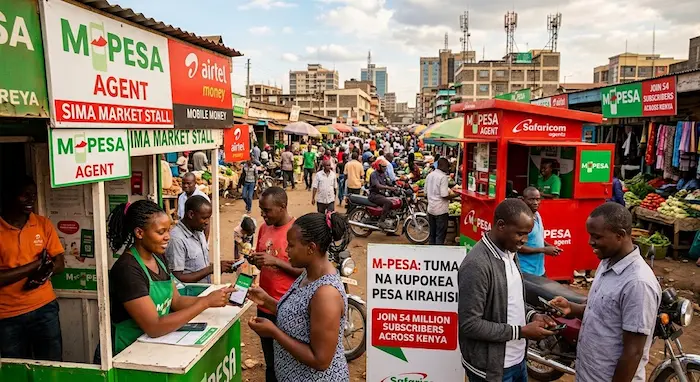

Kenya’s mobile-money market continues to expand, with mobile-money subscriptions reaching 54 million by June 2026, according to the latest sector statistics reported by the Communications Authority of Kenya (CA).
The figure represents a 13.2% increase from a year earlier and puts mobile-money penetration at 101.3%.
At the same time, the market remains heavily concentrated around one provider.
Safaricom’s M-Pesa accounted for 88.8% of mobile-money subscriptions, leaving other providers to compete for the remaining 11.2%.
The latest numbers highlight two different trends in Kenya’s digital-finance market: more subscriptions are being recorded, while M-Pesa continues to hold the overwhelming share of the market.
But the numbers also raise another question.
If more Kenyans are using mobile money, why did the number of registered mobile-money agents fall during the period?
Kenya’s Mobile Money Market at a Glance
| Metric | June 2026 |
|---|---|
| Mobile-money subscriptions | 54 million |
| Year-on-year growth | 13.2% |
| Mobile-money penetration | 101.3% |
| M-Pesa market share | 88.8% |
| Other providers combined | 11.2% |
Figures refer to the mobile-money subscription measure reported in the Communications Authority’s sector statistics. Subscription and account measures published by different regulators can use different definitions.
Mobile Money Subscriptions Reach 54 Million
Kenya has continued to expand its use of mobile financial services.
The 54 million mobile-money subscriptions recorded by June 2026 represent a significant increase from the previous year.
The penetration rate of 101.3% is also notable.
However, penetration above 100% does not mean every Kenyan has a mobile-money account.
The figure is calculated using subscriptions relative to the population. One person can have multiple mobile-money subscriptions, including accounts connected to different mobile numbers or services.
This is similar to Kenya’s wider telecommunications market, where the number of mobile subscriptions is significantly higher than the country’s population because many consumers use more than one SIM card.
Why multiple mobile-money subscriptions matter
A Kenyan consumer might use one mobile number primarily for M-Pesa while maintaining another line for Airtel Money or another service.
Businesses can also maintain multiple numbers or payment channels.
This means subscription growth should not automatically be interpreted as 54 million individual people using mobile money.
Instead, it shows the scale of mobile-money connections within Kenya’s financial ecosystem.
M-Pesa Still Controls Most of the Market
The most striking number in the latest data is M-Pesa’s 88.8% market share.
That leaves all other mobile-money providers combined with approximately 11.2%.
Safaricom’s M-Pesa has been deeply integrated into everyday economic activity in Kenya, from sending money to family members to paying merchants, bills, school fees and other services.
For many consumers, mobile money is no longer simply a way to transfer cash.
It has become part of the infrastructure used to manage everyday finances.
This creates a significant advantage for a platform that already has a large customer and merchant ecosystem.
What Does an 88.8% Share Mean for Consumers?
For ordinary Kenyan users, market share can influence the usefulness of a financial platform.
A large network means consumers are more likely to encounter businesses, relatives, employers and service providers already using the same platform.
For example, a customer may receive money through M-Pesa, use it to pay a merchant, purchase airtime, pay a bill and move money into another financial product without leaving the broader ecosystem.
This network effect can make an established platform difficult for competitors to displace.
However, market share does not mean consumers have no alternatives.
Airtel Money and other payment services continue to provide competing options, while banks, fintech companies and payment platforms are increasingly connecting digital payments to other financial services.
The Interesting Part: Mobile-Money Agents Declined
There is another development hidden behind the headline.
While mobile-money subscriptions increased, the number of registered mobile-money agents fell by 5.6%, from 602,470 to 568,463 during the period reported by Techweez.
That creates an interesting contrast.
More mobile-money subscriptions.
Fewer registered agents.
The two trends show that growth in digital financial services does not necessarily require an equally large expansion of physical outlets.
Are Kenyans Becoming Less Dependent on Agents?
One possible explanation is the increasing use of digital channels.
Many transactions that once required customers to visit an agent can now be completed through phones, apps, merchant payments and other digital interfaces.
Customers can increasingly:
- Send money directly from their phones
- Pay businesses electronically
- Buy goods through mobile payments
- Pay utility bills
- Purchase airtime
- Access savings and investment products
- Make some financial transactions without visiting a physical outlet
This does not mean agents are becoming irrelevant.
Cash remains important in Kenya, particularly for consumers who need to deposit or withdraw physical money.
But the role of the agent network may be changing as more transactions move directly between digital accounts.
What the Decline in Agents Could Mean for Businesses
For mobile-money agents, competition can become more complicated as digital transactions grow.
An agent’s traditional role has largely revolved around cash-in and cash-out services.
But as more customers keep money digitally and pay merchants directly, some transactions can happen without physical cash.
This could put pressure on agents that depend heavily on small cash transactions.
At the same time, busy agents located near markets, transport hubs, residential areas and other high-traffic locations can continue to play an important role.
The decline in registered agents should therefore not be interpreted as proof that physical mobile-money services are disappearing.
Instead, it may indicate that the market is becoming more consolidated and that the nature of mobile-money usage is changing.
Mobile Money Is Becoming More Than Money Transfers
Kenya’s mobile-money ecosystem has expanded far beyond sending money from one phone to another.
M-Pesa and other digital financial platforms increasingly connect users to services such as:
- Savings
- Investments
- Insurance
- Merchant payments
- Credit
- Wealth-management products
- Business payments
This broader ecosystem helps explain why mobile money is strategically important to Kenya’s telecommunications industry.
The country’s mobile operators are no longer competing only on voice calls and data bundles.
Financial services have become an important part of the digital-business model.
Mobile Money and Kenya’s Digital Economy
The continued growth of mobile money has implications beyond telecommunications.
Small businesses can accept payments without maintaining traditional card-payment infrastructure.
Online sellers can receive payments from customers using mobile channels.
Freelancers can receive domestic payments digitally.
Customers can pay for services without carrying large amounts of cash.
For businesses, digital payment records can also make it easier to track transactions and manage cash flow.
This is particularly relevant to Kenya’s large informal and small-business economy.
A small food business, online seller, boda boda operator or independent service provider can use mobile payments as part of daily operations without needing the infrastructure associated with a conventional bank branch.
Mobile Money Is Also Changing Financial Products
Another important development is the connection between mobile money and financial products.
Kenyan users can increasingly access savings, investment and insurance services through digital platforms.
This is changing the role of a mobile phone in the financial system.
The phone is no longer simply a communication device.
It can also function as a payment tool, savings interface, investment gateway and access point for financial services.
That transformation is particularly significant in a country where mobile-money adoption has developed faster than traditional branch-based financial services in many everyday transactions.
What About Airtel Money?
Airtel Money remains one of the most visible alternatives to M-Pesa in Kenya.
However, the latest 88.8% figure shows the scale of the gap between the dominant provider and its competitors.
For competing mobile-money platforms, attracting customers is only one part of the challenge.
They also need merchants to accept their payment systems and users to find enough people and businesses within their network.
This is where network effects become important.
A consumer may hesitate to switch platforms if most of the people they send money to and businesses they pay are already using another service.
Could M-Pesa’s Market Share Change?
Market share is not permanently fixed.
Competition can change as providers introduce new pricing models, products, partnerships and financial services.
Smartphone adoption could also create opportunities for fintech companies that offer services through applications rather than traditional USSD-based systems.
Banks and fintech firms can increasingly integrate payments, savings, investments and credit into digital platforms.
However, competing against an established mobile-money ecosystem requires more than offering another way to send money.
A rival platform needs enough users, merchants, agents and useful services to create its own network effect.
Why This Matters to Kenyan Consumers
The growth of mobile money has practical consequences for consumers.
More digital payment options
Mobile payments make it easier to transact without carrying physical cash.
More financial products
Mobile platforms can provide access to savings, investments, insurance and other services.
Greater convenience
Consumers can complete many transactions without travelling to a bank branch.
More competition to watch
Although M-Pesa remains dominant, competition from other operators and fintech companies can influence pricing, product development and service innovation.
Consumers should therefore compare fees and features instead of assuming that the largest platform is automatically the cheapest option for every transaction.
Why Mobile-Money Penetration Is Above 100%
Seeing a penetration rate of 101.3% may initially look confusing.
Kenya’s population is smaller than the number of mobile-money subscriptions.
That does not mean every Kenyan has more than one active wallet.
Penetration statistics can exceed 100% because the calculation is based on subscriptions rather than unique individuals.
One person may have multiple mobile numbers and mobile-money subscriptions.
The same issue occurs with Kenya’s wider mobile market, where mobile subscriptions can exceed the country’s population.
Mobile Money vs Mobile Subscriptions
It is also important not to confuse mobile-money subscriptions with ordinary mobile subscriptions.
They measure different things.
Mobile subscriptions relate to connections to mobile networks.
Mobile-money subscriptions relate to registered mobile financial-service connections.
A person can therefore have several SIM cards but use only one primary mobile-money service.
Likewise, mobile-money statistics from different institutions can use different definitions and reporting methodologies.
For that reason, figures should always be identified by the exact measure being reported.
What the 54 Million Figure Says About Kenya’s Fintech Market
The latest number reinforces Kenya’s position as a major mobile-finance market.
But the more important development may be what happens after basic money transfers.
The next phase of competition is increasingly about what users can do with money once it reaches their mobile wallet.
That includes:
- Saving
- Investing
- Paying merchants
- Accessing credit
- Buying insurance
- Managing business payments
- Connecting mobile money with bank accounts and fintech services
This is where telecommunications and financial technology increasingly overlap.
Frequently Asked Questions
How many mobile-money subscriptions does Kenya have?
Kenya had approximately 54 million mobile-money subscriptions by June 2026, according to the latest sector statistics reported by the Communications Authority.
What is M-Pesa’s market share in Kenya?
M-Pesa accounted for approximately 88.8% of Kenya’s mobile-money subscriptions in the June 2026 data.
Does 54 million mobile-money subscriptions mean Kenya has 54 million users?
No. The figure represents subscriptions rather than necessarily 54 million unique individuals. One person can have multiple mobile-money subscriptions.
Why is mobile-money penetration above 100%?
Penetration is calculated using subscriptions relative to the population. Multiple subscriptions held by individuals can push the figure above 100%.
Did the number of mobile-money agents increase?
No. The number of registered agents reported in the latest figures fell by 5.6%, from 602,470 to 568,463.
Is M-Pesa the only mobile-money service in Kenya?
No. Other providers, including Airtel Money and other licensed services, operate in Kenya. However, M-Pesa holds the overwhelming majority of the reported mobile-money subscription market.
Why are mobile-money agents still important?
Agents remain important for customers who need cash deposits, withdrawals and assistance with physical-money transactions, particularly in areas where digital payments have not completely replaced cash.
Is mobile money replacing banks in Kenya?
Mobile money has changed how Kenyans make everyday payments and access some financial services, but it has not eliminated the role of banks. Instead, banks, mobile operators and fintech companies increasingly operate within a connected digital-finance ecosystem.
Conclusion
Kenya’s mobile-money market continues to expand, with subscriptions reaching 54 million by June 2026 and penetration reaching 101.3%.
But the headline number only tells part of the story.
The more significant development is the continued concentration of the market around M-Pesa, which held an 88.8% share of mobile-money subscriptions.
At the same time, the number of registered mobile-money agents declined by 5.6%, suggesting that the growth of digital finance is not necessarily being matched by growth in physical cash-out and cash-in networks.
For Kenyan consumers, the mobile phone is increasingly becoming more than a communication device. It is a payment tool and an entry point into savings, investments, insurance and other financial services.
For businesses and fintech companies, the numbers show both the size of the opportunity and the challenge: Kenya has a large and increasingly digital financial market, but competing within it requires more than simply launching another mobile-money service.
The next stage of competition is likely to focus increasingly on what users can do with their money digitally — not simply how they send it.
