
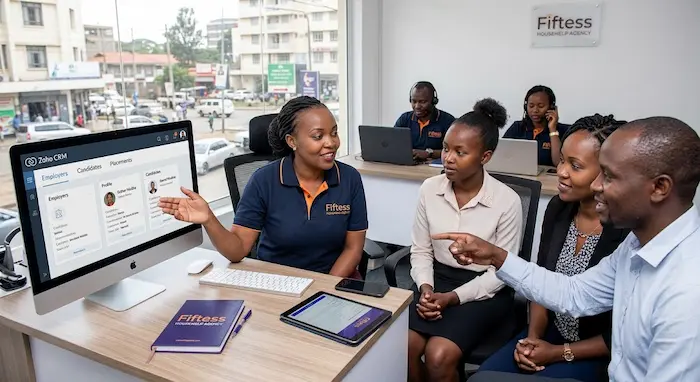

Kenya’s domestic recruitment industry is beginning to move beyond phone calls, personal referrals and paper-based records as technology creates new ways to organize candidates, manage employers and track the recruitment process.
For domestic staffing agencies, the shift is not simply about putting existing paperwork into a computer. Digital tools are increasingly being used to capture employer requirements, organise candidate information, track vetting, manage interviews and monitor what happens after a worker is placed.
Fiftess Househelp Agency, a Kenyan domestic staffing company led by Esther Muitha, is among the agencies working toward this more structured model.
The company says it is implementing Zoho CRM to centralize information covering employer leads, candidates, recruitment, placements, services and follow-up activities.
However, Fiftess says technology is not intended to replace human judgment.
Instead, the agency sees digital systems as a way to make recruitment information easier to organise, track and use while keeping interviews, references, physical verification and professional judgment at the centre of hiring decisions.
From informal recruitment to structured digital processes
Domestic recruitment in Kenya has traditionally relied heavily on personal referrals, phone calls and informal networks.
That model can work for small-scale recruitment, but managing information becomes more complicated as the number of employers and candidates increases.
A family looking for a nanny, househelp, caregiver, cook or house manager may have several requirements covering experience, location, salary expectations, childcare responsibilities, cooking skills, employment arrangements and availability.
At the same time, an agency may have to manage information about dozens or hundreds of potential candidates.
Digital systems can help bring these separate pieces of information into a more structured workflow.
According to Fiftess, clients can now reach the agency through channels including its website, WhatsApp and social media.
Their requirements can then be captured in a more systematic way before candidates are shortlisted.
This creates a digital trail from the initial enquiry through candidate selection and placement.
Fiftess is implementing a CRM for recruitment management
One of the major changes underway at Fiftess is the implementation of Zoho CRM.
The agency says its CRM architecture covers areas including:
- Employer leads
- Candidate information
- Recruitment
- Services
- Placements
- Follow-up activities
- Interviews
- Probation
- Replacement cases
The objective is to reduce fragmentation.
When enquiries arrive through different channels and are handled by different people, information can become disconnected. A centralised CRM can give the recruitment team greater visibility into what has already happened, what needs to happen next and who is responsible for the next action.
This is an important distinction between simply using digital communication tools and actually digitising a business process.
WhatsApp, email and social media can help an agency communicate with clients. A CRM, meanwhile, can provide an internal structure for managing the information generated through those interactions.
Candidate management is becoming more data-driven
Finding a domestic worker is not simply a matter of identifying someone who is available.
Employers can have very different requirements depending on whether they are looking for a nanny, caregiver, cook, house manager or general househelp.
Candidate records can contain information such as:
- Previous employment
- Relevant experience
- References
- Skills
- Salary expectations
- Availability
- Preferred employment arrangement
- Identity information
- Verification records
Fiftess says structuring this information digitally makes candidate records easier to retrieve and allows its placement team to compare employer requirements with candidate profiles more systematically.
This could reduce some of the inefficiencies associated with searching through disconnected records or relying on individual employees to remember candidate details.
However, the company emphasises that digital matching does not determine the final hiring decision.
Technology can support vetting, but it cannot replace it
Domestic recruitment involves a particularly high level of trust.
A worker may enter a private home and be responsible for children, elderly family members, household property or other sensitive responsibilities.
For that reason, recruitment technology has an important limitation.
A database can record that a reference check has been completed, but it cannot by itself establish whether a candidate is genuinely suitable for a particular household.
Fiftess says its vetting process can include original identification checks, physical interviews, reference and previous-employment checks, identity verification and biometric fingerprinting.
Police Clearance Certificates may also be requested depending on the placement.
The agency says technology’s role is primarily to improve record keeping and traceability.
Digital records can help recruitment teams identify which verification steps have been completed and maintain more organised candidate documentation.
That distinction matters.
Technology can organise the vetting process, but the quality of the underlying verification still depends on people and procedures.
Matching a candidate with the right family
One of the potentially valuable applications of recruitment technology is candidate matching.
For domestic employment, suitability can depend on several factors at the same time.
For example, a family looking for a nanny may prioritise childcare experience, while another household may need someone with strong cooking skills or experience caring for an elderly person.
Salary expectations, location, communication, previous employment and preferred working arrangements can also influence whether a placement is appropriate.
Structured digital records make it easier to filter and compare these characteristics.
But Fiftess says compatibility cannot be reduced entirely to software.
Interviews, communication, references and professional judgment remain important.
The company’s approach is therefore to use technology to support human decision-making rather than replace it.
What happens after the worker is placed?
Another important part of recruitment technology is what happens after hiring.
A placement does not necessarily end when an employer and candidate agree to work together.
Fiftess says it provides a 14-day probation period and post-placement support.
The company is using CRM workflows to improve how it records and assigns follow-ups, placement outcomes, probation cases and replacement situations.
This can become increasingly important as a recruitment agency grows.
When a business is small, employees may be able to remember individual clients and candidates. As the organisation expands, relying on personal memory and disconnected conversations becomes more difficult.
A centralised system can give managers a clearer view of outstanding tasks and responsibilities.
Why Fiftess is cautious about claiming efficiency gains
Technology companies and businesses frequently promote digitisation using percentage improvements in productivity, response times or revenue.
Fiftess is taking a more cautious approach.
The agency says it does not yet want to attach percentage improvements to its technology investment because parts of its CRM and reporting infrastructure are still being implemented.
Instead, it plans to establish stronger baseline measurements around areas such as:
- Enquiry response times
- Lead conversion
- Placement turnaround
- Replacement rates
- Follow-up compliance
That approach is significant because it creates a distinction between digitisation as an operational project and digitisation as a measurable business transformation.
Once reliable baseline data exists, the company can compare future performance against previous results.
Data protection becomes more important
Digitising recruitment also creates new responsibilities.
Domestic staffing agencies handle potentially sensitive personal and employment information.
Candidate records may contain identity information, employment histories, references, contact details and verification records.
As more of this information moves into digital systems, agencies need to think carefully about how information is collected, stored, accessed and shared.
Fiftess identifies data protection as one of the challenges associated with digitising domestic recruitment.
The company also points to another practical issue: candidate information changes frequently.
A candidate’s availability or employment status can change, meaning databases need continuous maintenance.
A digital database is only useful if the information inside it remains accurate.
Digital literacy remains a challenge
Not every job seeker interacts with technology in the same way.
Fiftess says digital literacy and internet access vary among job seekers.
This means that a recruitment model built entirely around digital platforms could potentially exclude people who have limited connectivity or are less comfortable using online services.
For Kenya’s domestic recruitment sector, this makes a hybrid approach particularly relevant.
Digital systems can improve internal organisation while recruitment agencies continue using human communication and offline processes where necessary.
The objective should be to improve access and efficiency without making technology a barrier to employment.
Technology does not automatically create trust
There is an important lesson in Fiftess’ experience.
A CRM system does not automatically make a recruitment agency trustworthy.
Neither does a digital candidate database.
Trust still depends on accurate information, proper verification, accountability and consistent service.
A poorly managed digital database can simply make bad information easier to find.
Similarly, automated workflows cannot compensate for weak interviews, incomplete reference checks or unsuitable candidate matching.
The value of technology therefore depends heavily on the quality of the processes surrounding it.
What digital recruitment could mean for Kenya
The opportunity extends beyond one recruitment agency.
Kenya’s domestic staffing sector could potentially benefit from more structured digital processes across several areas.
These include:
Better candidate records
Digital databases can make it easier for agencies to retrieve and update candidate information.
More structured employer requirements
Instead of relying entirely on informal conversations, agencies can capture household requirements in a consistent format.
Improved verification tracking
Digital workflows can help agencies identify which checks have been completed and which remain outstanding.
Better placement tracking
Agencies can monitor candidates and employers from initial enquiry through interviews, placement and probation.
Stronger accountability
Digital records can make it easier to determine who handled a particular task and what action is required next.
Better reporting
Once sufficient data is collected, agencies can begin measuring response times, conversion rates, placement turnaround and replacement rates.
These changes could help move domestic recruitment toward a more professional and traceable operating model.
The bigger shift: from software to systems
The most interesting part of Fiftess’ digital transformation is not necessarily the adoption of a particular CRM platform.
It is the attempt to create a connected recruitment journey.
That journey begins with a client enquiry and can continue through requirement capture, candidate identification, vetting, interviews, placement, probation and post-placement support.
This represents a broader change in how businesses in Kenya are approaching digital transformation.
Digitisation is increasingly moving beyond simply creating a website or opening a social media account.
For businesses, the bigger opportunity is to connect information, people and processes so that work becomes easier to track and measure.
What comes next for Fiftess?
Fiftess says its next phase will focus on strengthening CRM adoption across the organisation, improving candidate-data management, increasing workflow automation and developing better reporting and analytics.
The company also wants stronger integration between the digital channels through which enquiries originate and the internal systems used to manage recruitment.
Its longer-term objective is to create a more traceable recruitment journey from the first client enquiry through candidate vetting, matching, interviewing and placement to probation and post-placement support.
For a domestic recruitment business, that could provide a foundation for measuring performance more consistently as the company grows.
The future of domestic recruitment will still require people
The digitisation of domestic recruitment does not mean recruitment agencies are becoming fully automated.
In fact, Fiftess’ experience highlights the opposite.
Technology can organise information, automate workflows and improve visibility, but the most important decisions still involve people.
A candidate’s experience, references, communication and suitability for a particular household cannot necessarily be reduced to a database entry.
The emerging model is therefore less about replacing human recruitment with technology and more about using technology to make human recruitment more structured, traceable and scalable.
For Kenya’s domestic staffing sector, that distinction could become increasingly important as more agencies adopt digital tools.
Frequently Asked Questions
What technology is Fiftess Househelp Agency using?
Fiftess says it is implementing Zoho CRM to centralise and structure areas including employer leads, candidates, recruitment, placements, services and follow-up activities.
How does technology help domestic recruitment in Kenya?
Technology can help agencies organise candidate records, capture employer requirements, track verification, manage recruitment workflows, monitor placements and improve follow-up.
Does technology replace human recruitment decisions?
No. Fiftess says interviews, communication, references and professional judgment remain important. Technology is being used to support rather than replace human decision-making.
How are domestic workers vetted?
According to Fiftess, its vetting process can include original identification checks, physical interviews, reference and previous-employment checks, identity verification and biometric fingerprinting. Police Clearance Certificates may also be requested depending on the placement.
What are the challenges of digital recruitment?
Challenges include maintaining accurate candidate information, differences in digital literacy and internet access, data protection responsibilities and the risk of relying too heavily on technology for fundamentally human decisions.
Can recruitment technology improve candidate matching?
Digital records can make it easier to filter and compare factors such as experience, skills, salary expectations, availability and employment preferences. However, technology alone cannot determine whether a candidate is suitable for a particular household.
What is the future of digital domestic recruitment in Kenya?
The sector could increasingly use CRM systems, structured candidate databases, workflow automation, digital documentation and analytics to make recruitment more organised and measurable while retaining human oversight.
About Fiftess Househelp Agency
Fiftess Househelp Agency is a Kenyan domestic staffing and recruitment company founded and led by Esther Muitha.
The agency says it has operated in the domestic staffing sector for more than a decade, recruiting and placing househelps, nannies, certified and premium nannies, caregivers, house managers, cooks and other household-support professionals.
Fiftess says its experience with digitisation has shown that transformation is not simply about replacing paper with software.
Instead, it involves moving from fragmented information and informal processes toward a recruitment system where information can be structured, actions can be tracked, responsibilities can be assigned and outcomes can eventually be measured.
Conclusion
Technology is beginning to change how Kenya’s domestic recruitment sector manages information and relationships.
For agencies such as Fiftess, CRM systems and digital workflows can create greater visibility across the recruitment journey, from the first employer enquiry to candidate vetting, placement and post-placement follow-up.
But technology is not a substitute for trust.
The effectiveness of digital recruitment will ultimately depend on the quality of the information being collected, the strength of verification processes and the people making the final decisions.
As Kenya’s domestic staffing sector becomes more organised, the combination of digital systems and human judgment could become an increasingly important part of how agencies recruit, place and support household workers.
