
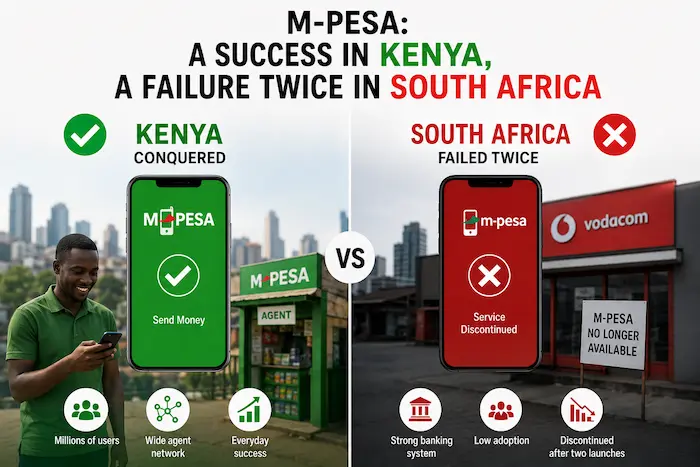

It changed how millions of Kenyans send money, pay bills, receive salaries, run businesses and access financial services. What began in 2007 as a relatively simple way to “send money home” eventually became a financial ecosystem deeply embedded in everyday life.
But there is another side to the M-Pesa story that is far less celebrated.
Vodacom eventually discontinued M-Pesa in South Africa in June 2016.
So what went wrong?
The surprising answer is that M-Pesa was not simply a technology product. It was a solution built for a particular problem, at a particular time, in a particular market.
And South Africa was not Kenya.
M-Pesa Was Built Around a Kenyan Problem
To understand why M-Pesa succeeded, you first have to understand what it was solving.
Before M-Pesa, sending money from Nairobi to family members in rural Kenya could be inconvenient, expensive and risky. Many recipients did not have bank accounts, while formal banking infrastructure was not easily accessible to everyone.
Safaricom’s early M-Pesa team identified this gap.
The original concept was actually designed around microfinance loan repayments. But during testing, customers began using the service to send money to one another. The team realised they had discovered something much bigger.
That led to one of the most powerful propositions in African fintech:
Send money home.
And Kenyans understood it immediately.
M-Pesa did not need to convince people that they needed another banking app.
It solved a problem they already had.
Kenya Had the Perfect Conditions
M-Pesa launched officially in Kenya on 6 March 2007.
The response was extraordinary.
Within a month, there were almost 20,000 active users. By November 2007, the platform had passed one million active users, and it crossed two million customers within its first year.
But the technology itself wasn’t the only reason.
1. Kenya had a huge financial inclusion gap
When M-Pesa launched, access to formal financial services was much lower than it is today.
Safaricom says financial inclusion in Kenya was about 23% in 2007, compared with 84% by 2023.
That created an enormous opportunity.
M-Pesa didn’t have to fight hard to convince people to abandon an existing digital wallet.
For many customers, it was introducing a new way of moving money altogether.
2. Safaricom Already Had the Network
This may have been M-Pesa’s secret weapon.
Safaricom already had an enormous network of airtime dealers across Kenya.
Instead of building a completely new financial-services infrastructure from scratch, M-Pesa could turn existing dealers into agents.
Suddenly, a small shop could become a place where customers deposited and withdrew money.
That made M-Pesa visible everywhere.
Safaricom itself describes the extensive dealer network as an important part of the service’s growth.
And that created a powerful cycle:
More agents → more convenience → more users → more transactions → more merchants → more reasons to use M-Pesa.
The network effect became difficult for competitors to break.
Then Came South Africa
In August 2010, Vodacom and Nedbank officially launched M-Pesa in South Africa.
The ambition was huge.
Vodacom believed the service could replicate the Kenyan success, where millions of people had already adopted M-Pesa.
But there was one major problem.
South Africa was not Kenya.
And that difference would eventually destroy the business case.
South Africa Already Had a Strong Banking System
This was probably the biggest difference.
South Africa had a significantly more developed banking sector, with established banks, branches, ATMs, cards and other financial products already serving consumers.
In Kenya, M-Pesa was filling a major gap.
In South Africa, it was entering a market where many consumers already had alternatives.
That meant Vodacom wasn’t introducing mobile money into an empty space.
It was asking consumers to adopt another financial service.
Vodacom eventually acknowledged this itself.
When announcing the shutdown in 2016, the company said M-Pesa needed to achieve a critical mass of users to become sustainable, but South Africa’s high level of financial inclusion made that unlikely.
The First Attempt Struggled
The original 2010 launch failed to generate the kind of adoption Vodacom expected.
According to contemporary reporting, the service attracted fewer than 100,000 users during its first year, despite the enormous expectations surrounding it.
And there was another problem.
The South African version did not initially have the same distribution model that had made M-Pesa so powerful in Kenya.
Instead of immediately recreating Kenya’s enormous informal agent network, the South African operation relied heavily on a bank partnership.
That was a fundamental difference.
M-Pesa in Kenya was becoming part of the neighbourhood economy.
In South Africa, it struggled to achieve the same physical presence.
Then Vodacom Tried Again
This is where the story gets even more interesting.
Vodacom didn’t simply give up.
In 2014, it relaunched M-Pesa in South Africa with a redesigned strategy intended to address some of the problems from the first attempt. Distribution was given greater attention and the product was reworked.
On paper, this looked like a second chance.
But the numbers still weren’t good enough.
By 2015, contemporary reports put the number of active users at only around 76,000, despite far higher registration numbers and years of effort.
The relaunch had failed to create the critical mass Vodacom needed.
And in May 2016, the company announced that M-Pesa would be discontinued in South Africa from June 30.
Two launches. One market. No sustainable mass adoption.
So Was M-Pesa the Problem?
Not really.
That’s what makes this story so fascinating.
M-Pesa wasn’t necessarily a bad product.
It was a great product solving the wrong problem in the wrong market.
Think about it this way:
Imagine discovering that umbrellas sell millions of units in Nairobi during the rainy season.
You take exactly the same umbrella business to a desert.
The umbrella hasn’t suddenly become a bad product.
The environment changed.
M-Pesa faced a similar problem.
Kenya Needed M-Pesa. South Africa Didn’t Need It in the Same Way.
In Kenya, M-Pesa answered a very obvious question:
“How do I quickly send money to someone who may not have a bank account?”
In South Africa, many consumers already had access to formal banking services.
So the urgency wasn’t the same.
And technology adoption is rarely just about whether a product works.
People adopt products because they solve problems that matter to them.
That’s one of the biggest lessons hidden inside the M-Pesa story.
The Agent Network Was More Important Than the App
Today, when people think about fintech, they often think about smartphone apps.
But M-Pesa’s original breakthrough had very little to do with smartphones.
It was about access.
A customer could walk into an agent shop, deposit or withdraw money and send funds without needing a traditional bank branch.
That physical network became one of M-Pesa’s biggest competitive advantages.
Research into the early M-Pesa model found that the service’s rapid expansion was closely associated with its widespread agent network.
This is an important lesson for African fintech startups:
Digital products still need physical infrastructure when the customers they serve need it.
Another Problem: You Can’t Copy-Paste a Business Model
Perhaps the biggest mistake was assuming that what worked in Kenya would automatically work in South Africa.
Contemporary analysts were blunt about this.
The markets had different economic conditions, different banking structures, different regulatory environments and different consumer behaviour.
M-Pesa’s Kenyan success was the result of several factors working together:
- A major unmet financial need
- Low formal financial inclusion
- Safaricom’s large customer base
- A powerful agent network
- A simple value proposition
- Strong consumer adoption
- A rapidly growing ecosystem
Take away several of those factors and you don’t necessarily get the same result.
The Irony: M-Pesa Wasn’t a Failure Everywhere Else
This is important.
South Africa’s failure did not mean M-Pesa was fundamentally broken.
Vodacom’s own 2016 reporting showed that M-Pesa was growing in other international markets, while South Africa remained the problem market.
Kenya remains the clearest example.
Safaricom says M-Pesa has grown from its original money-transfer service into a broader platform for payments, savings, credit, insurance and other financial services.
That is why the South African experience is so valuable.
It demonstrates that market fit can matter more than technology.
The Real M-Pesa Lesson for Africa
There is a temptation to look at M-Pesa and conclude:
Build a mobile-money platform and millions of people will use it.
That’s not what happened.
The real formula was closer to:
A real problem + the right technology + distribution + trust + timing + market conditions = massive adoption.
Remove one or two of those ingredients and the outcome can be completely different.
This is particularly important for African startups.
A product that works brilliantly in Kenya may fail in Nigeria.
A product that succeeds in Nigeria may struggle in South Africa.
A business model that works in Ghana may require significant changes in Tanzania.
Africa is not one market.
It is a collection of very different markets.
The Most Important Lesson: Don’t Copy M-Pesa. Understand Why M-Pesa Worked.
M-Pesa’s greatest innovation wasn’t simply putting money on a mobile phone.
Its real innovation was understanding a specific African problem and building an infrastructure around it.
Safaricom started with a simple message:
Send money home.
Then customers showed the company what else they wanted to do.
The platform expanded.
Payments came.
Bills came.
Savings came.
Credit came.
Businesses came.
And eventually, M-Pesa became much bigger than its original idea.
That is how great technology platforms are often built.
They don’t begin by trying to do everything.
They begin by solving one painful problem extremely well.
Kenya Won Because M-Pesa Became More Than a Product
Today, M-Pesa is not simply something Kenyans download.
It is embedded into the country’s economy.
You can find it at shops, restaurants, transport businesses, online merchants and countless small enterprises.
Safaricom says M-Pesa now has millions of users and has evolved into a broad financial ecosystem.
That’s the difference between launching a fintech product and building financial infrastructure.
South Africa got the product.
Kenya built the ecosystem.
And that may be the biggest reason M-Pesa conquered one market while failing in another.
The Bottom Line
M-Pesa’s South African failure is not an embarrassing footnote to the company’s history.
It is one of the most important lessons in African technology.
A successful technology cannot simply be exported.
You have to export the technology and redesign the business around the realities of the new market.
Kenya gave M-Pesa a problem desperate for a solution.
South Africa had a very different problem.
And M-Pesa learned the hard way that being a revolutionary product in one country doesn’t automatically make you a revolutionary product everywhere.
The technology was the same.
The markets weren’t.
And that is why M-Pesa conquered Kenya — but failed twice in South Africa.
