
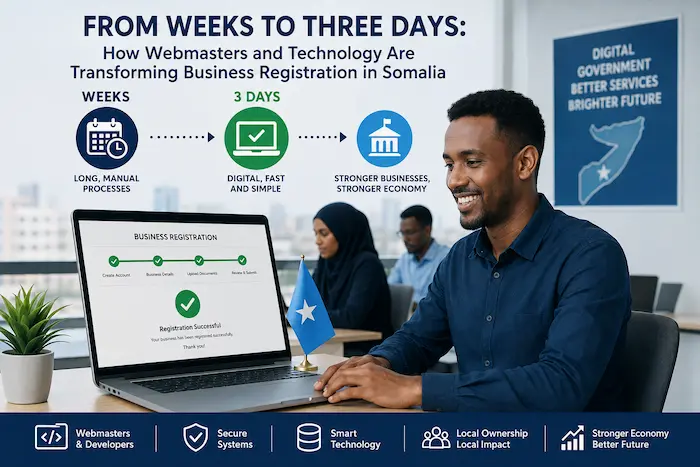

Starting a business should be about turning an idea into reality — not spending weeks navigating paperwork, government offices and fragmented administrative processes.
In Somalia, technology is helping change that experience.
A digital business registration system is enabling businesses to be registered in as little as three days, dramatically reducing the time and complexity associated with a process that previously involved fragmented and manual procedures.
But behind this transformation is a group that deserves more attention: the Webmasters, developers and technology professionals who built the digital systems making this possible.
Their work demonstrates an important reality about Africa’s digital transformation.
Technology does not transform economies simply because governments launch digital platforms.
It transforms economies because people build the systems that solve real problems.
From Weeks of Paperwork to Three Days
For entrepreneurs, time is one of the most valuable resources.
A business owner waiting weeks to complete registration is losing time that could otherwise be spent finding customers, hiring employees, opening a bank account or launching products.
Traditional registration processes can also involve multiple government offices, paper documents and repeated interactions with officials.
This creates friction for entrepreneurs and can discourage some people from formally registering their businesses.
The digital approach aims to change that.
Instead of moving between different offices and relying heavily on paperwork, entrepreneurs can interact with a centralised digital system designed to streamline the registration process.
The goal is simple:
Make it easier to start a business.
And when the process can potentially be completed in three days instead of weeks, the impact goes beyond convenience.
It becomes an economic advantage.
The Technology Behind the Transformation
When people hear about digital government, they often see the final product — a website, portal or online application form.
What they don’t see is the technology infrastructure underneath it.
A modern business registration platform may require multiple components working together, including:
- User registration and authentication
- Digital application forms
- Databases
- Document management
- Identity verification
- Workflow automation
- Payment integration
- Government data systems
- Notifications
- Security controls
- Reporting and analytics
Someone has to design, develop, connect and maintain all these components.
That is where Webmasters, software developers and technology teams become critical.
They translate government requirements and complicated administrative processes into digital systems that ordinary citizens and businesses can actually use.
The People Behind the Platform
It is easy to talk about technology as if it operates by itself.
It doesn’t.
Behind every digital government platform are people writing code, designing interfaces, managing databases, testing systems, fixing bugs and improving performance.
The Webmasters and developers involved in Somalia’s business registration transformation are part of this often-overlooked layer of digital infrastructure.
Their contribution goes beyond building a website.
They help create the technical foundation that allows government services to operate differently.
For an entrepreneur, that may simply mean filling out an online form and receiving business registration information faster.
For the developer, however, making that experience work reliably can involve hundreds of technical decisions.
How should information be stored?
How should different users access the system?
How should applications move from one stage to another?
How should sensitive information be protected?
How can the platform remain available as more people use it?
These are the questions that technology professionals have to solve.
Webmasters Are Becoming Part of Africa’s Economic Infrastructure
The word Webmaster traditionally referred to someone responsible for managing a website.
Today, the role behind many digital platforms is much broader.
Technology professionals can be responsible for designing websites, developing applications, managing databases, integrating APIs, implementing security measures and maintaining complex digital systems.
In government, these responsibilities become even more important.
A public-sector platform may serve thousands or millions of users.
It must be accessible, reliable and secure.
A technical failure can prevent businesses from accessing important government services.
That means the people building these systems are not simply creating websites.
They are helping build digital public infrastructure.
Why Faster Business Registration Matters
Reducing registration time from weeks to three days may sound like a small improvement.
It isn’t.
Consider an entrepreneur who wants to launch a new company.
Before the business can operate fully, the owner may need registration documents, licences, tax information and access to financial services.
Every delay can push the launch further into the future.
A faster registration process can help entrepreneurs move from an idea to an operating business more quickly.
It can also encourage more businesses to enter the formal economy.
That matters because formal businesses can potentially gain better access to:
- Banking services
- Credit
- Investment
- Government programmes
- Larger customers
- Business partnerships
- Formal employment opportunities
Digital registration can therefore become an important part of creating a more business-friendly environment.
Technology Can Remove Friction From Government
One of the biggest opportunities for technology in Africa is not necessarily creating another social media platform or smartphone application.
It is removing friction from everyday interactions with institutions.
Imagine being able to:
Register a company online.
Apply for a licence digitally.
Pay government fees electronically.
Track an application from your phone.
Receive official documents digitally.
These services can save citizens time while giving governments better records and more efficient processes.
That is the broader promise of digital government.
And Somalia’s business registration system provides an example of what that transformation can look like.
The Importance of Local Somali Ownership
There is another part of the story that may be even more important than the technology itself.
The system has been handed over to a local Somali team to operate.
That matters because technology projects should not depend permanently on external organisations.
If a digital platform is built but local institutions do not have the knowledge or capacity to operate it, its long-term sustainability can become difficult.
Local ownership changes that.
A Somali team managing the platform can understand local requirements, respond to problems and continue improving the system as the country’s needs evolve.
The technology professionals who built the system can also contribute to knowledge transfer and capacity building.
The ultimate goal should be sustainable digital infrastructure that local institutions can own and improve.
Building a System Is Only the Beginning
Launching a digital platform is not the end of digital transformation.
It is the beginning.
Technology systems require continuous maintenance.
Software needs updates.
Security vulnerabilities need to be addressed.
Servers and databases need monitoring.
User feedback needs to be analysed.
New government requirements need to be incorporated.
As more businesses use the system, the platform may also need to scale.
This means the Webmasters and developers behind the system remain important even after the initial launch.
A successful digital platform is a living system.
It must evolve with the people using it.
The User Experience Matters
There is another important lesson for governments across Africa.
Digitising an inefficient process does not automatically make it efficient.
If a traditional business registration process requires ten unnecessary steps, simply putting those ten steps online will not solve the problem.
Good digital transformation requires rethinking the process itself.
Technology teams need to work with government institutions to identify unnecessary procedures and determine which steps can be automated.
The objective should be to make the experience as simple as possible while maintaining security and regulatory requirements.
For entrepreneurs, the ideal experience should be straightforward:
Create an account → Submit information → Complete requirements → Track the application → Receive registration.
The less unnecessary friction, the better.
Security and Trust Cannot Be Ignored
There is also an important responsibility that comes with building government technology.
Business registration systems can handle sensitive information about companies and individuals.
That makes cybersecurity essential.
Technology teams must consider:
- Data protection
- User authentication
- Access controls
- Encryption
- System monitoring
- Backup and recovery
- Fraud prevention
- Secure software development
A faster system is valuable.
But a faster system that compromises sensitive information creates a different set of problems.
Digital transformation therefore needs to balance speed, accessibility and security.
The Broader African Digital Transformation
Somalia’s business registration system is part of a much larger African technology story.
Across the continent, governments are increasingly digitising public services.
These include:
- Tax collection
- National identification
- Healthcare
- Education
- Business licensing
- Land administration
- Government payments
- Company registration
- Public procurement
The opportunity is enormous.
Africa has a young population, growing internet access and an increasingly technology-driven private sector.
Governments that successfully digitise their services can potentially make it easier for citizens and businesses to interact with public institutions.
The result could be faster services, better records and greater economic participation.
What Other African Countries Can Learn
The Somali experience offers several lessons.
1. Solve a real problem
Technology should address a genuine problem experienced by citizens and businesses.
Faster business registration is a clear example.
2. Build around the user
Government systems should be designed around how people actually use services, not around complicated internal bureaucracy.
3. Invest in local technical skills
Countries need developers, engineers, cybersecurity specialists, system administrators and other technology professionals capable of maintaining digital infrastructure.
4. Think beyond the launch
Digital platforms require continuous investment, maintenance and improvement.
5. Prioritise security
Government technology handles information that can be extremely sensitive.
6. Build for local ownership
External technology partners can help create systems, but local institutions should ultimately have the capability to operate and improve them.
The People Behind Africa’s Digital Future
Africa’s technology story is often told through famous companies, entrepreneurs and products.
But there is another group quietly shaping the continent’s future.
The developers.
The engineers.
The Webmasters.
The cybersecurity professionals.
The system architects.
The technology teams.
They are building the infrastructure behind digital government, fintech, e-commerce, telecommunications and countless other services.
Their work may not always make headlines.
But millions of people can eventually depend on the systems they create.
Somalia’s faster business registration process is a good example.
For the entrepreneur using the platform, it may simply feel like a faster government service.
Behind that simple experience, however, are technology professionals who designed the digital workflows, built the platform and helped turn a complicated administrative process into something more accessible.
From Technology Project to Economic Infrastructure
The most important question is not whether Somalia has launched another digital platform.
The bigger question is what happens next.
Can the system continue improving?
Can more government services connect to it?
Can more entrepreneurs use digital services without visiting government offices?
Can local Somali technology professionals take greater responsibility for maintaining and expanding the infrastructure?
If the answer is yes, then the impact could extend far beyond business registration.
The platform could become part of a broader digital government ecosystem.
And that is where the real opportunity lies.
The Bottom Line
The story of Somalia’s faster business registration process is ultimately a story about people, technology and government working together.
Reducing the time required to register a business from weeks to as little as three days can make a meaningful difference to entrepreneurs.
But the achievement is not just about speed.
It is about removing unnecessary barriers.
It is about building digital infrastructure.
It is about giving government institutions better tools.
And importantly, it is about recognising the Webmasters, developers and technology professionals whose work makes these systems possible.
Africa’s digital transformation will not be built by technology alone.
It will be built by people who understand local problems and have the skills to turn those problems into technological solutions.
Somalia’s experience offers a powerful reminder:
Sometimes the most important technology is not the technology that gets the most attention.
It is the technology that quietly makes everyday life easier.
And sometimes, the people building that technology are the Webmasters working behind the scenes.
From weeks to three days, the change may look simple to the person using the system. But behind that simplicity is a significant technology achievement — and a glimpse of what digital government could mean for Africa’s future.
