
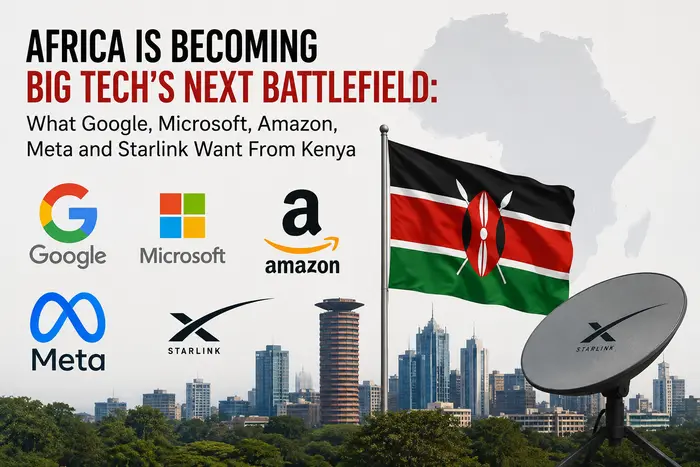

Big Tech in Africa is entering a new and potentially transformative phase, and Kenya is increasingly becoming one of the most important markets in the competition.
Google, Microsoft, Amazon, Meta and Starlink are no longer simply looking at Africa as a place to sell digital products. They are investing in cloud computing, artificial intelligence, data centres, subsea cables, satellite connectivity and the infrastructure that will power the continent’s next digital economy.
The question is no longer whether Africa will become a major technology market.
The bigger question is who will control the infrastructure on which that digital future is built—and what Kenya stands to gain from the race.
It is about who builds the infrastructure on which Africa’s digital economy will run.
That means subsea cables.
Data centres.
AI computing.
Cloud platforms.
Satellite internet.
Digital skills.
Developer ecosystems.
And increasingly, the data generated by hundreds of millions of African users.
A recent analysis of Big Tech’s expanding African presence described the development as a new “scramble for Africa.” Google says it has already reached its five-year target of investing $1 billion across the continent, while Microsoft, Meta, Amazon and Starlink are expanding their own connectivity and technology footprints.
For Kenya, this presents an enormous opportunity.
But it also raises a difficult question:
What exactly do these technology giants want from Africa—and why is Kenya so important?
This isn’t just another technology boom
Africa has long been described as the next big technology market.
This time, however, something is different.
The world’s largest technology companies are no longer waiting for African consumers to come online.
They are helping build the infrastructure that will bring them online.
That distinction matters.
Google is investing in connectivity, AI and skills.
Microsoft is pushing cloud and AI infrastructure.
Amazon is expanding AWS and moving into satellite connectivity.
Meta has invested heavily in subsea connectivity.
Starlink is taking internet access beyond traditional fibre and mobile networks.
These companies are competing in different areas, but their strategies increasingly overlap.
And that creates a much bigger contest for the future of Africa’s digital economy.
1. Google wants to build the AI layer
Google’s African strategy is no longer primarily about search.
The company sees AI as one of the biggest opportunities for the continent.
Google says it has trained millions of Africans in digital skills and has committed funding toward universities, research institutions and AI development. It has also been expanding connectivity infrastructure and AI capabilities designed for African markets.
This is important because Africa’s AI opportunity is not simply about importing ChatGPT-style tools.
The continent has problems that require locally relevant AI.
Flood prediction.
Agriculture.
Healthcare.
Education.
African languages.
Financial inclusion.
Public services.
Google’s AI research presence in Nairobi is therefore strategically significant.
Kenya isn’t just a consumer market for AI.
It is increasingly becoming a place where AI products can be developed and tested for African conditions.
And whoever builds the AI platforms used by African developers and businesses could eventually occupy an extremely powerful position in the continent’s digital economy.
2. Microsoft wants the infrastructure behind Africa’s AI economy
If Google is fighting to build the AI layer, Microsoft is deeply invested in the infrastructure underneath it.
Cloud computing is becoming increasingly important as businesses move their applications, databases and AI workloads online.
Microsoft’s Azure ecosystem gives the company a major position in that market.
Kenya has become particularly important to Microsoft’s African ambitions through its partnership with G42 on a planned $1 billion data-centre project.
But that project has encountered a major problem: power.
Reports in 2026 have highlighted concerns over whether Kenya’s electricity infrastructure can support the enormous energy requirements associated with the proposed facility.
And this reveals something most consumers don’t see when they use AI.
AI doesn’t live in the cloud.
AI lives in buildings full of computers that consume enormous amounts of electricity.
That makes Kenya’s energy infrastructure part of the country’s AI strategy.
Cheap, reliable and increasingly renewable electricity could become one of Kenya’s biggest competitive advantages—or one of its biggest constraints.
3. Amazon wants more than online shopping
When people hear Amazon, they often think about e-commerce.
In Africa, the more strategically important Amazon business may be AWS.
Amazon Web Services provides the cloud infrastructure used by companies, banks, governments, startups and developers.
Amazon already established an AWS development centre in Nairobi, creating opportunities around software development, cloud support and engineering.
But Amazon’s ambitions in Africa are now moving beyond cloud computing.
Its satellite internet project, Project Kuiper, is also entering the African connectivity race.
Kenya has been identified as an important location for Amazon’s satellite-internet infrastructure, including plans for a ground station.
That puts Amazon into direct strategic competition with Starlink.
And suddenly Kenya is no longer just a cloud market.
It could become part of the infrastructure connecting satellites to African users.
4. Meta wants Africa connected—and it needs enormous bandwidth
Meta’s business depends on people being online.
More people online means more Facebook, Instagram and WhatsApp users.
It also means more digital advertising, more video consumption and more data.
That makes internet infrastructure strategically important to Meta.
The company has been involved in major subsea cable infrastructure, including the 2Africa system, which is designed to improve connectivity around the African continent.
The significance of subsea cables is easy to underestimate.
Before a phone can load a website or an AI application, enormous amounts of information have to travel through physical infrastructure.
That infrastructure includes fibre-optic cables running under oceans.
The companies that help build and operate those networks are therefore influencing how much capacity Africa has—and how cheaply people can access the global internet.
This is why the next phase of Africa’s internet competition is increasingly happening beneath the ocean.
5. Starlink is attacking the connectivity problem from above
Then there is Starlink.
Instead of relying primarily on fibre cables, terrestrial towers and traditional telecom infrastructure, Starlink uses low-Earth-orbit satellites to deliver internet connectivity.
That makes the technology particularly interesting for regions where conventional infrastructure is expensive or difficult to deploy.
Africa has hundreds of millions of people who remain offline, while large populations live beyond the reach of fibre and traditional mobile networks.
Starlink therefore isn’t simply selling another internet connection.
It is challenging the traditional economics of connectivity.
A village doesn’t necessarily need to wait years for a fibre network to arrive.
A remote business doesn’t necessarily need a terrestrial connection.
A school far from a major city can potentially access high-speed internet through a satellite terminal.
That could dramatically change the economics of rural connectivity.
But it also creates a new dependency.
If satellites become a major part of Africa’s internet infrastructure, who controls those satellites?
That question is becoming increasingly important.
Kenya is becoming the meeting point
This is where Kenya’s position becomes particularly interesting.
The country already has a strong technology ecosystem, widespread mobile-money adoption, a large startup community and an increasingly sophisticated digital economy.
But its biggest advantage may be something else:
Kenya is willing to experiment.
Fintech companies experimented with mobile money.
Startups experimented with digital lending.
Telecom operators experimented with mobile services.
Now global technology companies are experimenting with AI, cloud infrastructure, satellite connectivity and advanced data centres.
That creates an ecosystem where new technology can move from experiment to mass adoption relatively quickly.
And Big Tech knows it.
The hidden battle is over data
There is another reason Africa matters.
Data.
Every search, transaction, video, message, location signal and AI interaction generates information.
Africa’s digital population is growing.
That means the continent is becoming an increasingly valuable source of data for technology companies.
But this creates a difficult debate.
Should African data primarily be stored and processed outside the continent?
Should African governments require more data localisation?
Should African companies own more of the infrastructure?
And who ultimately benefits when African users generate enormous amounts of economic value for global technology platforms?
Some African governments are already moving toward stronger data-localisation rules and local cloud infrastructure.
This debate will become even more important as AI grows.
Africa doesn’t just need Big Tech. It needs African Tech.
This may be the most important part of the story.
Foreign investment can accelerate Africa’s digital transformation.
But investment alone doesn’t create technological sovereignty.
Africa needs its own companies building products.
Its own engineers developing AI models.
Its own data centres.
Its own cloud infrastructure.
Its own semiconductor and hardware ambitions.
Its own digital platforms.
And its own standards.
Otherwise, Africa risks becoming extremely connected without becoming technologically independent.
That is the uncomfortable side of the Big Tech opportunity.
The same companies that can provide billions of dollars in infrastructure can also become extremely powerful gatekeepers.
The power problem could determine who wins
There is one issue that could quietly determine the success of Africa’s AI ambitions:
electricity.
AI data centres consume huge amounts of power.
Cloud infrastructure needs reliable electricity.
Telecom networks need electricity.
Satellite ground stations need electricity.
Digital economies cannot function without it.
Kenya’s Microsoft-G42 data-centre debate is therefore bigger than one project.
It illustrates a fundamental challenge facing countries across Africa.
You cannot build a serious AI economy without serious energy infrastructure.
Kenya’s renewable-energy resources, particularly geothermal power, could become a significant advantage if the country can expand generation and transmission capacity fast enough.
The countries that solve the energy problem could become the countries that attract the next wave of AI infrastructure investment.
The race could create a massive opportunity for Kenyan businesses
The biggest beneficiaries may not ultimately be Google, Microsoft, Amazon or Starlink.
They could be the thousands of businesses that build on top of their infrastructure.
A Kenyan startup doesn’t need to build a data centre to become an AI company.
A developer doesn’t need to launch a satellite to build a global software business.
A logistics company doesn’t need to own fibre cables to use cloud computing.
Infrastructure creates platforms.
Platforms create businesses.
And businesses create jobs.
This is where Kenya’s opportunity becomes much more interesting.
If global technology companies build the infrastructure, Kenyan entrepreneurs can potentially build the products.
But Kenya must negotiate from a position of strength
The arrival of Big Tech should not mean Kenya simply accepts whatever infrastructure and business models global companies offer.
Kenya needs to ask harder questions.
How many local jobs will be created?
How much technology transfer will happen?
Where will African data be stored?
How much tax revenue will be generated?
How much local content will be created?
Will Kenyan startups receive meaningful access to infrastructure?
Can local companies participate in supply chains?
And perhaps most importantly:
What capabilities will Kenya still own ten years from now?
These questions matter because digital infrastructure can shape an economy for decades.
The next African tech war will be fought on several fronts
The competition is no longer just between smartphone brands.
It is becoming a competition over:
AI.
Cloud computing.
Data centres.
Subsea cables.
Satellite internet.
Digital skills.
Data.
Energy.
And ultimately, the African developer and consumer.
Google wants AI and connectivity.
Microsoft wants cloud and AI infrastructure.
Amazon wants cloud—and is entering satellite connectivity.
Meta needs billions of people connected to its platforms.
Starlink wants to disrupt traditional internet infrastructure from space.
Their interests overlap.
And Kenya is increasingly becoming one of the places where those strategies collide.
What happens next could determine Kenya’s digital future
The most interesting thing about Africa’s technology boom is that the next decade may look very different from the previous one.
The first internet revolution connected Africans.
The mobile revolution put powerful computers into their pockets.
The fintech revolution changed how millions of people move money.
The next revolution could be about intelligence and infrastructure.
AI systems will require enormous computing capacity.
Businesses will move more operations to the cloud.
Satellite networks will connect places traditional infrastructure struggles to reach.
Data centres will become as strategically important as telecom towers.
And countries that can combine connectivity, energy, skills and local entrepreneurship will have a significant advantage.
Kenya has already built part of that foundation.
The question now is whether it can turn foreign technology investment into lasting local technological power.
Because the real prize isn’t simply getting Google, Microsoft, Amazon, Meta or Starlink to invest in Kenya.
The real prize is making sure that when they build here, Kenyan businesses, developers and consumers become part of the value created.
That is the difference between being a market for Big Tech and becoming one of the places where the future of technology is actually built.
And Africa’s next technology battle has already begun.
