
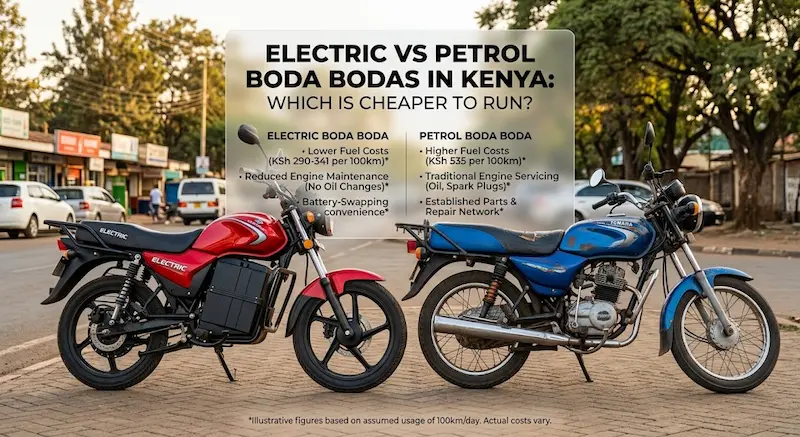

Kenya’s boda boda industry is beginning to experience a significant technological shift. Electric motorcycles are offering riders an alternative to petrol-powered bikes, promising lower energy costs, reduced engine maintenance and a different approach to financing commercial transport.
But switching to an electric motorcycle is not automatically the cheapest option for every rider.
The real question is how much a boda boda costs to buy, operate and maintain over time. Battery-swapping fees, daily loan repayments, access to charging infrastructure and the distance covered each day can all influence the final cost.
For Kenyan riders who depend on their motorcycles for daily income, understanding these expenses is essential before committing to either technology.
This TechDrivers comparison examines the cost of running electric and petrol boda bodas using transparent calculations, current fuel prices and reported electric motorcycle pricing.
Kenya’s electric boda boda market is growing
Electric motorcycles are becoming increasingly visible on Kenyan roads as companies expand battery-swapping networks and introduce financing arrangements designed for commercial riders.
Citizen Digital reported on 4 October 2026 that approximately 64,840 electric motorcycles had been registered cumulatively between 2023 and mid-2026, citing the Electric Mobility Association of Kenya.
The transition is not happening at the same pace everywhere. Riders need access to reliable charging or battery-swapping stations, affordable financing and motorcycles suited to their daily routes.
Petrol motorcycles also retain practical advantages, particularly in areas where electric charging and battery-swapping infrastructure is limited.
Consequently, the decision to switch is not simply about choosing newer technology. It is a business decision that depends on the rider’s income, operating expenses and working environment.
1. How much does petrol cost compared with electricity?
Energy costs are among the most important differences between electric and petrol motorcycles.
According to the Energy and Petroleum Regulatory Authority (EPRA), the maximum retail price of petrol in Nairobi was KSh 214.03 per litre for the period from 15 September to 14 October 2026.
A petrol motorcycle’s actual fuel consumption depends on its engine, load, mechanical condition, traffic and riding style.
For this comparison, assume a commercial petrol motorcycle covers 40 kilometres per litre. This is a working assumption for the calculation, not a measured result for every motorcycle.
A rider travelling 100 kilometres would use:
100 km ÷ 40 km per litre = 2.5 litres
At KSh 214.03 per litre, the fuel cost would be:
2.5 litres × KSh 214.03 = KSh 535.08 per 100 kilometres.
Electric motorcycles have different energy costs depending on whether the rider charges a personally owned battery or uses a battery-swapping service.
For example, TechDrivers previously reported a battery-swap price of approximately KSh 290 for a Spiro electric motorcycle, with an estimated range of 85–100 kilometres per swap.
Using those figures, the energy-access cost works out as follows:
- At 85 kilometres per swap: KSh 290 ÷ 85 = KSh 3.41 per kilometre.
- At 100 kilometres per swap: KSh 290 ÷ 100 = KSh 2.90 per kilometre.
This produces an estimated battery-swap cost of KSh 290–341 per 100 kilometres, assuming the reported swap price and range apply to the motorcycle being used.
These are illustrative figures, not guaranteed operating costs. Battery range varies with the model, passenger or cargo load, terrain, speed and battery condition.
Electric vs petrol energy costs
| Cost measure | Petrol motorcycle | Electric motorcycle |
|---|---|---|
| Assumed distance | 100 km | 100 km |
| Energy requirement | 2.5 litres | Approximately one swap |
| Price used | KSh 214.03/litre | KSh 290/swap |
| Estimated cost | KSh 535 | KSh 290–341 |
| Cost per kilometre | KSh 5.35 | KSh 2.90–3.41 |
Under these assumptions, the electric motorcycle’s battery-swap expense is approximately 36%–46% lower than the petrol motorcycle’s fuel expense.
This is an energy-cost comparison only. It does not include purchase prices, loan repayments, maintenance, insurance or battery replacement.
2. What happens to monthly operating costs?
Daily mileage can make a significant difference to a rider’s finances.
Consider a boda boda rider who travels 100 kilometres per working day and works 26 days per month.
Petrol motorcycle
Daily fuel expense:
100 km ÷ 40 km per litre × KSh 214.03 = KSh 535.08.
Monthly fuel expense:
KSh 535.08 × 26 = approximately KSh 13,912.
Electric motorcycle
Using the reported battery-swap range of 85–100 kilometres and a price of KSh 290 per swap, the estimated monthly energy expense for 2,600 kilometres would be approximately KSh 7,540–8,859.
The calculation uses a proportional cost per kilometre. Actual spending may differ because battery swaps are purchased in whole units and the rider may need additional energy for a particular route.
Monthly energy-cost comparison
| Expense | Petrol | Electric |
|---|---|---|
| Daily distance | 100 km | 100 km |
| Monthly distance | 2,600 km | 2,600 km |
| Monthly fuel or battery-swap expense | KSh 13,912 | KSh 7,540–8,859 |
| Indicative difference | — | KSh 5,053–6,372 less |
Under this example, an electric motorcycle could reduce monthly energy expenses by roughly KSh 5,000–6,400.
However, the difference is not the same as the rider’s final profit. Loan repayments, servicing, tyres, insurance, downtime and other expenses must also be deducted from daily earnings.
3. What about the purchase price?
The upfront cost is another important consideration.
Electric motorcycles are sold under different ownership arrangements. Some prices cover the motorcycle chassis without a battery, while other packages include the battery or provide access through a battery-swapping subscription.
Business Today Kenya reported in September 2026 that some Spiro Ekon models were listed at approximately KSh 95,000–152,000 for the motorcycle chassis without the battery. The publication also described financing arrangements with deposits and daily payments.
These figures should not be interpreted as the complete purchase price of every electric motorcycle. Battery access, model specifications, financing fees and the ownership agreement can change the final cost.
A petrol motorcycle’s advertised price must also be checked against its engine capacity, warranty, registration costs and any financing charges.
Before comparing two motorcycles, request a written quotation showing:
- The total cash price.
- The deposit required.
- The repayment amount and duration.
- The total amount payable over the financing period.
- Whether the battery is included or leased.
- Any battery-swapping or subscription charges.
- Ownership and transfer conditions.
The cheapest advertised price is not necessarily the cheapest option over the full repayment period.
4. How does financing affect a rider’s earnings?
Many commercial riders cannot afford to pay the full purchase price upfront. Daily or weekly instalments can make a motorcycle accessible, but they also reduce the money available for household expenses and savings.
For example, consider a hypothetical motorcycle financing arrangement requiring a daily repayment of KSh 300 over 26 working days.
Monthly repayments would be:
KSh 300 × 26 = KSh 7,800.
If the rider also spends KSh 7,540–8,859 per month on electric battery swaps, the combined monthly expense would be approximately KSh 15,340–16,659 before maintenance, insurance and other costs.
This is an illustration, not a quoted financing offer.
A petrol motorcycle with a different deposit, repayment period or interest rate may have a lower or higher monthly financing burden.
Riders should compare the total cost of financing rather than relying only on a manageable daily instalment.
They should also establish what happens if payments are delayed, whether the motorcycle can be remotely disabled, and whether they can continue earning if a battery-swapping account or service becomes unavailable.
5. Which motorcycle is cheaper to maintain?
Electric motorcycles have fewer moving mechanical parts than petrol motorcycles. They do not require engine oil changes, spark plugs or the same engine servicing associated with internal-combustion motorcycles.
This can reduce certain maintenance expenses.
Petrol motorcycles, however, have established repair networks and mechanics familiar with common engine problems. Spare parts are often available through existing motorcycle dealers and repair shops.
Electric motorcycles still require attention to tyres, brakes, suspension, bearings, electrical connections and other mechanical components. Battery health, motor repairs and electronic components may also affect long-term costs.
The availability of qualified technicians and replacement parts can vary by location and brand.
There is another important consideration: the battery.
With a battery-swapping model, the rider may pay for energy access without owning the battery outright. This can reduce the initial purchase requirement, but the rider must understand the provider’s fees, service conditions and battery-access rules.
For a fair comparison, riders should ask local mechanics and authorised service centres for actual service prices instead of assuming that every electric motorcycle will be cheaper to maintain by the same percentage.
6. Charging at home versus battery swapping
Electric motorcycles do not all use the same energy model.
Home charging
Some models allow riders to charge their own battery using compatible charging equipment.
This can be convenient for riders with secure parking, reliable electricity and enough time to recharge between shifts.
The energy cost depends on the battery’s capacity, charging losses and the applicable electricity tariff.
For illustration, if a motorcycle consumes 6 kWh of electricity to travel 100 kilometres and the effective tariff is KSh 15 per kWh, the energy expense would be:
6 kWh × KSh 15 = KSh 90 per 100 kilometres.
This is a hypothetical calculation, not a claim that every electric motorcycle consumes 6 kWh per 100 kilometres or that every household pays KSh 15 per kWh.
Battery swapping
Battery swapping allows riders to exchange a depleted battery for a charged one at a compatible station.
The main advantage is convenience: a rider can resume work without waiting for a battery to recharge.
The disadvantage is dependence on the provider’s network, pricing and battery compatibility. A rider who operates far from available swapping stations may experience downtime or additional travel costs.
The two systems should therefore be compared based on the actual motorcycle, route and energy arrangement available to the rider.
7. What are the biggest risks of switching to an electric boda boda?
Lower energy costs do not eliminate the challenges of electric mobility.
Limited battery-swapping access: Riders who operate outside established networks may struggle to find convenient stations.
Battery compatibility: Batteries from different manufacturers may not be interchangeable. Before buying, check which network supports the motorcycle and whether the provider’s conditions could restrict future use.
Financing obligations: Daily repayments can become difficult during illness, poor business periods or mechanical downtime.
Battery and warranty terms: Understand who owns the battery, who pays for replacement and what the warranty covers.
Resale value: The future resale price of an electric motorcycle can depend on battery condition, brand support, software restrictions and demand in the local market.
Route suitability: Long-distance routes, steep terrain, heavy loads and limited charging infrastructure can affect the practicality of a particular model.
These issues do not mean electric motorcycles are a poor investment. They mean that riders should evaluate the complete business arrangement before committing.
8. Which option makes more financial sense?
An electric motorcycle may be attractive to a rider who covers many kilometres daily, has reliable access to affordable charging or battery swapping, and can secure financing on reasonable terms.
A petrol motorcycle may remain more practical for riders who operate in remote areas, travel unpredictable routes or depend on repair networks that are not yet available for their preferred electric model.
The correct decision depends on the total cost of ownership and the income the motorcycle can generate.
Before making a purchase, calculate:
Total operating cost = energy + maintenance + financing + insurance + other operating expenses.
Then compare the result with expected daily revenue after allowing for days when the motorcycle is not working.
A rider who saves on energy but takes on an unaffordable loan may not improve their financial position. Likewise, a rider who pays more upfront for a reliable electric motorcycle may recover that difference over time if operating savings are sustained.
Frequently asked questions
Is an electric boda boda cheaper than a petrol motorcycle in Kenya?
It can be cheaper to operate, particularly when energy and certain maintenance expenses are lower. The total financial benefit depends on purchase price, financing, battery access, maintenance and daily mileage.
How much does it cost to run an electric boda boda for 100 kilometres?
Using an illustrative battery-swap price of KSh 290 and a reported range of 85–100 kilometres, the estimated swap expense is approximately KSh 290–341 per 100 kilometres. Actual costs depend on the motorcycle and riding conditions.
How much does a petrol boda boda cost to run per day?
At a petrol price of KSh 214.03 per litre and assumed fuel economy of 40 kilometres per litre, travelling 100 kilometres would cost approximately KSh 535 in fuel. The actual cost will vary with fuel economy and pump prices.
Can I charge an electric boda boda at home?
Some electric motorcycles support home charging, while others use battery-swapping systems. Check the specific model’s charging requirements and warranty conditions before buying.
Do electric motorcycles require less maintenance?
They avoid engine oil changes and several engine-related servicing tasks. However, tyres, brakes, suspension, electrical components and batteries still require maintenance or replacement when necessary.
What should I check before financing an electric motorcycle?
Compare the deposit, total repayment amount, loan duration, battery ownership, swapping charges, warranty, service network and the consequences of missed payments. Ensure the daily repayment is affordable even when business is slow.
Conclusion: Look beyond the fuel bill
Electric motorcycles are creating a new opportunity for Kenya’s boda boda industry, but the strongest financial case depends on the numbers.
In our illustrative comparison, a rider covering 100 kilometres per working day could spend approximately KSh 13,912 monthly on petrol, compared with KSh 7,540–8,859 for battery swaps under the stated assumptions.
That difference could help improve a rider’s cash flow, but it does not represent guaranteed savings or additional profit.
The next step is to compare the full purchase and operating costs of specific motorcycles, including their financing arrangements and access to energy infrastructure.
For Kenya’s boda boda operators, the best motorcycle is not necessarily the newest or the one with the lowest advertised price. It is the one that delivers reliable service and leaves the rider with more money after all expenses have been paid.
TechDrivers will continue examining the technology, costs and business models shaping electric mobility in Kenya.
