
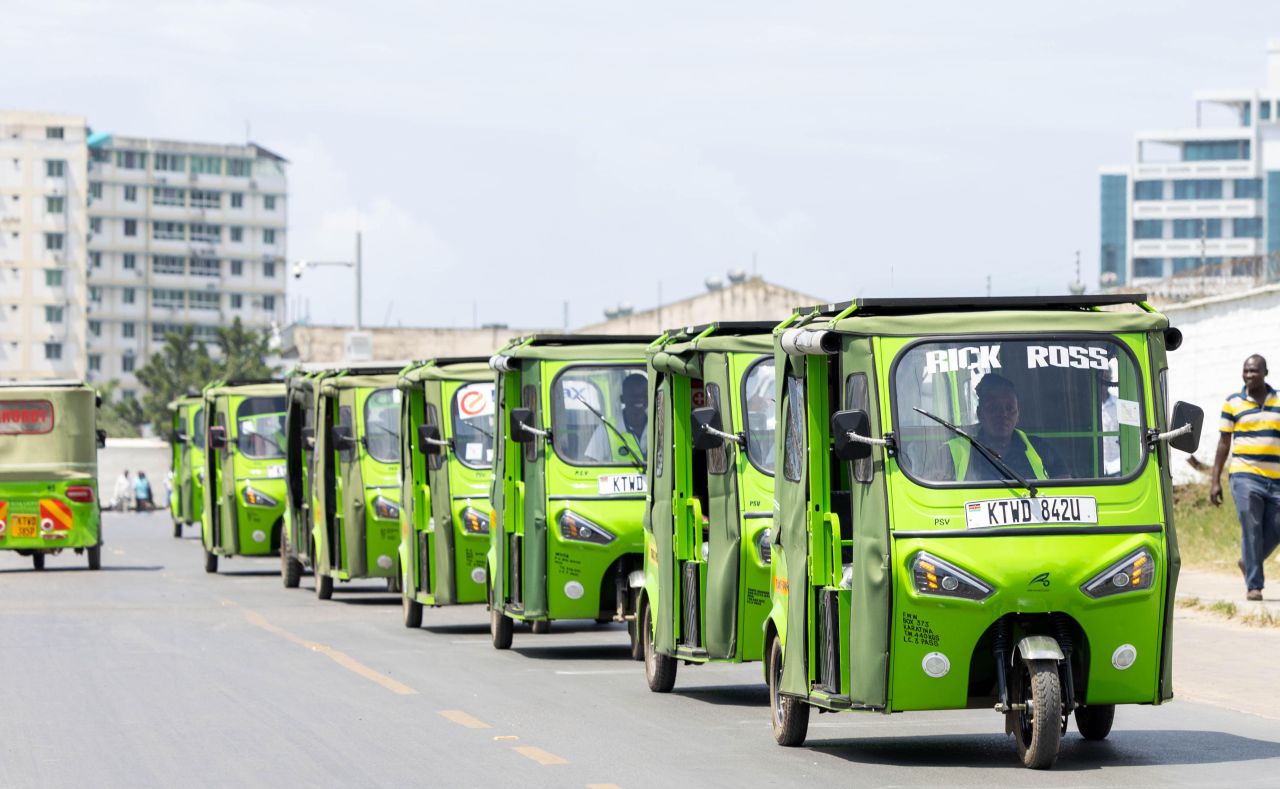

Kenya’s shift toward electric mobility is moving beyond motorcycles, with M-KOPA expanding its pay-as-you-go financing model to electric tuk-tuks.
The move targets commercial transport operators, particularly tuk-tuk drivers who rely on their vehicles for daily income and face recurring costs from fuel, maintenance and other operating expenses.
M-KOPA says the expansion follows its experience financing more than 10,000 electric motorbikes in Kenya since launching M-KOPA Mobility in 2023.
The company is now looking to bring the same financing approach to electric tuk-tuks, potentially making the technology more accessible to drivers who may not be able to afford the full upfront cost of an electric vehicle.
Why Electric Tuk-Tuks Matter in Kenya
Tuk-tuks are an important part of local transport in several Kenyan towns and cities, with Mombasa being one of the most visible markets.
For many operators, a tuk-tuk is not simply a vehicle. It is a source of income.
The economics of switching from petrol to electricity therefore matter just as much as the environmental argument.
Fuel prices can represent a significant recurring expense for commercial drivers. Electric vehicles, meanwhile, have fewer mechanical components associated with conventional internal-combustion engines and can potentially reduce some maintenance requirements.
This makes operating costs one of the most important factors in determining whether electric tuk-tuks can achieve wider adoption.
M-KOPA Brings Pay-As-You-Go Financing to Tuk-Tuks
The company’s approach is based on financing rather than requiring customers to pay the entire vehicle cost upfront.
That is particularly relevant in Kenya, where many commercial drivers depend on daily earnings to meet household expenses and vehicle-related payments.
Under a pay-as-you-go model, the cost of accessing an electric vehicle can be spread over time instead of being concentrated into a large initial payment.
M-KOPA says this approach is designed to help more drivers switch to electric mobility while keeping their vehicles productive.
The company has not publicly provided, in the announcement reviewed by TechDrivers, the full pricing structure, repayment period or specific electric tuk-tuk model details.
Those details will be important for drivers comparing electric tuk-tuks with conventional petrol models.
M-KOPA Reports KSh530 in Average Daily Savings for Motorcycle Riders
M-KOPA says its electric motorcycle customers save an average of KSh530 per day through lower energy and maintenance costs, alongside access to battery-swapping infrastructure.
That figure relates to the company’s motorcycle customers and should not automatically be interpreted as the expected saving for an electric tuk-tuk.
Tuk-tuks have different operating patterns, vehicle sizes, passenger loads and energy requirements.
For potential buyers, the more useful calculation will be the total cost of operating a particular electric tuk-tuk compared with an equivalent petrol vehicle.
That should include:
- Daily energy or charging costs
- Maintenance
- Financing payments
- Insurance
- Battery-related costs
- Downtime
- Expected daily distance
- Passenger revenue
- Resale value
For commercial drivers, the key question is ultimately simple:
How much money remains from each day’s work after the vehicle has been paid for and operated?
Mombasa Could Become an Important Market
Mombasa is particularly relevant to the electric tuk-tuk conversation because three-wheelers are a familiar part of the city’s transport network.
M-KOPA says its electric mobility expansion is intended to help drivers in Mombasa reduce fuel and operating costs while also reducing noise associated with conventional engines.
Lower noise could be an additional benefit in busy urban areas where tuk-tuks operate close to pedestrians, businesses and residential communities.
However, the success of electric tuk-tuks will depend on more than the vehicles themselves.
Drivers need convenient charging or battery-swapping options, reliable after-sales support and financing terms that match their daily income patterns.
Kenya Is Building a Policy Framework for Electric Mobility
The expansion comes as Kenya strengthens its national framework for electric transport.
Kenya officially launched its National Electric Mobility Policy in February 2026, establishing a framework covering the adoption, regulation and expansion of electric mobility across transport modes. The government says the policy is intended to encourage investment, innovation and private-sector participation in the e-mobility ecosystem.
The policy also links electric mobility with broader economic objectives, including cleaner transport, reduced dependence on imported fossil fuels and opportunities for local manufacturing and innovation.
That makes commercial vehicles such as motorcycles and tuk-tuks particularly important.
Unlike private cars, commercial vehicles can spend many hours on the road every day. A reduction in operating costs can therefore have a direct effect on the driver’s income.
Financing Could Be One of the Biggest Barriers to EV Adoption
The cost of an electric vehicle is only one part of the adoption challenge.
For a commercial driver, the bigger issue is often how the vehicle is financed.
A vehicle that costs more upfront but significantly reduces daily operating expenses can make economic sense over time. The problem is reaching that point if the buyer cannot afford the initial investment.
This is where pay-as-you-go and other alternative financing models could influence Kenya’s e-mobility market.
Instead of asking drivers to make a large upfront purchase, financing providers can spread the cost across a period in which the vehicle is already generating income.
That could make electric tuk-tuks accessible to a wider group of operators.
But Financing Alone Will Not Solve Every Problem
Kenya’s electric mobility sector still faces infrastructure and ecosystem challenges.
Charging and battery infrastructure needs to expand alongside vehicle adoption. Drivers also need confidence that they can access energy when and where they need it.
This is particularly important for commercial vehicles.
A private vehicle owner may be able to plan around charging at home or work. A tuk-tuk driver earning income throughout the day has less flexibility.
Downtime can directly translate into lost income.
The availability and reliability of charging or battery-swapping infrastructure will therefore be a major factor in determining whether electric tuk-tuks work for commercial operators.
What Drivers Should Check Before Switching
The arrival of more financing options does not automatically mean every driver should switch to an electric tuk-tuk.
Drivers should first calculate their actual daily operating costs.
A useful comparison should include the petrol vehicle’s average fuel consumption, maintenance expenses and daily mileage against the electric vehicle’s energy costs, financing payment and maintenance requirements.
Drivers should also ask:
- Where will the vehicle be charged or its battery swapped?
- How long does charging take?
- What happens if the battery develops a problem?
- What is included in the financing package?
- Is insurance included?
- How long is the repayment period?
- What happens after the financing period ends?
- What warranty does the vehicle have?
- How much does scheduled maintenance cost?
- Is technical support available locally?
These questions can reveal whether an electric tuk-tuk is genuinely cheaper to operate rather than simply cheaper to finance.
Electric Tuk-Tuks Could Broaden Kenya’s E-Mobility Transition
Kenya’s electric mobility story has so far received significant attention around motorcycles.
That is understandable. Electric motorcycles are relatively compact, have high daily utilization among commercial riders and can benefit from battery-swapping networks.
But tuk-tuks represent another opportunity.
They carry more passengers, operate heavily in urban and peri-urban areas and are an important source of income for many drivers.
If financing, infrastructure and vehicle reliability improve together, electric tuk-tuks could become a more visible part of Kenya’s public transport system.
M-KOPA’s expansion is therefore significant not simply because it introduces another electric vehicle category, but because it tests whether a financing model that has been used for electric motorcycles can be extended to another commercial transport segment.
What This Means for Kenya’s Electric Mobility Market
The next stage of Kenya’s electric mobility transition will likely depend less on whether electric vehicles exist and more on whether they make financial sense for ordinary users.
For commercial drivers, the environmental benefits are important, but economics can be even more decisive.
If an electric tuk-tuk can reliably reduce daily operating costs, provide sufficient range and remain productive throughout the working day, the case for switching becomes stronger.
Financing can then address another major barrier: the upfront cost.
But the market will ultimately need more than financing.
It will need reliable vehicles, accessible charging or battery-swapping infrastructure, affordable maintenance, clear consumer protections and financing products designed around the realities of commercial drivers.
M-KOPA’s expansion into electric tuk-tuks is an indication that Kenya’s e-mobility market is beginning to move into that next stage.
The bigger test will be whether drivers can save money while earning a reliable income from the switch.
Frequently Asked Questions
Are electric tuk-tuks available in Kenya?
Yes. Electric tuk-tuks are emerging as part of Kenya’s growing electric mobility market, with financing companies and mobility providers exploring ways to make them accessible to commercial operators.
What is M-KOPA doing with electric tuk-tuks?
M-KOPA is expanding its pay-as-you-go financing approach to electric tuk-tuks after financing more than 10,000 electric motorbikes in Kenya since launching its mobility business in 2023.
How much can an electric tuk-tuk save in Kenya?
There is no single saving figure that applies to every electric tuk-tuk. M-KOPA reports average savings of KSh530 per day among its electric motorcycle customers, but that figure should not be treated as the expected saving for tuk-tuks. Actual savings will depend on energy consumption, mileage, maintenance, financing and usage.
Are electric tuk-tuks cheaper to operate than petrol tuk-tuks?
They can have lower energy and maintenance costs, but the total cost depends on the vehicle, financing terms, electricity or battery-swapping costs, mileage and maintenance requirements. Drivers should compare the full cost of ownership before switching.
Where are electric tuk-tuks likely to be most useful in Kenya?
Urban and peri-urban areas with high tuk-tuk usage and reliable charging or battery-swapping infrastructure are likely to be important markets. Mombasa is one example where tuk-tuks already play a significant role in local transport.
What is Kenya’s National Electric Mobility Policy?
Kenya’s National Electric Mobility Policy provides a national framework for the adoption, regulation and expansion of electric mobility. It was officially launched on February 3, 2026, and covers multiple transport modes.
Editorial Note
The KSh530 daily saving figure is M-KOPA’s reported customer-data figure for electric motorcycles, not a projected saving for tuk-tuks. Keeping that distinction in the article strengthens its credibility and avoids presenting a company claim as an independently verified tuk-tuk result.
Bottom line: M-KOPA’s move into electric tuk-tuks could make clean commercial transport more accessible in Kenya, but the real measure of success will be whether drivers can combine affordable financing, reliable energy access and lower operating costs to increase their take-home earnings.
