
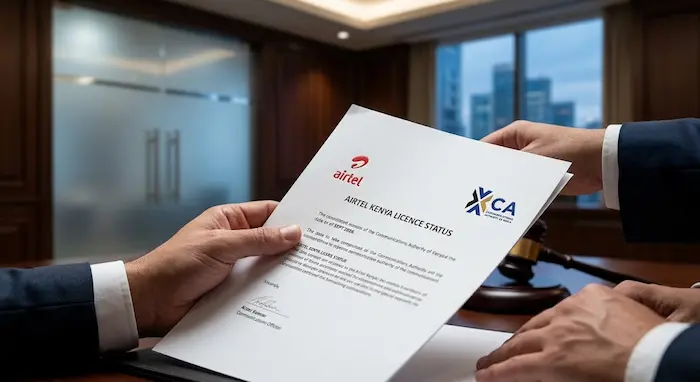

Airtel Kenya’s long-running license story has taken another turn after the Communications Authority of Kenya (CA) published a notice showing that two key regulatory applications from the operator are still awaiting approval.
The development comes weeks after Airtel Kenya said it had secured a 25-year operating licence, raising questions about where the company’s long-term licensing process currently stands.
According to reports on the CA notice, public submissions on Airtel’s applications for a Network Facilities Provider Tier 1 (NFP-T1) license and an International Gateway Systems and Services (IGSS) authorization are open until September 28, 2026. The regulator can consider the submissions before making its decision.
The situation does not mean Airtel Kenya has been shut down or lost its ability to operate.
Instead, it highlights the difference between the company announcing a long-term licensing agreement and the regulator completing the formal approval process for the relevant licences and authorisations.
What Is Happening With Airtel Kenya’s 25-Year Licence?
Airtel Kenya CEO Djibril Tobe said in August that the company had secured a 25-year license after paying an undisclosed fee, describing the development as the conclusion of a long-running licensing process.
However, the CA subsequently published a notice indicating that Airtel’s applications for the NFP-T1 license and IGSS authorisation were still undergoing the regulatory process.
The public participation period gives stakeholders an opportunity to submit comments before the regulator makes its decision.
This creates an unusual situation: Airtel has publicly described the 25-year license as secured, while the CA’s formal process for key permits is still underway.
Neither development necessarily means that Airtel’s mobile customers should expect an immediate disruption.
The more important question is when the remaining regulatory process will be completed and what conditions, if any, will apply.
Why Does the Airtel Licence Matter?
Telecommunications licences are fundamental to how mobile operators build and run networks.
A long-term licence provides greater certainty for investment in infrastructure, spectrum, network expansion and new technologies.
For Airtel Kenya, a 25-year operating horizon could provide a much longer planning window for investments in mobile connectivity and other digital services.
It could also strengthen competition in Kenya’s telecommunications market by giving Airtel greater certainty as it competes with market leader Safaricom and other connectivity providers.
For consumers, competition matters because operators compete on areas such as:
- Mobile data prices
- Voice services
- Network coverage
- Internet speeds
- 4G and 5G availability
- Mobile money
- Customer service
- Digital products
A stronger Airtel could therefore have implications beyond the company’s regulatory status.
What Is the NFP-T1 Licence?
The Network Facilities Provider Tier 1 (NFP-T1) licence relates to the infrastructure side of telecommunications.
It allows an operator to deploy and operate communications infrastructure within the scope of the licence.
The CA’s ongoing work to revise Kenya’s telecommunications market structure also shows that licensing categories are evolving as the industry changes.
In stakeholder consultations on the proposed framework, Airtel itself supported the possibility of NFP-T1 licences having 15- or 25-year terms, saying longer terms could provide flexibility around future investment plans.
That context helps explain why licence duration is commercially important for large infrastructure investors.
What Is the IGSS Authorisation?
The International Gateway Systems and Services (IGSS) authorisation covers another important part of telecommunications infrastructure and international connectivity.
It becomes particularly relevant as satellite connectivity increasingly intersects with traditional mobile networks.
Airtel has been working with SpaceX on satellite-powered connectivity, including testing satellite data and messaging technology in Kenya.
The companies successfully tested the technology in Kenya in March 2026, but testing the technology does not by itself mean a commercial service can immediately launch. Regulatory approvals remain necessary.
This makes the outstanding regulatory process particularly significant for Airtel’s future connectivity plans.
Airtel and Starlink Could Change Rural Connectivity
One of the potentially bigger developments behind the licence story is Airtel’s planned partnership with SpaceX’s Starlink for direct-to-device connectivity.
The concept is different from traditional Starlink broadband.
Instead of requiring a customer to install a satellite dish, compatible mobile phones could potentially connect to satellites when terrestrial network coverage is unavailable.
For Kenya, that could be significant in remote areas where building conventional mobile infrastructure can be expensive or difficult.
A farmer, traveller or worker in an area outside normal mobile coverage could potentially maintain basic connectivity through satellite-enabled mobile services.
However, commercial availability in Kenya depends on the relevant regulatory approvals and rollout plans.
Airtel’s Licence History Has Been Complicated
The latest development is part of a much longer licensing story.
Airtel inherited its Kenyan operations after acquiring YuMobile in 2014. Its original licence subsequently became the subject of a prolonged dispute with the regulator.
An out-of-court settlement in 2022 helped resolve part of the dispute and led to a renewal arrangement.
The CA later granted Airtel a temporary extension while outstanding issues involving licensing, fees, spectrum and other regulatory matters were addressed. The temporary arrangement was reported to run into January 2027.
That history helps explain why the company’s announcement of a 25-year licence was viewed as an important milestone.
The latest CA notice, however, shows that the regulatory process still contains important steps.
What Does This Mean for Airtel Customers?
For the average Airtel customer, the immediate impact is likely to be limited.
The current development is primarily a regulatory and infrastructure issue, rather than an announcement that Airtel mobile services are being switched off.
Airtel continues to operate its mobile network and provide services to customers in Kenya.
The longer-term implications could be more significant.
If the outstanding approvals are completed, Airtel could have greater certainty to invest in network infrastructure and new connectivity technologies.
That could eventually affect network coverage, capacity and the availability of new services.
Could the Licence Affect Competition With Safaricom?
Airtel is Kenya’s major mobile competitor to Safaricom.
A longer licence term could allow Airtel to plan infrastructure investments over a much longer period.
That matters because telecommunications networks require substantial capital expenditure.
Operators need to invest in:
- Base stations
- Fibre networks
- Spectrum
- Data infrastructure
- 4G and 5G equipment
- International connectivity
- Network maintenance
Long-term regulatory certainty can make it easier for companies to plan those investments.
For Kenyan consumers, stronger competition could potentially mean more choices and pressure on operators to improve pricing and service quality.
What Happens After September 28?
The current public participation period is scheduled to run until September 28, 2026.
After the deadline, the CA can consider submissions before determining the applications.
The outcome could clarify the status of Airtel’s NFP-T1 and IGSS applications and provide greater visibility into the operator’s long-term regulatory position.
Until that process is complete, it is safer to describe Airtel’s 25-year licence as undergoing final regulatory processes rather than treating the matter as completely settled.
Why This Matters Beyond Airtel
The issue illustrates a broader challenge facing Kenya’s telecommunications industry.
The country’s connectivity needs are changing rapidly.
Traditional mobile networks are being joined by fibre, 5G, cloud infrastructure, data centres and satellite connectivity.
Regulators therefore have to balance several objectives at once:
Encourage investment while protecting competition and consumers.
For operators, licensing provides the regulatory certainty needed to invest.
For the government, licensing ensures that companies operate within Kenya’s regulatory framework.
For consumers, effective regulation should help maintain competition, service quality and reliable access to communications.
The Airtel case is therefore about more than one company’s licence.
It is also a glimpse into how Kenya is adapting its telecommunications regulatory framework to a rapidly changing digital economy.
What Kenyan Consumers Should Watch Next
For Airtel customers, the most important developments to watch are not simply the licence headlines.
They include whether the company expands network coverage, introduces new 5G services, improves capacity and eventually launches satellite-enabled connectivity.
The regulatory outcome could influence how much certainty Airtel has to pursue those investments.
For consumers in areas with weak terrestrial coverage, the satellite component could be particularly interesting.
For businesses, greater competition could create more choices for connectivity, enterprise internet and digital services.
And for Kenya’s wider technology sector, the outcome could provide another signal about how the country intends to regulate the next generation of telecommunications infrastructure.
Frequently Asked Questions
Has Airtel Kenya received a 25-year licence?
Airtel Kenya said in August 2026 that it had secured a 25-year operating licence. However, a subsequent CA notice showed that applications for key related permits, including an NFP-T1 licence and IGSS authorisation, were still undergoing the formal regulatory process.
When is the deadline for public submissions on Airtel’s applications?
The current public participation period runs until September 28, 2026.
Will Airtel Kenya customers lose service?
There is no indication from the current development that Airtel customers are facing an immediate service shutdown. The issue concerns the operator’s long-term regulatory approvals.
What is an NFP-T1 licence?
NFP-T1 is a telecommunications infrastructure licence category covering the deployment and operation of communications infrastructure within the scope of the licence.
What is Airtel’s IGSS authorisation?
IGSS refers to International Gateway Systems and Services, a regulatory category associated with international telecommunications connectivity and related infrastructure.
Is Airtel Kenya planning satellite connectivity?
Airtel has been working with SpaceX on satellite-powered connectivity and conducted tests in Kenya in March 2026. Commercial rollout still depends on regulatory approval and the companies’ deployment plans.
Why is Airtel’s 25-year licence important?
A longer licence term can give a telecommunications operator greater certainty when planning major infrastructure investments. It could therefore influence Airtel’s future network expansion and technology investments in Kenya.
The Bottom Line
Airtel Kenya’s 25-year licence story is not as straightforward as the August announcement suggested.
Airtel said it had secured the long-term licence, but the CA’s subsequent regulatory notice shows that important applications are still going through the formal approval process.
With public submissions open until September 28, the next major milestone will be the regulator’s consideration of those applications.
For Kenyan consumers, the bigger question is what Airtel does with the regulatory certainty if the approvals are completed: more network investment, stronger competition and potentially new satellite-powered connectivity.
That makes the outcome worth watching—not only for Airtel customers, but for the future of Kenya’s telecommunications market.
