
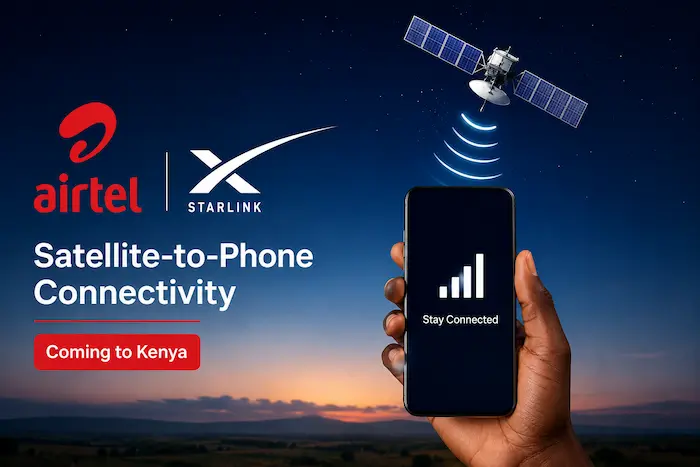

For millions of Kenyans, losing mobile coverage could soon become less of a problem.
Airtel Africa has successfully tested Starlink Mobile satellite-to-phone connectivity in Kenya, opening the possibility of mobile messaging and data services in areas where conventional cellular towers cannot reach.
The technology comes from SpaceX’s Starlink Direct-to-Cell network, which is designed to connect satellites directly to ordinary mobile phones instead of requiring customers to install a Starlink dish.
Airtel Africa announced in March 2026 that it had successfully completed data and messaging tests of Starlink Mobile in Kenya.
But there is an important distinction:
Testing is not the same as commercial launch.
As of August 2026, Kenya is not yet listed by Airtel Africa as a commercial Starlink Mobile launch market. The company has, however, commercially launched the service in the Democratic Republic of Congo, making it the first African commercial launch announced by Airtel Africa.
That makes Kenya one of the markets to watch.
What Is Satellite-to-Phone Connectivity?
Traditional mobile networks depend on physical infrastructure.
Your phone normally connects to:
Phone → Cell tower → Mobile network → Internet
If you travel beyond the coverage area of a cell tower, your phone loses service.
Starlink Direct-to-Cell changes part of that equation.
The concept becomes:
Phone → Starlink satellite → Starlink network → Airtel network
Starlink says its Direct-to-Cell satellites contain an advanced modem that functions much like a cell tower in space. The satellite can connect with compatible LTE phones without requiring users to install a satellite dish.
That is the key difference between ordinary Starlink and Starlink Mobile.
Ordinary Starlink
You need:
- Starlink dish
- Power
- Clear view of the sky
- Wi-Fi-enabled device
Starlink Mobile / Direct-to-Cell
The objective is:
- Compatible mobile phone
- Airtel SIM/network relationship
- View of the sky
- Satellite connection
No Starlink dish is required for the phone itself.
Airtel Has Already Tested It in Kenya
This isn’t simply a theoretical partnership.
Airtel Africa says it successfully tested Starlink Mobile data and messaging services in Kenya in March 2026.
The tests are important because they demonstrate that the satellite-to-phone technology can work with Airtel’s network environment in Kenya.
The company originally announced its broader partnership with SpaceX in December 2025, covering the planned rollout of Starlink Direct-to-Cell connectivity across Airtel Africa’s markets.
The technology has therefore moved through several stages:
Partnership → testing → regulatory process → commercial launch
Kenya has reached the testing stage, but the commercial-launch stage is still the critical next step.
How Does Starlink Connect Directly to a Phone?
The technology is quite different from conventional satellite phones.
A traditional satellite phone typically uses specialised hardware designed specifically to communicate with satellites.
Starlink Mobile is designed around existing cellular technology.
Starlink says its Direct-to-Cell service works with existing LTE phones where there is a clear view of the sky, with no special satellite hardware required.
The Starlink satellite effectively acts like a mobile tower in orbit.
The satellite receives the phone’s signal and connects it through Starlink’s network infrastructure to the mobile operator.
That is why Airtel is important.
Starlink provides the satellite infrastructure, while Airtel provides the mobile-network relationship and spectrum/network integration required to serve its customers.
Do You Need a Starlink Dish?
No.
This is probably the biggest misunderstanding surrounding the technology.
If Airtel eventually launches Starlink Mobile commercially in Kenya, you would not need to buy the Starlink dish currently used for home internet.
The dish-based Starlink service is designed to provide broadband to homes, businesses and other locations.
Starlink Mobile is designed to connect directly to mobile devices.
That means a person hiking in a remote part of Kenya could potentially have connectivity from a compatible phone without carrying a Starlink terminal.
Which Phones Will Work?
This is where Kenyan consumers should be careful.
Starlink says its Mobile service works with existing LTE phones, and its current global Starlink Mobile information says data is available across more than 100 devices.
However, that does not mean every 4G phone in Kenya will automatically work with Airtel Starlink.
Actual compatibility can depend on:
- Phone model
- LTE bands
- Firmware
- Carrier configuration
- SIM/network settings
- Regulatory approval
- Airtel’s supported-device list
Therefore, don’t buy a phone simply because someone claims:
“It has 4G, so it will work with Starlink.”
That’s not enough.
What Kind of Phone Should You Look For?
The safest starting point is a modern 4G LTE smartphone that Airtel confirms as supported once the Kenyan service becomes commercially available.
Starlink’s technology is specifically designed around existing LTE phones rather than requiring a special satellite handset.
That could potentially include smartphones from major manufacturers such as:
- Samsung
- Apple
- OPPO
- Xiaomi
- Motorola
- TECNO
- Infinix
But TechDrivers should not publish a specific model-by-model compatibility list until Airtel Kenya officially releases one.
That distinction will protect the article from becoming outdated or misleading.
Will It Work on Any Airtel SIM?
Not necessarily.
The service is being delivered through an operator partnership.
Starlink says its satellite-to-mobile network integrates with participating mobile operators in a manner similar to a roaming partner.
So the eventual Kenyan service is likely to depend on:
Airtel customer + supported phone + supported network configuration + Starlink coverage + regulatory approval
Airtel will need to communicate the exact activation and eligibility process when commercial service launches.
What Services Will Kenyans Get?
The first major benefit is expected to be messaging and data connectivity.
Airtel’s Kenyan tests specifically involved data and messaging.
Starlink’s current Mobile information says messaging is already operating at scale, while data is available across more than 40 apps and more than 100 devices in supported markets. Native voice calling is described as a future capability, while voice through apps is already possible.
This means Kenyan users should not assume that satellite connectivity will immediately provide the same experience as ordinary 5G.
The service is likely to develop over time.
Stage One: Messaging
The immediate use case is staying connected when conventional cellular service disappears.
That could include:
- Text messages
- Emergency communication
- Basic communication apps
Stage Two: Data
As capacity increases, satellite connectivity can support more applications.
Starlink says its next-generation network is intended to support significantly higher throughput and eventually provide much broader smartphone broadband capabilities.
Stage Three: Voice
Native satellite-to-phone voice is part of the longer-term roadmap.
Starlink currently describes native voice as a future capability.
Why Kenya Needs This Technology
Kenya has achieved broad mobile coverage, but not every part of the country has the same quality of connectivity.
The Communications Authority said in February 2026 that nearly 98% of the population was covered by 4G, while also stressing that more work is required to achieve universal and meaningful connectivity.
The remaining coverage gaps matter.
They can affect:
- Rural communities
- Roads
- National parks
- Farms
- Border areas
- Remote schools
- Tourism operations
- Emergency responders
- Fishing communities
- Mining operations
Satellite-to-phone technology could help address some of these gaps without requiring a conventional tower everywhere.
Kenya’s National Parks Could Be a Major Use Case
Consider someone travelling through a remote part of Kenya.
There may be areas where mobile coverage is weak or nonexistent.
A satellite-connected phone could potentially provide basic communication without requiring a tower to be constructed in that exact location.
This could be particularly useful for:
- Tour guides
- Rangers
- Researchers
- Drivers
- Tourists
- Emergency teams
It could also improve communication during emergencies where terrestrial infrastructure has been damaged.
Starlink itself highlights emergency response and disaster-relief connectivity as important applications of Direct-to-Cell.
What Does It Mean for Rural Kenya?
This may ultimately be the biggest impact.
Building a mobile tower in every remote location is expensive.
Satellite connectivity offers a different model.
Instead of asking:
“Where can we build another tower?”
network operators can potentially ask:
“Where can the satellite fill the coverage gap?”
The Communications Authority has specifically recognised the potential of Low Earth Orbit satellite networks and Direct-to-Device services to complement terrestrial networks and extend connectivity to remote areas.
That doesn’t mean satellites will replace mobile towers.
They are more likely to supplement them.
Will Starlink Replace Airtel Towers?
No.
This is another important misconception.
Starlink Mobile is designed to complement terrestrial mobile networks.
A normal urban Airtel connection will generally make more sense where there is good terrestrial coverage.
Satellite connectivity becomes valuable when the phone moves outside that coverage.
The ideal future is therefore:
Airtel tower → normal connectivity
No tower → Starlink satellite connectivity
The phone could potentially transition between the two.
Starlink says its future Direct-to-Cell network is intended to allow seamless transitions between terrestrial and satellite networks.
What About 5G?
Don’t confuse the current service with full satellite 5G.
Starlink’s next-generation V2 Direct-to-Cell satellites are intended to provide substantially greater capacity and, in many environments, full 5G cellular connectivity.
That is a future capability.
For Kenya’s initial service, the more realistic focus is:
Messaging + basic data connectivity
rather than expecting satellite-based 5G to immediately replace terrestrial 5G.
Kenya’s Regulatory Challenge
This is one of the most important parts of the story.
Satellite-to-phone services use radio spectrum.
And spectrum is regulated.
The Communications Authority of Kenya has been actively working on the regulatory framework surrounding satellite services and Direct-to-Device connectivity.
In its review of stakeholder comments, the Authority addressed Direct-to-Device (D2D) and Direct-to-Cellular (D2C) satellite services and clarified that D2C services would be handled through Kenya’s national spectrum allocation framework.
The Authority has also said that emerging satellite technologies must coexist with terrestrial networks while avoiding harmful interference.
That is why a successful technical test does not automatically mean a commercial launch.
The technology can work.
But the operator still needs the appropriate regulatory framework and approvals.
Why Spectrum Matters
Mobile phones communicate using radio frequencies.
Airtel already operates under spectrum rights in Kenya.
Direct-to-cell services need to work with those frequencies without causing harmful interference to other networks or services.
This creates several regulatory questions:
- Which spectrum is being used?
- Who has the spectrum rights?
- How will satellite and terrestrial signals coexist?
- How will interference be prevented?
- How will cross-border satellite coverage be managed?
- What licences are required?
- How will emergency communications be handled?
The CA has specifically identified spectrum sharing, interference mitigation and cross-border coordination as issues regulators must consider as satellite connectivity develops.
Airtel Is Already a Licensed Kenyan Network Operator
The Communications Authority’s May 2026 register lists Airtel Networks Kenya Limited as an NFP-T1 licensee.
That matters because the Direct-to-Cell model depends on cooperation between the satellite provider and a licensed mobile network.
Kenya’s regulatory framework is therefore not starting from zero.
The remaining question is how the satellite component will be authorised and integrated into the existing mobile ecosystem.
How Much Will Airtel Starlink Cost in Kenya?
There is currently no official Airtel Kenya Starlink Mobile consumer price that should be quoted as a confirmed retail price.
That’s important.
Don’t confuse the price of ordinary Starlink internet with satellite-to-phone service.
For example, Starlink’s current Kenyan residential service starts at KSh 4,000 per month, while its Residential plan starts at KSh 6,500 per month.
Those are dish-based Starlink internet plans.
They are not the price of Airtel’s future Direct-to-Cell service.
Airtel will need to announce:
- Whether the service is free or paid
- Whether it is bundled with Airtel packages
- Data limits
- Messaging charges
- Eligibility
- Activation requirements
before consumers know the real cost.
Could Satellite Connectivity Be Free?
It is possible that some basic satellite services could eventually be bundled into mobile plans or offered for specific emergency uses.
But that is speculation until Airtel announces its Kenyan commercial pricing.
TechDrivers should therefore avoid publishing claims such as:
“Airtel Starlink will cost KSh X.”
unless Airtel officially confirms the figure.
What Happens When You’re Under a Roof?
Satellite connectivity requires a suitable path toward the sky.
Starlink’s Direct-to-Cell technology is designed to work where the phone can see the sky.
That means performance may be affected by:
- Buildings
- Mountains
- Dense vegetation
- Deep valleys
- Other obstructions
So satellite connectivity isn’t a magical signal that works equally well everywhere.
A phone in an open field is a very different situation from a phone deep inside a concrete building.
Will It Work During Bad Weather?
This will be an important real-world test in Kenya.
Satellite communication can be affected by environmental conditions and obstructions.
Users should therefore not expect satellite connectivity to be completely immune to network conditions.
The actual Kenyan experience will depend on satellite visibility, network capacity, weather and location.
That is another reason why real-world testing after commercial launch will be important.
What Happens to Emergency Communication?
This may be one of the strongest arguments for the technology.
Imagine an accident occurring on a remote road outside conventional mobile coverage.
Or a hiker becoming stranded.
Or a natural disaster damaging terrestrial infrastructure.
A satellite-to-phone network could potentially provide a communication link where traditional infrastructure is unavailable.
Starlink specifically identifies first responders, disaster relief and emergency communications among Direct-to-Cell use cases.
For Kenya, that could have applications far beyond consumer convenience.
What It Means for Kenyan Businesses
Businesses operating outside major urban centres could benefit significantly.
Potential users include:
Tourism
Safari operators and guides could maintain communication in remote areas.
Agriculture
Farmers and agricultural companies could improve connectivity across large farms.
Logistics
Transport companies could maintain communication along remote routes.
Mining
Remote mining operations could gain another communication option.
Construction
Companies working on remote infrastructure projects could use satellite connectivity as a backup.
Emergency services
Rescue and disaster-response teams could benefit from communications beyond terrestrial coverage.
Could This Change Kenya’s Mobile Market?
Potentially.
The biggest change may not be that Airtel suddenly gets millions of new customers.
It could be that mobile coverage itself becomes less dependent on physical towers.
That changes the economics of network expansion.
Instead of building infrastructure everywhere, operators could combine:
Fibre + 4G + 5G + satellite
into one network.
That hybrid approach could be particularly valuable in a country with large rural and sparsely populated areas.
Airtel vs Safaricom: A New Satellite Race?
Airtel’s Starlink partnership could eventually put pressure on other Kenyan operators.
If Airtel becomes the first major Kenyan operator to offer commercial satellite-to-phone connectivity, competitors may eventually need similar partnerships or alternative satellite strategies.
That could turn satellite connectivity into another competitive feature.
The market could eventually move from:
“Who has the widest 4G coverage?”
to:
“Who can keep you connected even outside terrestrial coverage?”
That would be a significant shift.
What Kenyan Smartphone Buyers Should Do Now
If you’re buying a phone today specifically because of future satellite connectivity, don’t rush.
You don’t need to buy a special Starlink phone.
Instead:
- Buy a modern 4G/5G phone.
- Check that the model is officially supported by Airtel when the service launches.
- Keep the phone’s software updated.
- Don’t pay extra for a phone based on unofficial Starlink compatibility claims.
- Wait for Airtel Kenya to publish its supported-device list.
The fact that Starlink says Direct-to-Cell works with existing LTE phones is encouraging, but operator-specific compatibility remains the final authority for Kenyan customers.
The Bigger Picture: Kenya Is Moving Toward Hybrid Connectivity
Kenya has already become one of Africa’s important mobile and digital markets.
The next phase may be about combining different technologies rather than choosing one.
A future Kenyan network could look something like:
Fibre → urban and fixed connectivity
4G → broad mobile coverage
5G → high-capacity mobile connectivity
Starlink Direct-to-Cell → remote coverage
Starlink dish → remote broadband
That combination could make connectivity significantly more resilient.
Final Verdict
Airtel and Starlink’s successful Kenyan tests are an important development, but the commercial launch should not be overstated.
Kenya has reached the testing stage, not full consumer availability. Airtel Africa confirms that data and messaging were successfully tested in Kenya in March 2026, while the company has since commercially launched Starlink Mobile in the DRC.
The technology itself is fascinating.
Instead of building a special satellite phone, Starlink’s Direct-to-Cell system aims to make the satellite behave like a mobile tower in space, allowing compatible LTE phones to connect directly where terrestrial coverage is unavailable.
For Kenya, the potential impact is enormous.
Remote communities could gain connectivity.
Tourism and logistics could become more connected.
Emergency communications could become more resilient.
And mobile operators could extend their networks into areas where building conventional towers is difficult or uneconomical.
But three things still matter:
Regulatory approval.
Commercial availability.
Affordable pricing.
Until Airtel Kenya announces those details, consumers should treat Starlink-to-phone connectivity as an upcoming service rather than something they can activate today.
The technology has already passed an important test.
Now Kenya is waiting to see when it can move from satellite testing to everyday smartphone connectivity.
