
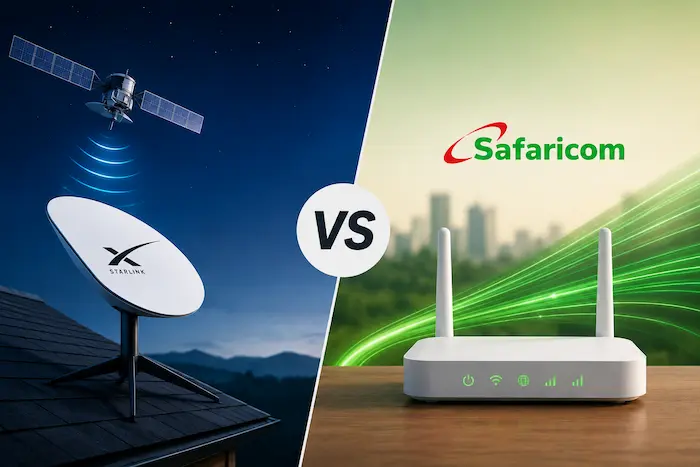

For years, Kenyans looking for reliable home internet had a relatively simple choice: get fibre, use mobile 4G/5G, or choose another traditional internet service provider.
Then Starlink arrived.
SpaceX’s satellite internet service has changed the conversation around internet access in Kenya, particularly for people living outside areas with reliable fibre or mobile network coverage.
But there is one big question many Kenyans are now asking:
Is Starlink actually better than Safaricom Internet?
The answer depends on where you live, how you use the internet and how much you are willing to spend.
In 2026, both services have strong advantages — but they are built for very different situations.
Starlink vs Safaricom: The Quick Answer
If you live in an area with good Safaricom fibre coverage, Safaricom is generally the better value for ordinary home users.
If you live in a remote area where fibre is unavailable or mobile networks are unreliable, Starlink can be the more practical choice.
And if you want satellite internet without depending on terrestrial infrastructure, Starlink has a major advantage.
But there is more to the comparison than price.
Starlink Internet in Kenya
Starlink connects homes to the internet using a network of satellites orbiting Earth.
Unlike fibre, you don’t need a cable running from a local network to your house.
You install a Starlink dish, point it toward the sky and connect your devices through the Starlink router.
This makes the service particularly interesting for Kenyans living in rural and remote locations.
Starlink currently offers a Residential Lite plan starting from KSh 4,000 per month, while its standard Residential service starts from KSh 6,500 per month.
The biggest advantage is coverage.
If you have a clear view of the sky and Starlink service is available in your area, you can potentially get high-speed internet even where traditional broadband infrastructure has not reached.
Safaricom Internet in Kenya
Safaricom has several home internet options, including fibre and 5G.
Its Home Fibre Bronze package currently starts at KSh 2,999 per month for up to 40 Mbps, while higher packages offer significantly more speed.
Safaricom’s 5G Home Internet also starts at KSh 2,999 for up to 15 Mbps, with higher-speed packages reaching up to 250 Mbps.
For customers living in towns, cities and estates with strong Safaricom coverage, this creates a major advantage.
You don’t have to install a satellite dish, and you can choose between fibre and wireless connectivity depending on what is available at your location.
Starlink vs Safaricom: Price
Price is where Safaricom has an important advantage.
A household looking for affordable internet can get Safaricom Home Fibre from around KSh 2,999 per month.
Starlink’s entry-level Residential Lite plan is currently KSh 4,000 per month, while the standard Residential plan starts at KSh 6,500.
That means Starlink isn’t necessarily the cheapest option for a household that already has access to reliable fibre.
However, price shouldn’t be considered in isolation.
Someone living in a remote area may happily pay more for Starlink because the alternative could be having no reliable fixed internet at all.
Winner: Safaricom
For price-conscious urban users with good fibre coverage, Safaricom offers better value.
Starlink vs Safaricom: Speed
This comparison is more complicated.
Safaricom’s fibre network can provide very high speeds, with its higher packages reaching hundreds of Mbps and even up to 1 Gbps.
Safaricom’s 5G Home Internet also offers plans of up to 250 Mbps.
Starlink’s advertised speeds can also be impressive, but actual performance depends on factors such as network congestion, location, weather and the specific Starlink plan.
This means you shouldn’t choose Starlink simply because you see a large maximum-speed number.
For someone with excellent Safaricom fibre, the fibre connection may provide a more consistent experience.
Winner: Safaricom Fibre
For users who have access to a strong fibre connection, Safaricom has the advantage.
Starlink vs Safaricom: Coverage
This is where Starlink becomes extremely interesting.
Fibre requires physical infrastructure.
A provider has to build and maintain a network that reaches your neighbourhood.
Starlink doesn’t need a fibre cable running to your house.
That makes satellite internet particularly useful in rural communities, farms, remote businesses, tourist facilities and locations where traditional broadband infrastructure is limited.
For a Kenyan living far from an urban centre, Starlink could therefore be a much better option.
Winner: Starlink
If traditional broadband isn’t available at your location, Starlink’s satellite technology can be a major advantage.
But There Is a Problem With Starlink
Starlink’s biggest strength is also creating one of its biggest challenges in Kenya.
Demand has been growing.
In July 2026, Starlink stopped accepting new subscriptions in several Kenyan counties, including Nairobi, Kiambu, Mombasa, Machakos, Murang’a, Kirinyaga and Kwale, because of network capacity constraints.
Customers in affected areas were instead placed on a waiting list.
That is an important reminder that satellite internet is not automatically unlimited in terms of network capacity.
As more people connect, Starlink needs to continue adding capacity.
For consumers, this means availability should be checked before making a purchase.
Starlink vs Safaricom for Streaming
If your main activities are YouTube, Netflix, TikTok, social media and general browsing, both services can work well.
However, the experience depends heavily on your location and network conditions.
A strong Safaricom fibre connection is excellent for households with several people streaming simultaneously.
Starlink can also support streaming, but performance can vary depending on satellite network congestion and local conditions.
Winner: Safaricom Fibre
If you have reliable fibre available, it is the safer choice for a busy household.
Starlink vs Safaricom for Gaming
Gamers should pay particular attention to latency, not just download speed.
Fibre generally has an advantage because the connection travels through terrestrial infrastructure rather than relying on a satellite link.
Starlink has improved latency considerably compared with older satellite internet technologies, but it can still experience variations.
For competitive online gaming, a good fibre connection is usually preferable.
Winner: Safaricom Fibre
Starlink vs Safaricom for Rural Kenya
This is where the story changes completely.
Imagine living on a farm several kilometres away from the nearest town.
There may be no fibre connection.
Mobile coverage might be weak.
Building new terrestrial infrastructure could take time or simply not make economic sense.
In such a situation, Starlink becomes much more attractive.
Instead of waiting for a fibre provider to reach your location, satellite internet can potentially provide connectivity directly from space.
Winner: Starlink
For underserved locations, Starlink can solve a problem that traditional broadband cannot easily solve.
Starlink vs Safaricom for Businesses
For businesses, the decision depends on location and the importance of connectivity.
An office in Nairobi with reliable fibre would probably have little reason to replace its primary connection with Starlink.
But a lodge, farm, construction site, remote office or business operating in an underserved area could benefit significantly from satellite internet.
Starlink can also be considered as a backup connection for businesses that cannot afford prolonged downtime.
Which One Is More Reliable?
Neither service is perfect.
Safaricom fibre can be affected by physical infrastructure problems, fibre cuts, power issues and local network congestion.
Starlink doesn’t depend on a physical fibre cable running to your property, but it requires suitable satellite visibility and can experience performance changes caused by congestion or environmental conditions.
The right question isn’t simply:
“Which internet is more reliable?”
It is:
“Which connection is more reliable at my location?”
That is what Kenyan consumers should test before making a decision.
Starlink vs Safaricom: The Cost Beyond the Monthly Bill
There is another factor many buyers overlook: installation and equipment.
With Safaricom, your upfront equipment requirements depend on whether you choose fibre or 5G.
With Starlink, you need Starlink hardware in addition to the monthly subscription.
Starlink has introduced payment options in Kenya that reduce the upfront hardware burden, making satellite internet more accessible than when the service first launched.
However, potential customers should always check the latest equipment, activation, shipping and monthly costs before ordering because Starlink pricing can change.
So, Which Internet Is Better?
There is no universal winner.
Choose Safaricom if:
- You live in an area with good fibre coverage.
- You want a lower monthly starting price.
- You need a stable connection for a large household.
- You play competitive online games.
- You regularly stream on multiple devices.
- You want traditional home broadband.
Choose Starlink if:
- You live in a rural or remote area.
- Fibre isn’t available at your home.
- Mobile network coverage is weak.
- You operate a remote business.
- You need internet at locations away from traditional infrastructure.
- You want satellite internet as a backup connection.
The Bigger Story: Kenya’s Internet Market Is Changing
The most interesting part of the Starlink-versus-Safaricom battle isn’t simply who has the faster internet.
It is the fact that Kenyans now have more ways to get connected.
Fibre companies are expanding.
5G networks are becoming more important.
Satellite internet is growing.
And new satellite technologies are beginning to explore partnerships with traditional mobile operators.
This means the old definition of a telecom network is changing.
The future of Kenyan internet could involve fibre, 4G, 5G and satellites working alongside each other rather than one technology replacing everything else.
Final Verdict
For most Kenyans living in areas with reliable fibre, Safaricom remains the more attractive choice because of its lower entry price and strong terrestrial network.
But for people outside traditional broadband coverage, Starlink is a game changer.
The real winner depends on your location.
If fibre reaches your home and works well, take advantage of it.
If you live somewhere traditional broadband cannot reach, look toward the sky.
Starlink isn’t necessarily here to replace Safaricom. It is changing what Kenyans expect from internet connectivity.
And as competition increases, the biggest winner could ultimately be the Kenyan consumer.
What do you think?
Would you choose Starlink or Safaricom Internet for your home?
Share your experience in the comments.
