
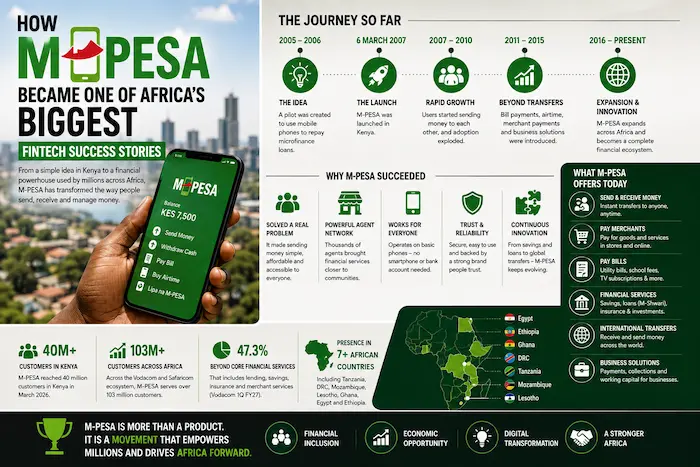

When M-PESA launched in Kenya on 6 March 2007, few could have predicted how dramatically it would transform financial services.
The service initially had a much narrower purpose: a pilot was designed around using mobile phones to repay microfinance loans. But users quickly began using the system to send money to one another. That unexpected behaviour helped reveal a much bigger opportunity.
Today, M-PESA has moved far beyond person-to-person transfers. It has become an ecosystem covering payments, merchant services, international transfers, savings, credit and other financial products.
And in 2026, its expansion is continuing.
From a Kenyan experiment to a fintech giant
M-PESA’s name combines “M” for mobile and “pesa,” the Swahili word for money.
The service was developed through a partnership involving Vodafone and Safaricom and was commercially launched in Kenya in 2007. Safaricom says M-PESA had 19,671 active users just one month after launch, forcing the company to rethink how quickly the service could grow.
The original concept was relatively simple.
Instead of needing a traditional bank account, customers could use their mobile phones and a network of agents to move money.
That was revolutionary in a country where access to formal financial services was much more limited than it is today.
The phone effectively became a financial tool.
The breakthrough was not the technology alone
One of the biggest reasons M-PESA succeeded was that it solved a real everyday problem.
Kenya has a large population of people who needed to send money between cities and rural communities.
A worker in Nairobi could earn money and send part of it home to family.
A small trader could receive payments.
A parent could send money to a student.
A customer could pay a bill without visiting a bank.
The service therefore wasn’t asking consumers to adopt technology simply because it was new.
It gave them a practical reason to use it.
The World Bank describes mobile money as having become foundational to financial inclusion in Sub-Saharan Africa.
The agent network changed everything
Another crucial part of the M-PESA model was the agent network.
Customers didn’t necessarily need a bank branch.
They could visit an M-PESA agent to deposit or withdraw cash.
This created a physical bridge between the traditional cash economy and digital money.
The model effectively combined:
Mobile phone + digital wallet + local agent + telecommunications network
That combination was extremely powerful.
It meant M-PESA could reach communities where traditional banking infrastructure was expensive or difficult to establish.
The IMF has noted that mobile-network operators have advantages in many emerging markets because they already have large customer bases, trusted mobile services and extensive agent networks.
M-PESA helped change financial inclusion in Kenya
M-PESA’s impact goes beyond the number of transactions it processes.
It helped millions of people participate in the formal digital economy.
Kenya has subsequently become one of the world’s most advanced mobile-money markets.
The Communications Authority of Kenya reported that 47.7 million people were actively using mobile-money services in 2025, equivalent to a penetration rate of 91%.
The broader financial-inclusion effect is even more significant.
The IMF says mobile-money accounts have surpassed traditional deposit accounts in multiple economies in the region, providing rural households with ways to save, transfer money and pay bills.
M-PESA was a major part of that transformation.
M-PESA reached 40 million customers in Kenya
The scale of M-PESA today is difficult to compare with its beginnings.
On 6 March 2026, exactly 19 years after its launch, Safaricom announced that M-PESA had reached 40 million customers in Kenya.
That milestone illustrates how deeply the service has become embedded in everyday Kenyan life.
M-PESA is now used for far more than sending money.
Customers can use the ecosystem for:
- Person-to-person transfers
- Merchant payments
- Bill payments
- Airtime purchases
- Savings
- Credit
- Insurance
- Investments
- International transfers
- Business payments
Safaricom describes the platform as having evolved into a broader financial-services ecosystem.
The smartphone wasn’t necessary for M-PESA’s original success
One of M-PESA’s most important innovations was its ability to work without requiring a sophisticated smartphone.
That mattered enormously in the early years.
Customers could use basic mobile phones to conduct transactions.
This dramatically lowered the barrier to adoption.
The lesson for fintech companies was important:
You don’t always need the latest technology to create a successful digital financial product.
You need technology that works for the people you are trying to serve.
M-PESA turned mobile networks into financial infrastructure
Before mobile money became widespread, telecommunications companies were primarily associated with:
📞 Voice calls
📩 SMS
🌐 Internet access
M-PESA changed that model.
The mobile network became a financial infrastructure layer.
A telecommunications company could now participate in:
💰 Payments
🏦 Financial services
🛒 Commerce
🌍 Remittances
💳 Digital transactions
This helped create an entirely new category of business in Africa: mobile-money fintech.
The platform expanded beyond sending money
The next stage of M-PESA’s development was particularly important.
The service began integrating with banks and other financial institutions.
Customers could increasingly use mobile money to access financial products without leaving the mobile ecosystem.
One example was M-Shwari, developed through a partnership with NCBA and M-PESA.
Safaricom says M-PESA has evolved from person-to-person transfers into a platform integrated with banks and payments, allowing users to complete more transactions without withdrawing cash.
This was a critical step.
M-PESA was no longer simply a digital wallet.
It was becoming a financial platform.
Businesses became an important part of the ecosystem
M-PESA’s growth accelerated as businesses began accepting mobile payments.
Today, customers can use M-PESA to pay:
🏪 Shops
🍔 Restaurants
⛽ Fuel stations
🏥 Healthcare providers
🏫 Schools
🛒 Online businesses
📱 Digital services
This created a network effect.
The more merchants accepted M-PESA, the more useful it became to customers.
And the more customers used M-PESA, the stronger the incentive became for businesses to accept it.
That cycle helped turn M-PESA into an everyday payment infrastructure.
M-PESA also became a business tool
The platform isn’t only used by consumers.
Small and medium-sized businesses use mobile payments to collect revenue and manage transactions.
This is particularly important in Africa, where MSMEs account for a significant portion of economic activity.
M-PESA’s evolution has therefore connected:
Consumers → merchants → banks → businesses → digital platforms
That is one reason it is better understood as a fintech ecosystem rather than simply a money-transfer service.
M-PESA expanded beyond Kenya
The success of M-PESA in Kenya eventually led to expansion into other markets.
M-PESA has operated across markets including:
🇹🇿 Tanzania
🇨🇩 Democratic Republic of Congo
🇲🇿 Mozambique
🇱🇸 Lesotho
🇬🇭 Ghana
🇪🇬 Egypt
🇪🇹 Ethiopia
Vodacom and Safaricom created a joint venture to accelerate the M-PESA platform’s international expansion, after acquiring the M-PESA brand and related platform assets from Vodafone.
The expansion demonstrates that the original Kenyan model had potential beyond Kenya.
However, M-PESA does not operate identically in every country. Local regulations, competition, banking systems and consumer behaviour influence how the service develops in each market.
Ethiopia could become M-PESA’s next major growth engine
Among the newer markets, Ethiopia is particularly important.
Safaricom Ethiopia launched M-PESA commercially on 16 August 2023.
The opportunity is enormous because Ethiopia has a huge population and significant room for growth in digital financial services.
And adoption is accelerating.
During FY2026, Safaricom Ethiopia reported that M-PESA customers more than doubled to 5.2 million, representing 119.4% year-on-year growth.
That makes Ethiopia one of the most important markets to watch in M-PESA’s future.
M-PESA is becoming a payments platform
The future of M-PESA is not simply about sending money between two people.
The platform is increasingly focused on digital commerce.
Consider what happens when a customer can:
Receive salary → pay bills → buy goods → save → borrow → invest → send money abroad
all through connected digital financial services.
That is the direction in which M-PESA has been moving.
Safaricom’s own description of the platform highlights its expansion into payments, savings, credit, insurance and international money transfers.
International money transfers are another major opportunity
Africa has large cross-border and international remittance flows.
M-PESA has responded by expanding international transfer capabilities.
M-PESA Global allows registered customers to send and receive money internationally and connect with bank accounts and other financial systems.
This is important because mobile money can make remittances faster and more accessible.
The IMF has also highlighted the increasing importance of digital payments for remittances across the region.
M-PESA is increasingly competing with fintech companies
The irony of M-PESA’s success is that the platform helped create the market it now has to defend.
Africa’s fintech industry has exploded.
Today, consumers can choose from:
- Mobile-money platforms
- Digital banks
- Fintech apps
- Digital lenders
- Payment processors
- Bank apps
- E-commerce payment platforms
M-PESA therefore cannot rely purely on its historical dominance.
It must continue innovating.
That means improving:
User experience + merchant payments + digital credit + savings + investment + international transfers + security
Why M-PESA has been difficult to replace
There are several reasons M-PESA has remained so powerful.
1. Trust
Customers became comfortable storing and moving money through the platform.
2. Network effects
Millions of customers and merchants already use it.
3. Agent infrastructure
Physical agents provide access to cash and services.
4. Strong brand recognition
M-PESA became almost synonymous with mobile money in Kenya.
5. Simple user experience
The original service worked on basic phones.
6. Constant expansion
M-PESA continued adding services rather than remaining a simple transfer product.
7. Integration
Banks, merchants and businesses increasingly connect to the ecosystem.
These advantages create a significant barrier for competitors.
M-PESA also changed the global fintech conversation
Before M-PESA, many financial institutions assumed that expanding financial access required building more traditional banking infrastructure.
M-PESA challenged that assumption.
Instead of:
Bank branch → bank account → customer
the model demonstrated:
Mobile network → mobile wallet → agent → customer
That idea attracted global attention.
Researchers, development institutions and financial companies began studying Kenya’s mobile-money ecosystem as a potential model for financial inclusion.
The IMF has described mobile money as a major force behind financial inclusion in Sub-Saharan Africa.
The M-PESA lesson for African fintech startups
Perhaps the biggest lesson is that successful fintech products don’t necessarily begin by trying to disrupt everything.
M-PESA succeeded by solving one problem extremely well:
How can people move money easily using a mobile phone?
From there, the ecosystem expanded.
This provides a valuable lesson for African startups:
Solve a real local problem first.
Then build around it.
M-PESA’s success wasn’t based solely on technology.
It was based on understanding how people actually live and transact.
Challenges remain
M-PESA’s success doesn’t mean mobile money is without challenges.
The industry faces issues including:
- Fraud
- Cybersecurity
- Privacy
- Consumer protection
- Transaction costs
- Regulation
- Competition
- Taxation
- Financial literacy
The IMF has warned that mobile-money taxation can reduce usage, with low-income and rural users potentially bearing a disproportionate burden.
As mobile money becomes more deeply integrated into economies, regulators therefore face a difficult balancing act.
They need to protect consumers without making digital financial services too expensive to use.
The next chapter: AI, digital finance and Africa
The next phase of M-PESA could be even more interesting.
Artificial intelligence is increasingly entering financial services.
Future mobile-money platforms could use AI for:
🤖 Fraud detection
🤖 Customer support
🤖 Credit assessment
🤖 Personalised financial advice
🤖 Business analytics
🤖 Risk management
The combination of mobile money + AI + digital banking could create entirely new financial products.
For a platform with tens of millions of customers, that represents a huge opportunity.
M-PESA’s biggest achievement may not be its revenue
The most important legacy of M-PESA may be the change in behaviour it created.
Millions of people who once relied heavily on cash now use digital payments every day.
Businesses can accept payments digitally.
Families can send money instantly.
Financial institutions can connect to mobile wallets.
Consumers can access financial products through their phones.
That is a much bigger transformation than simply launching a successful app.
The bigger story
M-PESA is one of Africa’s greatest technology stories because it demonstrates that innovation doesn’t always have to come from Silicon Valley, London or Shenzhen.
A major global fintech model emerged from Kenya.
The service began in 2007 with a relatively simple idea and eventually became a platform used across multiple African markets.
In Kenya alone, M-PESA reached 40 million customers in March 2026.
Across the wider Vodacom/Safaricom ecosystem, M-PESA reached 103 million customers, according to Vodacom’s latest quarterly trading update, with beyond-core financial services such as lending, savings and merchant services accounting for 47.3% of M-PESA revenue in that quarter.
And Ethiopia’s rapidly growing customer base shows that the story is far from over.
M-PESA started by moving money between people. It has evolved into a digital financial infrastructure connecting people, businesses, banks and economies.
