
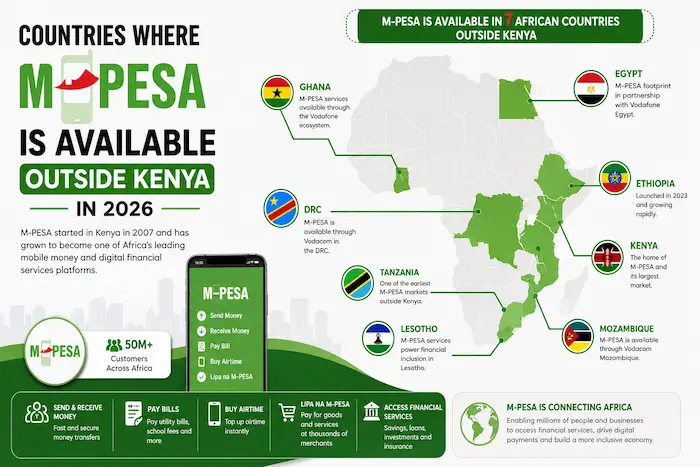

For TechDrivers readers searching for “countries where M-PESA is available,” “M-PESA countries in Africa,” or “M-PESA outside Kenya,” here is the current picture.
Important: M-PESA availability can mean the full local M-PESA service or M-PESA-enabled cross-border transactions. This article focuses on countries where the M-PESA service operates locally.
Which countries have M-PESA outside Kenya?
As of 2026, M-PESA’s African operating footprint includes:
- 🇹🇿 Tanzania
- 🇨🇩 Democratic Republic of Congo (DRC)
- 🇲🇿 Mozambique
- 🇱🇸 Lesotho
- 🇬🇭 Ghana
- 🇪🇬 Egypt
- 🇪🇹 Ethiopia
Kenya is the original and largest market, but the expansion into these countries has turned M-PESA into a major African fintech platform. Safaricom says M-PESA’s business and agent ecosystem spans Kenya, Ethiopia, Tanzania, Mozambique, DRC, Lesotho, Ghana and Egypt.
The IMF also identified M-PESA as being available in seven African countries outside the original Kenyan market in its 2025 analysis, reflecting the established M-PESA Africa footprint at that point.
1. Tanzania 🇹🇿
Tanzania was one of the earliest countries outside Kenya to adopt M-PESA.
The service operates through Vodacom Tanzania, giving customers access to mobile-money services including transfers and payments.
Tanzania is particularly important because of its geographical and economic relationship with Kenya.
M-PESA’s cross-border connection between Kenya and Tanzania was established years ago, allowing customers in the two markets to send and receive money across the border.
Today, Tanzania remains one of the most important M-PESA markets outside Kenya.
2. Democratic Republic of Congo 🇨🇩
M-PESA also operates in the Democratic Republic of Congo, where Vodacom is a major telecommunications operator.
The service provides customers with mobile financial services, helping people transfer money and make payments without necessarily relying on traditional banking infrastructure.
M-PESA’s presence in the DRC is particularly significant because of the country’s large population and the challenges of providing traditional financial services across a geographically huge market.
Vodacom’s current African footprint includes the DRC, while its M-PESA strategy has historically identified the country as one of the core M-PESA markets.
3. Mozambique 🇲🇿
M-PESA is also available in Mozambique, another important Vodacom market.
The service has helped expand access to digital financial services, allowing customers to use their mobile phones for payments and money transfers.
Mozambique is one of the markets that M-PESA Africa identified as part of its core expansion strategy alongside Tanzania, DRC and Lesotho.
4. Lesotho 🇱🇸
M-PESA is available in Lesotho, where mobile money plays an important role in financial inclusion.
One particularly interesting part of the Lesotho market is its connection with migrant workers.
Vodacom has highlighted partnerships such as Hello Paisa, which help migrant workers send money home to their families.
This demonstrates how M-PESA has evolved beyond simple person-to-person transfers into a broader financial-services ecosystem.
5. Ghana 🇬🇭
M-PESA also expanded into Ghana.
The Ghanaian market is somewhat different from Kenya because consumers have several established mobile-money options.
M-PESA therefore operates within a highly competitive mobile-financial-services environment.
Vodacom’s strategy documents identify Ghana as one of the markets where M-PESA’s wider financial-services ecosystem has been developed.
6. Egypt 🇪🇬
Egypt is another market associated with the wider M-PESA footprint.
However, it is important to distinguish the M-PESA Africa operating model from markets where Vodafone/Vodacom offers other mobile-money products.
Safaricom’s historical M-PESA information lists Egypt among the African countries where M-PESA has been available.
Vodacom currently operates in Egypt through Vodafone Egypt, which is one of its major African businesses.
For readers researching M-PESA internationally, Egypt therefore deserves a place on the list, but the exact local product structure should not be assumed to be identical to Kenya’s M-PESA.
7. Ethiopia 🇪🇹 — The newest major M-PESA market
Ethiopia is perhaps the most important recent expansion of M-PESA.
Safaricom Ethiopia launched M-PESA commercially on 16 August 2023, following regulatory approval from the National Bank of Ethiopia.
Customers can use M-PESA to:
- Send money
- Receive money
- Pay merchants
- Buy airtime
- Transfer money to bank accounts
- Receive international remittances
- Withdraw cash through agents
And adoption has been growing rapidly.
By March 2025, Safaricom Ethiopia said M-PESA had 2.4 million 90-day active customers and processed transactions worth ETB15.8 billion.
By 2026, the growth had accelerated further. Safaricom Ethiopia reported that M-PESA customers had more than doubled to 5.2 million during the financial year ending March 2026.
That makes Ethiopia one of the most important markets to watch for M-PESA’s future growth.
Why did M-PESA expand beyond Kenya?
M-PESA’s international expansion is closely connected to a major problem across many African economies:
Millions of people need financial services but do not have easy access to traditional bank branches.
A mobile phone can solve part of that problem.
Instead of requiring:
Bank account → bank branch → paperwork → traditional transaction
mobile money can provide:
Phone → mobile wallet → transfer/payment
This is particularly valuable in areas where bank branches and ATMs are limited.
The IMF describes M-PESA as one of Africa’s most successful mobile-money services and highlights its role in financial inclusion.
M-PESA is becoming more than mobile money
The biggest change in M-PESA’s international strategy is that it is no longer simply about sending money.
The platform is increasingly being developed around:
💸 Money transfers
🛒 Merchant payments
🏦 Banking integration
🌍 International remittances
💰 Savings
📈 Investments
💳 Digital payments
📱 Super-app services
🏪 Business payments
In Kenya, M-PESA has already developed into a major financial-services ecosystem.
Safaricom says the service has expanded into wealth management, savings and credit products, among other financial services.
The same approach is increasingly being adapted to other markets.
Ethiopia could become M-PESA’s next major success story
Kenya’s M-PESA business is mature.
Ethiopia is different.
The country has a huge population, a young demographic and significant room for growth in digital financial services.
Safaricom’s latest information shows that M-PESA in Ethiopia reached 5.2 million customers in FY2026, while Safaricom Ethiopia’s total 90-day active customer base reached 13.6 million.
That gives M-PESA a potentially enormous growth opportunity.
The company’s own strategy has described Ethiopia as a major long-term opportunity for connectivity and fintech.
How M-PESA connects Africa
One of the most interesting developments is the increasing ability to move money across borders.
Kenyan M-PESA customers can use M-PESA Global to send and receive money internationally.
Safaricom lists destinations including Tanzania, Rwanda, Uganda, Botswana, Burundi, Zambia and Malawi for particular M-PESA Global transfer services.
This is different from saying M-PESA operates as a local wallet in every one of those countries.
That’s an important distinction.
Local M-PESA operation
A customer has an M-PESA wallet provided within that country’s mobile-money ecosystem.
M-PESA Global
A Kenyan M-PESA customer can send or receive money through international remittance and payment connections.
Therefore, a country appearing as an M-PESA Global destination does not necessarily mean M-PESA operates there as a local mobile-money service.
Why M-PESA matters to African businesses
M-PESA’s expansion isn’t only important for individual consumers.
It is also changing how businesses receive and send money.
Small businesses can use mobile payments to:
- Receive customer payments
- Pay suppliers
- Manage cash flow
- Pay employees
- Accept digital payments
- Receive international payments
Safaricom and M-PESA Africa have also partnered with Microsoft to provide digital skills and business support to MSMEs across several M-PESA markets, including Kenya, Lesotho, Mozambique, DRC and Tanzania.
This demonstrates the broader economic role that mobile-money platforms can play.
Which country has the biggest M-PESA market?
Kenya remains the flagship M-PESA market.
The service was launched in Kenya in 2007 and has developed into one of the country’s most important financial platforms.
Safaricom reported that M-PESA had more than 32 million active customers in Kenya in FY2024.
But Ethiopia is becoming particularly interesting because of its rapid customer growth.
Tanzania is also strategically important because of its mature M-PESA operation and close economic links with Kenya.
M-PESA’s African footprint at a glance
| Country | M-PESA status | Main operator/connection |
|---|---|---|
| 🇰🇪 Kenya | Core market | Safaricom |
| 🇹🇿 Tanzania | Local M-PESA | Vodacom Tanzania |
| 🇨🇩 DRC | Local M-PESA | Vodacom |
| 🇲🇿 Mozambique | Local M-PESA | Vodacom |
| 🇱🇸 Lesotho | Local M-PESA | Vodacom |
| 🇬🇭 Ghana | M-PESA ecosystem | Vodafone/Vodacom ecosystem |
| 🇪🇬 Egypt | Historical/current M-PESA footprint | Vodafone Egypt/Vodacom |
| 🇪🇹 Ethiopia | Local M-PESA | Safaricom Ethiopia |
The exact products and services available vary by country and regulatory environment. M-PESA is not identical in every market.
What does M-PESA’s expansion mean for Kenya?
M-PESA’s international success is also important for Kenya.
It demonstrates that a technology developed for the Kenyan market can become a major African financial-services platform.
The technology, expertise and operational knowledge behind M-PESA have helped Safaricom and its partners expand into new markets.
The M-PESA Africa joint venture was created by Safaricom and Vodacom specifically to accelerate the platform’s expansion across the continent.
That gives Kenya an interesting position in Africa’s fintech story.
M-PESA was born in Kenya — and its next chapter is increasingly being written across Africa.
Final Thoughts
M-PESA has come a long way from its launch in Kenya in 2007.
The service has expanded into Tanzania, DRC, Mozambique, Lesotho, Ghana, Egypt and Ethiopia, while M-PESA Global connects Kenyan customers to payment and remittance corridors in additional countries.
Among these markets, Ethiopia is one of the most exciting to watch in 2026, with M-PESA customer numbers more than doubling to 5.2 million during FY2026.
The bigger story is that M-PESA is evolving from a mobile-money product into a broader African digital-finance platform.
And for Kenya, that makes M-PESA one of the country’s most successful technology exports.
