

The results underline the strength of KCB’s diversified banking model at a time when Kenya’s financial sector is navigating changing interest rates, credit conditions and growing demand for digital financial services.
KCB’s official investor calendar confirms that the Group announced its unaudited H1 2026 results on 12 August 2026.
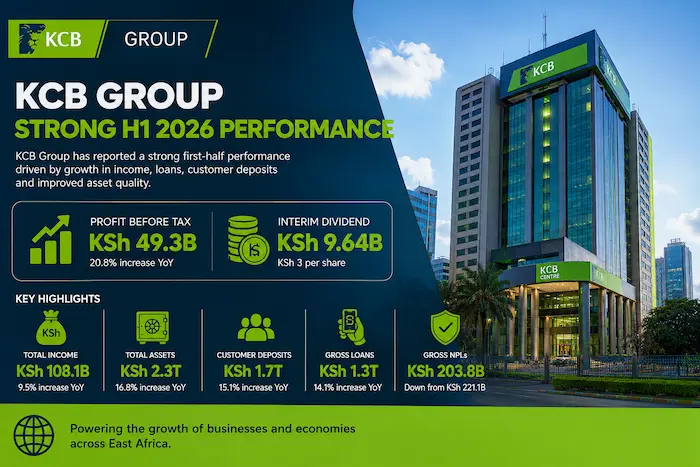
KCB’s profit climbs to KSh49.3 billion
KCB Group’s first-half profit before tax reached KSh49.3 billion, representing strong growth from the previous year’s comparable period.
The performance builds on momentum recorded during the first quarter, when KCB reported KSh24.4 billion in profit before tax, up 15.3% year-on-year.
The first-half numbers show that KCB maintained that momentum through the second quarter.
For investors, the performance is particularly important because the banking group continues to operate across several East African markets rather than relying solely on Kenya.
Shareholders to receive KSh9.64 billion interim dividend
One of the biggest highlights for investors is KCB’s recommended KSh9.64 billion interim dividend.
The proposed payout translates to KSh3 per ordinary share.
The dividend demonstrates KCB’s continued focus on returning value to shareholders while maintaining capital to support future growth.
KCB’s dividend policy allows for distribution of up to 50% of net earnings, balancing shareholder returns with the need to maintain capital buffers for strategic investment and growth.
The latest payout also follows a strong dividend history.
For the 2025 financial year, KCB shareholders approved total dividends of KSh22.5 billion, equivalent to KSh7 per share.
That shows how important shareholder returns have become to the Group’s investment proposition.
KCB’s balance sheet continues to expand
KCB’s performance isn’t only about profit.
The Group has continued expanding its balance sheet as customer activity increases across its markets.
KCB’s first-quarter results showed total assets reaching approximately KSh2.3 trillion, with customer deposits increasing by 15.7%.
The Group’s broader scale is significant.
KCB says it has approximately 33 million customers, 528 branches, 1,313 ATMs and more than 1.2 million Vooma merchants and agents across East Africa.
That gives the Group one of the largest financial-services footprints in the region.
Regional banking is becoming increasingly important
One of KCB’s biggest strategic advantages is its presence outside Kenya.
The Group operates across markets including:
- Kenya
- Uganda
- Tanzania
- Rwanda
- Burundi
- South Sudan
- Democratic Republic of Congo
Its regional subsidiaries have become an increasingly important contributor to Group earnings.
KCB’s 2025 results showed that subsidiaries outside Kenya contributed 29.5% of the Group’s net profit, demonstrating the importance of diversification.
That regional strategy could become even more important as East African economies become increasingly connected through trade, digital payments and investment.
Digital banking remains a major growth opportunity
KCB is also investing heavily in digital transformation.
The bank increasingly uses digital channels to deliver services to customers, reduce transaction costs and expand access to financial products.
This is particularly important as Kenyan consumers move more of their financial activity to smartphones.
Digital banking allows customers to:
Send money → pay bills → borrow → save → invest → manage businesses
without necessarily visiting a physical branch.
For KCB, this creates an opportunity to serve millions of customers at a lower cost while collecting more data about customer behaviour.
The Group has previously identified continued investment in digital innovation as part of its strategy.
KCB is not just a traditional bank anymore
KCB Group’s business has expanded beyond conventional banking.
The Group owns or oversees businesses including:
- KCB Bank Kenya
- Regional banking subsidiaries
- KCB Investment Bank
- KCB Asset Management
- KCB Bancassurance Intermediary
- KCB Foundation
This diversified structure allows KCB to generate income from multiple areas of financial services.
That diversification can help protect the Group when one part of the banking market comes under pressure.
Interest rates remain an important challenge
Despite the strong results, KCB is operating in a changing interest-rate environment.
During the first quarter, the Group said regulatory rate cuts across the region had contributed to lower asset yields and declining net interest margins.
However, growth in interest-bearing assets helped offset some of that pressure.
This will remain an important issue for investors.
Banks traditionally generate a large portion of their income from the difference between what they earn on loans and investments and what they pay on deposits.
When interest rates fall, that margin can come under pressure.
KCB therefore needs continued loan growth, deposit growth and diversification to maintain earnings momentum.
Loan growth will be closely watched
Credit demand is another important factor.
Businesses and households need financing for:
- Working capital
- Expansion
- Homes
- Education
- Agriculture
- Vehicles
- Business equipment
- Personal consumption
KCB has continued growing its loan book, but the quality of those loans is equally important.
Rapid lending growth can increase profitability, but poor-quality loans can eventually result in higher defaults and provisions.
That makes asset quality one of the most important indicators to watch in future KCB results.
KCB is also focusing on non-performing loans
The banking industry has faced pressure from customers struggling with repayments.
KCB has been working to improve recoveries and reduce non-performing loans.
Its 2025 integrated report said the Group was targeting a reduction in its non-performing-loan ratio to between 14% and 16% in 2026.
Improving asset quality would be positive because lower problem loans can reduce the amount banks need to set aside for credit losses.
For investors, this means KCB’s profit growth should be viewed alongside the quality of its loan book.
What the results mean for Kenyan businesses
KCB’s performance is also important for businesses across Kenya.
Banks are a major source of financing for SMEs and large companies.
A stronger KCB balance sheet could support more lending to businesses seeking capital for expansion.
This matters particularly for:
Small businesses
Startups
Manufacturers
Agribusinesses
Property developers
Importers and exporters
Technology companies
The availability and cost of credit can directly influence business growth.
KCB’s fintech opportunity
Kenya’s financial sector is changing rapidly.
Banks are increasingly competing with fintech companies, mobile-money platforms and digital lenders.
KCB therefore needs to continue investing in technology if it wants to remain competitive.
The opportunity is enormous.
Millions of Kenyans already use smartphones for financial transactions.
The next stage could involve greater integration of:
Banking + mobile money + AI + digital lending + wealth management + payments
KCB’s large customer base gives it an advantage, but technology companies are moving quickly.
What does this mean for KCB shareholders?
For shareholders, the H1 performance offers several positive signals:
📈 Strong profit growth
💰 A substantial interim dividend
🏦 Continued balance-sheet expansion
🌍 Strong regional diversification
📱 Growing digital opportunities
At the same time, investors will need to watch interest-rate movements, loan quality, operating costs and economic conditions.
A strong half-year result does not guarantee that the same growth rate will continue throughout the year.
Why KCB matters to Kenya’s economy
KCB is one of Kenya’s largest banks and an important part of the country’s financial infrastructure.
Its lending supports businesses, households and government-related economic activity.
Its digital platforms also contribute to the country’s broader transition toward cashless and technology-driven financial services.
The Group’s performance therefore provides a useful snapshot of the health of Kenya’s banking sector.
What to watch in the second half of 2026
Several areas will determine whether KCB can maintain its momentum.
1. Loan growth
Can the bank continue expanding lending without compromising asset quality?
2. Non-performing loans
Will problem loans continue declining?
3. Interest rates
How will lower interest rates affect margins?
4. Digital banking
Can KCB turn its digital investments into stronger revenue and customer engagement?
5. Regional operations
Can subsidiaries outside Kenya continue contributing significantly to Group earnings?
6. Shareholder returns
Will strong profitability allow KCB to maintain attractive dividends?
The bigger picture
KCB’s H1 2026 performance demonstrates the changing nature of African banking.
The biggest banks are no longer competing solely through branches.
They are competing through:
Technology
Mobile applications
Digital payments
Data
Fintech partnerships
Regional expansion
Customer experience
That transformation creates opportunities for banks that can combine their existing scale with modern technology.
KCB appears to be pursuing exactly that strategy.
Conclusion
KCB Group’s KSh49.3 billion first-half profit before tax is a strong performance that puts the bank firmly among the companies to watch in Kenya’s 2026 business landscape.
The proposed KSh9.64 billion interim dividend also provides a significant return for shareholders.
But the most important story goes beyond the headline profit.
KCB is expanding its balance sheet, investing in digital banking, growing across East Africa and working to improve the quality of its loan book.
The challenge now is to maintain that growth while navigating lower interest rates, credit risks and an increasingly competitive fintech environment.
For Kenya’s banking sector, KCB’s results are another indication that scale, technology and regional diversification are becoming increasingly important to long-term profitability.
