
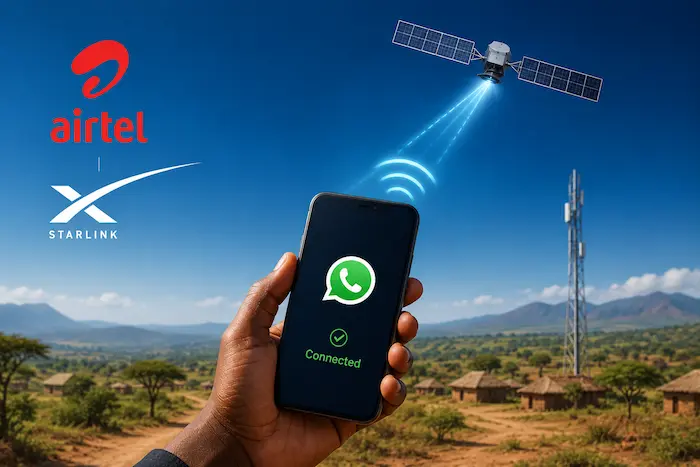

The development has become more significant after Airtel Africa and SpaceX commercially launched Starlink Mobile in the Democratic Republic of the Congo (DRC) on August 14, 2026.
The DRC is the first Airtel Africa market where the service has moved from testing to commercial deployment. The initial service allows compatible smartphones to connect to Starlink satellites outside conventional mobile coverage, with support for SMS and selected light-data applications such as WhatsApp messaging.
For Kenya, however, the situation is different.
Airtel and SpaceX have already demonstrated the technology in areas without terrestrial mobile coverage. The remaining question is whether Airtel Kenya receives the necessary approval from the Communications Authority of Kenya (CA) to launch the service commercially.
What Is Airtel Starlink Mobile?
Airtel Starlink Mobile is based on direct-to-cell satellite technology.
Traditional Starlink broadband requires equipment such as a satellite dish and router. Direct-to-cell technology takes a different approach.
Instead of sending a signal to a dedicated satellite terminal, Starlink satellites communicate directly with compatible mobile phones.
The satellite effectively functions as a mobile cell site in space.
That means a customer could potentially remain connected after leaving the coverage area of a conventional Airtel mobile tower.
The important distinction is that this technology is designed to extend a mobile network, rather than replace traditional mobile infrastructure.
Airtel’s terrestrial network would continue to provide normal mobile connectivity where towers are available. Satellite connectivity would become an additional layer for areas where terrestrial coverage is unavailable.
Airtel Has Already Tested Starlink Mobile in Kenya
Kenya is not waiting for its first demonstration of the technology.
On March 24, 2026, Airtel Africa and SpaceX announced successful testing of Starlink Mobile data and messaging services in Kenya.
The tests were carried out in locations where conventional terrestrial mobile networks had no signal.
Airtel said compatible 4G smartphones were able to connect to Starlink’s satellite constellation in these no-coverage areas.
During the tests, the service supported light-data applications including WhatsApp calling and messaging, maps, Facebook Messenger and transactions through the MyAirtel application.
That is important because it demonstrates that the Kenyan deployment has progressed beyond a theoretical proposal.
The technology has already been tested in the country.
The next challenge is commercial authorization.
Why Does Airtel Need Regulatory Approval?
Satellite-to-mobile connectivity introduces a complicated spectrum-management issue.
Traditional mobile networks use radio spectrum to communicate between phones and terrestrial cell towers.
Direct-to-cell systems also use mobile spectrum to establish communication between satellites and compatible phones.
That means regulators have to ensure that satellite transmissions do not interfere with existing mobile networks.
Kenya’s Communications Authority has been reviewing Airtel’s application and examining the potential impact on existing 3G, 4G and 5G networks.
This is one reason why a successful technology test does not automatically lead to a commercial launch.
The technology can work technically while regulators still need to determine how it should operate within Kenya’s telecommunications framework.
When Will Airtel Starlink Mobile Launch in Kenya?
There is currently no confirmed public commercial launch date for Kenya.
Airtel Kenya was still awaiting regulatory approval in August 2026.
A report published by The Star on August 3 said Airtel Kenya was waiting for approval from the Communications Authority before commercially introducing its Direct-to-Cell service. Airtel also said customers would not pay an additional charge for using the satellite service, although commercial terms could ultimately depend on the approved rollout.
Therefore, Kenyan customers should be careful with claims suggesting that Airtel Starlink Mobile already has a confirmed launch date.
The more accurate picture is:
Kenya testing completed → Regulatory review → Approval → Commercial rollout
Kenya has already passed the testing stage.
The regulatory review remains the critical step.
What Will Airtel Starlink Mobile Actually Do?
The initial service should not be confused with full Starlink broadband.
A compatible smartphone will not suddenly become a normal high-speed Starlink terminal.
The DRC commercial launch currently focuses on SMS and selected low-bandwidth applications, including WhatsApp messaging.
This makes the first generation of the service particularly useful for basic communication.
Potential applications include:
- Sending messages from areas without terrestrial coverage
- Emergency communication
- Using maps in remote areas
- Communicating with field workers
- Supporting logistics operations
- Staying connected while travelling through remote regions
- Maintaining communication during some network outages
The technology is expected to become more capable as Starlink’s satellite-to-mobile platform develops.
Airtel Africa and SpaceX have also discussed future improvements to data and voice capabilities.
What This Could Mean for Rural Kenya
The biggest opportunity may not be in Nairobi or other areas with dense mobile infrastructure.
It could be in places where building and maintaining conventional mobile towers is difficult or expensive.
Kenya has large areas containing:
- Remote rural settlements
- National parks and conservation areas
- Long transport corridors
- Arid and semi-arid regions
- Mining and infrastructure sites
- Agricultural areas
- Remote tourism destinations
In such locations, extending terrestrial mobile coverage can require significant investment in towers, power, backhaul and maintenance.
Satellite-to-mobile introduces another option.
Instead of building a physical tower in every difficult-to-cover location, an operator could use satellites to provide an additional layer of connectivity.
That does not mean satellites will replace mobile towers.
A more realistic model is:
Terrestrial towers + fibre + microwave links + satellite connectivity
Each technology can serve locations where it is most practical.
Why This Could Matter for Northern Kenya
Consider a vehicle travelling through a remote area of northern Kenya.
Once the vehicle leaves Airtel’s terrestrial coverage area, a conventional smartphone may lose its connection.
With satellite-to-mobile technology, a compatible device could potentially connect to a Starlink satellite when conditions allow.
That could enable basic communication without requiring the traveller to carry a dedicated satellite phone or install a satellite dish.
For logistics companies, field researchers, humanitarian organizations, conservation teams and people travelling through remote regions, even basic connectivity can be valuable.
The technology therefore has applications beyond ordinary consumer smartphone use.
Emergency Communication Could Be Another Major Use Case
Satellite-to-mobile connectivity could also improve communication resilience.
Mobile networks can be affected by infrastructure damage, power failures, natural disasters and other disruptions.
A satellite-based connection provides another potential communication path when terrestrial infrastructure becomes unavailable.
This does not mean satellite connectivity will work in every emergency.
Users still need a compatible device, satellite visibility and a functioning satellite service.
However, adding a satellite layer to an existing mobile network could provide another option when conventional coverage is unavailable.
Will Every Airtel Phone Work?
No. Device compatibility will matter.
The DRC launch initially requires compatible LTE Android smartphones, while users also need appropriate network conditions and a clear view of the sky.
This means Kenyan customers should not assume that every Airtel smartphone will automatically support the service once it launches.
Airtel and Starlink are expected to expand device support as the technology develops.
For consumers, the eventual supported-device list will therefore be an important part of the Kenyan rollout.
Airtel Starlink Mobile Is Not the Same as Traditional Starlink
This distinction is important because the two services solve different problems.
| Feature | Traditional Starlink | Starlink Mobile |
|---|---|---|
| Main equipment | Satellite terminal/dish | Compatible smartphone |
| Router required | Usually | No dedicated satellite router |
| Intended use | Broadband internet | Mobile connectivity beyond terrestrial coverage |
| Installation | Requires equipment | Designed to work directly with compatible phones |
| Coverage problem addressed | Fixed-location connectivity | Mobile coverage gaps |
| Initial mobile capability | Full broadband service | SMS and selected light-data services |
The direct-to-cell model therefore isn’t simply “Starlink without the dish.”
It is a different network architecture designed to connect satellites with ordinary mobile devices.
How the Technology Could Change Mobile Coverage
For decades, the basic model of mobile connectivity has been:
Phone → Cell Tower → Mobile Network
Direct-to-cell technology introduces another route:
Phone → Satellite → Mobile Network
That is the important technological shift.
The satellite becomes part of the mobile network rather than simply providing a separate broadband service.
This could eventually allow mobile operators to cover difficult geographic areas without relying exclusively on terrestrial infrastructure.
What Airtel Brings to the Partnership
The Airtel-Starlink arrangement combines two different capabilities.
Airtel provides:
- Existing mobile customers
- Mobile network infrastructure
- Spectrum
- Local market operations
- Billing and customer relationships
- Regulatory engagement
Starlink provides:
- Low-Earth-orbit satellites
- Direct-to-cell technology
- Satellite network capacity
- Space-based connectivity
The objective is therefore not simply for Starlink to compete with Airtel.
Instead, Starlink can potentially extend Airtel’s existing mobile network into areas that terrestrial infrastructure cannot easily reach.
What the DRC Launch Means for Kenya
The commercial launch in the DRC provides an important real-world example for Airtel Africa.
The company can now observe how customers use satellite-to-mobile connectivity outside a laboratory or controlled pilot.
That experience could provide useful information about:
- Device compatibility
- Network performance
- Customer demand
- Satellite capacity
- Network handovers
- Regulatory requirements
- Customer support
- Commercial models
Kenya’s previous testing also gives Airtel experience from a local environment.
That could make the eventual Kenyan rollout easier to plan, although approval from the regulator is still required.
What About Safaricom?
Airtel’s potential satellite-to-mobile launch could also introduce a new competitive dimension to Kenya’s telecommunications market.
Safaricom has a large terrestrial network and a dominant position in Kenya’s mobile market.
But satellite-to-mobile changes the meaning of network coverage.
Instead of asking only:
“How many towers does an operator have?”
customers could increasingly ask:
“Can I stay connected when I leave terrestrial coverage?”
If Airtel becomes the first major operator in Kenya to commercially offer satellite-to-mobile connectivity, the technology could become a differentiator, particularly for customers who frequently travel through remote areas.
It could also encourage other operators to investigate satellite partnerships or alternative direct-to-device technologies.
What Kenyan Consumers Should Watch
If Airtel receives regulatory approval, several details will matter more to consumers than the technology announcement itself.
1. Supported smartphones
Customers will want to know exactly which devices can connect to the service.
2. Pricing
Airtel has previously indicated that customers would not pay an additional charge for the satellite service, but the final commercial terms should be confirmed when the Kenyan service launches.
3. Supported applications
The first generation is focused on basic communication and selected light-data services rather than unrestricted broadband.
4. Coverage
Satellite availability does not mean every location will provide identical performance.
A clear view of the sky and other technical conditions remain important.
5. Network switching
One of the most interesting features will be how smartphones move between normal Airtel coverage and satellite connectivity.
A seamless transition could make the service considerably more useful.
What Airtel Starlink Mobile Does Not Mean
There are several misconceptions worth clearing up.
It does not mean every phone will receive Starlink automatically.
Device compatibility is required.
It does not mean phones will receive unlimited high-speed Starlink broadband.
The initial service is focused on SMS and selected light-data applications.
It does not mean mobile towers will become unnecessary.
Terrestrial networks will remain essential for high-capacity mobile connectivity.
It does not mean Kenya has already launched the service.
The country has completed testing, but commercial deployment still depends on regulatory approval.
The Bigger Opportunity for Kenya
The significance of satellite-to-mobile technology goes beyond Airtel.
Kenya’s digital economy increasingly depends on reliable connectivity.
Mobile networks support mobile money, digital banking, e-commerce, education, communications, logistics and remote work.
Extending connectivity to areas that are difficult to serve with conventional infrastructure could therefore have economic as well as social benefits.
However, satellite connectivity should be viewed as one component of Kenya’s broader connectivity strategy, not a replacement for investment in terrestrial networks.
Fibre, mobile towers, spectrum, data centres and satellite systems can all play different roles.
Bottom Line
Airtel Starlink Mobile is not yet commercially available in Kenya, but the country is further along than many consumers may realize.
Airtel Africa and SpaceX successfully tested the technology in Kenyan no-coverage areas in March 2026. The Communications Authority subsequently began reviewing Airtel’s application, including potential interference with existing terrestrial mobile networks.
Meanwhile, Airtel Africa has moved ahead with the first commercial Starlink Mobile deployment in Africa, launching the service in the DRC on August 14, 2026.
For Kenya, the next major milestone is therefore regulatory approval, not another technology test.
If approved, Airtel could eventually give compatible smartphones the ability to maintain basic connectivity beyond the reach of conventional mobile towers.
That would not replace Kenya’s existing mobile networks.
It would add something new: a network layer in the sky that could help connect people where terrestrial infrastructure cannot easily reach.
And for a country with large remote areas and a highly mobile population, that could make satellite-to-mobile one of the more important developments to watch in Kenya’s telecommunications market.
Frequently Asked Questions
Is Airtel Starlink Mobile available in Kenya?
Not yet. Airtel has successfully tested Starlink Mobile in Kenya, but commercial deployment requires regulatory approval.
When will Airtel Starlink launch in Kenya?
There is currently no confirmed public commercial launch date. Airtel Kenya has been awaiting approval from the Communications Authority.
Do I need a Starlink dish to use Starlink Mobile?
No. The direct-to-cell service is designed to connect compatible smartphones directly to Starlink satellites.
Will Airtel Starlink provide normal high-speed internet?
The initial service is focused on SMS and selected light-data applications. It should not be confused with traditional Starlink broadband.
Will every Airtel smartphone support Starlink Mobile?
No. The service requires compatible devices. Airtel’s supported-device requirements should be checked when the Kenyan service officially launches.
Can Starlink Mobile replace Airtel towers?
No. The technology is intended to supplement terrestrial networks by providing connectivity in areas where conventional coverage is unavailable.
Why does Airtel need approval from the Communications Authority?
The regulator needs to assess technical and spectrum issues, including the potential for satellite transmissions to interfere with existing terrestrial mobile networks.
