
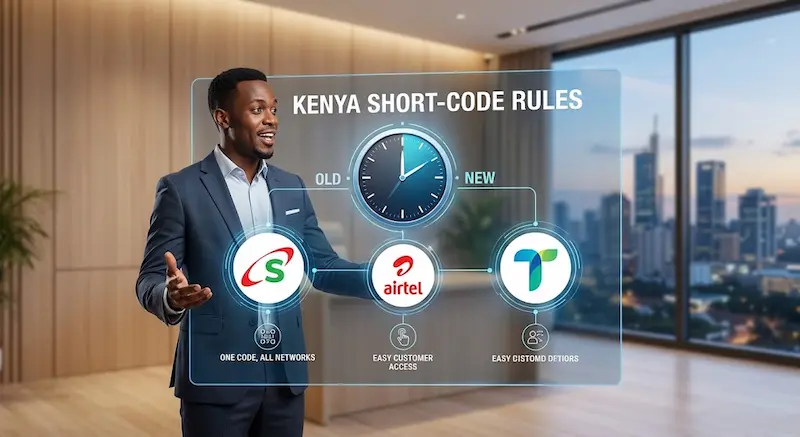

Kenya has changed how telecommunications short codes are allocated, in a move that could make it easier for businesses and service providers to offer the same mobile service across different networks.
Under the new framework issued by the Communications Authority of Kenya (CA), short-code allocation will be based on the service being provided rather than being tied primarily to a specific telecommunications operator.
The change is important in a market where consumers regularly move between Safaricom, Airtel and Telkom lines and where businesses use SMS, USSD and other mobile services to reach customers.
The CA says the enhanced framework for the administration and management of telecommunications numbering, naming, addressing and identification resources applies to new assignments going forward. Existing numbering arrangements are not automatically affected by the change.
What has changed under Kenya’s new short-code framework?
Previously, short-code arrangements could be closely associated with individual telecommunications operators.
The new approach moves towards service-based allocation.
In practical terms, this means a business offering a particular service can potentially use a common short code across multiple mobile networks instead of having to build its customer access around separate operator-specific codes.
The CA has also made Content Service Providers (CSPs) eligible to receive short codes directly from the Authority in bulk for subsequent assignment to end users.
The changes are part of a broader effort to make Kenya’s numbering resources more efficiently managed while supporting competition, innovation and easier access to telecommunications services.
What is a short code?
A short code is a short telephone number used to access a particular service.
Kenyan consumers encounter short codes regularly when checking account information, accessing mobile services, receiving alerts, interacting with businesses or using USSD-based services.
They are different from ordinary mobile numbers because they are designed specifically for service access.
For example, the national numbering plan designates 100 for customer service, 112 for general emergency services, 130 for airtime recharge and 131 for balance inquiry as common services.
USSD codes such as those beginning with * and ending with # are another important part of Kenya’s mobile service ecosystem.
Why the change matters to Safaricom, Airtel and Telkom users
For consumers, the biggest potential benefit is consistency.
A Kenyan using a service today may sometimes need to know which network they are on before choosing the appropriate short code.
A more service-based system could reduce that complexity.
For example, imagine a financial service, transport platform, education service or government-linked platform that wants customers on different networks to access the same service.
Instead of designing the customer experience around separate network arrangements, a common short code could make the service easier to remember and communicate.
That does not mean every existing short code used by Safaricom, Airtel or Telkom will suddenly become identical.
The new framework applies to new assignments, so consumers should continue using the official short codes provided by their service provider until any changes are formally announced.
One code could make life easier for businesses
The change could be particularly significant for Kenyan businesses.
A company serving customers nationally may have customers spread across Safaricom, Airtel and Telkom.
Under a fragmented short-code model, supporting different networks can increase technical and operational complexity.
A common short code can potentially simplify:
- Customer onboarding
- SMS campaigns
- USSD services
- Customer support
- Account enquiries
- Payment-related services
- Surveys and feedback
- Promotions
- Authentication and alerts
This is particularly relevant to banks, fintech companies, SACCOs, retailers, transport companies, schools, healthcare providers and government services that depend on mobile channels.
For smaller businesses, simpler access to mobile service infrastructure could also reduce some of the barriers to building services that work across networks.
The CA is also opening short-code access to Content Service Providers
Another important part of the framework is the treatment of Content Service Providers.
The CA says CSPs can now be eligible for direct short-code allocation from the Authority in bulk, which they can subsequently assign to end users.
This could change how some companies obtain and manage numbering resources.
Instead of every service provider necessarily approaching the system through an individual operator-specific arrangement, eligible CSPs can play a more central role in managing short-code resources for their customers.
That could encourage more competition among companies providing SMS, USSD and other mobile-content services.
What does this mean for Safaricom?
For Safaricom customers, the immediate impact should not be interpreted as a change to existing Safaricom services.
Safaricom remains one of Kenya’s largest mobile operators, and its customers will continue using the company’s established USSD and SMS channels unless a particular service announces a new code.
The bigger change is regulatory: future services may be able to operate through a common short-code structure rather than being designed around one mobile operator.
That could make it easier for businesses to build services that are accessible to customers regardless of their network.
What does this mean for Airtel customers?
Airtel customers could similarly benefit from services that become easier to access across networks.
For businesses, the ability to design one customer-facing access point rather than separate network experiences could make Airtel users easier to include in nationwide services.
This could be particularly useful as competition in Kenya’s telecommunications market continues to develop.
The CA says its telecommunications mandate includes promoting effective competition and protecting consumers with respect to prices, quality and variety of telecommunications services.
What does this mean for Telkom customers?
Telkom users could also benefit from greater interoperability.
One challenge for smaller or less dominant networks is that some digital services are designed primarily around the largest mobile network.
A service-based short-code framework has the potential to make network neutrality easier for businesses that want to serve customers across Kenya.
However, the actual benefit will depend on how widely businesses adopt common short codes and how operators implement the new framework.
The regulatory change creates the opportunity; it does not automatically mean every service will become cross-network overnight.
Will Kenyans have to learn new short codes?
Not necessarily.
Existing users should not assume that all familiar short codes have changed.
The CA’s public notice specifically states that the enhanced framework applies to new assignments and does not affect existing numbering arrangements.
If a bank, fintech company, retailer or other service changes its short code, it should communicate that change to customers through its official channels.
This is particularly important because fraudsters can exploit confusion around mobile service codes.
Kenyans should therefore avoid relying on forwarded WhatsApp messages, social-media posts or unverified websites when looking for a new USSD or SMS code.
Why short codes matter in Kenya
Short codes remain important because Kenya’s digital economy is heavily dependent on mobile connectivity.
Not every customer has a smartphone, a reliable mobile-data connection or a mobile application installed for every service.
USSD and SMS can provide a simpler alternative.
A customer with a basic handset can access a USSD service without opening an app.
This makes mobile short codes particularly relevant to services targeting customers outside major urban centres.
For example, a small business in Kisumu, Eldoret, Nakuru, Mombasa or a rural county may have customers using different networks.
A common service access point can potentially reduce friction for both the business and its customers.
The change could encourage more mobile innovation
Kenya’s mobile ecosystem has historically been an important foundation for digital financial services, commerce and other technology businesses.
The new short-code framework could support the next generation of services by making cross-network access easier.
A startup could, for example, build a USSD-based service intended for customers nationwide without making the customer experience unnecessarily dependent on which mobile network they use.
This could be useful for:
- Fintech startups
- Digital lenders
- Insurance platforms
- Agricultural services
- Transport platforms
- Healthcare services
- Education platforms
- E-commerce businesses
- Government digital services
The biggest opportunity is therefore not simply having a shorter number.
It is reducing the network barrier between a service and its customer.
What businesses should watch
Businesses planning to use short codes in Kenya should pay attention to several issues.
1. Availability of the desired code
A common short code still has to be allocated under the regulatory framework. Businesses cannot simply choose a number and start using it.
The CA remains responsible for managing Kenya’s numbering resources.
2. Network implementation
A common short code only becomes useful to consumers if the participating networks support the service properly.
Businesses should therefore test their services across Safaricom, Airtel, Telkom and any other relevant networks before launch.
3. Consumer protection
Short codes are frequently used for financial services, promotions and other customer interactions.
Businesses must therefore consider transparency, pricing, consent, privacy and protection against abuse.
The CA’s existing numbering guidelines identify consumer protection and fair competition as important objectives of numbering-resource management.
4. Fraud prevention
A new or unfamiliar short code can create opportunities for fraudsters to impersonate legitimate companies.
Businesses should clearly communicate official short codes and provide customers with reliable ways to verify them.
Consumers should also be cautious about entering sensitive information into unfamiliar USSD services.
What the change means for Kenya’s telecom market
The short-code reform may appear technical, but it reflects a broader direction in Kenya’s telecommunications regulation.
The CA’s current telecommunications market structure is based on a Unified Licensing Framework and technology- and service-neutral principles.
The regulator also identifies effective competition and consumer protection among its responsibilities.
Making numbering resources more service-oriented fits into that wider effort.
Rather than treating mobile services primarily according to individual networks, the framework can make it easier for services to operate across an increasingly diverse communications market.
What happens next?
The immediate question is how quickly businesses and service providers will adopt the new model.
The framework applies to new assignments, meaning the impact will become more visible as new services receive short codes under the updated rules.
Consumers should therefore expect a gradual transition rather than an overnight replacement of every familiar USSD or SMS number.
For businesses, however, the change could become strategically important when designing new mobile services.
What Kenyan consumers should know
For ordinary mobile users, there is no need to start changing familiar USSD codes simply because the CA has introduced the new framework.
The practical rules are simple:
- Continue using official service codes.
- Check a company’s official website or customer-care channels when a code changes.
- Do not trust unverified short-code information shared on social media.
- Be careful when entering PINs or other sensitive information through unfamiliar services.
- Expect new services to increasingly support customers across multiple networks.
The most important change is behind the scenes: Kenya is moving towards a more service-based approach to short-code allocation.
Frequently Asked Questions
What are Kenya’s new short-code rules?
The Communications Authority of Kenya has introduced an enhanced numbering framework under which telecommunications short codes will be allocated on a service-based rather than primarily operator-specific basis for new assignments.
Will Safaricom, Airtel and Telkom use the same short codes?
Some new services may be able to use common short codes across networks, but this does not mean all existing Safaricom, Airtel and Telkom short codes will immediately become identical.
The framework applies to new assignments.
Do I need to change the USSD codes I already use?
No. Existing users should continue using the official codes provided by their service providers unless the company announces a change.
Why is the CA changing short-code allocation?
The broader goal is to improve management of Kenya’s numbering resources while supporting equitable access, competition, innovation and consumer protection. The CA has long treated numbering resources as a limited national resource that needs to be managed efficiently.
What is a common short code?
A common short code is a short number designed to work across different telecommunications networks rather than being restricted to one carrier.
What are short codes used for in Kenya?
They are used for services including customer support, account enquiries, SMS services, USSD services, alerts, payments, promotions and other mobile interactions.
Will the new rules affect mobile money services?
They could affect how future mobile-based services are designed, but the framework does not mean existing mobile-money USSD codes will automatically change.
Customers should follow official announcements from their financial service provider.
Can businesses now get short codes directly from the CA?
The new framework makes eligible Content Service Providers able to receive short codes directly from the CA in bulk for subsequent assignment to end users.
Bottom line
Kenya’s new short-code framework could make mobile services more accessible across Safaricom, Airtel and Telkom by shifting new short-code allocation towards the service being offered rather than the network carrying it.
For consumers, the biggest potential benefit is convenience: fewer network-specific barriers when accessing digital services.
For businesses, the change could be even more significant. A common short-code environment could make it easier to build nationwide SMS and USSD services without designing the customer experience around separate mobile networks.
But the impact will depend on implementation and adoption.
For now, Kenyans should keep using their existing official short codes. The bigger change is likely to appear gradually as new services are launched under the updated framework.
