
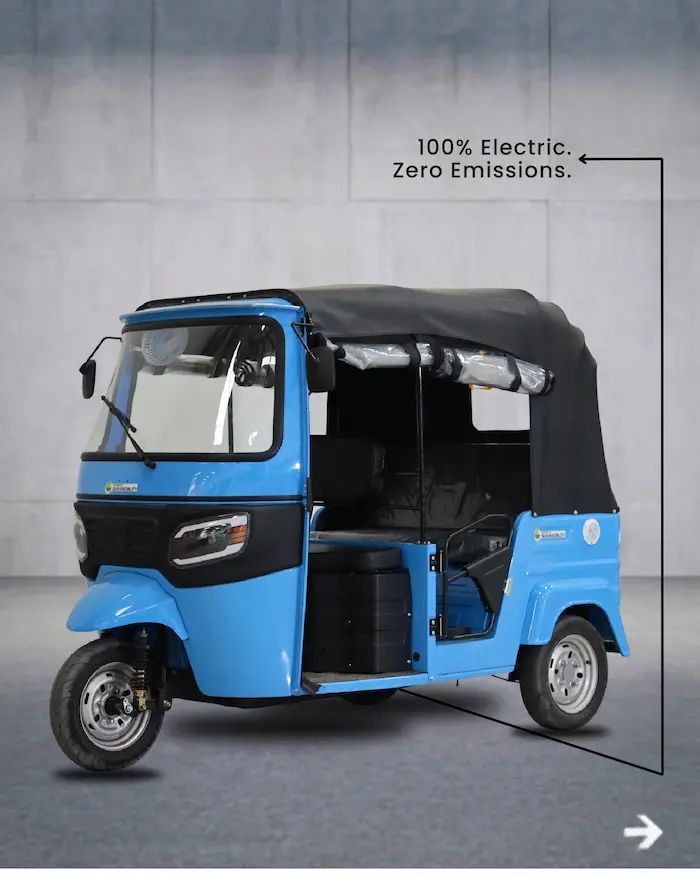

Afrina Electric Tuk-Tuk Set to Enter Kenya Through Battery-Swapping Partnership
Kenya’s electric mobility market is set to gain another commercial vehicle option with the planned introduction of the Afrina 3W, an electric tuk-tuk that will use SUN Mobility’s battery-swapping ecosystem.
According to the launch announcement, the vehicle will begin rolling out in the coming weeks and will be distributed in Kenya through Silent Power Limited. The partnership aims to make electric three-wheelers more accessible to individual riders and fleet operators by allowing drivers to exchange depleted batteries for fully charged ones in minutes.
For Kenya’s tuk-tuk operators, the announcement raises an important business question: could an electric vehicle with battery swapping reduce the cost of daily operations while allowing drivers to spend more time earning money?
The answer will depend on the vehicle’s purchase price, battery-swapping charges, maintenance requirements, driving range and access to compatible swapping stations.
Battery swapping could address one of the practical challenges associated with electric commercial vehicles: the time required to recharge a battery. However, the Afrina announcement does not disclose enough financial information to establish how much operators could save compared with petrol-powered or diesel-powered tuk-tuks.
The planned launch nevertheless adds to the options available in Kenya’s developing electric mobility market, where the availability of shared battery infrastructure could make it easier for different vehicle manufacturers to introduce new models.
What Is the Afrina 3W Electric Tuk-Tuk?
The Afrina 3W is an electric three-wheeler planned for the Kenyan market. Its announced operating model combines the vehicle with SUN Mobility’s battery-swapping network.
Under this arrangement, drivers will be able to exchange depleted batteries for charged replacements at compatible stations instead of waiting for a battery to recharge while the vehicle is parked.
SUN Mobility provides the battery-swapping ecosystem, while Silent Power Limited will distribute the Afrina 3W in Kenya, according to the announcement.
The model is relevant to commercial transport because tuk-tuks support passenger trips, local deliveries and other small-business activities. Drivers depend on keeping their vehicles available for work, making both energy costs and downtime important parts of their daily expenses.
However, the announcement does not provide the Afrina 3W’s Kenyan retail price, real-world driving range, passenger capacity, payload rating, warranty terms or financing arrangements.
Those details will be essential for drivers who want to determine whether the vehicle can meet their operational needs at an affordable cost.
How Battery Swapping Could Change Tuk-Tuk Operations in Kenya
Battery swapping allows a driver to exchange a depleted compatible battery for a charged one at a designated station.
The process is designed to reduce the time a commercial vehicle spends waiting for its battery to recharge. Once the exchange is complete, the driver can return to work, provided the vehicle is ready for use and the battery is suitable for the journey.
For a tuk-tuk operator in Nairobi, Mombasa, Kisumu or another busy town, this could offer a practical advantage when the vehicle operates for long hours.
A driver working on passenger routes may need to complete multiple trips throughout the day. A delivery operator may also have deadlines that make extended charging stops inconvenient.
With battery swapping, the potential benefits include:
- Less time waiting for a battery to recharge.
- More predictable breaks for vehicles operating throughout the day.
- A possible reduction in time lost to energy replenishment.
- Greater flexibility for fleet operators managing several vehicles.
These benefits are not automatic. A driver may still lose time travelling to a swapping station, waiting for service or returning to the usual route. The system will be most useful when compatible stations are conveniently located and have charged batteries available when needed.
Operators should therefore assess the network’s actual coverage before deciding whether the Afrina 3W suits their routes.
Can the Afrina Electric Tuk-Tuk Reduce Daily Operating Costs?
Electric vehicles can offer a different cost structure from petrol or diesel vehicles. For a commercial operator, however, the relevant measure is the total cost of running the vehicle rather than the price of energy alone.
The Afrina 3W’s financial performance will depend on several factors.
1. Energy expenditure per kilometre
A conventional tuk-tuk requires petrol or diesel, depending on its engine. An electric tuk-tuk uses electricity stored in its battery, with the driver paying for energy through the applicable swapping arrangement.
The fairest comparison is the cost of covering the same distance under similar operating conditions.
For example, a driver in Mombasa could record the fuel expenditure of a conventional tuk-tuk over a typical working day. The driver could then compare that amount with the actual battery-swapping fees required to cover the same distance in the Afrina 3W.
The comparison should account for differences in passenger loads, traffic, route conditions and driving patterns.
The announcement does not disclose Afrina-specific swap fees or verified real-world energy consumption. Consequently, it is not yet possible to calculate a reliable daily saving for this vehicle.
2. Maintenance and repairs
An electric tuk-tuk does not require routine servicing of a conventional combustion engine, such as engine oil changes. This may simplify some maintenance tasks.
However, electric vehicles still require attention to tyres, brakes, suspension, steering, electrical components and other parts that wear out during normal use.
Operators must also understand who is responsible for battery faults, damage and replacement under the battery-swapping arrangement.
For a commercial vehicle, the cost and availability of spare parts and qualified technicians can affect profitability. A vehicle that is inexpensive to maintain on paper may still become costly if repairs take a long time or parts are difficult to obtain.
The Afrina 3W’s actual maintenance costs will need to be established through the distributor’s service terms and operating experience in Kenya.
3. Purchase price and financing
The initial cost of an electric vehicle can influence whether a driver can afford to switch.
Even if the vehicle offers lower daily energy expenses, a high purchase price or expensive financing could offset some of those benefits.
Prospective buyers should compare the Afrina 3W’s eventual price with similar petrol-powered or diesel-powered tuk-tuks. They should also ask about deposits, repayment periods, interest, insurance requirements and any additional charges.
For a driver who earns money daily, the repayment schedule needs to leave sufficient income for household expenses and other business costs.
The supplied announcement does not confirm the Afrina 3W’s retail price or financing options. Buyers should obtain this information from the authorised distributor before committing to a purchase.
4. Downtime and lost earning opportunities
For a commercial driver, time spent off the road can affect the number of trips completed during a working day.
Battery swapping could reduce charging-related downtime, particularly where the driver has convenient access to a station.
Consider a driver whose normal route involves frequent passenger trips between residential areas, markets and a town centre. A swapping station close to that route may be more useful than one that requires a long detour.
The financial benefit will depend on whether the time saved is meaningful and whether the driver can use it productively.
Operators should assess station locations, service availability and the time required for a complete swap rather than relying solely on the advertised exchange time.
5. Battery ownership and recurring charges
Battery swapping can separate the vehicle purchase from some aspects of battery provision, depending on the provider’s commercial model.
This arrangement may reduce the amount a buyer needs to pay upfront if the battery is supplied through a separate service rather than purchased with the vehicle. However, it can introduce recurring swap fees, subscriptions or other charges.
The Afrina announcement does not specify whether customers will pay per swap, subscribe to a service or use another payment arrangement.
Before purchasing, operators should request written details of the battery ownership model, all recurring charges, payment requirements and responsibility for battery replacement.
How to Calculate Whether an Electric Tuk-Tuk Is Worth Buying
Kenyan drivers can make a more informed decision by comparing actual expenses from their current vehicles with verified costs for the Afrina 3W.
The following framework can be used once the necessary prices and operating figures become available.
| Cost item | Petrol or diesel tuk-tuk | Afrina electric tuk-tuk |
|---|---|---|
| Purchase price | Actual vehicle price | To be confirmed |
| Energy expenditure | Fuel consumed multiplied by the pump price | Actual battery-swapping charges |
| Maintenance | Servicing, oil, repairs and parts | Servicing, repairs, parts and applicable battery charges |
| Downtime | Refuelling and repair time | Travel to stations, queues and repair time |
| Financing | Actual deposit and repayments | Terms to be confirmed |
| Other expenses | Insurance, licences and applicable fees | Insurance, licences and applicable fees |
The basic daily operating-cost calculation is:
Daily operating cost = energy expenditure + maintenance allowance + other operating expenses.
To compare the vehicles fairly, use the same daily distance and similar workloads.
The potential operating-cost difference is:
Conventional tuk-tuk daily operating cost − electric tuk-tuk daily operating cost.
A positive result indicates that the electric vehicle costs less to operate under the assumptions used. A negative result means it costs more.
Purchase price and financing should also be considered when assessing total ownership costs. Where the vehicles have different purchase prices, buyers should evaluate whether any operating savings are sufficient to justify the difference over the period they expect to use the vehicle.
This approach avoids relying on unsupported claims about how much a driver will save.
Why Battery-Swapping Infrastructure Matters
The availability of battery-swapping stations will be a major factor in determining whether the Afrina 3W is practical for Kenyan operators.
SUN Mobility’s entry into Kenya has already been covered by TechDrivers in its article, 10+ Electric Motorcycle Brands Set to Enter Kenya as Battery-Swapping Network Opens the Market.
That article explains how shared battery infrastructure can allow different manufacturers to introduce electric two-wheelers and three-wheelers without each company having to build a separate swapping network.
For Afrina 3W buyers, the key issue is whether the available stations support their particular vehicle and are conveniently located along their working routes.
A driver operating in Nairobi may have different network requirements from one working in Mombasa or Kisumu. Fleet operators may also need to consider whether stations can support the locations and operating hours of several vehicles.
Before purchasing, operators should ask:
- Which stations will support the Afrina 3W?
- Where are the stations located, and when do they operate?
- What is the charge for each battery swap?
- Are subscriptions, deposits or minimum usage commitments required?
- What happens when a station has no charged batteries available?
- What support is provided if a battery or swapping station develops a fault?
These details will help drivers establish whether battery swapping can fit into their daily operations.
How Kenya’s EV Charging Infrastructure Fits Into the Picture
Battery swapping is one approach to supplying energy to electric vehicles. Plug-in charging is another, and the most suitable option depends on the vehicle, its usage pattern and the available infrastructure.
TechDrivers has previously examined the companies and facilities supporting the country’s charging network in EV Charging Stations in Kenya: Locations, Costs and Companies.
For tuk-tuk operators, the distinction is important. Plug-in charging may be suitable when a vehicle can remain parked for an extended period, while battery swapping may be more convenient for some commercial operations that require shorter stops.
Neither model is automatically cheaper or more convenient in every location. Operators need to consider energy costs, equipment requirements, station access, working hours and vehicle compatibility.
The Afrina announcement specifically identifies SUN Mobility’s battery-swapping ecosystem. It does not provide a complete list of compatible stations for the vehicle or establish how much drivers will spend on energy.
Kenya’s Electricity Tariffs and Electric Tuk-Tuk Costs
Electricity pricing is another consideration when evaluating the economics of electric mobility.
TechDrivers previously covered the removal of the electric vehicle charging tariff cap in Kenya Removes EV Charging Tariff Cap to Support Electric Mobility.
For the Afrina 3W, however, drivers should not assume that the electricity tariff translates directly into their cost per kilometre. Under a battery-swapping arrangement, the provider’s charges and payment model determine what the driver pays for battery exchanges.
The cost of operating the vehicle will therefore depend on the commercial terms offered to customers, alongside the distance covered and the vehicle’s actual energy consumption.
A transparent comparison should use the price charged to the driver, not simply the underlying electricity tariff.
What Afrina 3W Could Mean for Kenya’s Electric Mobility Market
The planned launch adds another potential option for businesses and individuals considering electric three-wheelers.
For passenger transport operators, an electric tuk-tuk could offer an alternative to conventional vehicles, with potential differences in energy costs, maintenance requirements and noise.
For delivery businesses, the combination of an electric vehicle and battery swapping could be relevant where predictable vehicle availability is important.
The wider market impact will depend on affordability, reliability and the quality of supporting services. Manufacturers need more than a vehicle that works: they also need accessible distribution, spare parts, technical support, financing and an energy network that serves customers where they operate.
Kenya’s electric mobility market also includes electric buses, motorcycles and other commercial vehicles. TechDrivers has examined the broader infrastructure supporting this transition in its charging-station coverage linked above.
For Afrina, the important test will be whether the vehicle can deliver dependable service at a total operating cost that works for Kenyan drivers.
A successful rollout could expand consumer choice, but the announcement alone does not establish future sales volumes, market share or the amount operators will save.
What Has Been Confirmed About the Afrina Tuk-Tuk?
Based on the supplied announcement, the following details have been confirmed by the parties making the announcement:
- Vehicle: Afrina 3W, an electric three-wheeler.
- Battery-swapping ecosystem: SUN Mobility.
- Kenyan distributor: Silent Power Limited.
- Rollout timing: Expected to begin in the coming weeks, according to the announcement.
- Intended customers: Riders and fleet operators.
- Battery-swapping proposition: Drivers will be able to exchange depleted batteries for charged ones in minutes.
The following details have not been disclosed in the supplied announcement:
- The vehicle’s retail price in Kenya.
- Financing and leasing arrangements.
- Battery-swapping fees and subscription requirements.
- Real-world driving range and energy consumption.
- Passenger capacity and payload rating.
- Warranty and after-sales service terms.
- The precise Kenyan rollout locations and compatible stations.
- Verified operating-cost savings compared with conventional tuk-tuks.
These unanswered questions are important because they determine whether the Afrina 3W will be financially attractive to its intended customers.
Frequently Asked Questions
1. What is the Afrina electric tuk-tuk?
The Afrina 3W is an electric three-wheeler planned for the Kenyan market. According to the announcement, it will use SUN Mobility’s battery-swapping ecosystem and be distributed locally through Silent Power Limited.
2. When will the Afrina 3W launch in Kenya?
The announcement says the rollout will begin in the coming weeks, but it does not provide an exact launch date or confirm when individual dealers will begin taking orders.
3. How does battery swapping work?
Battery swapping allows a driver to exchange a depleted compatible battery for a charged one at a designated station. The process can reduce the time spent waiting for a battery to recharge, although access to a station and service availability still matter.
4. Will the Afrina electric tuk-tuk be cheaper to operate than a petrol tuk-tuk?
It could offer operating-cost advantages, but the actual difference has not been established. A reliable comparison requires the vehicle’s purchase price, swapping fees, real-world range, maintenance costs and financing terms.
5. How much will the Afrina 3W cost in Kenya?
The supplied announcement does not disclose the Kenyan retail price. Prospective buyers should contact the authorised distributor for pricing and financing details once they are available.
6. Where can drivers swap Afrina 3W batteries?
The announcement identifies SUN Mobility’s battery-swapping ecosystem but does not list the specific Kenyan stations that will support the Afrina 3W. Drivers should confirm station locations, operating hours and vehicle compatibility before purchasing.
7. Who will distribute the Afrina electric tuk-tuk in Kenya?
Silent Power Limited has been identified as the Kenyan distribution partner in the announcement.
8. Is the Afrina 3W suitable for fleet operators?
It could be an option for fleets that have access to compatible swapping stations and can secure suitable operating and financing terms. Fleet managers should assess route coverage, vehicle capacity, maintenance support, reliability and total cost of ownership.
9. Does battery swapping eliminate charging downtime completely?
No. It can reduce the time spent waiting for a battery to recharge, but drivers may still need to travel to a station or wait for service. The actual benefit depends on network coverage, station capacity and battery availability.
Conclusion: Will the Afrina 3W Make Electric Tuk-Tuks More Affordable?
The planned introduction of the Afrina 3W through SUN Mobility’s battery-swapping ecosystem could give Kenyan tuk-tuk operators another option as the electric mobility market develops.
The main potential benefit is convenience. Exchanging a depleted battery for a charged one in minutes could reduce charging-related downtime and help commercial drivers return to work sooner.
However, lower downtime does not automatically mean lower operating costs. The vehicle’s purchase price, battery-swapping charges, driving range, maintenance requirements, financing terms and access to compatible stations will determine its financial value.
For now, the announcement establishes the planned partnership and rollout, not a confirmed level of savings.
Kenyan drivers and fleet operators should wait for the commercial terms and technical specifications before comparing the Afrina 3W with conventional tuk-tuks. Once verified prices and operating data become available, a detailed cost-per-kilometre comparison will provide a clearer picture of whether the vehicle can improve their daily business economics.
