
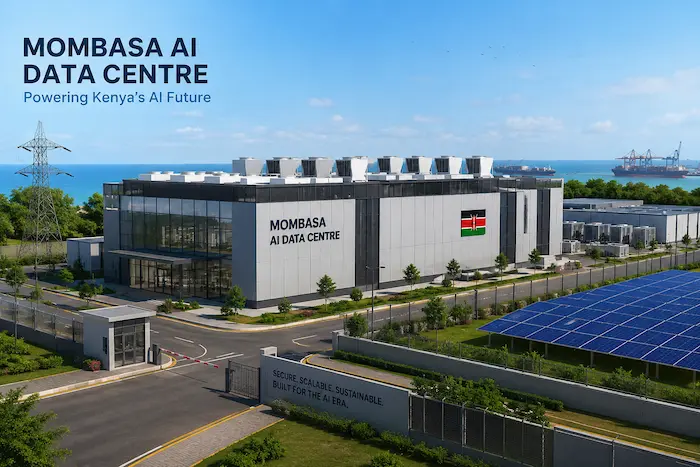

A proposed KSh194 billion artificial intelligence data-centre project in Mombasa associated with AMACO could add a new dimension to Kenya’s rapidly expanding digital infrastructure ambitions.
The proposal comes at a time when Kenya is positioning itself as a regional destination for data centres, cloud computing and artificial intelligence infrastructure.
But there is something particularly important about the Mombasa proposal.
It puts energy at the heart of Kenya’s AI strategy.
AMACO’s own infrastructure plans focus heavily on solving the power challenge facing AI data centres through its HERCULES platform—an offshore smart-power concept designed to provide independent and scalable energy for hyperscale and AI infrastructure rather than relying entirely on national grids.
That could become increasingly important as AI workloads demand enormous amounts of electricity.
Why the Mombasa Proposal Matters
For years, conversations about Kenya’s technology ambitions have focused on internet connectivity, smartphones, mobile money, cloud services and software startups.
The next stage is much more physical.
AI needs computing infrastructure. Computing infrastructure needs data centres. And data centres need huge amounts of reliable electricity.
That is why Kenya’s growing data-centre ambitions are increasingly becoming an energy story.
The government has already acknowledged that Kenya is becoming a destination for global data centres and AI infrastructure, pointing to connectivity, regulation, renewable-energy potential and regional demand as competitive advantages.
The proposed Mombasa project therefore arrives at an important moment.
It could potentially position the Coast not simply as Kenya’s gateway for undersea internet cables, but also as a strategic location for the computing infrastructure powering the next generation of digital services.
From Internet Gateway to AI Gateway
Mombasa already occupies a unique position in Africa’s digital infrastructure.
The city is connected to international submarine cable networks that bring global internet traffic into East Africa.
It also already hosts commercial data-centre infrastructure.
For example, iColo, a Digital Realty company, operates data-centre facilities in Mombasa, including Mombasa One in Miritini and Mombasa Two in Nyali.
That gives Mombasa an important foundation.
The combination of international connectivity, existing data-centre infrastructure, geographic location and access to energy infrastructure could make the Coast increasingly attractive for large-scale digital investments.
An AI-focused facility would take that opportunity to another level.
Instead of simply moving data through Kenya, Mombasa could increasingly become a place where data is stored, processed and turned into AI-powered services.
But There Is a Problem: AI Needs Power
This is where AMACO’s proposal becomes particularly interesting.
AMACO says its HERCULES platform is designed specifically around the energy requirements of AI data centres.
The company describes it as an offshore smart-power system capable of operating independently from national grid infrastructure and directly supplying hyperscale and AI facilities.
AMACO says the system combines power generation, AI-driven operational optimisation, heat and cold recovery and direct integration with data-centre infrastructure.
That approach addresses one of the biggest challenges emerging in the global AI industry.
Building an AI data centre is no longer just about finding land and installing servers. It is about securing enough electricity to keep those servers running continuously.
And Kenya is already seeing how difficult that equation can become.
Kenya Has Already Seen the AI Power Problem
The proposed AMACO project is not happening in isolation.
Kenya has been dealing with questions around how much electricity large AI data centres could consume.
A separate Microsoft and G42 data-centre proposal has faced concerns over its enormous power requirements. Business Daily reported in May 2026 that discussions around a planned Sh129 billion data centre had been affected by disagreements over power and other requirements.
The issue illustrates a critical reality:
Kenya cannot build a major AI economy without simultaneously building the energy infrastructure required to support it.
This is why the AMACO approach deserves attention.
If AI infrastructure can be paired with dedicated power generation rather than placing the entire burden on the national grid, it could offer another model for Kenya’s digital expansion.
Why Mombasa Could Be the Right Location
Mombasa has several advantages that make it strategically interesting for AI infrastructure.
1. International connectivity
Mombasa is one of Kenya’s major international connectivity gateways.
That matters because AI companies need fast and resilient connections between data centres, cloud platforms, businesses and international networks.
2. Existing data-centre ecosystem
The city already has commercial data-centre facilities.
That means the ecosystem is not starting from zero.
3. Proximity to the Indian Ocean
AMACO’s HERCULES concept is specifically based around offshore power infrastructure.
Mombasa’s coastal location therefore creates an interesting geographical fit for such a model.
4. Regional access
Mombasa can serve markets across Kenya and the wider East African region.
A sufficiently large AI data centre could potentially provide computing, cloud and AI infrastructure beyond the Kenyan market.
Kenya Is Building a Larger Data-Centre Ecosystem
The Mombasa proposal is part of a much broader transformation.
In September 2025, Kenya announced the start of construction of an Airtel Africa/Nxtra data centre in Tatu City.
The facility is designed for 44MW and is intended to support cloud and AI workloads, with completion targeted for the first quarter of 2027.
The government has also been actively promoting Kenya as a destination for data-centre and cloud investment.
In 2026, the ICT ministry said Kenya was increasingly becoming a preferred destination for global data centres and AI infrastructure.
Meanwhile, commercial data centres have formally entered Kenya’s telecommunications regulatory framework following revised regulations by the Communications Authority of Kenya.
Taken together, these developments show that Kenya is moving from having isolated data-centre facilities toward building a broader digital infrastructure ecosystem.
The Real Opportunity Could Be Bigger Than the Data Centre
A project of this scale would not only be about servers.
A major AI data centre can create demand across an entire technology supply chain.
That includes:
- Cloud computing
- Fibre connectivity
- Cybersecurity
- Network infrastructure
- Power generation
- Cooling systems
- Construction
- Engineering
- AI software
- Data analytics
- Hardware maintenance
- Physical security
- Digital skills
- Managed IT services
This could create opportunities for Kenyan technology companies and startups.
For businesses, the most important question may therefore be:
How do we position ourselves around Kenya’s AI infrastructure boom before the biggest projects are operational?
Kenyan Startups Could Benefit
A large AI infrastructure ecosystem could also change what Kenyan startups can build.
Today, many African startups depend on international cloud infrastructure.
More local computing capacity could eventually improve access to high-performance computing and cloud services for companies developing:
- AI assistants
- Agricultural AI
- Healthcare technology
- Financial technology
- Logistics platforms
- Fraud detection systems
- Education technology
- Computer vision
- Local-language AI models
This is particularly important for African AI.
The continent needs infrastructure that can support AI systems trained and deployed for African realities rather than relying entirely on infrastructure located outside the continent.
Kenya’s government has already argued that data centres are essential infrastructure for applications ranging from healthcare and agriculture to education, manufacturing and public administration.
Jobs Could Extend Beyond Technology
A common misconception is that data centres only create jobs for software engineers.
In reality, large facilities require a much broader workforce.
That includes:
Electrical engineers
Power-intensive data centres need specialised electrical infrastructure.
Cooling specialists
AI servers generate enormous amounts of heat, making thermal management increasingly important.
Network engineers
Data centres require high-capacity connectivity and resilient networks.
Cybersecurity professionals
The facilities will host highly valuable data and computing resources.
Construction and engineering professionals
Large facilities require extensive physical infrastructure.
Operations teams
Data centres operate around the clock and require specialised maintenance and monitoring.
This means Kenya’s AI infrastructure push could create opportunities across several sectors.
The Energy Question Will Decide Everything
There is, however, an important reality that should not be ignored.
AI data centres consume enormous amounts of electricity.
Kenya therefore has to answer a difficult question:
How can the country attract massive AI infrastructure investment without putting excessive pressure on electricity supply?
This is precisely the problem AMACO says its HERCULES technology is designed to address.
The company says its system is intended to provide dedicated, scalable power for AI data centres and reduce dependence on national grid infrastructure.
Whether this particular model becomes commercially viable in Kenya will depend on financing, regulatory approvals, environmental considerations, technology deployment, power economics and execution.
That distinction is important.
A proposal is not the same thing as a completed investment.
For now, the KSh194 billion Mombasa AI data-centre proposal should be viewed as an ambitious project under development rather than infrastructure that is already operational.
Kenya Could Become More Than an Internet Hub
Kenya has spent years establishing itself as one of Africa’s strongest digital economies.
M-Pesa demonstrated the country’s ability to leapfrog traditional financial infrastructure.
Mobile broadband expanded access to the internet.
Fibre and submarine cables strengthened international connectivity.
The next leap could be computing infrastructure.
That means moving from:
connecting people → storing data → processing data → powering AI.
If Kenya gets this transition right, the country could become an important regional platform for AI services.
What This Means for Businesses in Kenya
For Kenyan businesses, the rise of AI data centres should not be viewed simply as a technology-sector story.
It could affect almost every industry.
Banks could deploy more AI-powered fraud detection.
Hospitals could use AI for diagnostics and administration.
Agriculture companies could use AI for weather, crop and market analysis.
Retailers could use AI for demand forecasting.
Manufacturers could introduce predictive maintenance.
Logistics companies could optimise routes.
Media companies could use AI for content production and personalisation.
Government agencies could process enormous datasets more efficiently.
The infrastructure underneath these applications is therefore becoming just as important as the AI applications themselves.
The Bigger Battle Is Now About Megawatts
The global AI race has revealed something that many people overlooked.
The future of artificial intelligence is not determined only by algorithms.
It is also determined by:
chips + data + networks + cooling + land + electricity.
Kenya already has strong advantages in several of these areas.
Its next challenge is scaling them.
AMACO’s proposed Mombasa project is therefore interesting not simply because of its reported KSh194 billion scale.
It is interesting because it highlights the question Kenya will increasingly have to answer:
Where will the electricity come from to power Africa’s next generation of AI infrastructure?
If projects such as AMACO’s HERCULES concept can successfully combine dedicated power generation with AI data-centre infrastructure, Mombasa could become an important part of that answer.
And if Kenya can solve the power problem while maintaining reliable connectivity, competitive costs and a strong regulatory environment, its AI ambitions could move from policy statements to something much more tangible.
Final Takeaway
Kenya’s AI race is no longer just about building smarter software. It is about building the physical infrastructure that makes smarter software possible.
The proposed AMACO Mombasa AI data-centre project puts that reality into sharp focus.
The next generation of Kenya’s digital economy will require much more than faster internet.
It will require massive computing capacity, resilient networks, advanced cooling and—above all—reliable power.
That is why the most important technology investment in Kenya’s AI future may not be the next AI application.
It may be the infrastructure that keeps the servers running.
Editor’s note: AMACO’s own materials confirm its HERCULES AI data-centre power concept and its focus on East Africa, but the KSh194 billion valuation and specific Mombasa project details should be treated as a proposal until independently confirmed through Kenyan regulatory, government or project-financing documentation.
