

Kenya’s artificial intelligence story is moving beyond technology companies and research laboratories.
AI is increasingly becoming a consumer technology.
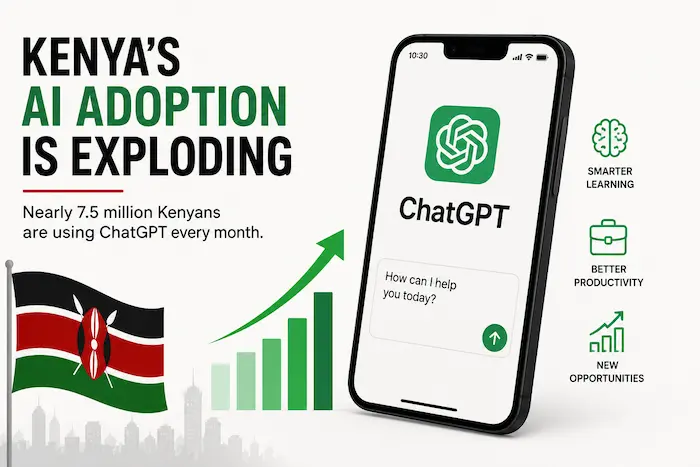
New data from Omdia shows just how quickly that shift is happening: as of January 2026, ChatGPT was used monthly by 22.9% of Kenya’s active smartphone installed base, equivalent to almost 7.5 million monthly users. The figures come from Omdia analysis of Sensor Tower data published in its March 2026 AI Roadmap for Smartphone Vendors in Africa’s Emerging Markets.
That number is significant because it suggests that AI adoption in Kenya is no longer limited to developers, technology professionals or large companies.
Millions of ordinary smartphone users are already experimenting with generative AI.
And that could have much bigger consequences for how Kenyans work, study, communicate, create businesses and access information.
Nearly 7.5 Million Monthly ChatGPT Users
The headline figure comes from Omdia’s analysis of monthly active users of leading AI applications.
According to the report, ChatGPT accounted for 22.9% of Kenya’s active smartphone installed base in January 2026, representing almost 7.5 million monthly users.
Omdia also found that other AI applications were being used at lower levels.
For example, Gemini had reached approximately 3.5% of Kenya’s smartphone installed base by January 2026, with usage particularly increasing among Android users.
This distinction is important.
The 7.5 million figure is not the number of all Kenyans using AI.
It specifically represents Omdia’s estimate of monthly ChatGPT users relative to the active smartphone installed base.
It also should not be interpreted as 7.5 million people paying for ChatGPT.
The data describes usage, not paid subscriptions.
Why This Matters
Kenya has already built a reputation as one of Africa’s strongest technology and mobile-money markets.
The rapid adoption of ChatGPT suggests another technology transition may now be underway.
Instead of simply using smartphones to access websites and applications, Kenyans are increasingly using smartphones to interact with AI systems directly.
That changes how people obtain information.
Instead of searching Google for:
“How do I write a CV?”
a user can ask an AI assistant to create one.
Instead of searching for explanations of a complicated topic, a student can ask an AI system to explain it in simpler language.
A small business owner can ask AI to write a marketing message.
A freelancer can use it to brainstorm ideas.
A developer can use it to troubleshoot code.
A farmer could eventually use AI-powered tools to analyse information about crops, weather or markets.
The technology is therefore moving from being something people read about to something they use.
What Does AI Adoption Actually Mean?
AI adoption doesn’t simply mean that people have downloaded ChatGPT.
It means people are incorporating AI tools into real activities.
For Kenyan consumers, that can include:
- Writing and editing
- Learning
- Research
- Translation
- Coding
- Business planning
- Marketing
- Customer service
- Content creation
- Job applications
- Data analysis
- Brainstorming
- Summarising documents
The quality and sophistication of that use will vary considerably.
Someone asking ChatGPT to rewrite a WhatsApp message is participating in AI adoption.
So is a company integrating an AI model into its customer-service platform.
The difference is the depth of adoption.
AI Is Moving Into Kenyan Businesses
The consumer numbers matter because businesses follow their customers.
If millions of Kenyans are already comfortable interacting with AI, companies have an incentive to build AI into the products and services they offer.
Kenyan businesses could use AI for:
Customer service
AI-powered chatbots can help answer routine customer questions around the clock.
Marketing
Businesses can use AI to generate initial drafts of advertising copy, social-media posts and campaign ideas.
Sales
AI can help analyse customer information and identify potential leads.
Finance
Businesses can use AI-assisted systems for document processing, forecasting and data analysis.
Human resources
AI can assist with drafting job descriptions, analysing applications and preparing training material—subject to appropriate human oversight.
Software development
Developers can use AI coding assistants to accelerate certain programming tasks.
Research
Small businesses without large research teams can use AI to summarise information and explore new markets.
The important point is that AI adoption can potentially reduce the cost of accessing capabilities that were previously available mainly to organisations with specialised staff.
Kenya’s Government Is Already Planning for AI
The consumer adoption trend is occurring alongside a formal government strategy.
Kenya launched its Artificial Intelligence Strategy 2025–2030 in March 2025.
The strategy is built around three major pillars:
- AI digital infrastructure
- Data and AI governance
- AI research, innovation and commercialisation
It also identifies talent development, governance, investment, ethics, equity and inclusion as important enablers.
The government’s implementation roadmap identifies sectors including agriculture, healthcare, education, security, MSMEs, public-service delivery and the creative industry as priority areas for AI applications.
That means the country’s AI conversation is becoming broader than ChatGPT.
The real opportunity is what happens when AI becomes embedded into Kenyan businesses, public services and local products.
The Biggest Opportunity Could Be Small Businesses
Large corporations have the resources to hire consultants, data scientists and software developers.
Small businesses generally don’t.
AI could narrow part of that gap.
Consider a small business owner running an online shop.
They may need:
- Product descriptions
- Customer responses
- Social-media content
- Basic market research
- Spreadsheet analysis
- Advertising ideas
- Email templates
AI can help with many of these tasks.
It doesn’t eliminate the need for business knowledge.
But it can make some capabilities cheaper and faster to access.
For Kenya’s large MSME sector, that could be significant.
But AI Does Not Mean Every Job Will Disappear
One of the biggest misconceptions surrounding AI adoption is that more AI use automatically means mass unemployment.
The reality is more complicated.
AI can automate some tasks while creating demand for others.
A marketing employee may use AI to produce a first draft faster but still need to decide whether the content is accurate and appropriate.
A developer may use AI to generate code but still need to test and secure it.
An accountant may use AI to analyse documents but still need professional judgement.
The more immediate change for many Kenyan workers may therefore be AI-assisted work, rather than complete replacement.
This is why AI skills are becoming increasingly important.
Kenya’s AI Skills Challenge
Adoption creates demand for people who know how to use the technology properly.
That means Kenya needs more than people who know how to type prompts into ChatGPT.
Businesses will need people who understand:
- AI tools
- Data
- Cybersecurity
- Privacy
- Automation
- Software development
- AI governance
- Model limitations
- Responsible AI use
Kenya’s AI Strategy explicitly identifies talent development as an important enabler of the country’s AI ambitions.
The government has also highlighted AI and digital-skills programmes as part of its broader strategy, including a Centre of Competence developed with UNDP and Microsoft.
The Language Problem
There is another important issue for Kenya.
Most global AI systems have historically performed best in widely represented languages and contexts.
Kenya’s linguistic environment is much more diverse.
People communicate in:
- English
- Kiswahili
- Sheng
- Local languages
- Combinations of several languages
For AI to become genuinely useful across Kenya, systems need to understand local contexts, language patterns and cultural references.
That creates an opportunity for Kenyan developers and researchers.
Instead of Kenya only consuming foreign AI products, local companies could build AI systems specifically designed for African problems.
AI and the Cost of Connectivity
Omdia’s research highlights an important limitation in African emerging markets: AI applications depend heavily on connectivity.
This matters in Kenya because AI services are increasingly accessed through smartphones.
If the AI application requires a constant internet connection, users in areas with expensive or unreliable connectivity may have a poorer experience.
Omdia argues that moving some AI capabilities on-device could help improve consistency in markets where connectivity remains a constraint.
This could become an important smartphone trend.
Instead of sending every AI request to a cloud server, some tasks could increasingly be performed directly on the phone.
AI Could Change Smartphone Buying Decisions
The rapid adoption of ChatGPT also changes what consumers may expect from smartphones.
People may increasingly ask:
How good is this phone’s AI?
rather than simply:
How many megapixels does its camera have?
Smartphone manufacturers are already incorporating AI features into devices.
These include:
- AI photo editing
- Translation
- Writing assistance
- Voice transcription
- Summarisation
- Image generation
- Search assistance
- On-device AI
Omdia’s research suggests that AI features are becoming part of the smartphone value proposition in African emerging markets, although factors such as price, specifications and battery life remain important.
For Kenya, this could create a new battleground between Samsung, Google, OPPO, Xiaomi, Huawei, TECNO, Infinix and other manufacturers.
The Risks Are Growing Too
Rapid AI adoption is not entirely positive.
The more people rely on AI, the more important responsible use becomes.
Kenyans need to understand that AI systems can:
- Produce incorrect information
- Generate convincing misinformation
- Misrepresent sources
- Expose sensitive information if users enter it into inappropriate tools
- Produce biased responses
- Create convincing scams
- Generate deepfakes
Businesses face additional risks.
Employees could accidentally enter confidential customer information into an AI service.
A company could publish AI-generated information without checking its accuracy.
An AI-powered system could also introduce cybersecurity vulnerabilities if it is poorly implemented.
AI literacy therefore needs to grow alongside AI adoption.
What Kenyan Businesses Should Do Now
Businesses don’t need to immediately build their own AI model.
They should start by identifying where AI can solve an actual business problem.
Step 1: Identify repetitive tasks
Look for activities that consume significant employee time.
Step 2: Test AI on low-risk work
Use AI for tasks such as brainstorming, drafting and summarisation before moving into sensitive workflows.
Step 3: Establish an AI policy
Employees should know:
- What information they can enter into AI tools
- Which tools are approved
- When human review is required
- How customer data should be protected
Step 4: Train employees
AI adoption works better when employees understand both the capabilities and limitations of the technology.
Step 5: Measure results
Businesses should ask:
Did AI save time?
Did it reduce costs?
Did it improve customer service?
Did it increase revenue?
If the answer is no, the business should reconsider the use case.
What This Means for Ordinary Kenyans
For consumers, AI adoption could make sophisticated digital capabilities more accessible.
A student can have a personal study assistant.
A job seeker can receive help improving a CV.
A freelancer can research a new market.
A small business can produce marketing material.
A developer can get coding assistance.
A content creator can brainstorm ideas.
But users should treat AI as an assistant rather than an unquestionable authority.
Verify important information.
Don’t upload confidential documents without understanding the privacy implications.
And don’t assume that a confident AI answer is necessarily a correct one.
Kenya Is Moving From AI Curiosity to AI Adoption
The nearly 7.5 million monthly ChatGPT users reported by Omdia provide an important signal.
Kenya’s AI story is no longer only about government strategies, technology conferences and startup pitches.
Consumers are already using AI at significant scale.
The next stage will be much more important.
Will Kenyan businesses turn that interest into productivity?
Will local developers build AI products designed around African needs?
Will schools teach students how to use AI responsibly?
Will government services use AI effectively?
And can Kenya ensure that AI benefits don’t remain concentrated among people with the best internet access, devices and technical skills?
Those questions will determine whether Kenya’s AI adoption becomes a genuine economic advantage.
Final Verdict
The 7.5 million figure is impressive, but the number itself isn’t the most important part of the story.
What matters is what millions of users are doing with AI.
If Kenyans are increasingly using AI to learn, work, build businesses and solve everyday problems, then AI is becoming part of the country’s digital infrastructure.
Kenya’s official AI Strategy already aims to position the country as a regional leader in AI research, innovation and commercialisation.
The consumer data suggests that Kenyans may already be moving in that direction from the bottom up.
The challenge now is to turn AI usage into AI productivity.
And that could be the next major chapter in Kenya’s digital economy.
