
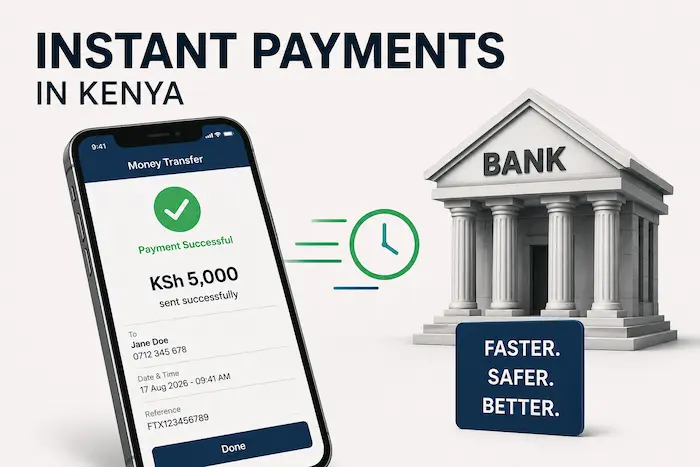

Kenya’s banking sector is moving deeper into the era of instant payments, as banks, payment providers and regulators work to make sending and receiving money faster, more convenient and increasingly interoperable.
For customers, the change is already visible. Services such as PesaLink allow money to move between participating financial institutions in real time, while the Central Bank of Kenya (CBK) is working on a broader Fast Payment System (FPS) designed to connect different parts of the financial ecosystem.
The goal is simple: make it possible for Kenyans to send and receive money instantly, regardless of which financial institution or payment platform they use.
Kenya Already Has Instant Bank Transfers
Instant payments are not completely new to Kenya.
PesaLink, operated by Integrated Payment Services Limited (IPSL), a subsidiary of the Kenya Bankers Association, has provided real-time account-to-account transfers since 2016.
Today, PesaLink says its network has more than 80 participating institutions, including banks, telecommunications companies, fintechs, microfinance institutions and SACCOs. It allows users to transfer up to KSh999,999, although individual banks can impose their own transaction limits.
The service is accessible through participating banks’ mobile applications, internet banking platforms and USSD services.
This means customers can already send money between participating banks without waiting for traditional bank-transfer processing periods.
The Bigger Change Is Kenya’s Fast Payment System
The more significant development is the planned national Fast Payment System.
The CBK has been working with the Kenya Bankers Association, banks and payment service providers on a financial-sector-wide interoperability solution.
According to the CBK, the proposed system is intended to allow customers to send and receive money instantly “anytime, anywhere,” regardless of the type of financial institution they use.
That could eventually make it easier to move money between bank accounts, mobile money services and other regulated financial platforms without customers having to worry about which payment network the recipient uses.
Kenya’s National Financial Inclusion Strategy 2025–2028 also lists the rollout of the Fast Payment System as an initiative involving the CBK, telecommunications companies and other stakeholders. The strategy identifies greater interoperability and more affordable digital financial services as important objectives.
Why Banks Are Moving Toward Instant Payments
Customer expectations are changing.
People increasingly expect financial transactions to work the same way as messaging apps: immediately and around the clock.
Waiting hours or days for a transfer to arrive can be inconvenient for consumers and expensive for businesses.
For banks, faster payment infrastructure can also improve competition and create opportunities for new digital financial products.
PesaLink, for example, already supports payments for individuals and businesses, including rent, school fees, supplier payments, salary disbursements and other transactions.
What Instant Payments Could Mean for Kenyan Customers
1. Faster bank-to-bank transfers
Customers can already use PesaLink through participating banks to transfer money instantly.
This can be particularly useful when someone needs to send money to another bank account outside normal banking hours.
PesaLink says its service operates 24 hours a day, including weekends and public holidays.
2. More convenient payments
A broader interoperable payment system could reduce the need for customers to maintain multiple accounts simply because a particular person or business uses another financial institution.
The long-term objective is to make the payment ecosystem more connected.
3. Potentially lower costs
Greater interoperability could increase competition between payment providers and potentially reduce transaction costs.
However, customers should not assume that every instant transfer is free.
PesaLink states that transaction fees vary by bank, meaning users should check their bank’s current tariff before transferring money.
4. Better services for businesses
Instant payments could be particularly valuable to Kenyan SMEs.
Businesses can use real-time payments for supplier payments, salary disbursements, customer refunds and other transactions.
PesaLink also supports bulk payments, allowing businesses and institutions to make multiple account-to-account payments.
What About M-Pesa?
This is one of the most important questions for Kenyan consumers.
M-Pesa remains central to Kenya’s digital payments ecosystem, while PesaLink has traditionally focused heavily on account-to-account payments.
In January 2025, Safaricom and the Kenya Bankers Association proposed integrating M-Pesa with PesaLink, with the broader objective of improving interoperability between mobile money and bank accounts.
However, customers should distinguish between a proposal and a fully implemented nationwide system.
The larger Fast Payment System being pursued by the CBK is intended to address interoperability across the financial sector.
What Customers Should Do Now
If you have a Kenyan bank account, you may already have access to instant transfers.
Check your bank’s mobile app, internet banking platform or USSD menu for a PesaLink option.
Before sending money:
- Confirm the recipient’s name and account or phone details.
- Check the transaction fee.
- Check your bank’s daily or per-transaction limit.
- Keep the confirmation SMS or notification.
- Never share your PIN, password or one-time authentication code.
- Contact your bank immediately if a transaction does not go as expected.
PesaLink currently allows transfers of up to KSh999,999 per transaction on its network, but your individual bank may apply a lower limit for security or other reasons.
Instant Payments Could Reshape Kenya’s Digital Economy
Kenya’s next phase of digital payments is likely to be less about individual payment platforms and more about interoperability.
PesaLink has already demonstrated that instant bank-to-bank payments can work at scale. The CBK’s planned Fast Payment System could take the concept further by connecting different parts of Kenya’s financial ecosystem.
For consumers, that could mean faster transfers and greater convenience.
For businesses, it could mean quicker settlements and improved cash flow.
For banks and fintechs, it could create a more competitive environment for developing new digital financial services.
The biggest question is therefore no longer whether Kenyans want instant payments. The technology is already here.
The bigger question is how quickly Kenya can build a truly interoperable payment ecosystem where customers can move money instantly between different financial institutions and payment platforms.
That is the transformation the country’s banking and payments industry is now working toward.
Sources: Central Bank of Kenya; PesaLink/Integrated Payment Services Limited; Kenya Bankers Association.
