

Walk into a university campus, matatu, office or shopping centre in Kenya and there is a good chance you will find someone carrying a phone with two SIM cards.
For many users, the arrangement is familiar:
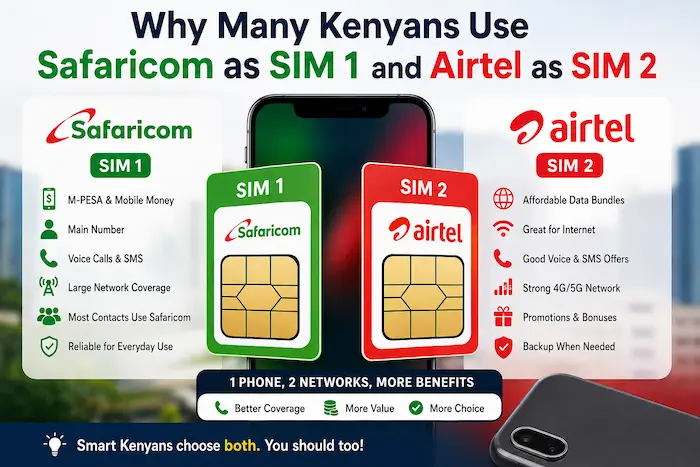
SIM 1: Safaricom
SIM 2: Airtel
It may look like a simple preference, but there is a bigger economic and technological story behind it.
Kenya had 84.1 million active mobile subscriptions by the end of March 2026, equivalent to mobile penetration of 157.7%. The Communications Authority of Kenya says active subscriptions increased 7.4% during the quarter. Importantly, the figure represents subscriptions, not individual people, meaning one person can have multiple active SIMs.
So why do Kenyans maintain both networks instead of choosing one?
The answer comes down to coverage, M-Pesa, data prices, calling costs, network reliability and the ability to switch between competing offers.
Safaricom Is Usually the “Main” SIM
Safaricom remains overwhelmingly dominant in Kenya’s mobile market.
The Communications Authority’s latest published operator figures show Safaricom with 52.38 million mobile subscriptions, compared with 22.93 million for Airtel as of December 2025.
Earlier CA market-share data put Safaricom at 65.1% of mobile SIM subscriptions, compared with Airtel’s 30.9%. Safaricom also held 62.8% of mobile broadband subscriptions.
That dominance matters because a Safaricom number is not simply a telephone number.
For millions of Kenyans, it is also connected to:
- M-Pesa
- Banking
- Fuliza
- Business payments
- Lipa na M-Pesa
- Government services
- Online accounts
- Family and work contacts
Safaricom’s dominance is even stronger in mobile money. CA data gives M-Pesa approximately 90.9% of mobile-money subscriptions, compared with 9.1% for Airtel Money in the referenced period.
That makes the Safaricom SIM difficult to abandon completely.
Then Why Add Airtel?
This is where the second-SIM strategy becomes interesting.
Airtel doesn’t need to convince a Kenyan to completely abandon Safaricom.
It only needs to convince the customer that keeping an Airtel SIM is useful.
And for many consumers, it is.
The main attraction has historically been price.
A Communications Authority data study found that Safaricom generally had higher data-bundle prices than Airtel across the bundles examined, although the Authority cautioned that network speed and coverage differences make direct price comparisons imperfect.
That creates a simple consumer strategy:
Keep Safaricom for the things you cannot easily replace, and use Airtel where it gives you better value.
The Dual-SIM Strategy Is Really About Specialisation
Think of the two SIM cards as having different jobs.
Safaricom SIM
Primary communication and financial identity
Used for:
- M-Pesa
- Important calls
- Banking
- Work contacts
- Family
- Business
- Areas where Safaricom coverage is stronger
Airtel SIM
Cost-saving and alternative connectivity
Used for:
- Mobile data
- Cheap calls
- Promotional bundles
- Secondary contacts
- Internet-heavy activities
- Backup connectivity
This doesn’t mean every Kenyan uses the networks this way.
But it helps explain why having two competing networks can be more attractive than choosing one.
Kenya’s SIM Penetration Shows Why This Happens
The country’s 157.7% mobile penetration is one of the clearest pieces of evidence that multiple-SIM ownership is widespread.
There are substantially more active mobile subscriptions than people.
That doesn’t mean every Kenyan has 1.57 phones.
Someone could have:
- One phone with two SIMs
- Two phones
- A personal and work number
- A smartphone and feature phone
- Several lines used for different purposes
The CA itself cautions that subscription numbers should not be interpreted as individual mobile-phone ownership.
So while we can establish that Kenya has a very high level of multiple-line usage, there isn’t currently a CA statistic saying “X% of Kenyans use Safaricom SIM 1 and Airtel SIM 2.”
That’s an important distinction.
The specific SIM 1/SIM 2 behaviour is an interesting consumer pattern, but it should not be presented as an official nationwide survey finding without polling evidence.
The “SIM 1” Advantage Is More Psychological Than Technical
There is also an interesting social element.
People often refer to their main number as their “Safaricom line.”
They may have used the same number for years.
Changing it would mean updating:
- Banks
- Friends
- Family
- Employers
- Customers
- Online accounts
- Delivery services
- Government services
So even when another operator offers a cheaper deal, switching completely can be inconvenient.
A second SIM eliminates that problem.
You don’t have to choose.
You can simply add another network.
Airtel Doesn’t Have to Beat Safaricom Everywhere
This is one of the most important points in understanding Kenya’s telecom competition.
Airtel doesn’t necessarily need to become the primary SIM for every customer.
It can capture specific use cases.
For example:
Safaricom: “I need reliable access to M-Pesa.”
Airtel: “I need affordable data.”
The consumer can happily use both.
That’s a much easier proposition than convincing someone to abandon an entire financial and communications ecosystem.
Data Prices Have Helped Airtel’s Second-SIM Strategy
Airtel has historically positioned itself as an aggressive competitor on data.
Its current official Smarta packages, for example, include:
- KSh300 — 3.5GB for seven days
- KSh500 — 7GB for seven days
- KSh1,000 — 22GB for 30 days
- KSh1,500 — 32GB for 30 days
The packages also include voice minutes and SMS.
That makes the Airtel SIM attractive to someone who doesn’t want to consume their primary Safaricom bundle for every online activity.
However, the competitive gap has changed.
Airtel recently revised its Smarta packages, meaning consumers should compare current prices, rather than relying on older articles claiming Airtel is always dramatically cheaper.
Network Coverage Is Another Reason for Keeping Safaricom
Price isn’t everything.
A cheaper bundle is useless if your connection is poor where you live or work.
Safaricom’s much larger subscriber base and broad network presence have helped it maintain a strong position in the market.
The result is a common consumer calculation:
“Airtel is good where I am, but I don’t want to give up my Safaricom line.”
This is especially relevant for people who travel between urban and rural areas.
Someone might have excellent Airtel connectivity in Nairobi but prefer Safaricom when travelling upcountry.
Having both SIMs eliminates the need to guess which network will work.
Dual-SIM Phones Made This Much Easier
The smartphone itself has helped create this behaviour.
Many Android phones sold in Kenya support two SIM cards.
That means users can carry:
One phone + two networks.
There is no need to carry two handsets.
On many devices, users can also select which SIM should handle:
- Mobile data
- Calls
- SMS
That turns the phone into a small telecom switching system.
A user can effectively say:
“Use Safaricom for calls and Airtel for data.”
Or change the arrangement whenever prices or network conditions change.
It Also Gives Consumers Bargaining Power
This may be the most interesting economic consequence.
A Kenyan with only one SIM is locked into that operator’s:
- Prices
- Bundles
- Promotions
- Network
- Customer service
A Kenyan with two SIMs has an alternative.
If Safaricom increases a bundle price, the user can buy Airtel data.
If Airtel’s network is weak in a particular location, the user can switch to Safaricom.
If one operator offers a particularly good promotion, the customer can take advantage of it.
The second SIM therefore functions almost like consumer insurance.
But the Two-SIM Strategy Is Not Always About Price
There are other reasons.
1. Network backup
If one network experiences an outage, the second SIM may still work.
2. Work and personal life
One number can be used for work while another is reserved for personal contacts.
3. Different bundles
One operator may have a better data offer while another has a better voice package.
4. Travel
Coverage can differ by location.
5. Mobile money
A user may retain Safaricom because of M-Pesa while using Airtel for communications.
The Business Case for Airtel Is Clear
From a competitive perspective, Airtel’s position in Kenya is fascinating.
It has grown from 26.8% mobile subscription market share in FY2019/20 to 29.5% in FY2023/24, while Safaricom’s share moved from 64.2% to 65.4% over the same period.
That suggests Airtel has been able to strengthen its position without eliminating Safaricom’s dominance.
And that is exactly what a dual-SIM market allows.
Airtel doesn’t necessarily need to become “the new Safaricom.”
It needs to become the network consumers don’t want to remove from their phone.
The Hidden Competition Is for the Second SIM
This changes how we should think about Kenya’s telecom market.
The battle isn’t simply:
Safaricom vs Airtel
It is increasingly:
Who gets SIM 1?
and
Who gets SIM 2?
Safaricom has a huge advantage in SIM 1 because of M-Pesa, customer relationships and network scale.
Airtel’s opportunity is to win SIM 2 by offering compelling value.
If a customer keeps both for years, Airtel has achieved something important even without becoming the primary line.
What Could Make Kenyans Drop the Second SIM?
The strategy could change if the gap between the networks becomes smaller.
For example, if:
- Data prices become similar
- Network quality becomes similar
- Mobile-money ecosystems converge
- Promotions become less attractive
- Consumers increasingly use Wi-Fi
- eSIM adoption changes how people manage numbers
then some consumers may decide that two lines are unnecessary.
But as long as the two networks provide different advantages, keeping both makes sense.
What This Means for Kenya’s Telecom Industry
The Kenyan consumer is becoming increasingly sophisticated.
People aren’t necessarily loyal to one operator for everything.
They can be:
Safaricom customers for money, Airtel customers for data and both for voice.
That forces telecom companies to compete at a much more granular level.
A network can lose a customer’s data spending without losing the customer’s entire relationship.
That’s an important distinction.
What About 5G?
5G could eventually change the equation.
As more Kenyans upgrade to 5G-capable smartphones and operators expand their 5G networks, customers may increasingly choose networks based on:
- Speed
- Latency
- Coverage
- Reliability
- Price per GB
That could make the second-SIM market even more competitive.
But for the average Kenyan today, the basic question remains simpler:
Which network gives me the best value where I actually live and work?
We Need More Kenyan Consumer Data
There’s one important editorial limitation with this story.
The available CA statistics can tell us how large the mobile market is and how Safaricom and Airtel compare in subscriptions.
They do not prove that a specific percentage of Kenyans use:
Safaricom as SIM 1 + Airtel as SIM 2.
So a stronger TechDrivers follow-up would conduct a simple reader poll.
For example:
Poll: If you use two SIM cards, which combination do you use?
- Safaricom + Airtel
- Safaricom + Telkom
- Airtel + Telkom
- Two Safaricom lines
- Two Airtel lines
- Other
Then ask:
Why do you keep two SIMs?
- Cheaper data
- M-Pesa
- Better coverage
- Cheaper calls
- Work/personal separation
- Backup network
- Promotions
Final Verdict
The popularity of the Safaricom SIM 1 + Airtel SIM 2 combination is not simply because Kenyans like carrying two phone numbers.
It reflects the way Kenya’s telecom market has evolved.
Safaricom has built an enormous ecosystem around connectivity, M-Pesa and everyday transactions, while Airtel has positioned itself as a powerful alternative, particularly around competitive pricing and data.
With 84.1 million active subscriptions and 157.7% mobile penetration, Kenya clearly has a market where multiple SIM ownership is common.
The most interesting part is that consumers don’t necessarily see the two networks as substitutes.
They can use both.
Safaricom can be the financial and primary communication line. Airtel can be the value and backup line.
And as long as each network provides something the other doesn’t, the Kenyan dual-SIM habit is likely to remain one of the defining characteristics of the country’s mobile market.
