
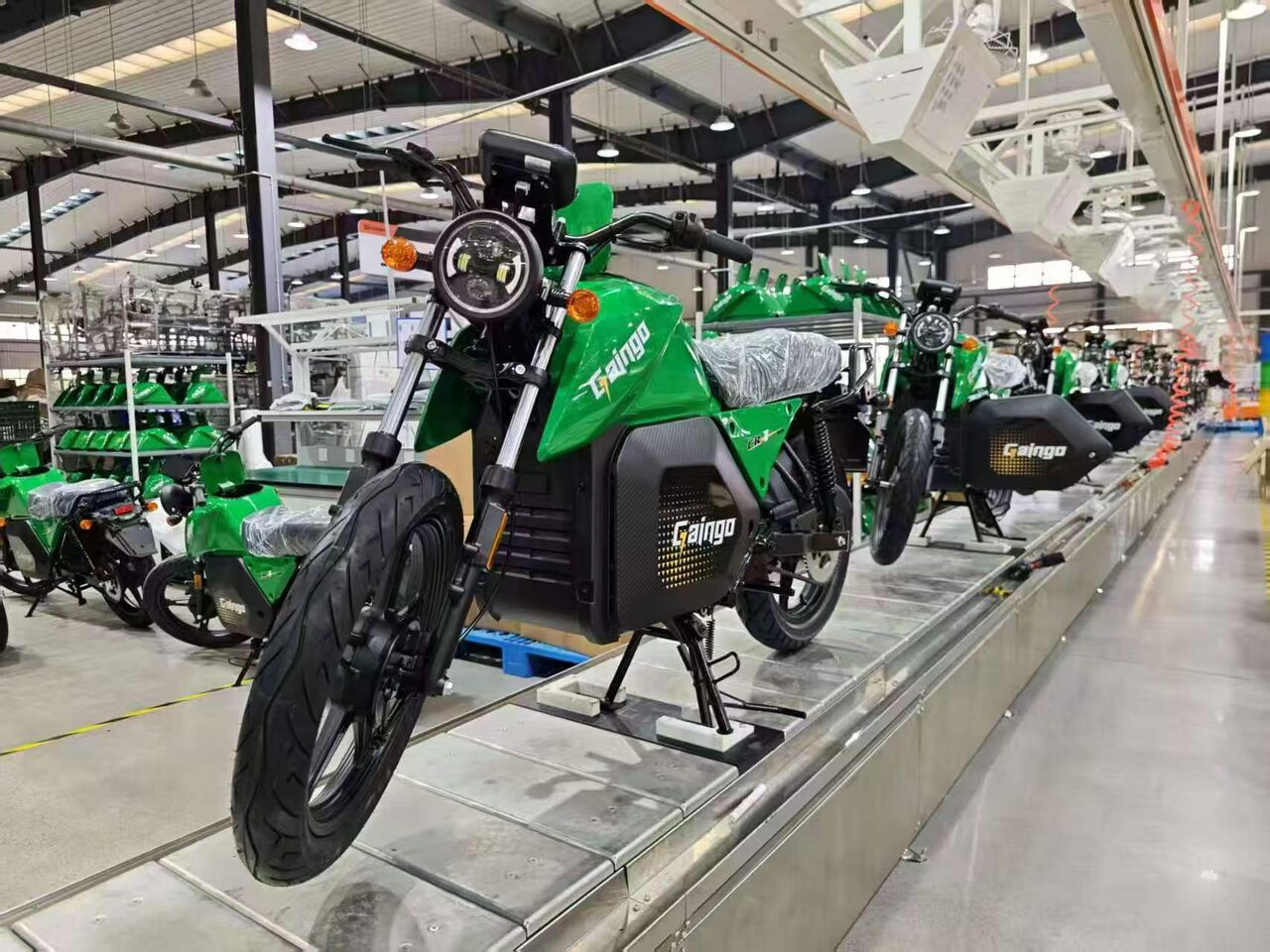

Zambia’s electric-mobility market is gaining another boost as Gaingo begins assembling a new batch of electric motorcycles, bringing its plans for locally adapted electric mobility closer to the road.
The company recently announced that the latest batch of Gaingo electric motorcycles had rolled off its assembly line, describing the milestone as part of its effort to build an electric-mobility ecosystem around motorcycles, battery swapping and commercial transportation.
The development is significant because Gaingo’s model goes beyond putting electric motorcycles on the road.
The company is combining the motorcycles with a battery-swapping network designed to reduce the time riders spend waiting for batteries to recharge.
Gaingo says its battery-swapping system can replace a depleted battery in under two minutes and that its network is expanding across Zambia. These figures are company-reported rather than independently verified by TechDrivers.
What Gaingo Is Building in Zambia
Gaingo describes itself as a battery-swapping electric-motorcycle company operating in Zambia.
Its model combines three major components:
- Electric motorcycles
- Battery-swapping infrastructure
- Commercial mobility services
The company says its motorcycles are designed for Zambian road and commercial-use conditions, while its battery network is intended to keep riders moving without waiting for conventional charging.
Gaingo also says its system can provide riders with a fully charged replacement battery during a swap and claims savings of up to 70% compared with petrol motorcycles. That savings figure is a company claim and will depend on factors such as electricity, battery-swapping fees, petrol prices, financing, maintenance and rider usage.
The latest assembly milestone therefore matters because the motorcycle itself is only one part of the company’s strategy.
The bigger proposition is an integrated mobility system.
Why Battery Swapping Matters for Electric Motorcycles
For a private electric-car owner, waiting for a vehicle to charge may be manageable.
For a commercial motorcycle rider, downtime can directly affect income.
A rider who depends on a motorcycle for deliveries, passenger transportation or other daily work needs to spend as much time earning as possible.
Battery swapping addresses this challenge differently from conventional charging.
Instead of waiting for the battery installed on the motorcycle to recharge, the rider can exchange it for a charged battery at a compatible station.
The depleted battery can then be recharged separately.
This makes battery swapping particularly relevant to high-use commercial motorcycles.
Gaingo says its swaps take less than two minutes.
The real test, however, will be whether stations are available where riders actually need them, whether enough charged batteries are available during busy periods and whether the overall cost remains attractive.
Local Assembly Could Become an Important Part of Africa’s EV Market
Africa’s electric-mobility market is increasingly moving beyond simply importing finished electric vehicles.
Companies across the continent are experimenting with local assembly, battery production, swapping networks and commercial fleet models.
Recent reporting by The Associated Press highlighted a growing split in Africa’s EV market, with some countries importing large numbers of electric scooters while businesses in parts of East and West Africa focus more heavily on commercial electric motorcycles, local assembly and battery-swapping infrastructure.
That makes developments such as Gaingo’s assembly operations relevant beyond Zambia.
Local assembly can potentially make it easier for companies to adapt vehicles to local road conditions, maintenance requirements and commercial use.
It can also create opportunities around assembly, servicing, logistics and other parts of the mobility supply chain.
However, assembly should not automatically be confused with complete local manufacturing.
In much of Africa’s EV industry, companies assemble vehicles using imported components. The level of local content can vary significantly between manufacturers and markets.
Gaingo’s Battery-Swapping Network Is Central to the Model
Electric motorcycles require more than a vehicle.
They require an energy system capable of supporting riders throughout the day.
Gaingo says it is building a network of battery-swapping stations across Zambia and has positioned swapping as a central part of its business model. The company currently advertises an average swap time of under two minutes and says it has completed more than 5,000 battery swaps.
The company has also previously highlighted solar-powered battery-swapping stations in Lusaka as part of its operations. In a recent update, Gaingo representatives said five solar-powered swapping stations were operational and that about 250 commercial electric motorcycles were active in its urban operations. These figures were reported by Gaingo and have not been independently verified by TechDrivers.
If the network continues to expand, the model could provide a useful case study for other African markets considering electric motorcycles.
What Kenya Can Learn From Zambia’s Model
Kenya is already one of Africa’s more active electric-motorcycle markets.
Electric motorcycles are being deployed commercially in Nairobi and other parts of the country, while several companies are developing battery-swapping networks.
Recent reporting has highlighted both the growth of Kenya’s electric motorcycle sector and the challenges created by proprietary battery systems and limited interoperability between networks.
This creates an important lesson for both Zambia and Kenya:
The motorcycle is only part of the electric-mobility equation.
A rider also needs reliable access to energy.
Kenya’s market illustrates why the availability, location and compatibility of battery-swapping infrastructure can be just as important as the vehicle itself.
There are already efforts to improve visibility of Kenya’s charging and swapping infrastructure. For example, SwapIt provides a map of EV charging and battery-swapping stations and includes networks from several providers.
Kenya Is Also Testing Integrated Electric-Motorcycle Models
The comparison between Zambia and Kenya is particularly relevant because Kenya is developing its own models combining electric motorcycles and battery infrastructure.
In Nairobi, Autopax launched the Cheche electric motorcycle in partnership with Ghanaian battery company Kofa and Chinese manufacturer TailG. The launch included 12 battery-swapping stations, demonstrating an approach in which the motorcycle and energy infrastructure are introduced together rather than treating charging as an afterthought.
Other major players are also expanding.
Spiro, for example, has been expanding its electric-motorcycle and battery-swapping operations across several African countries, including Kenya. Recent reporting said the company had deployed more than 100,000 electric vehicles and 2,500 smart-swap stations across its markets, although these figures are company-reported.
This means Zambia’s Gaingo development is part of a wider African experiment.
Different companies are testing different combinations of:
- Electric motorcycles
- Battery swapping
- Local assembly
- Solar energy
- Commercial fleets
- Pay-per-use models
- Battery financing
- Maintenance services
The companies that can make those components work together will determine how practical electric motorcycles become for commercial riders.
Why Electric Motorcycles Could Matter to Commercial Riders
For commercial riders, the economics of an electric motorcycle can be more important than the environmental argument.
Petrol is a recurring operating expense.
Electric motorcycles can potentially reduce energy and maintenance costs, although actual savings depend on the vehicle, electricity or swapping price, battery system, financing and riding patterns.
Battery swapping adds another potential advantage: time.
A commercial rider does not necessarily want to stop working for several hours while a battery charges.
A fast swap can potentially make an electric motorcycle more compatible with intensive daily use.
But that advantage disappears if a rider reaches a swapping station and finds that compatible batteries are unavailable.
That makes network density and reliability critical.
The Challenges Gaingo Will Need to Solve
The assembly milestone is significant, but scaling electric motorcycles involves more than producing the vehicles.
1. Battery availability
A swapping network needs enough charged batteries to support riders during peak demand.
2. Station coverage
Stations need to be located where commercial riders actually operate.
3. Battery standardization
Closed battery ecosystems can limit rider flexibility.
Kenya’s experience has already demonstrated some of the tensions around proprietary battery networks and interoperability.
4. Financing
The upfront cost of an electric motorcycle can be a barrier for riders who depend on daily income.
Financing models can therefore influence adoption as much as the vehicle’s technical specifications.
5. Maintenance
Electric motorcycles have fewer conventional engine components than petrol motorcycles, but they still require servicing, tyres, brakes, electrical components and battery management.
6. Battery safety
As battery-swapping networks expand, safe battery design, charging, monitoring and maintenance become increasingly important.
7. Local supply chains
Assembly plants still depend on components, spare parts and logistics.
The long-term industrial benefit will depend partly on how much of the supply chain can eventually be localized.
Why This Matters Beyond Zambia
The significance of Gaingo’s latest assembly milestone extends beyond the number of motorcycles leaving the factory.
It represents an approach to African electric mobility built around local conditions.
Instead of treating electric transportation as simply an imported vehicle, companies are increasingly looking at the entire system:
Vehicle + battery + energy infrastructure + financing + maintenance + rider economics.
That is particularly important for commercial motorcycles.
A rider does not simply need an electric motorcycle.
The rider needs a motorcycle that can earn money reliably every day.
That means the energy infrastructure has to work alongside the vehicle.
Could Zambia Become a Larger Electric-Mobility Market?
Gaingo’s expansion comes at a time when electric motorcycles are gaining greater attention across Africa.
Recent data reported by the Associated Press showed a significant increase in African imports of electric motorcycles and three-wheelers from China during the first half of 2026. The same report noted that commercial electric motorcycles are becoming an important focus for companies developing local assembly and battery-swapping ecosystems in parts of the continent.
But market growth will depend on more than imports or assembly capacity.
Consumers and commercial operators need affordable financing, reliable infrastructure, accessible spare parts and a business model that makes financial sense.
That is why Gaingo’s battery-swapping strategy will be worth watching alongside its motorcycle assembly operations.
What the Gaingo Development Means for Southern Africa
The next stage of Africa’s electric-mobility transition may increasingly be defined by local experimentation.
Kenya has its own electric-motorcycle and battery-swapping ecosystem.
Zambia is developing another model through Gaingo.
Other African markets are pursuing different combinations of imported vehicles, local assembly, battery infrastructure and fleet operations.
There is unlikely to be one solution that works identically across the continent.
Road conditions, electricity infrastructure, financing, fuel prices, motorcycle usage and urban density differ from country to country.
The companies that succeed will therefore need to adapt their systems to the realities of each market.
Frequently Asked Questions
What is Gaingo?
Gaingo is a Zambia-based electric-mobility company focused on electric motorcycles and battery-swapping infrastructure. The company describes itself as Zambia’s battery-swapping solution and says it is expanding its network across the country.
Where is Gaingo operating?
Gaingo is based in Zambia, with its current electric-motorcycle and battery-swapping operations focused on the Zambian market, particularly Lusaka.
How does Gaingo’s battery swapping work?
Instead of waiting for a motorcycle battery to recharge, a rider exchanges a depleted compatible battery for a charged one at a swapping station. Gaingo says its swaps can take under two minutes.
Is battery swapping available in Kenya?
Yes. Kenya has several electric-mobility companies operating or developing battery-swapping infrastructure. The country’s network remains fragmented across different providers, while newer platforms are attempting to make charging and swapping locations easier for riders to find.
Are electric motorcycles cheaper to operate than petrol motorcycles?
They can have lower energy and maintenance costs, but the actual savings depend on the motorcycle, battery model, electricity or swapping fees, financing and usage. Claims of specific savings should therefore be evaluated against real operating costs.
Why is local assembly important for electric motorcycles?
Local assembly can help companies adapt vehicles to local operating conditions and may create opportunities in manufacturing, maintenance and supply chains. However, assembly does not necessarily mean that all components are manufactured locally.
What are the biggest challenges facing electric motorcycles in Africa?
Major challenges include upfront financing, battery availability, charging and swapping infrastructure, network compatibility, maintenance, spare parts and battery safety.
Conclusion
Gaingo’s latest electric-motorcycle assembly milestone is more than a factory-floor announcement.
It highlights a broader shift taking place across Africa’s mobility sector.
Companies are increasingly looking beyond the electric motorcycle itself and building complete systems around the vehicle — from battery swapping and energy infrastructure to maintenance and commercial-use models.
Zambia’s approach will be worth watching as Gaingo expands its operations in Lusaka and potentially beyond.
Kenya’s experience offers another important lesson: electric-mobility adoption depends not only on putting more electric motorcycles on the road, but also on building reliable, accessible and practical energy networks around them.
For commercial riders, the question ultimately comes down to economics and uptime.
If an electric motorcycle can provide reliable transportation, affordable energy and minimal downtime, the technology becomes more than an environmental alternative to petrol.
It becomes a practical business tool.
And that could be one of the most important factors shaping the next stage of electric mobility in Africa.
