

Artificial intelligence is increasingly being discussed as if the next stage of the workplace will involve companies hiring digital employees.
That description is attractive because it is easy to understand. But it may also miss the bigger change taking place.
The more important development is not simply that AI can write, summarize, classify documents or generate reports faster. AI is increasingly being connected to the systems where work actually happens.
It can monitor incoming information, organize context, identify missing details, prepare the next action, follow predefined rules, request human approval and help move recurring processes forward.
That does not make AI an employee in the traditional sense.
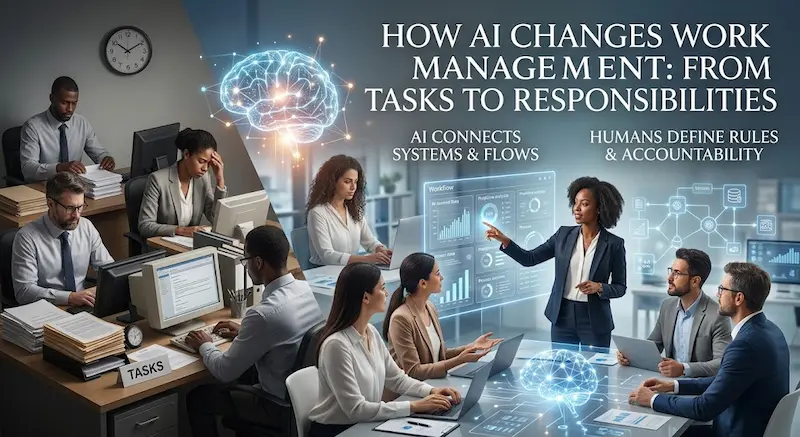
Instead, it changes how work is managed.
For businesses in Kenya and elsewhere, that distinction could become increasingly important as AI moves from being a tool employees open when they need help to becoming part of the workflow itself.
From AI That Answers Questions to AI That Moves Work Forward
The first wave of workplace AI largely focused on individual productivity.
An employee could ask an AI chatbot to write an email, summarize a document, create a spreadsheet formula or generate ideas.
That remains useful.
But there is a difference between an AI tool that waits for instructions and an AI system that sits inside a business process.
Consider a customer-support operation.
A traditional AI assistant might draft a response to a customer’s question.
A more integrated AI workflow could potentially:
- Detect a new customer request.
- Identify the customer and retrieve relevant account information.
- Summarize previous interactions.
- Identify the applicable company policy.
- Draft a response.
- Flag missing information.
- Determine whether the case falls within an approved routine process.
- Request human approval for sensitive actions.
- Record the outcome.
- Remind the responsible employee if the case remains unresolved.
The difference is significant.
The AI is no longer simply producing text.
It is helping manage a recurring responsibility.
Work Often Breaks Between Tasks
Businesses often describe work in terms of individual tasks.
Someone receives an email.
Someone checks a document.
Someone updates a customer record.
Someone sends a follow-up.
Someone approves a payment.
Someone creates a report.
But the biggest operational problems often occur between those tasks.
The email arrives, but nobody owns the follow-up.
The customer information exists, but it is scattered across different systems.
The document is reviewed, but an important exception is missed.
The salesperson makes a note, but the CRM is never updated.
A payment is approved, but nobody checks whether the underlying information has changed.
These are not necessarily failures of individual employees.
They are often failures of workflow design.
AI becomes more interesting when it is used to reduce those gaps.
Instead of simply asking, “Can AI do this task?”, businesses may increasingly ask:
AI Is Not an Employee
Calling AI an “employee” can create the wrong expectations.
An employee operates within an organization with responsibilities, authority, accountability and consequences.
AI does not automatically possess those things.
If an AI system prepares a customer refund and the refund is sent incorrectly, someone in the organization remains responsible for the decision.
If an AI system sends inaccurate information to a customer, the company cannot simply say that the AI made the mistake.
If an AI system makes a recommendation based on incomplete information, the organization still needs to decide whether that recommendation should be acted upon.
That is why the more realistic model is human-led, AI-assisted or AI-powered workflows.
The machine may prepare, route, monitor and execute bounded actions.
Humans still determine the rules, approval points and accountability.
The Real Shift Is From Tasks to Responsibilities
A useful way to think about workplace AI is to move one level above individual tasks.
A task might be:
“Write a follow-up email.”
A responsibility might be:
“Make sure every qualified sales lead receives an appropriate follow-up within 24 hours.”
Those are very different problems.
The first can be solved with a writing assistant.
The second requires a system.
That system might need to identify new leads, collect information, determine which leads qualify, prepare messages, update records, monitor responses and escalate cases that require human attention.
AI can become one component of that system.
This is where the technology becomes more consequential for managers.
The question is no longer only:
What can AI do?
It becomes:
What responsibility can we redesign around AI without losing accountability?
What This Could Look Like in a Kenyan Business
The concept does not require a multinational corporation with a huge AI department.
A Kenyan SME could apply the same principle on a much smaller scale.
Customer support
A small online retailer receives customer questions through WhatsApp, email and social media.
Instead of having an employee repeatedly search for order information, an AI-enabled workflow could organize incoming questions, identify common requests, prepare responses and flag complaints or unusual cases for human attention.
The employee’s role shifts from answering every routine question manually to managing exceptions and customer relationships.
Sales
A Kenyan real-estate agency may receive dozens of enquiries about houses or apartments.
Instead of manually sorting every enquiry, an AI workflow could structure information such as location, budget, property type and preferred timing.
The system could then prepare follow-ups while a salesperson handles serious prospects and negotiations.
Finance and administration
An SME may receive invoices, receipts and payment requests through email or messaging platforms.
AI could help extract information, classify documents and identify missing details.
But the payment itself could remain subject to human approval.
That creates a useful division:
AI prepares the transaction. A human authorizes the transaction.
Human resources
Recruitment teams often deal with CVs, interview notes, candidate communications and scheduling.
AI can help organize information and identify missing fields.
But decisions involving hiring, rejection, compensation or sensitive personal information require appropriate human oversight and organizational policies.
Media and publishing
A technology publication can use AI to help monitor news developments, organize research, identify related stories and prepare drafts.
But editorial judgment still matters.
A journalist or editor must determine whether a claim is sufficiently supported, whether sources are reliable and whether the story should be published.
This distinction is especially important for publishers because a faster workflow does not automatically produce a more trustworthy article.
Kenya Is Already Building Around AI Adoption
Kenya’s AI conversation is moving beyond consumer chatbots.
The country’s Artificial Intelligence Strategy 2025–2030 sets out a national framework covering AI digital infrastructure, data and governance, and AI research, innovation and commercialization. The strategy also emphasizes talent, investment and responsible deployment.
That matters for businesses because AI adoption requires more than access to a chatbot.
Companies need usable data, digital infrastructure, appropriate skills, security controls and clear rules around how AI systems can be used.
The direction is also visible in Kenya’s private sector.
Safaricom has publicly described using AI and machine learning for areas including customer service, fraud detection, network issue identification and personalization. Its Zuri chatbot, for example, has been used to help customers access services such as M-PESA statements, PUK information and data bundles.
These examples illustrate an important point.
AI does not have to replace an entire job to change how an organization operates.
It can change the workflow around that job.
Why AI Pilots Often Do Not Become Real Business Systems
There is a major difference between experimenting with AI and redesigning a business process around it.
Many organizations can demonstrate an AI tool writing an impressive email or summarizing a report.
The harder question is what happens afterwards.
Who checks the result?
Where is the information stored?
What happens if the AI does not have enough context?
Who approves the action?
What happens when the case falls outside the normal pattern?
What happens when the system is wrong?
Recent research from PwC’s Africa AI performance work illustrates this challenge: the firm reported that many organizations are running AI pilots while relatively few have scaled AI across the enterprise. It also found that 64% of workers surveyed were already using AI, highlighting the gap between experimentation and structured organizational adoption.
This is why simply buying access to an AI model is not the same as implementing AI successfully.
The difficult part is often the workflow surrounding the model.
Human Approval Becomes More Important as AI Gets Closer to Action
There is an important difference between generating information and taking action.
If an AI produces a rough list of ideas, the consequences of an error may be relatively small.
If an AI sends a customer message, changes a database record, approves a refund or initiates a financial transaction, the consequences can be much greater.
That suggests a useful principle for businesses:
The closer AI gets to an irreversible or high-impact action, the stronger the human review should become.
A simple workflow could therefore look like this:
AI detects → AI prepares → AI checks → Human reviews → System executes → System records
Not every workflow needs every step.
A low-risk task may be fully automated.
A sensitive task may require several approval points.
The important thing is that the organization decides this deliberately rather than allowing automation to expand without clear boundaries.
The New Skill: Designing How Work Moves
This shift could also change what employees and managers need to be good at.
When AI handles more repetitive execution, people may spend more time defining how work should move through a system.
That requires skills such as:
- Identifying bottlenecks
- Defining business rules
- Designing approval processes
- Recognizing exceptions
- Writing clear requirements
- Evaluating AI output
- Understanding data quality
- Designing escalation paths
- Measuring outcomes
- Knowing when automation should stop
In other words, some employees may increasingly need to think like workflow designers and operators, not just task performers.
That does not mean traditional skills disappear.
It means their value may increasingly depend on how effectively they are combined with AI-enabled systems.
Managers May Have to Manage Systems, Not Just People
Management has historically involved assigning work to people, monitoring progress and evaluating results.
AI introduces another layer.
Managers may increasingly need to understand which work is being performed by people, which parts are supported by AI, which actions are automated and where human approval remains necessary.
That creates new management questions.
Who owns the AI workflow?
Who reviews its performance?
How often should its rules be updated?
What happens when business policy changes?
How do employees report an AI failure?
What information should the system be allowed to access?
How should the company measure whether the automation is actually helping?
These are management questions, not merely technical questions.
The Risk of Automating a Bad Process
There is another danger.
AI can make an inefficient workflow faster without making it better.
Suppose a company has a poorly designed approval process involving five unnecessary steps.
Automating those five steps does not necessarily solve the underlying problem.
It may simply allow the organization to process more unnecessary work at greater speed.
The same applies to poor data.
If customer information is incomplete or inconsistent, an AI system connected to that information may produce faster decisions without producing better decisions.
This is why businesses should first understand the process they want to improve.
Then they can determine which parts should be automated.
Not Every Job Needs Full AI Automation
There is also a tendency to treat automation as an all-or-nothing decision.
It does not have to be.
Businesses can choose different levels of AI involvement.
Level 1: Assistance
AI helps an employee perform a task.
Example: drafting an email.
Level 2: Preparation
AI gathers information and prepares the next step.
Example: compiling a customer’s account history before an employee responds.
Level 3: Supervised execution
AI performs a predefined action after meeting certain conditions, with human oversight available.
Example: processing a routine support request while escalating unusual cases.
Level 4: Automated workflow
AI and software handle a recurring process with humans involved primarily in exceptions, monitoring and governance.
The appropriate level depends on the risk, complexity and reversibility of the work.
What Kenyan Businesses Should Ask Before Automating Work
For businesses considering AI adoption, the starting point should not necessarily be:
“Which AI tool should we buy?”
A better starting point is:
“Which recurring workflow causes us the most unnecessary work?”
Then ask:
- How often does this process happen?
- What information does it require?
- Where does that information currently live?
- Which steps are repetitive?
- Which steps require judgment?
- Which decisions can be safely automated?
- Which decisions require approval?
- What happens when the system is uncertain?
- Who is accountable for the final outcome?
- How will we know whether the new workflow actually improved the business?
These questions are particularly relevant for Kenyan SMEs, which may not have large technology teams but still deal with repetitive customer service, sales, administration, finance and reporting processes.
AI Could Change What “Productivity” Means
For years, productivity has often been associated with doing the same task faster.
AI introduces another possibility.
A business may instead become more productive by changing the structure of the work itself.
Instead of asking an employee to remember every follow-up, the system can monitor outstanding work.
Instead of requiring someone to search through multiple records, the workflow can assemble the relevant context.
Instead of asking managers to manually identify exceptions, the system can surface unusual cases.
The employee then spends more time on decisions that actually require human judgment.
That is a different definition of productivity.
It is not simply:
Human + AI = faster human.
It can become:
Human + AI + redesigned workflow = different operating model.
The AI Employee Is the Wrong Question
The phrase “AI employee” will probably remain popular because it makes a complicated technological shift easy to describe.
But it can distract businesses from the questions that matter more.
Who is responsible?
What can the system do?
What can it not do?
What information can it access?
When must it ask for approval?
How are mistakes detected?
What happens when the system encounters an unusual case?
Where is the record of its actions?
Those questions may sound less exciting than an announcement about a digital employee.
They are also much closer to the practical reality of deploying AI inside an organization.
The Next Workplace Shift Is About Responsibility
AI will continue to become better at generating content, analyzing information and completing individual tasks.
But the larger organizational change may come when AI becomes connected to the flow of work.
At that point, companies will not simply be deciding which tasks to automate.
They will be deciding which recurring responsibilities can be turned into supervised systems.
That means clearer triggers.
Better context.
Defined approval points.
Stronger escalation paths.
Better records.
And clearer accountability.
The responsibility does not disappear because AI is involved.
Instead, responsibility is redistributed between people, software and organizational processes.
That is why the next phase of workplace AI may be less about creating an artificial employee and more about redesigning how work gets managed.
For businesses in Kenya, the opportunity is not necessarily to automate everything.
It is to identify where AI can remove repetitive coordination, reduce dropped handoffs, improve access to information and allow people to spend more time on decisions that genuinely require human judgment.
The most important question may therefore not be:
“What job will AI replace?”
It may be:
“What responsibility can we redesign so that humans and AI can manage it better together?”
Frequently Asked Questions
Will AI replace employees?
AI can automate or assist with individual tasks and, in some cases, parts of larger workflows. The effect on employment will vary by occupation, industry and how businesses deploy the technology. It is more useful to examine specific tasks and responsibilities than to assume that entire occupations will disappear.
Is AI becoming an employee?
Not in the conventional employment sense. AI systems can perform defined tasks or actions, but organizations still need to establish authority, accountability, oversight and responsibility around those systems.
How can Kenyan businesses use AI?
Businesses can start with repetitive processes such as customer-support triage, document processing, sales follow-ups, internal knowledge retrieval, reporting and administrative workflows. The appropriate level of automation depends on the sensitivity and risk of the process.
Should businesses fully automate their workflows?
Not necessarily. A staged approach can be appropriate, particularly where financial, legal, customer-facing or irreversible decisions are involved. AI can prepare information or recommendations while a human retains approval authority.
What skills will workers need as AI adoption increases?
Workers may increasingly benefit from AI literacy, critical thinking, communication, domain expertise, data skills and the ability to design or supervise workflows. Understanding how to identify exceptions and evaluate AI output can also become increasingly important.
What is the difference between AI assistance and AI automation?
AI assistance helps a person complete a task. AI automation connects AI to a workflow so that information can be processed and actions can occur with less manual intervention. Automation normally requires clearer rules, triggers, permissions and monitoring.
Why is human oversight important?
AI systems can produce incorrect or incomplete results. Human oversight becomes particularly important when an AI-generated recommendation could create financial, legal, reputational, security or customer consequences.
Conclusion
AI is unlikely to become an employee in the traditional sense.
The more important change is happening underneath that idea.
As AI becomes connected to business systems, data, triggers and approval processes, organizations can begin redesigning how recurring responsibilities are handled.
That could change what employees do, what managers supervise and where accountability sits.
The businesses that benefit from AI may not simply be the ones with access to the most powerful models.
They may be the ones that understand their workflows well enough to determine where AI should assist, where it can act and where a human must remain firmly in control.
The future of work may therefore be less about AI replacing the employee and more about AI changing the system in which the employee works.
