
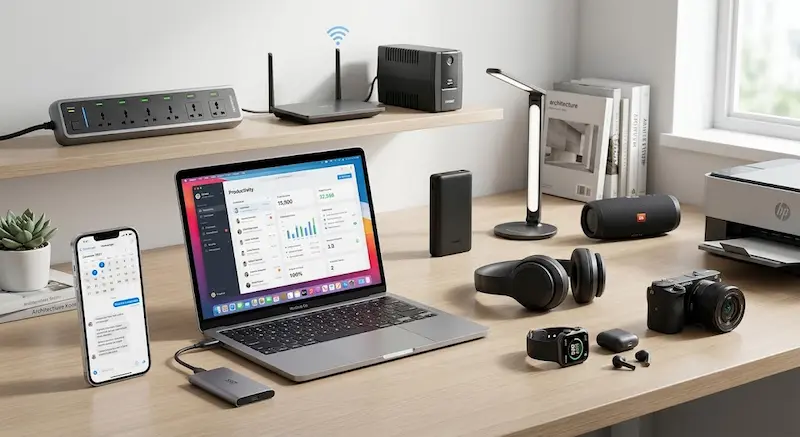

Technology has become part of almost every aspect of modern life.
From sending money and attending online meetings to studying, working remotely, navigating unfamiliar places and keeping a home secure, people increasingly depend on electronic devices to complete everyday tasks.
However, not every gadget is equally useful.
Some devices provide practical benefits that people can rely on every day, while others are mainly designed for entertainment or convenience.
For consumers in Kenya, the most useful gadgets often solve very practical problems such as internet access, power interruptions, communication, work, education, security and access to digital services.
Here are 15 essential gadgets that can make everyday life easier and explain why they matter.
1. Smartphone
The smartphone is arguably the most versatile gadget many people own.
A modern smartphone is no longer just a device for making calls and sending text messages. It can function as a camera, navigation device, mobile banking tool, entertainment system, learning device and work computer.
In Kenya, smartphones are particularly important because many digital services can be accessed directly from a mobile phone.
People use smartphones to:
- Make calls and send messages
- Access mobile money services
- Use banking applications
- Browse the internet
- Attend online meetings
- Take photos and videos
- Navigate using GPS
- Access social media
- Study online
- Run small businesses
For many users, the smartphone is effectively the main gateway to the internet.
Why it matters
A smartphone combines several separate functions into one portable device.
Instead of carrying a camera, GPS device, music player and communication device separately, users can perform many of these tasks from one phone.
2. Laptop
A laptop remains one of the most important gadgets for work, education and business.
While smartphones are useful for quick tasks, laptops provide a larger screen, physical keyboard and more powerful computing capabilities.
Students can use laptops for research, assignments, programming and online learning.
Professionals can use them for documents, spreadsheets, video conferences, graphic design, software development and other demanding tasks.
Small-business owners can also use laptops for accounting, marketing, inventory management and communication with customers.
Why it matters
A laptop provides the flexibility of a desktop computer without requiring a permanent workstation.
For remote workers and students, this portability can be particularly valuable.
3. Power Bank
A power bank is a simple gadget that can become extremely useful when a smartphone battery is running low and there is no convenient power outlet.
This can be important when travelling, working away from home or experiencing a power interruption.
A good power bank can recharge smartphones, wireless earbuds and other USB-powered devices.
What to check before buying
Look at:
- Battery capacity
- Output wattage
- Number of ports
- USB-C support
- Charging speed
- Size and weight
- Safety protections
A higher-capacity power bank is not automatically the best option. Buyers should consider whether its size and weight are practical for everyday carrying.
4. Wi-Fi Router
A Wi-Fi router provides internet connectivity to multiple devices.
At home, one connection can serve smartphones, laptops, smart TVs, tablets and other connected devices.
For businesses, routers can provide connectivity for employees and customers while supporting multiple computers and other equipment.
Kenyan consumers can choose between fixed broadband routers, fibre routers and mobile 4G or 5G routers depending on the available network infrastructure.
Why it matters
Instead of buying separate internet connections for every device, a router allows several devices to share one connection.
It is particularly useful for households with multiple internet users.
5. Rechargeable LED Lamp
A rechargeable LED lamp may not look as sophisticated as a smartphone or smartwatch, but it can be extremely useful during a power interruption.
It can provide lighting for studying, cooking, working or moving around the house when conventional electricity is unavailable.
LED technology also generally consumes less electricity than traditional incandescent lighting.
Why it matters
For households that experience occasional power interruptions, having a rechargeable light provides an independent source of illumination.
It can also be useful when camping, travelling or working in areas without reliable electricity.
6. UPS
A uninterruptible power supply (UPS) is particularly useful for computers, networking equipment and other sensitive electronics.
A UPS provides temporary battery power when electricity fails and can help protect connected equipment against certain power disturbances.
For someone working from home, a UPS can provide enough backup time to save work and shut down a computer properly.
Why it matters
Unexpected power loss can interrupt work and potentially result in unsaved data.
A UPS provides a short window to continue working or shut down equipment safely.
For networking equipment, a UPS can also help keep internet connectivity running during short power interruptions, provided the internet service itself remains available.
7. External SSD or Hard Drive
Digital files can be extremely valuable.
Family photos, business documents, school assignments, videos and other files can disappear if a computer or smartphone is damaged, lost or affected by storage failure.
An external SSD or hard drive provides additional storage and can be used for backups.
Why it matters
Backing up important files reduces dependence on a single device.
For important documents, users should ideally maintain more than one copy, with at least one backup stored separately from the primary device.
An external SSD is generally faster and more resistant to physical shocks than a traditional mechanical hard drive, although it can cost more per gigabyte.
8. Earbuds or Headphones
Wireless earbuds and headphones have become common accessories for smartphones and computers.
They can be used for phone calls, music, podcasts, online classes, video meetings and entertainment.
For people who work remotely, headphones with a good microphone can also improve communication during virtual meetings.
Why it matters
Headphones provide private audio without disturbing people nearby.
Noise-cancelling models can also help reduce background noise in busy environments.
However, users should avoid listening at excessively high volumes for long periods.
9. Smartwatch
A smartwatch extends some smartphone functions to the wrist.
Depending on the model, it can display notifications, track exercise, monitor heart rate, provide alarms, control music and support calls or messages.
Some models can operate more independently when paired with cellular networks.
Why it matters
A smartwatch can provide quick access to information without requiring users to repeatedly take their phone out of their pocket or bag.
Its usefulness depends heavily on the user’s lifestyle and the features supported by the particular model.
10. Mobile Hotspot
A mobile hotspot can turn a cellular connection into Wi-Fi for laptops, tablets and other devices.
This is particularly useful when fixed broadband is unavailable or when someone needs temporary internet access while travelling.
A dedicated 4G or 5G hotspot can also be useful for people who regularly work from different locations.
Why it matters
Internet access is increasingly essential for work, education, communication and business.
A mobile hotspot provides another way to get connected when a conventional broadband connection is unavailable.
However, users should consider the cost of mobile data and network coverage before relying on a hotspot as their primary connection.
11. Security Camera
Security cameras can help homeowners and businesses monitor their premises.
Modern internet-connected cameras can provide features such as:
- Live viewing
- Motion detection
- Night vision
- Smartphone notifications
- Cloud or local recording
- Two-way communication
Some models can send alerts when movement is detected.
Why it matters
A security camera can provide visibility when the owner is away from a property.
However, cameras should be installed responsibly, with consideration for privacy and applicable laws. Cameras should not be positioned in places where people reasonably expect privacy.
12. Printer
Although many documents are now digital, printers remain useful in schools, offices and businesses.
They can be used to print contracts, invoices, assignments, forms, receipts and other documents.
An all-in-one printer can also scan and copy documents.
Why it matters
Businesses and institutions still regularly require physical documents.
For frequent printing, buyers should look beyond the purchase price and consider the ongoing cost of ink or toner.
13. Bluetooth Speaker
A portable Bluetooth speaker can provide wireless audio from a smartphone, tablet or laptop.
It can be useful at home, during small gatherings, for presentations or when listening to audio without headphones.
Why it matters
Bluetooth speakers are relatively simple to use and can provide better sound than many small smartphone speakers.
When choosing one, consider battery life, sound quality, durability and connectivity rather than focusing only on maximum volume.
14. Surge Protector or Quality Power Strip
Many homes and offices have several electronic devices that need to be connected to power.
A quality power strip can provide multiple outlets, while a properly rated surge protector can offer protection against certain electrical surges.
This can be particularly useful for equipment such as computers, televisions, routers and gaming consoles.
Why it matters
A single power outlet may not be enough for a modern workstation or entertainment setup.
However, users should avoid overloading power strips and should ensure that the device is appropriately rated for the equipment connected to it.
15. Digital Camera
Smartphones have replaced many compact cameras for everyday photography.
However, dedicated digital cameras remain important for professional photography, journalism, filmmaking and content creation.
They can provide larger sensors, interchangeable lenses and greater manual control than most smartphones.
Why it matters
For professional creators, the ability to change lenses and control exposure can make a dedicated camera a valuable production tool.
For casual photography, however, a modern smartphone may already provide sufficient image quality.
Which Gadgets Are Most Important?
There is no universal list because the usefulness of a gadget depends on the user’s needs.
For a student, a smartphone, laptop, power bank and headphones may be particularly useful.
For a remote worker, a laptop, router, UPS, external storage and headphones could be more important.
For a small business, useful equipment may include a laptop, smartphone, printer, router, security camera and backup storage.
For a household dealing with occasional power interruptions, a power bank, rechargeable lamp and UPS can provide practical backup.
The important lesson is that consumers do not necessarily need the newest or most expensive gadget.
How to Choose an Essential Gadget
Before buying a gadget, ask five simple questions.
What problem does it solve?
A gadget should have a clear purpose.
Buying a device simply because it is popular can result in money being spent on features that are rarely used.
How often will I use it?
A device used every day can justify a higher investment than one that will only be used occasionally.
What will it cost after purchase?
Consider accessories, subscriptions, replacement batteries, data costs, repairs and other recurring expenses.
Is it compatible with my existing devices?
Check compatibility with your smartphone, laptop, operating system, network and other equipment.
Is it reliable?
Read specifications and independent reviews, and consider warranty support before purchasing.
Essential Gadgets Are About Solving Problems
The most useful gadget is not necessarily the one with the most impressive specifications.
A KSh2,000 rechargeable lamp could be more useful to a household during a blackout than an expensive smartwatch.
Similarly, a reliable power bank can be more valuable to someone who spends most of the day away from a power outlet than a premium wireless accessory.
Technology becomes valuable when it solves a real problem.
For Kenyan consumers, that means choosing gadgets based on connectivity, electricity availability, work requirements, education, security, communication and affordability rather than simply following trends.
Frequently Asked Questions
What are the most essential gadgets?
Some of the most useful gadgets for everyday life include smartphones, laptops, power banks, Wi-Fi routers, rechargeable lamps, UPS systems, external storage and headphones.
Why is a smartphone an essential gadget?
A smartphone combines communication, internet access, navigation, photography, mobile payments, banking, entertainment and many other functions in one portable device.
Is a power bank worth buying?
A power bank can be useful for people who frequently travel, work away from power outlets or need backup charging during power interruptions.
Do I need a UPS at home?
A UPS can be useful if you work on a computer from home or need to keep networking equipment running during short power interruptions.
Is an external hard drive still useful?
Yes. External storage remains useful for backing up photos, videos, documents and other important files. SSDs offer faster performance, while traditional hard drives can provide more storage at a lower cost.
Are smartwatches essential?
Smartwatches are useful for some people but are not essential for everyone. Their value depends on whether features such as notifications, fitness tracking and quick access to calls or messages are useful to the individual.
What should I consider before buying a gadget in Kenya?
Consider the price, warranty, availability of replacement parts or accessories, compatibility, power requirements, network support where applicable and the device’s long-term usefulness.
Final Thoughts
Gadgets have become important tools for communication, work, education, entertainment and security.
But buying technology does not always mean buying the latest model.
For most people, the better approach is to identify a problem first and then find a device that solves it at a reasonable cost.
A smartphone can connect you to digital services. A laptop can support work and education. A router can provide internet access to an entire household. A power bank can keep a phone running when electricity is unavailable, while an external drive can protect important digital memories and documents through backups.
The best gadget for you is ultimately the one that provides practical value in your everyday life.
