

Electric motorcycles and scooters are becoming increasingly relevant in Kenya as riders look for alternatives to petrol-powered two-wheelers.
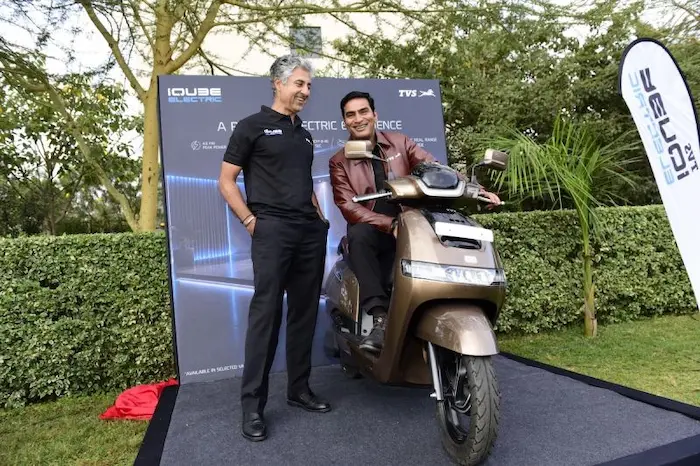
One of the biggest recent developments is the arrival of the TVS iQube, an electric scooter from Indian manufacturer TVS Motor Company. The iQube officially entered the Kenyan market in August 2026 through Car & General, giving Kenyan buyers access to a mainstream electric scooter backed by an established automotive distributor.
The Kenya lineup includes the TVS iQube 2.2 and TVS iQube 3.5, with claimed real-world ranges of 75 km and 115 km respectively.
So, is the TVS iQube worth buying in Kenya?
TVS iQube Kenya: Quick Verdict
Yes, if your main use is urban commuting and you have somewhere convenient to charge it.
The iQube is particularly attractive for riders who travel relatively predictable daily distances and want to reduce spending on petrol and routine engine maintenance.
However, it is not necessarily the best choice for riders who regularly travel long distances between towns or who do not have reliable access to electricity.
The biggest advantages are its quiet operation, low energy costs, automatic transmission, connected technology and relatively practical range.
The biggest considerations are the upfront purchase price, charging access, battery longevity and the still-developing electric-mobility ecosystem in Kenya.
TVS iQube Kenya Price
The first thing many Kenyan buyers will want to know is the price.
Unlike the Indian market, where TVS publishes detailed local pricing, Kenyan pricing can vary depending on the distributor, taxes, registration, accessories and other on-road costs.
TVS currently lists the iQube 2.2 and iQube 3.5 on its Kenya website, but buyers should confirm the current Kenya on-road price directly with the authorised distributor before purchasing.
This is important because Indian-market prices should not simply be converted into Kenyan shillings and presented as Kenya prices.
For a Kenyan buyer, the final figure should include the relevant local taxes, registration, delivery and any accessories.
TVS iQube 2.2 vs iQube 3.5
The two Kenya-spec versions give buyers a choice between affordability and additional range.
| Specification | TVS iQube 2.2 | TVS iQube 3.5 |
|---|---|---|
| Battery | 2.2 kWh | 3.5 kWh |
| Real-world range | About 75 km | About 115 km |
| Top speed | Up to 82 km/h* | 82 km/h |
| Motor | Electric hub motor | 4.6 kW peak hub motor |
| Charging | Household socket | Household socket |
| Riding modes | Eco/Power | Eco/Power |
| Storage | Practical under-seat storage | 32 litres |
| Regenerative braking | Yes | Yes |
*Specifications can vary by market/variant, so Kenyan buyers should confirm the exact specification of the unit being purchased.
TVS officially lists the iQube 3.5 with a 115 km real-world range, 82 km/h top speed, 4.6 kW peak power and a 3-hour 0–80% charging time.
TVS iQube Range in Kenya
Range is arguably the most important specification when buying an electric scooter.
The Kenya-market iQube 2.2 is reported to offer approximately 75 km of real-world range, while the iQube 3.5 is rated at approximately 115 km of real-world range.
For example, if you commute approximately 25 km each way, a 50 km daily journey would theoretically fit within the iQube 2.2’s claimed range.
But you should not plan your daily journey around the absolute maximum figure.
Range can change depending on:
- Rider weight
- Riding speed
- Traffic
- Hills and slopes
- Passenger weight
- Tyre pressure
- Temperature
- Riding mode
- Battery condition
TVS itself notes that real-world range can vary depending on factors such as traffic and speed.
For Kenyan riders dealing with traffic, hills and varying road conditions, it is sensible to maintain a safety buffer rather than riding until the battery is almost empty.
How Long Does the TVS iQube Take to Charge?
Charging is one of the biggest differences between an electric scooter and a petrol motorcycle.
The iQube 3.5 uses an off-board charger and TVS lists approximately three hours for a 0–80% charge. The charger can be connected to a standard 5A household socket.
That makes overnight charging particularly convenient.
Instead of visiting a petrol station, you can potentially arrive home, plug the scooter into an appropriate electrical outlet and have it ready for the next day’s commute.
For many urban riders, this is one of the iQube’s biggest advantages.
How Much Does It Cost to Charge the TVS iQube in Kenya?
This is where electric mobility becomes particularly interesting.
The calculation is straightforward:
Charging cost = electricity consumed × your electricity tariff
For example, a 3.5 kWh battery theoretically requires around 3.5 kWh to fill from completely empty. In practice, electricity drawn from the wall can be somewhat higher because of charging losses.
So if your effective electricity cost were KSh 30 per kWh, a theoretical 3.5 kWh charge would cost about:
3.5 × KSh 30 = KSh 105
The actual cost will depend on your electricity tariff and charging losses.
That means a full charge could potentially cost only around the cost of a few litres of petrol while providing a claimed real-world range of up to 115 km.
This is an important reason electric scooters can become attractive for high-mileage urban commuters.
What Does the iQube Cost Per Kilometre?
Using the same illustrative KSh 30/kWh electricity assumption:
- 3.5 kWh battery × KSh 30 = KSh 105
- 115 km claimed real-world range
- KSh 105 ÷ 115 km = about KSh 0.91 per km
This is only an illustration, not a guaranteed running cost.
Your actual cost will depend on your electricity tariff, charging losses, riding style, traffic and battery condition.
Still, the calculation demonstrates why electric mobility can offer substantial energy-cost savings compared with petrol-powered motorcycles.
TVS iQube Performance
The iQube isn’t designed to be a high-performance sports motorcycle.
It is designed primarily as a practical urban commuter.
The iQube 3.5 has a peak power output of 4.6 kW, a top speed of 82 km/h and a claimed 0–40 km/h acceleration time of 4.2 seconds.
That should be sufficient for many urban journeys.
The immediate torque of an electric motor also makes the scooter feel responsive when pulling away from traffic lights.
For normal city riding, the iQube should have enough performance for commuting without needing the complexity of a conventional petrol engine.
Riding the TVS iQube
One of the biggest benefits of an electric scooter is simplicity.
There is no conventional petrol engine to warm up, no gear shifting and no clutch operation.
The iQube uses riding modes including Eco and Power, allowing the rider to balance efficiency and performance. It also has regenerative braking.
The result should feel familiar to someone who has ridden a conventional automatic scooter, but with much less mechanical noise.
For Nairobi-style stop-and-go traffic, that combination can be particularly appealing.
TVS iQube Technology
The iQube is more than simply an electric motor and battery.
The iQube 3.5 includes a TFT display and TVS SmartXonnect connectivity. Features include navigation, ride statistics, remote charging status and geofencing through the connected system.
The scooter also includes features such as:
- Turn-by-turn navigation
- Distance-to-empty information
- Music controls
- USB charging
- Parking/reverse assist
- Service reminders
- Incoming-call alerts
- Battery information
These features make the iQube feel closer to a connected technology product than a basic motorcycle.
Storage and Practicality
Electric scooters sometimes sacrifice practicality because of battery packaging.
The iQube 3.5, however, provides 32 litres of under-seat storage, according to TVS.
That makes it more useful for everyday commuting.
You can carry items such as:
- A small backpack
- Personal belongings
- Charging accessories
- Shopping items
For a scooter intended primarily for city transportation, practical storage matters almost as much as range.
Is the TVS iQube Good for Kenyan Roads?
The iQube is primarily an urban scooter, so its ideal environment is relatively good roads and city commuting.
The iQube 3.5 has 157 mm of ground clearance, tubeless tyres and an IP67 water and dust-resistance rating.
That doesn’t mean it should be treated like an off-road motorcycle.
If your daily route involves badly damaged roads, deep mud, rocky terrain or frequent long-distance rural travel, a conventional motorcycle may still be more appropriate.
For paved urban roads, however, the iQube’s design makes much more sense.
Maintenance Costs
Another potential advantage of the iQube is reduced mechanical complexity.
A petrol motorcycle has components such as:
- Engine oil
- Oil filters
- Spark plugs
- Fuel system components
- Clutch components
- Exhaust system
- Engine-related belts and parts
An electric scooter eliminates many of these requirements.
That does not mean the iQube is maintenance-free.
Owners still need to maintain:
- Tyres
- Brakes
- Suspension
- Bearings
- Electrical systems
- Battery system
- Charger
- Software and electronics
TVS also has a Kenyan service presence and lists the iQube among the products supported through its Kenya service network.
TVS also promotes genuine parts and provides measures such as QR-code verification to help customers identify genuine parts.
Battery Life: The Biggest Long-Term Question
The battery is arguably the most important component of an electric scooter.
Replacing a battery can be significantly more expensive than replacing conventional motorcycle consumables.
Therefore, before buying an iQube in Kenya, ask the dealer:
- What is the battery warranty?
- How long is the motor warranty?
- How much does a replacement battery cost?
- Can individual battery components be serviced?
- Where are battery repairs performed?
- Is software support available locally?
- Are replacement chargers available?
These questions matter because the long-term ownership cost of an EV depends heavily on battery durability and after-sales support.
TVS iQube vs Petrol Motorcycle
For many Kenyan riders, the real question isn’t whether the iQube is better than another electric scooter.
It is whether it makes sense compared with a conventional petrol motorcycle.
TVS iQube advantages
Lower energy cost: Electricity can be considerably cheaper per kilometre than petrol, depending on your electricity tariff and usage.
No engine oil: There is no conventional petrol engine requiring regular oil changes.
Quiet operation: The electric motor produces very little noise.
Easy to ride: No clutch or conventional gear shifting.
Home charging: You can charge from a suitable household socket.
Connected technology: The iQube offers features beyond basic transportation.
Petrol motorcycle advantages
Longer effective range: Refuelling takes only a few minutes.
Established infrastructure: Petrol stations and motorcycle mechanics are widespread.
Better for long-distance travel: Long journeys are easier to plan.
Familiar technology: Most Kenyan mechanics already understand conventional motorcycles.
Potentially lower purchase cost: Depending on the motorcycle and iQube variant, the upfront price can be a major consideration.
Who Should Buy the TVS iQube?
The iQube makes the most sense for a Kenyan buyer who:
- Lives in an urban area
- Has reliable electricity
- Can charge at home or work
- Travels a predictable daily distance
- Wants to reduce petrol spending
- Primarily rides on paved roads
- Values quiet and easy transportation
- Is comfortable with new technology
It could be particularly interesting for commuters who travel roughly 20–60 km per day and return home every evening.
Who Should Avoid the TVS iQube?
It may not be the right choice if you:
- Regularly travel hundreds of kilometres
- Frequently ride in remote areas
- Do not have reliable charging access
- Carry heavy loads regularly
- Ride extensively on rough roads
- Need to refuel in minutes
- Are uncomfortable with battery-based transportation
For these riders, a conventional petrol motorcycle may still be more practical.
Is the TVS iQube Worth Buying in Kenya?
For urban commuting, yes — the TVS iQube is one of the more interesting electric two-wheelers to consider in Kenya in 2026.
Its biggest strength isn’t simply that it is electric.
It is the combination of usable range, familiar scooter design, automatic operation, connected technology, home charging and backing from an established manufacturer and local distribution network.
The iQube 2.2’s approximately 75 km real-world range makes it suitable for shorter commutes, while the iQube 3.5’s approximately 115 km range provides more breathing room for riders who travel farther each day.
However, buyers should look beyond the sticker price.
The real ownership calculation should include:
Purchase price + electricity + maintenance + insurance + battery considerations + resale value.
If you have a predictable urban commute and can charge at home, the running-cost advantage could make the iQube very compelling.
If you regularly make long-distance journeys or lack reliable charging access, a petrol motorcycle remains the safer practical choice.
Final Verdict
TVS iQube rating for Kenya: 8/10
Best for: Urban commuters, technology enthusiasts and riders looking to reduce petrol costs.
Biggest strength: Low-cost, convenient electric commuting.
Biggest weakness: Charging and range limitations compared with petrol motorcycles.
Best variant: The iQube 3.5 is the more compelling option if the additional purchase cost fits your budget because its 115 km real-world range gives riders significantly more flexibility.
The arrival of the iQube is also significant beyond one scooter. TVS has officially added electric mobility to its Kenyan product lineup, while its local service ecosystem already lists both iQube variants.
