
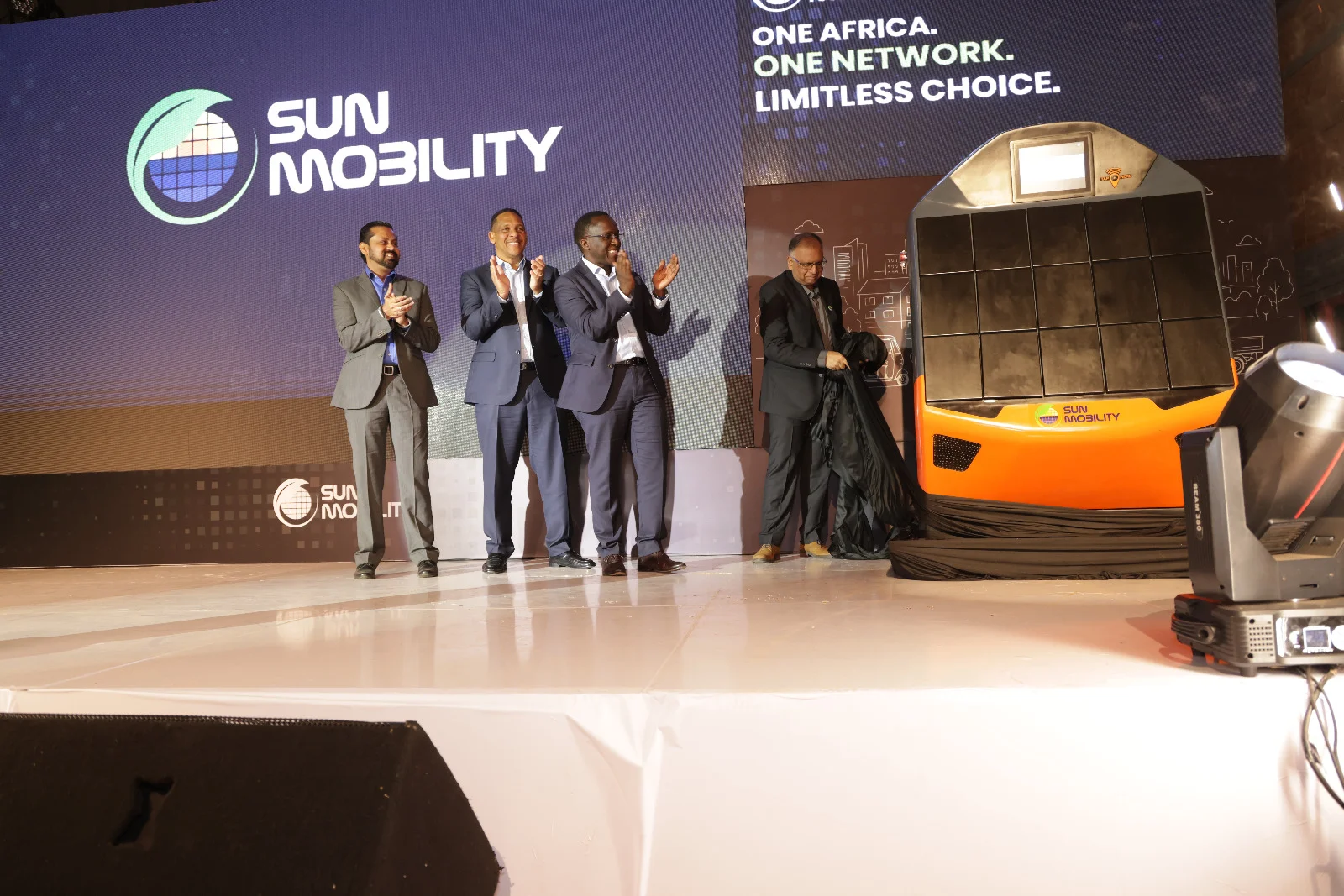

Kenya’s electric mobility market has entered a significant new phase with the launch of an open-architecture battery-swapping network by SUN Mobility in partnership with Vivo Energy.
The network is already operational with 35 battery-swapping stations across Nairobi and Mombasa, creating a new model for how electric motorcycles, scooters and three-wheelers can access energy without waiting hours for conventional charging.
This is more than the launch of another electric-vehicle service. It could mark an important shift in Kenya’s approach to EV infrastructure.
Instead of Charging, Riders Can Swap
The concept behind SUN Mobility is straightforward.
Rather than waiting for an electric vehicle’s battery to recharge, a rider arrives at a swapping station, removes the depleted battery and replaces it with a fully charged one.
SUN Mobility says the swap can take about two minutes.
Its technology uses smart batteries, Quick Interchange Stations and a cloud-connected network that monitors equipment and battery information in real time.
For commercial motorcycle and three-wheeler operators, that difference could be significant.
Time spent charging is time spent off the road. A system that allows a rider to replace a depleted battery in minutes could therefore make electric mobility more practical for people who depend on their vehicles for income.
One Network, Multiple Vehicle Brands
One of the most important aspects of the Kenyan rollout is its open architecture.
The network is designed to work across vehicles from multiple manufacturers rather than forcing each manufacturer to build its own proprietary battery-swapping infrastructure.
SUN Mobility says more than 10 vehicle manufacturers are already part of the ecosystem, including Afrina Neopower, BGauss, Fika Mobility, Motovolt, Odysse, Piaggio, QJ Motor, Sprocomm, VMOTO and Wylex.
The system supports electric motorcycles, scooters, passenger three-wheelers and cargo/loader three-wheelers.
That interoperability could become one of the biggest advantages of the model.
If EV manufacturers can rely on a shared energy network, they do not necessarily have to spend as much capital creating separate swapping networks for their customers.
For riders, meanwhile, a shared network potentially means greater freedom to choose between vehicle brands.
Why Kenya Is an Important Market
Kenya has emerged as one of Africa’s most active markets for electric two- and three-wheelers.
The country’s large boda-boda sector makes motorcycles particularly important to urban transportation and the wider economy.
But electric motorcycles still face several barriers, including upfront costs, range concerns and access to convenient charging infrastructure.
Battery swapping attempts to address all three.
SUN Mobility’s model separates the battery from the vehicle and offers energy as a service, which can reduce the need for customers to purchase and own the battery outright. The company says its approach is designed to address high upfront costs, range anxiety and long charging times.
That makes the technology particularly interesting for high-mileage commercial riders.
Shell Stations Could Become EV Energy Hubs
The partnership with Vivo Energy adds another important piece to the story.
Vivo Energy operates Shell and Engen-branded service-station networks across Africa. The partnership is intended to use that existing footprint to make battery-swapping infrastructure more accessible to riders.
SUN Mobility says its network could eventually reach more than 4,200 Shell and Engen-branded stations across 29 African countries.
This could transform the traditional role of a fuel station.
Instead of serving only petrol and diesel vehicles, stations could increasingly become multi-energy hubs, offering conventional fuel alongside battery swapping and other electric-mobility services.
For Africa, where existing fuel-station networks already provide strategically located transport infrastructure, this could be an important advantage.
The Economics Could Matter More Than the Technology
For riders, the biggest question will ultimately be simple:
Does an electric motorcycle make more money than a petrol motorcycle?
SUN Mobility says its solution can deliver savings compared with petrol vehicles, estimating around 20% savings for drivers travelling 100 kilometres per day and up to 35% at 150 kilometres per day.
If those economics hold up in real-world Kenyan operations, battery swapping could become more than an environmental proposition.
It could become a business proposition.
For a boda-boda operator working long hours every day, lower energy costs and less downtime can directly affect daily earnings.
The Network Is Only the Beginning
The current 35 stations represent the first stage of a much larger ambition.
SUN Mobility says its Africa expansion plans target 2,500 battery-swapping stations and more than 160,000 electric vehicles over five years.
Kenya is therefore being positioned as the launchpad for a broader African rollout.
That makes the success of the Kenyan network particularly important.
If battery swapping works at scale in Nairobi and Mombasa, the model could potentially expand into other Kenyan cities and then into additional African markets.
What Could Stop It From Working?
Despite the excitement, battery swapping still faces challenges.
The network needs enough stations in the right locations to make swapping genuinely convenient. It also needs sufficient battery availability during peak periods.
Vehicle compatibility must remain reliable as more manufacturers join the ecosystem.
And, perhaps most importantly, enough riders need to adopt compatible electric vehicles for the infrastructure to reach sustainable utilisation.
The economics will also need to be demonstrated consistently in the real world rather than only through projections.
Infrastructure scale will therefore be critical.
Kenya Could Become a Test Case for Africa
What makes SUN Mobility’s Kenyan launch particularly interesting is the combination of electric vehicles, shared infrastructure, software and an established energy network.
This isn’t simply about replacing petrol motorcycles with electric ones.
It is about creating a different way of delivering energy to vehicles.
The battery becomes an exchangeable energy asset. The swapping station becomes an energy hub. Software connects the batteries, vehicles, stations and users. And existing fuel-station infrastructure becomes part of the electric-mobility network.
That is a much bigger technology story.
With 35 stations already operating in Nairobi and Mombasa, Kenya now has an opportunity to demonstrate whether battery swapping can move electric mobility from an emerging technology into an everyday transportation solution.
The real test begins now: can Kenya’s boda-boda economy prove that electric mobility can be not only cleaner, but faster and more profitable?
