
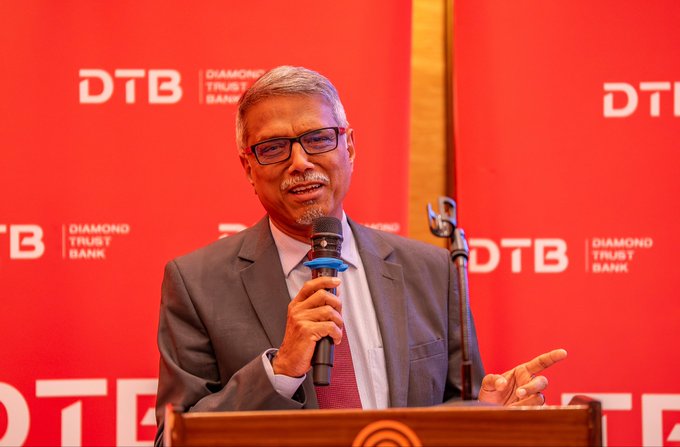

The results show how DTB’s investment in digital banking is increasingly becoming a major growth engine for the East African lender.
During the 12 months to June 2026, DTB’s customer base across Kenya, Tanzania and Uganda grew by 44% to 5.9 million, adding roughly 1.8 million customers from about 4.1 million a year earlier. Importantly, 99% of new customers were onboarded through digital platforms, highlighting the growing role of technology in the bank’s customer acquisition strategy.
DTB Profit Rises 37% to KSh9.8 Billion
DTB reported KSh9.8 billion in profit before tax for the six months ended June 30, 2026, representing a 37% increase from the same period in 2025.
The bank’s revenue also grew by 21%, supported by stronger interest income and increased activity across its markets. Net interest income increased by 26%, while non-interest income grew by 7%.
The performance marks another step in DTB’s turnaround and growth strategy following a strong 2025, when the bank reported a 26% increase in pre-tax profit and 21% growth in profit after tax to KSh10.7 billion for the full year.
1.8 Million New Customers in One Year
Perhaps the most striking figure in the latest results is DTB’s customer growth.
The bank now serves 5.9 million customers across East Africa, representing a 44% increase over the previous 12 months.
That means DTB added approximately 1.8 million customers in a single year.
But the bigger story is how those customers joined the bank.
According to the bank, 99% of new customers acquired during the year were onboarded digitally.
This suggests that DTB’s growth is increasingly being driven by mobile and digital channels rather than relying solely on its physical branch network.
For a traditional bank, the shift is significant because digital onboarding can make it easier to reach customers who may never visit a branch.
Digital Banking Is Becoming DTB’s Growth Engine
DTB says its DTB3.0 Business Growth Strategy is focused on customer acquisition and retention, stronger digital capabilities and improved customer propositions.
The numbers suggest the strategy is gaining traction.
More than 86% of all customer transactions were conducted through digital channels during the period, according to the bank’s latest results.
This represents a major shift in how customers interact with the bank.
Instead of visiting branches for routine services, customers are increasingly using digital platforms to transact, access financial products and interact with DTB.
The trend could also help DTB control costs as its customer base expands.
DTB Disburses KSh10 Billion in Digital Loans
Digital onboarding is not the only area where DTB is using technology to grow.
The bank extended approximately KSh10 billion in digital loans during the first half of 2026, targeting retail customers and small and medium-sized enterprises.
Digital lending allows banks to reach customers faster and potentially process applications without the lengthy procedures associated with traditional branch-based lending.
For DTB, combining digital customer acquisition with digital lending creates an opportunity to turn new account holders into active banking customers.
It also gives the bank more opportunities to cross-sell savings, payments, loans and other financial products.
Loans Grow 14% to KSh328 Billion
DTB’s overall lending business also expanded.
Loans and advances increased by 14% to KSh328 billion during the first half of 2026.
The increase indicates that the rapidly growing customer base is translating into greater demand for credit.
The bank continues to target retail customers, SMEs and mid-market businesses, while also maintaining its traditional relationships with larger commercial customers.
The challenge will be ensuring that faster loan growth does not lead to a deterioration in asset quality.
So far, the latest numbers suggest the bank is making progress on that front.
Loan Quality Improves
One of the more encouraging aspects of DTB’s results is the improvement in its non-performing loan ratio.
The bank’s NPL ratio declined to 11.6% from 13.0% a year earlier.
At the same time, its specific provision coverage ratio increased to 56.6% from 40.7%.
That means DTB has increased the level of provisions set aside against identified problem loans.
The improvement is particularly important because DTB is simultaneously growing its loan book.
A bank that grows rapidly but experiences worsening credit quality could face significant problems later. DTB’s improving NPL ratio provides a more positive signal, although the bank still has work to do.
DTB has previously targeted bringing its NPL ratio into the single digits.
Deposits Cross KSh534 Billion
Customer deposits also increased during the period.
DTB reported deposits of approximately KSh534 billion, representing 11% growth year-on-year.
Deposit growth is critical because deposits provide banks with an important source of funding for lending.
The combination of rising deposits and a larger loan book suggests DTB is expanding on both sides of its balance sheet.
It also gives the bank more capacity to support customers across its retail, SME and corporate segments.
Total Assets Reach KSh675 Billion
DTB’s total assets increased by more than 10% to approximately KSh675 billion.
The expansion reflects growth in lending and other areas of the bank’s balance sheet.
For investors, asset growth is useful to track alongside profitability and asset quality.
In DTB’s case, the combination of a growing balance sheet, higher profit and an improving NPL ratio provides a relatively positive picture of the lender’s first-half performance.
Costs Remain Under Control
DTB’s income growth was also supported by disciplined cost management.
Operating costs increased by about 6%, significantly slower than the 21% growth in revenue.
That difference matters.
If a bank can grow revenue faster than operating expenses, it can improve its efficiency and potentially generate stronger returns.
DTB says its growth strategy is also focused on operational efficiency and technology-backed processes.
AI and Automation Are Next
DTB isn’t stopping at digital onboarding.
The bank plans to increase its use of robotic process automation (RPA), digitised business processes and artificial intelligence as part of its next phase of growth.
According to the bank, it is also exploring agentic AI solutions to improve customer experience, service delivery, controls and compliance.
This could become an important area for DTB as competition among African banks increasingly moves beyond physical branches and traditional banking products.
AI could help banks automate repetitive processes, detect suspicious transactions, improve customer support and make internal operations more efficient.
DTB Still Plans to Expand Its Branch Network
The rise of digital banking does not mean DTB is abandoning physical branches.
The bank plans to open its 100th branch in Kenya by the end of 2026, taking its regional network to 163 branches across East Africa.
That creates an interesting hybrid strategy.
DTB is expanding its digital reach while continuing to invest in physical infrastructure.
For customers, this means the bank can combine digital services with physical locations for customers who need face-to-face assistance.
What This Means for Kenya’s Banking Industry
DTB’s performance highlights a broader transformation taking place across Kenya’s banking industry.
Banks are increasingly competing on:
- Digital account opening
- Mobile banking
- Digital lending
- Personalised financial products
- SME services
- Artificial intelligence
- Automated customer service
- Faster payments
The ability to acquire customers digitally is becoming particularly important.
DTB’s 99% digital onboarding rate demonstrates just how quickly traditional banking customer acquisition is changing.
The bank’s 2025 results had already shown strong customer growth, with its East African customer base reaching 4.5 million at the end of 2025 from 3.1 million a year earlier.
The latest figures show that momentum has continued.
Why DTB’s Digital Strategy Matters
For DTB, digital onboarding is more than a convenience feature.
It is becoming a way to scale the business.
Acquiring 1.8 million customers through traditional branches would require significant physical infrastructure, staff and time.
Digital onboarding allows the bank to reach customers at a much larger scale.
Once customers are onboarded, DTB can potentially offer them loans, savings products, payments and other financial services through the same digital ecosystem.
This creates a potentially powerful cycle:
Digital onboarding → more customers → more transactions → more lending opportunities → higher revenue.
The key will be ensuring that the growth remains profitable and that credit quality does not deteriorate.
The Bigger Challenge: Turning Customers Into Active Users
Adding millions of customers is impressive, but customer numbers alone do not guarantee sustainable growth.
The next question for DTB is how many of those new customers become active users.
Digital onboarding can make opening an account easier, but banks still need to encourage customers to transact, save, borrow and use other financial products.
DTB’s high digital transaction rate suggests the bank is making progress in this area, with more than 86% of transactions taking place through digital channels.
What Investors Should Watch Next
DTB’s latest results give investors several indicators to monitor going forward.
Customer growth
Can DTB continue adding customers at the current pace?
Digital engagement
Will customers acquired digitally become long-term active users?
Loan growth
Can the bank continue expanding its loan book without taking on excessive credit risk?
Asset quality
Can DTB push its NPL ratio below 10% while continuing to grow?
Efficiency
Can technology and automation help keep operating costs under control?
AI adoption
Will DTB’s planned AI and automation initiatives translate into measurable improvements in customer service and profitability?
These factors will determine whether the current growth can be sustained.
Final Takeaway
DTB’s latest results show that digital banking is no longer simply an alternative channel—it is becoming a central part of the bank’s growth strategy.
The lender added roughly 1.8 million customers in a year, taking its East African customer base to 5.9 million. Remarkably, 99% of new customers were onboarded digitally, while more than 86% of transactions were conducted through digital channels.
At the same time, DTB’s pre-tax profit rose 37% to KSh9.8 billion, loans grew 14% to KSh328 billion and deposits increased 11% to KSh534 billion.
Perhaps just as importantly, the NPL ratio improved from 13% to 11.6%.
For DTB, the next stage is clear: turn its rapidly expanding digital customer base into sustainable, profitable and high-quality growth.
With digital lending, automation and AI now becoming bigger parts of its strategy, DTB could increasingly look less like a traditional branch-led bank and more like a technology-enabled financial services company.
