
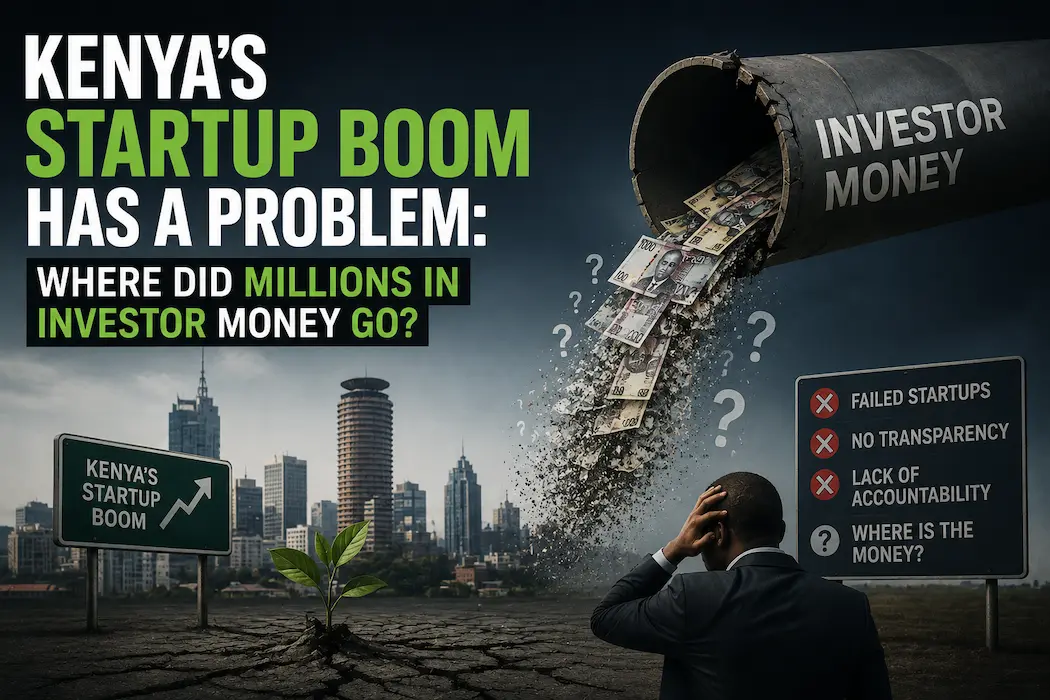

For years, Kenya was one of the biggest success stories in Africa’s technology ecosystem.
Nairobi became known as “Silicon Savannah.” International investors arrived, local founders raised increasingly large funding rounds, and startups working in fintech, agritech, logistics, healthtech, mobility and e-commerce promised to transform everyday life.
Then reality became more complicated.
Several Kenyan startups that had raised substantial amounts of venture capital eventually shut down, entered distress or dramatically changed direction.
A recent investigation by TechCabal found that 10 Kenyan startups on its list had raised more than $500 million combined before shutting down. Among them were Copia, which raised about $123 million, and Gro Intelligence, which raised more than $117 million.
That does not mean the entire Kenyan startup ecosystem is failing.
Far from it.
But it does expose a serious question for founders, investors and policymakers:
What happens when a startup can raise millions but cannot build a sustainable business?
Kenya’s Startup Story Is Bigger Than the Failures
It is important to put the recent shutdowns into perspective.
Kenya remains one of Africa’s most important technology markets, and investors continue to put money into businesses operating in the country.
In the first half of 2026, Kenyan startups secured about $157 million across 15 disclosed deals, according to TechCabal Insights. Climate, energy and agritech attracted significant investor interest.
Africa as a whole raised $1.44 billion in startup funding during the first half of 2026, showing that investors have not abandoned the continent.
The problem is therefore not simply that investors have stopped believing in Kenyan startups.
The bigger issue is that investors are becoming much more selective about which businesses deserve capital.
The Era of “Growth at All Costs” Is Fading
One of the biggest lessons from recent startup failures is that raising money is not the same as building a sustainable company.
During the global technology funding boom, startups could attract enormous valuations by demonstrating rapid user growth, aggressive expansion and the potential to dominate a market.
Profitability could come later.
But when global interest rates increased and venture capital became more cautious, that strategy became much harder to sustain.
African investors and founders have increasingly been forced to confront a new reality: growth without healthy economics eventually becomes expensive.
TechCabal’s H1 2026 review of Africa’s technology ecosystem noted that early-stage capital has become harder to secure and that investors are increasingly focused on sustainability and consolidation.
For Kenyan startups, that means the question is no longer simply:
“How fast can you grow?”
It is increasingly:
“Can this business eventually make money?”
So Where Did the Millions Go?
The answer is more complicated than simply saying that investors “lost” the money.
Startup funding is generally spent on building the business.
That can include:
- Salaries and hiring
- Technology development
- Marketing
- Customer acquisition
- Logistics
- Infrastructure
- Expansion into new markets
- Regulatory compliance
- Office operations
- Research and development
A startup that raises $50 million may spend years using that capital to build its product, acquire customers and expand.
If the business eventually collapses, much of the money may already have been spent.
The critical question is therefore not necessarily “Where did the money disappear?”
It is:
“Did the company convert that capital into a sustainable business?”
Copia Is a Major Example
Copia became one of Kenya’s most recognised startup stories.
The company built a digital commerce platform aimed at serving consumers who were traditionally underserved by formal e-commerce.
It raised approximately $123 million, according to TechCabal’s recent investigation.
Yet Copia ultimately shut down its Kenyan operations in 2024 after failing to secure additional funding.
Its story illustrates one of the biggest dangers facing startups:
A successful fundraising history does not guarantee a sustainable business model.
A company can have a strong mission, significant investor backing and a large market opportunity—and still run out of money.
Gro Intelligence Shows Another Side of the Problem
Gro Intelligence was another major Kenyan startup success story on paper.
The company used artificial intelligence and data analytics to provide agricultural and economic intelligence.
It attracted more than $117 million in funding before eventually shutting down.
Its collapse is particularly notable because AI and data were supposed to be among the most valuable technology opportunities in Africa.
The lesson is uncomfortable:
Having sophisticated technology does not automatically create a sustainable business.
A company still needs paying customers, manageable costs, strong execution and enough capital to survive difficult periods.
Why Startups Can Fail After Raising Millions
1. Customer acquisition can become too expensive
Some startups spend enormous amounts acquiring customers.
If a company spends KSh 1,000 to acquire a customer who generates only KSh 500 in profit, rapid growth actually makes the problem worse.
More customers mean more losses.
2. Expansion can happen too early
A startup may find some success in Kenya and decide to expand into several African markets.
Suddenly it faces different regulations, currencies, customer behaviour, infrastructure challenges and competitive environments.
Expansion increases costs dramatically.
3. Revenue may not grow as quickly as expenses
A startup can have millions of users and still struggle financially.
Users are not the same thing as revenue.
And revenue is not the same thing as profit.
Investors eventually want to know whether the company can generate enough gross profit to cover its operating costs.
4. Follow-on funding can disappear
Many startups depend on future funding rounds.
The model works when investors continue injecting capital.
But if the next funding round does not happen, a company with a high monthly burn rate can quickly find itself in trouble.
That is exactly why the funding environment matters so much.
Kenya’s Funding Environment Is Changing
Kenya’s startup ecosystem has experienced both extraordinary growth and increased pressure.
The country was Africa’s leading startup funding destination in 2025, but by the first half of 2026 it had been overtaken in the continental funding rankings, with its H1 funding haul representing its weakest performance since early 2021, according to Business Daily.
This does not mean investors have abandoned Kenya.
Instead, capital is becoming more concentrated around companies that can demonstrate strong fundamentals.
Investors increasingly want evidence of:
Revenue → retention → margins → sustainable growth → profitability.
That is a very different environment from the funding boom years.
The New Investor Question: “Show Me the Economics”
Kenyan founders now have to answer harder questions.
How much does it cost to acquire a customer?
How much revenue does each customer generate?
How long does a customer remain active?
How much does the company spend every month?
How much cash is left?
When can the business become profitable?
And perhaps most importantly:
What happens if you cannot raise another round?
A startup that can answer those questions convincingly is likely to be much more resilient than one whose entire strategy depends on continuous fundraising.
What This Means for Kenyan Entrepreneurs
The funding environment is not necessarily bad news for founders.
In some ways, it could produce a healthier ecosystem.
Entrepreneurs may become more disciplined about spending.
Instead of chasing vanity metrics, they may focus on customers who actually pay.
Instead of expanding across Africa immediately, they may build a profitable core business first.
Instead of hiring dozens of employees after a funding round, they may keep teams lean.
That could ultimately produce fewer startups—but stronger startups.
Investors Also Have Questions to Answer
The conversation should not focus only on founders.
Investors also need to examine how they evaluate African startups.
If a company raises tens or hundreds of millions before collapsing, there are questions about:
- Due diligence
- Growth assumptions
- Market-size estimates
- Unit economics
- Governance
- Founder oversight
- Follow-on funding strategies
Venture capital is inherently risky.
Some investments will fail.
That is normal.
But repeated large failures can reveal weaknesses in how opportunities are evaluated.
Kenya Still Has Enormous Potential
It would be a mistake to interpret startup failures as evidence that Kenya’s technology ecosystem is finished.
The country still has major advantages.
Kenya has:
- A sophisticated mobile-money ecosystem
- A large digital consumer market
- Strong fintech infrastructure
- A growing AI sector
- Increasing demand for digital services
- A growing pool of technology talent
- Nairobi’s position as a regional business hub
- Increasing interest in climate and energy technology
Investors are still funding Kenyan companies.
The difference is that the money is becoming harder to obtain and easier to lose.
The Next Winners May Look Different
The next generation of Kenyan technology companies may not necessarily be the startups with the biggest valuations or the loudest announcements.
They could be companies quietly solving difficult problems while generating real revenue.
Agriculture.
Energy.
Financial infrastructure.
Healthcare.
Enterprise software.
Cybersecurity.
AI.
Logistics.
Climate technology.
These sectors may not always generate the most exciting headlines, but they can create valuable businesses if entrepreneurs understand their customers and economics.
Kenya’s Startup Ecosystem Is Entering a New Phase
The first phase of Kenya’s startup boom was about proving that African technology companies could attract global capital.
That argument has already been won.
The next phase is more difficult.
Can Kenyan startups turn investment into durable companies?
The answer will determine whether Silicon Savannah becomes known primarily for producing successful funding rounds—or for producing companies that survive long enough to become major African businesses.
The shutdowns of heavily funded startups should therefore not be viewed simply as failures.
They are lessons.
For founders, the lesson is to build businesses that can survive beyond the next funding round.
For investors, it is to look beyond growth numbers and valuations.
And for Kenya, it is to create an environment where innovative companies can access capital while also developing the talent, infrastructure and markets needed to become sustainable.
The Bottom Line
Kenya’s startup boom did not necessarily waste hundreds of millions of dollars.
That money helped build products, employ people, develop technology and test ambitious business models.
But the collapse of startups that collectively raised more than $500 million shows that capital alone cannot guarantee success.
The next chapter of Kenya’s technology story will be less about how much money startups can raise and more about what they can build with it.
And that may ultimately be a healthier direction for Silicon Savannah.
