
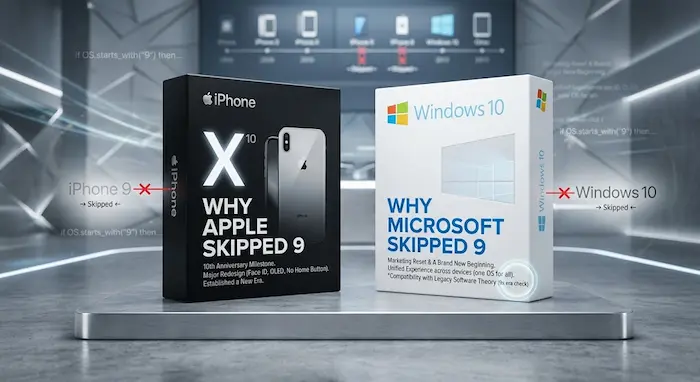

Technology companies usually follow simple numbering systems. Version 1 is followed by 2, then 3, 4 and so on.
But two of the world’s biggest technology companies broke that pattern in surprisingly visible ways.
Apple moved from the iPhone 8 to the iPhone X, while Microsoft went from Windows 8.1 to Windows 10.
So where did the number 9 go?
The answer is different for each company. Apple’s decision was closely connected to the 10th anniversary of the original iPhone and a major redesign. Microsoft’s decision is more complicated, with both branding considerations and a long-running compatibility theory involving older Windows software.
Here is what actually happened.
Apple Did Not Release an iPhone 9
In 2017, Apple introduced two familiar-looking numbered models: the iPhone 8 and iPhone 8 Plus.
But alongside them came a very different device: the iPhone X.
The “X” was pronounced “ten,” not “ex.”
Apple announced the iPhone X on September 12, 2017. The company described it as the beginning of a new era for the iPhone and highlighted technologies including its Super Retina OLED display, Face ID, TrueDepth camera system and A11 Bionic chip.
The timing was important.
The original iPhone had been introduced in 2007, making 2017 its 10th anniversary.
Apple itself referenced that milestone when introducing the iPhone X. The company said the original iPhone had revolutionized mobile phones 10 years earlier and described the iPhone X as a new era for the product.
So the sequence became:
iPhone 7 → iPhone 8 → iPhone X
There was no commercially released iPhone 9.
Why Did Apple Call It iPhone X?
The name helped separate the new device from the conventional numbered iPhone lineup.
The iPhone X was not simply an incremental specification upgrade.
It introduced several changes that became important to Apple’s smartphone strategy:
- A nearly all-screen front
- The removal of the traditional Home button
- Face ID
- An OLED display
- The TrueDepth camera system
- Wireless charging
- A new gesture-based interface
Apple’s own launch material described the device as a major transition for the iPhone rather than simply another annual numbered model.
The “X” therefore worked as both Roman numeral 10 and a marketing signal that Apple was entering a new phase.
It Was Not Simply a Case of Apple Forgetting Number 9
There is an important distinction here.
Apple did not permanently abandon numerical naming after the iPhone X.
The company later returned to conventional numbers with the iPhone XS, iPhone 11, iPhone 12, iPhone 13, iPhone 14, iPhone 15, and subsequent generations.
That makes the iPhone X’s name best understood in the context of its 2017 launch rather than as a permanent rule that Apple would never use the number 9.
Microsoft Also Jumped Over Windows 9
Microsoft’s numbering decision is even more mysterious.
The sequence before the jump was:
Windows 7 → Windows 8 → Windows 8.1 → Windows 10
There was no publicly released consumer version called Windows 9.
Microsoft announced Windows 10 in September 2014 and positioned it as the next generation of Windows rather than simply another incremental number following Windows 8.1.
But why not Windows 9?
That is where the famous compatibility theory comes in.
The Windows 95 and Windows 98 Problem
Before Windows 10, Microsoft had already released two hugely important operating systems whose names began with “Windows 9”:
- Windows 95
- Windows 98
Some older third-party software reportedly used simplistic methods to identify the Windows version.
Instead of properly checking the complete operating-system version, some applications could look for a string beginning with “Windows 9” and assume they were dealing with Windows 95 or Windows 98.
If Microsoft had released an operating system called Windows 9, that type of software could potentially have mistaken the new operating system for one of those older releases.
That is the basis of the famous Windows 9 theory.
But Was That Definitely the Reason?
Not according to publicly confirmed Microsoft documentation.
This is where many articles about Windows 9 become misleading.
The compatibility explanation originated from claims attributed to a person presenting themselves as a Microsoft developer and was widely reported in 2014. The theory was that early testing uncovered enough third-party software using simplistic “Windows 9” checks that avoiding the name became the practical option.
However, Microsoft did not publicly establish this as the official reason for the Windows 10 name.
Therefore, the safest explanation is:
The Windows 95/98 compatibility theory is plausible, but it should not be presented as a confirmed fact.
Microsoft also had a marketing reason to make Windows 10 feel like a significant reset after Windows 8.1.
Windows 10 Was More Than a Number Change
Microsoft wanted Windows 10 to represent a broader Windows platform.
The company was moving toward an operating system designed to work across different types of devices and provide a more unified experience.
The jump from Windows 8.1 to Windows 10 therefore made the new operating system look like a significant transition rather than another minor update.
The number itself was part of that positioning.
So Microsoft’s missing “9” may have had more than one consideration behind it.
The Two Missing 9s Are Not the Same Story
It is tempting to say:
“Apple and Microsoft both skipped 9 for the same reason.”
But that would be inaccurate.
The circumstances were different.
| Company | Previous version | What came next | Main documented context |
|---|---|---|---|
| Apple | iPhone 8 | iPhone X | 10th anniversary and major product redesign |
| Microsoft | Windows 8.1 | Windows 10 | Major Windows repositioning; legacy compatibility is a widely reported but unconfirmed theory |
Apple’s decision has a clear connection to the original iPhone’s 10-year anniversary. Microsoft’s decision has a less certain history.
That distinction matters when telling the story.
Why Technology Companies Sometimes Skip Numbers
Skipping a number is not unusual in technology.
Product names are not always designed purely for mathematical consistency.
Companies use naming to communicate things such as:
- A major redesign
- A new generation
- A milestone
- A change in strategy
- A different product category
- A marketing reset
- Compatibility considerations
A product can therefore move from version 8 to version 10 without version 9 ever becoming a consumer product.
Numbers Are Part of Branding
A technology product name is often a marketing tool.
For Apple, “X” immediately communicated “10” while giving the iPhone a more distinctive identity.
For Microsoft, “10” helped create a sense that the company was moving beyond the Windows 8 era.
The lesson is simple: technology version numbers are not always a strict mathematical sequence.
What Happened After iPhone X?
Apple eventually returned to straightforward numerical naming.
The company followed the iPhone X era with models including:
- iPhone XS
- iPhone 11
- iPhone 12
- iPhone 13
- iPhone 14
- iPhone 15
- iPhone 16
- iPhone 17
The missing iPhone 9 therefore became more of an interesting piece of Apple history than a permanent naming convention.
The iPhone X itself became particularly important because it established technologies and design choices that influenced subsequent iPhones.
What Happened After Windows 10?
Microsoft eventually moved from Windows 10 to Windows 11.
Windows 10 was released in 2015, while Windows 11 arrived in 2021.
Microsoft has also moved away from the old idea that every Windows release needs to follow a simple numerical progression.
For users in Kenya, the practical lesson is more important than the missing number.
A computer running an older version of Windows can continue working after support ends, but Microsoft warns that unsupported versions no longer receive normal security updates and technical support.
That is particularly relevant for Kenyan users relying on Windows PCs for banking, business, school, remote work and accessing sensitive online accounts.
What Kenyan Tech Users Can Learn From the Missing 9
The story may sound like harmless technology trivia, but it highlights an important issue for consumers.
Don’t judge technology only by its name.
A higher number does not automatically mean a better product.
Likewise, a missing number does not necessarily mean a company made a mistake.
When buying a phone or laptop in Kenya, users should pay attention to:
- Actual hardware specifications
- Software support
- Security updates
- Battery condition
- Repairability
- Warranty
- Network compatibility
- Storage and RAM
- Performance
- Total cost of ownership
This is particularly important in Kenya’s growing refurbished electronics market, where the model name alone does not tell you the condition or remaining useful life of a device.
For example, a refurbished phone with a familiar model number can still have a heavily degraded battery or damaged display.
That is why checking the actual condition of a device matters more than simply seeing a newer number on the box.
The Bottom Line
Apple skipped the iPhone 9 and went from the iPhone 8 to the iPhone X in 2017.
The timing was significant: it marked the 10th anniversary of the original iPhone, while the iPhone X introduced a major redesign and technologies such as Face ID and an OLED display. Apple itself described the device as marking a new era for the iPhone.
Microsoft went from Windows 8.1 to Windows 10 in 2014.
The company positioned Windows 10 as a major new generation of Windows. A widely reported explanation says Microsoft avoided “Windows 9” because of potential confusion with older software designed around Windows 95 and Windows 98. However, that explanation has never been firmly established by Microsoft as the official reason.
So the missing “9” has two different stories.
Apple’s jump was closely tied to a major anniversary and product redesign. Microsoft’s jump remains partly a naming mystery, with legacy software compatibility being one of the most persistent explanations.
Sometimes, in technology, the number you never see can be just as interesting as the one that gets released.
Frequently Asked Questions
Did Apple ever make an iPhone 9?
No. Apple never commercially released a phone officially called the iPhone 9. The company moved from the iPhone 8 and iPhone 8 Plus to the iPhone X in 2017.
Why did Apple skip the iPhone 9?
The iPhone X was introduced during the 10th anniversary period of the original iPhone and represented a major redesign. Apple described it as the beginning of a new era for the iPhone.
Was the iPhone X actually the iPhone 10?
Yes. The “X” is the Roman numeral for 10, and Apple pronounced the product name “iPhone ten.”
Did Microsoft release Windows 9?
No publicly released consumer version of Windows 9 exists. Microsoft moved from Windows 8.1 to Windows 10.
Why did Microsoft skip Windows 9?
One widely reported theory is that older software could interpret “Windows 9” as Windows 95 or Windows 98 because of simplistic version checks. However, Microsoft has not publicly confirmed that as the official reason.
Was Windows 9 cancelled?
There was no publicly released Windows 9 product that consumers were supposed to receive. Microsoft announced Windows 10 as the successor to Windows 8.1.
Is Windows 10 still supported?
Microsoft’s standard support for Windows 10 ended on October 14, 2025. Microsoft says unsupported Windows versions no longer receive normal security updates, quality updates or technical support, although eligible Windows 10 users may have Extended Security Updates options.
Why do technology companies skip numbers?
Companies can skip numbers for branding, product positioning, major redesigns, milestone anniversaries, compatibility concerns or other business and technical reasons. Product numbering is ultimately a naming strategy rather than a mathematical requirement.
