
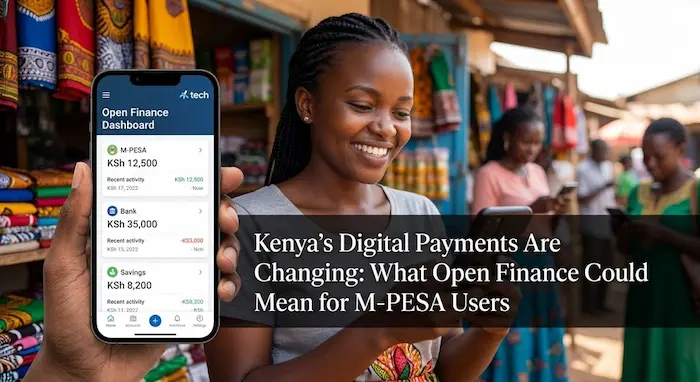

Kenya’s digital payments industry is entering another important phase.
For years, mobile money transformed how Kenyans send and receive money. Today, digital payments have expanded into merchant payments, banking, savings, investments, credit, insurance and business transactions.
Now, Kenya’s payment infrastructure could become even more connected.
On September 21, 2026, the Central Bank of Kenya (CBK) and National Treasury published the draft National Payment System Policy and National Payment System Bill, 2026. The proposals are intended to modernize Kenya’s payment framework, including interoperability, innovation, consumer protection, data protection and financial stability.
One of the most significant ideas in the proposals is open finance.
For ordinary Kenyans, that could eventually affect how financial information moves between banks, mobile-money providers and licensed fintech companies.
But the proposals are still at the draft stage. They should therefore not be interpreted as rules that are already fully in force.
Kenya’s Digital Payments Market Is Already Huge
Kenya has one of Africa’s most developed mobile-money ecosystems.
According to sector figures covering June 2026, Kenya had about 54 million mobile-money subscriptions, representing 101.3% penetration. M-PESA accounted for approximately 88.8% of those subscriptions.
The penetration figure does not mean that 101.3% of Kenyans have mobile-money accounts.
It is based on subscriptions rather than unique individuals. One person can have several mobile numbers or mobile-money accounts.
The numbers nevertheless demonstrate the scale at which digital payments operate in Kenya.
A typical Kenyan consumer can use a mobile phone to:
- Send money to another person
- Receive payments
- Pay a merchant
- Pay utility bills
- Purchase airtime
- Pay school fees
- Save money
- Access credit
- Invest
- Buy insurance
- Run a small business
The mobile phone has effectively become part of the country’s financial infrastructure.
What Is Changing in Kenya’s Digital Payments System?
The proposed National Payment System Bill seeks to establish a modern legal framework for Kenya’s payment system.
According to the CBK, the proposals are designed around areas including interoperability, financial inclusion, innovation, competition, consumer protection, data protection and financial stability.
This is important because Kenya’s digital-finance ecosystem has developed across several different types of providers.
There are:
- Mobile-money platforms
- Commercial banks
- Fintech companies
- Payment service providers
- Payment gateways
- Merchant-payment platforms
- Investment applications
- Digital lenders
- Insurance technology companies
The next stage of digital finance is increasingly about getting these systems to work together.
Kenya has already been moving in this direction through instant-payment initiatives.
For example, PesaLink provides real-time account-to-account transfers through participating financial institutions, while CBK has been working on a broader Fast Payment System intended to improve interoperability across the financial sector.
The new proposals could take that broader push further.
What Is Open Finance?
Open finance is a system in which customers can authorize regulated or approved third parties to access specified financial information held by different financial providers.
Imagine having accounts with:
- A bank
- M-PESA
- Airtel Money
- A savings platform
- An investment application
Instead of every service operating completely separately, an approved financial application could potentially bring information from multiple accounts into one place — with the customer’s authorization.
The idea is not simply to make companies share information freely.
Customer permission is a central part of the proposed framework.
That distinction matters.
Your financial information is sensitive, and any system that allows it to move between institutions needs clear rules around consent, security, accountability and consumer protection.
How Could Open Finance Affect M-PESA Users?
M-PESA is already deeply integrated into everyday financial activity in Kenya.
Open finance could potentially make it easier for other financial services to interact with information from established payment platforms.
For example, an authorized application could eventually help a user view information from multiple financial accounts in one interface.
A small business owner could potentially have a clearer picture of:
- Mobile-money transactions
- Bank transactions
- Business income
- Expenses
- Savings
- Cash flow
The exact services that become available would depend on the regulations, technical standards and implementation of the proposed framework.
That is why consumers should distinguish between what the draft Bill proposes and what is already available today.
Why Interoperability Matters
Another important concept is interoperability.
In simple terms, interoperability means different payment systems can communicate and transact with each other.
Kenya has already made progress in this area.
For consumers, better interoperability could eventually mean fewer barriers when sending money between different financial providers.
For businesses, it could make it easier to receive payments from customers using different financial platforms.
This could be particularly useful for Kenyan SMEs that increasingly accept digital payments.
Kenya’s Digital Payments Are Moving Beyond Sending Money
Mobile money started with a relatively simple proposition: send money from one phone to another.
That is no longer the whole story.
Kenya’s digital-finance ecosystem now covers a much broader range of services.
These include:
Merchant payments
Customers can pay businesses electronically instead of using cash.
Savings
Digital platforms allow customers to access savings products through mobile devices.
Investments
Some financial platforms allow customers to access investment products digitally.
Credit
Mobile and digital platforms have expanded access to different forms of credit, subject to eligibility and provider requirements.
Insurance
Insurance products are increasingly being distributed and accessed through digital channels.
Business payments
Businesses can receive customer payments and make payments to suppliers, employees and other parties digitally.
The result is a financial ecosystem where telecommunications, banking and fintech increasingly overlap.
What Could This Mean for Kenyan Businesses?
The changes are not only relevant to individual consumers.
Small and medium-sized businesses could also benefit from a more connected payment ecosystem.
Consider a Nairobi-based online retailer.
The business could receive payments through several channels while maintaining a bank account for its operating expenses.
Today, reconciling transactions across multiple platforms can require separate records.
A more interoperable ecosystem could eventually make it easier for businesses to connect payment information with accounting, financial-management and other business tools.
That could help businesses understand:
- Daily sales
- Payment sources
- Cash flow
- Customer payments
- Supplier expenses
- Business balances
However, these benefits depend on how the proposed framework is ultimately implemented.
The Data Privacy Question
This may be the most important part of the open-finance conversation.
Financial data can reveal a great deal about a person.
Transactions can show where someone spends money, which businesses they use and how frequently they make certain purchases.
That means greater connectivity also creates greater responsibility.
Kenya’s proposed payment framework includes consumer and data-protection objectives.
Consumers should therefore pay attention to questions such as:
Who can access my data?
What information are they accessing?
Why do they need it?
How long can they keep it?
Can I withdraw permission?
Who is responsible if my information is misused?
These questions will become increasingly important as financial services become more interconnected.
Is Open Finance Already Live in Kenya?
No.
This distinction is important.
The National Payment System Policy and National Payment System Bill, 2026 are proposals, not a statement that the proposed open-finance framework is already fully operational.
The CBK and National Treasury published the draft documents on September 21, 2026 as part of the process of developing a new payment-system framework.
The final framework, regulations and technical standards will determine how any new system actually operates.
For TechDrivers readers, this means the development is worth watching, but consumers should not assume that every proposed feature is currently available.
What Happens Next?
The next stage involves reviewing the proposals and developing the rules and systems needed to implement any changes that are eventually approved.
That could include decisions around:
- Data-sharing standards
- Customer consent
- Cybersecurity
- Liability
- Licensing
- Interoperability
- Consumer complaints
- Technical APIs
- Access requirements
The details matter because legislation can establish the framework while technical regulations determine how that framework works in practice.
How This Connects to Kenya’s Existing Fintech Story
This development is part of a much bigger transformation.
TechDrivers recently reported that Kenya had reached 54 million mobile-money subscriptions, with M-PESA accounting for 88.8% of the reported subscription market by June 2026.
The broader smartphone shift is also important.
Kenya had reached approximately 52.26 million smartphone connections by June 2026, creating an increasingly large potential audience for app-based financial services.
These developments are connected.
More smartphones → more digital services → more digital payments → more financial data → greater demand for interoperability and security.
That is the bigger story behind Kenya’s changing fintech landscape.
What Kenyan Consumers Should Watch
As the digital-payments ecosystem develops, consumers should pay attention to five areas.
1. Transaction costs
More competition and interoperability could change how providers price different transactions.
However, consumers should always check the current tariff before making a payment.
2. Data permissions
Before authorizing a financial application to access your information, understand what information it wants and why.
3. Security
Use strong authentication and avoid sharing PINs, passwords or one-time codes.
TechDrivers has previously covered how to protect an M-PESA account from fraud, including risks involving social engineering, SIM-swap attempts and unauthorized access.
4. New financial products
More connected systems could lead to new savings, investment, payment and financial-management services.
Consumers should compare fees, terms and risks before using them.
5. Regulatory changes
Because the current payment-system proposals are still being developed, users should follow updates from CBK and other relevant regulators.
Frequently Asked Questions
What are digital payments in Kenya?
Digital payments are electronic transactions that allow people and businesses to send, receive or make payments without relying exclusively on physical cash. They include mobile money, bank transfers, card payments, online payments and other electronic payment services.
What is open finance?
Open finance allows customers to authorize approved financial providers or third-party services to access specified financial information from different financial institutions, subject to applicable rules and customer consent.
Will open finance replace M-PESA?
There is no basis to say that the proposed open-finance framework will replace M-PESA. M-PESA is currently a major part of Kenya’s mobile-money ecosystem, with an 88.8% share of reported mobile-money subscriptions in June 2026.
Will my M-PESA data automatically be shared?
The proposed framework should not be interpreted as automatic unrestricted sharing of everyone’s financial information. The draft proposals contemplate customer authorization for open-finance data access. The final rules will determine how consent and data access operate in practice.
What is interoperability in digital payments?
Interoperability means different payment systems can communicate and work together, allowing users to transact across participating providers.
Is Kenya already using instant payments?
Yes. Services such as PesaLink already support real-time account-to-account transfers through participating institutions. CBK is also working toward a broader Fast Payment System.
Why is open finance important for fintech companies?
It could allow licensed financial-technology companies to build services that work with information and payment infrastructure from multiple providers, subject to regulation, customer authorization and technical requirements.
Is Kenya’s new National Payment System Bill already law?
No. The document published in September 2026 is a draft Bill. The final legal framework and implementation details may change during the legislative and regulatory process.
Conclusion
Kenya’s digital payments story is entering a new chapter.
The next stage is less about simply sending money from one phone to another.
It is about connecting payments, banks, fintech platforms, business systems and financial data.
But the final outcome will depend on the legislation, regulations, technical standards and safeguards that follow.
For Kenyan consumers, one thing is becoming increasingly clear: the smartphone is becoming an increasingly important gateway to the financial system.
The opportunity is greater convenience and potentially more choice.
The responsibility is making sure that convenience does not come at the expense of security, privacy and informed consumer choice.
