

If you’re considering Starlink for your home, business or rural property in Kenya, the biggest question is simple: how much does Starlink cost in Kenya in 2026?
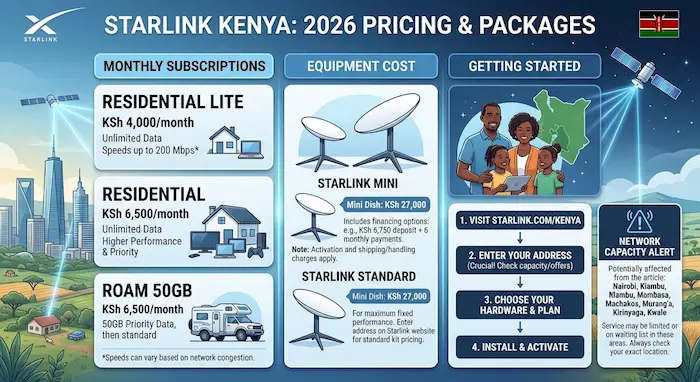
The good news is that Starlink has made its Kenyan service more affordable than it was when it first launched. As of August 2026, Starlink’s official Kenya website lists Residential Lite at KSh 4,000 per month and Residential at KSh 6,500 per month, both with unlimited data.
However, the monthly subscription isn’t the only cost. You also need to consider the Starlink hardware, installation, shipping and, depending on your location, whether the service is currently accepting new customers.
Starlink Kenya Prices in 2026
Here are the main residential options currently listed by Starlink for Kenya:
| Plan | Monthly price | Data | Best for |
|---|---|---|---|
| Residential Lite | KSh 4,000 | Unlimited | Smaller households |
| Residential | KSh 6,500 | Unlimited | Larger households/heavy users |
| Roam 50GB | KSh 6,500 | 50GB | Travel and mobile use |
Starlink says Residential Lite can provide speeds of up to 200 Mbps, although actual speeds can vary and may be lower during periods of network congestion. Residential is the higher-performance home option.
How Much Is the Starlink Kit in Kenya?
The hardware cost has changed considerably since Starlink launched in Kenya.
Starlink originally entered the Kenyan market with a much higher hardware price, but it has since introduced cheaper hardware and financing options.
For the Starlink Mini, Business Daily reported that the normal price was KSh 27,000, while Starlink introduced an instalment option that lowered the initial payment to KSh 6,750, followed by six monthly instalments. Customers also faced activation and shipping/handling charges.
Starlink’s own website advises customers to enter their service address to see the exact hardware and service pricing available in their area because offers and hardware prices can vary by location.
Starlink hardware options
The two main choices you’ll encounter are:
Starlink Mini
- Smaller and more portable
- Lower hardware cost
- Suitable for lighter household use
- Easier to move around
Starlink Standard
- Larger dish
- Designed for higher-demand fixed-location use
- Better suited to larger households and businesses
If you’re buying Starlink primarily for a home or office, the Standard system can make more sense. If portability and lower upfront cost are important, the Mini is worth considering.
How Much Will Starlink Cost You in the First Year?
This is where buyers need to look beyond the advertised monthly price.
For example, using the current KSh 4,000 Residential Lite price:
12 months × KSh 4,000 = KSh 48,000
For Residential:
12 months × KSh 6,500 = KSh 78,000
That is before adding the hardware and any applicable shipping, activation or installation costs.
So a household should not simply compare KSh 4,000 Starlink with a KSh 3,000 or KSh 4,000 fibre package.
The total first-year cost matters.
Starlink vs Traditional Fibre
Starlink’s biggest advantage is availability.
Fibre requires physical infrastructure to reach your home. Starlink only needs the appropriate equipment and a clear view of the sky.
That makes satellite internet particularly attractive for people living in areas where fibre isn’t available or where existing internet services are unreliable.
For someone living in a Nairobi apartment with good fibre coverage, however, Starlink may not necessarily be the best-value option.
A fibre connection can offer excellent performance and lower latency without requiring a satellite dish.
Starlink Is Becoming More Accessible
The introduction of cheaper hardware and instalment payments is significant.
When Starlink entered Kenya in 2023, its installation kit reportedly cost KSh 89,000. The standard kit was later reduced to around KSh 45,500, while cheaper service options were introduced.
The Mini instalment programme represents another attempt to reduce the barrier to entry.
Instead of paying the entire hardware cost at once, eligible customers can spread the remaining cost over several months.
For Kenyan households and small businesses with limited upfront cash, that can make satellite internet considerably easier to access.
But There Is a Major Catch in 2026
There is an important issue prospective buyers need to know about.
Starlink has recently reached capacity in parts of Kenya.
In July 2026, reports indicated that Starlink had stopped accepting new customers in several counties, including Nairobi, Kiambu, Mombasa, Machakos, Murang’a, Kirinyaga and Kwale, because demand had exceeded available network capacity in those areas. Customers in affected locations were directed toward a waiting list.
This means seeing a Starlink price online does not necessarily mean you can immediately order the service at your location.
Before spending money on equipment, check your exact address on Starlink’s website.
Is Starlink Worth KSh 4,000 a Month?
For the right customer, yes.
Starlink Residential Lite becomes particularly attractive if you:
- Live outside a fibre-covered area
- Need reliable internet in a rural location
- Work remotely
- Run an online business
- Need a backup internet connection
- Have poor local broadband options
- Need internet at a location where installing fibre is difficult
For someone already enjoying reliable fibre in Nairobi, Starlink’s value proposition is less obvious.
Is Starlink Residential at KSh 6,500 Worth It?
The KSh 6,500 Residential plan is aimed at users who need more performance than the Lite tier.
It’s better suited to:
- Larger families
- Heavy streaming households
- Remote workers
- Content creators
- Small offices
- Users connecting many devices
Starlink advertises Residential as its better-performing home service, while Residential Lite is positioned as the everyday home option.
What About Starlink for Business?
Starlink also offers business plans in Kenya.
Its official Kenyan business page currently lists Local Priority 50GB from KSh 4,200 per month, with higher tiers including:
- 500GB — KSh 10,600/month
- 1TB — KSh 18,600/month
- 2TB — KSh 34,600/month
These plans provide prioritised data and are designed for businesses with different connectivity requirements.
For a small business, the appropriate plan will depend heavily on how much data employees consume and whether Starlink is being used as the primary connection or as a backup.
Starlink vs Safaricom: Which Is Cheaper?
This is where your decision becomes more complicated.
If you have access to good fibre, Safaricom and other fibre providers can offer strong value for a fixed home connection.
Starlink’s advantage isn’t necessarily that it is always cheaper.
Its real advantage is that it can provide broadband without a fibre cable reaching your property.
That’s particularly important for rural Kenya and locations where traditional broadband infrastructure hasn’t reached.
Final Verdict
Starlink Kenya is significantly more affordable in 2026 than it was when the service first launched.
The current KSh 4,000 Residential Lite plan and KSh 6,500 Residential plan make the service more accessible, while instalment options for the Mini hardware reduce the upfront cost.
But price shouldn’t be the only consideration.
The most important question is:
What internet options are available at your exact location?
If you already have reliable fibre, Starlink may not offer enough additional value to justify the cost.
If you’re in a rural or underserved area, however, Starlink could be one of the most practical ways to get high-speed internet.
And in 2026, there’s one more thing to check before ordering: whether Starlink has capacity available in your county.
