

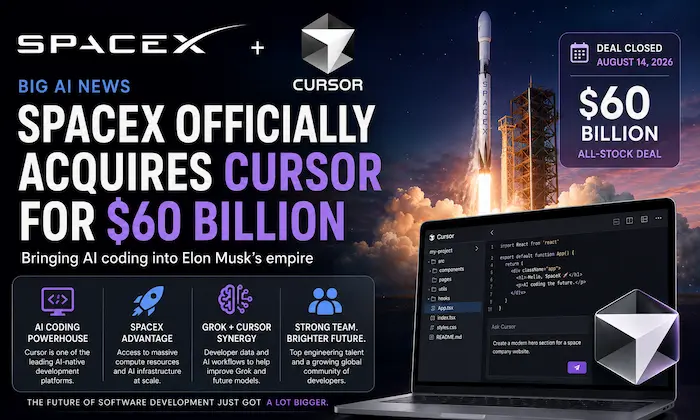

The transaction officially closed on August 14, 2026, according to recent filings and reporting, making Anysphere a wholly owned subsidiary of SpaceX. The deal is an all-stock transaction based on an implied $60 billion valuation for Cursor.
The acquisition is significant because SpaceX is no longer positioning itself solely as a space and satellite company. Its filings describe a strategy that combines compute infrastructure, AI models and applications, with Cursor playing an important role in that strategy.
SpaceX’s $60 billion bet on AI coding
Cursor is an AI-native development environment designed to help professional developers and engineering teams write, edit, review and refactor software using AI agents and workflows.
Instead of simply providing autocomplete suggestions, Cursor allows developers to interact with their code using natural-language instructions and AI-powered tools.
That makes the acquisition strategically important for SpaceX.
The company isn’t simply buying a software application. It is gaining access to:
- AI coding technology
- Developer workflows
- Engineering talent
- Coding-related data
- AI model expertise
- An established developer customer base
SpaceX’s own filings describe software development as a strategically important AI use case because coding produces structured, verifiable data and frequent feedback that can help improve AI models.
Cursor is now part of SpaceX
SpaceX initially announced its agreement to acquire Anysphere in June 2026.
The company’s SEC filing stated that SpaceX would acquire Anysphere through a wholly owned subsidiary, with Cursor surviving as a wholly owned subsidiary of SpaceX. The transaction was valued at an implied $60 billion equity value and would be paid using SpaceX Class A shares.
The acquisition was expected to close during the third quarter.
That process has now been completed.
Recent reports say the merger became effective on August 14, officially bringing Cursor under SpaceX.
Why does SpaceX want Cursor?
The answer is bigger than coding.
SpaceX is increasingly building an AI ecosystem around its enormous computing infrastructure.
Its strategy involves bringing together:
Computing power → AI models → software applications → users
Cursor fits directly into that model.
SpaceX’s regulatory filings explain that the company had already been providing Cursor with GPU cluster capacity and collaborating with it on AI models, including Grok.
The acquisition takes that relationship to another level.
Instead of simply partnering with Cursor, SpaceX now owns the company.
Cursor could help improve Grok
One of the most interesting parts of the deal is the potential connection between Cursor and Grok, SpaceX’s AI model family.
SpaceX said its collaboration with Cursor could accelerate development of its AI models.
Cursor brings valuable information from real-world software development, including developer prompts, coding iterations, workflows and software architecture decisions.
SpaceX believes this type of information can help improve AI model training and inference.
In simple terms:
Developers use Cursor → Cursor generates valuable coding interactions → those interactions can help improve AI → better AI can improve Cursor.
That creates a potentially powerful feedback loop.
SpaceX brings massive computing power
The relationship also works in the opposite direction.
Cursor gets access to SpaceX’s large-scale computing infrastructure.
SpaceX’s filings say it would provide Cursor with GPU cluster capacity for AI model development, training and improvement.
This is important because AI coding companies need enormous computing resources to train and operate increasingly sophisticated models.
SpaceX therefore brings something Cursor could not easily build on its own:
massive compute infrastructure.
The combination could allow Cursor to develop more capable AI coding systems while potentially reducing the cost of running those systems.
This isn’t SpaceX’s traditional business
The acquisition shows how dramatically SpaceX’s business ambitions have expanded.
SpaceX describes itself as building integrated infrastructure across space, connectivity and AI.
That means its technology portfolio now extends far beyond rockets.
Its broader ecosystem includes areas such as:
🚀 Space transportation
🛰️ Satellite connectivity
🤖 Artificial intelligence
💻 Developer software
🖥️ AI computing infrastructure
Cursor fits into the last three categories.
That makes the acquisition strategically significant even though Cursor has nothing directly to do with rockets.
Why AI coding is so valuable
AI-assisted software development has become one of the fastest-growing areas of generative AI.
Developers can now ask AI systems to:
- Generate code
- Explain existing code
- Find bugs
- Rewrite applications
- Create tests
- Build features
- Refactor large codebases
- Review pull requests
- Automate repetitive engineering tasks
This is changing the economics of software development.
A developer who previously spent hours writing a particular function can increasingly describe what they want and allow AI to produce an initial implementation.
Cursor is positioned directly in this market.
SpaceX is buying more than software
The $60 billion valuation is enormous.
But SpaceX’s filings indicate that the value it sees in Cursor extends beyond the application itself.
At the time of its earlier filings, SpaceX said Cursor had $3.1 billion in total assets, including approximately $2.7 billion in cash and cash equivalents and about $550 million in liabilities. SpaceX also expected the acquisition price to be primarily allocated to goodwill.
The company also expected to retain key Cursor talent through competitive compensation and retention incentives.
That suggests the engineers and technical expertise behind Cursor are a major part of what SpaceX is buying.
The acquisition could reshape the AI coding market
Cursor now finds itself inside one of the world’s most ambitious technology companies.
That could put pressure on competitors such as:
- GitHub Copilot
- OpenAI’s coding tools
- Anthropic’s coding products
- Google’s AI developer tools
- Other AI-native coding startups
The key question is whether SpaceX can use Cursor’s technology and developer data to create a stronger AI ecosystem.
If successful, Cursor could become much more than an AI code editor.
It could become an important distribution channel for SpaceX’s AI models.
What happens to Cursor users?
For developers already using Cursor, the immediate question is whether the acquisition will change the product.
SpaceX has not indicated that Cursor will suddenly disappear or be replaced.
Instead, the strategic direction appears to be continued development of the platform while integrating SpaceX’s AI models and computing capabilities more deeply.
The acquisition could eventually mean:
Better AI models + faster infrastructure + deeper Grok integration + more powerful coding agents.
But users will also watch closely for changes to pricing, privacy, data policies and product direction.
Those issues will become increasingly important as Cursor becomes part of a much larger corporate structure.
What does this mean for developers?
The biggest potential impact could be on the way software is created.
If Cursor and SpaceX succeed in combining powerful AI models with large-scale computing, developers could gain access to increasingly autonomous coding agents.
Instead of simply asking:
“Write this function.”
developers could increasingly ask AI systems to:
Understand the project → plan the work → modify multiple files → test the changes → identify problems → fix them.
That could dramatically increase developer productivity.
It could also change what companies expect from software engineers.
The value may increasingly shift from manually writing every line of code toward architecture, problem solving, product design, verification and managing AI agents.
A major strategic bet for Elon Musk
For Elon Musk, the acquisition fits a broader pattern of bringing different technology businesses and capabilities closer together.
SpaceX now has access to:
AI models + computing infrastructure + developer software + massive engineering talent.
The $60 billion Cursor acquisition therefore looks less like a traditional software acquisition and more like another piece of a larger AI strategy.
SpaceX’s own filings explicitly describe the Cursor relationship as part of its attempt to vertically integrate compute infrastructure, models and applications.
That is perhaps the most important part of this story.
The bigger picture
The boundaries between technology industries are disappearing.
A space company can become an AI company.
An AI company can become a software company.
A software company can become a cloud-computing company.
And a coding platform can become part of an aerospace and AI giant.
SpaceX’s acquisition of Cursor is a powerful example of that convergence.
The company is betting that the future of AI won’t be controlled by one product or one model.
Instead, the winners may be companies that control the computing infrastructure, the models, the applications and the users.
Cursor gives SpaceX a major piece of that puzzle.
Conclusion
SpaceX’s $60 billion acquisition of Cursor is one of the clearest signs yet that the company is expanding far beyond rockets and satellites.
With the deal now completed, Cursor becomes part of SpaceX’s growing AI strategy, giving the company an established AI coding platform, engineering talent and access to valuable developer workflows.
At the same time, Cursor gains access to SpaceX’s enormous computing infrastructure and the opportunity to work more closely with AI models such as Grok.
The biggest question is no longer simply how good Cursor’s coding assistant can become.
It is whether SpaceX can turn Cursor into a central part of a much larger AI ecosystem spanning compute, models, software and developers.
And that could make this $60 billion acquisition much more important than the headline suggests.
