
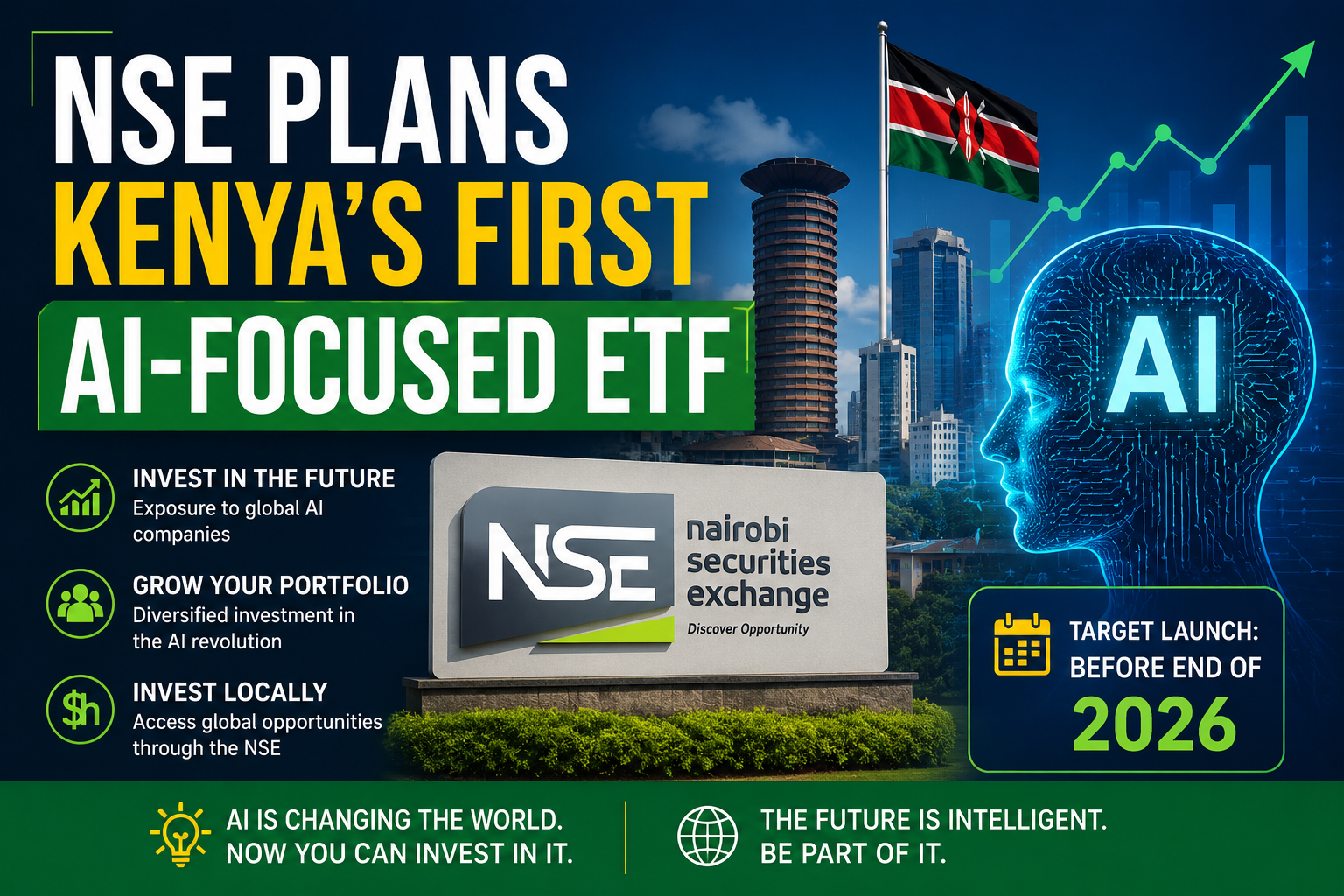

The Nairobi Securities Exchange is preparing to launch East Africa’s first artificial intelligence-focused exchange-traded fund, giving Kenyan investors a new way to gain exposure to the rapidly growing global AI industry.
Kenya’s investment market could soon get a major technology-focused product as the Nairobi Securities Exchange (NSE) prepares to introduce an artificial intelligence-focused exchange-traded fund (ETF) before the end of 2026.
The planned ETF would give investors in Kenya access to a basket of global companies with significant exposure to artificial intelligence without requiring them to directly purchase shares on foreign stock exchanges.
The initiative is part of the NSE’s broader push to expand investment products, attract younger investors and make it easier for Kenyans to participate in global investment opportunities through the local market.
What Is an AI ETF?
An exchange-traded fund is an investment product that tracks the performance of an underlying basket of assets. ETFs are traded on a stock exchange in a similar way to ordinary shares.
According to the NSE, an ETF can track an index, a basket of shares, bonds, money-market instruments or another underlying asset. Investors buy units of the ETF rather than having to purchase every underlying asset individually.
In the case of the proposed AI ETF, the underlying portfolio would focus on companies directly exposed to the artificial intelligence industry.
Companies such as Microsoft, OpenAI and Anthropic have been cited as examples of the type of global AI businesses that could influence the fund’s structure. However, the final list of companies and the exact composition of the ETF have not yet been announced.
Why the NSE Is Turning to AI
Artificial intelligence has become one of the biggest investment themes globally.
The rapid development of generative AI, cloud computing, AI chips, data centres and enterprise AI has created significant demand for companies providing the infrastructure and software behind the technology.
The NSE wants Kenyan investors to have more opportunities to participate in these global trends without necessarily having to open accounts with overseas brokers.
NSE Chief Executive Officer Frank Mwiti said the planned product is aimed partly at meeting growing interest in AI investments, particularly among younger investors.
The move also comes as the Kenyan stock market seeks to diversify beyond traditional sectors such as banking and telecommunications.
How Could the ETF Work for Kenyans?
If approved and launched as currently planned, investors could potentially purchase units of the AI ETF through the Kenyan capital-markets system.
Instead of buying individual shares in several international technology companies, an investor would buy the ETF, which would provide exposure to a broader portfolio.
For example, rather than separately purchasing shares or investment interests linked to multiple AI companies, the ETF could bundle exposure to a number of companies into one listed product.
This could make international technology investing simpler for some Kenyan investors.
The proposed ETF is also expected to be denominated in Kenyan shillings, which could help reduce some of the foreign-exchange complications that Kenyan investors face when investing directly in overseas markets.
However, a shilling-denominated ETF would not necessarily eliminate all currency-related risks. The underlying global assets could still be affected by movements in the Kenyan shilling against currencies such as the US dollar.
A New Opportunity for Younger Investors
The NSE is increasingly looking for ways to attract younger Kenyans into the capital markets.
Technology companies and AI have become particularly attractive to younger investors who are already familiar with digital platforms, artificial intelligence tools and global technology brands.
An AI ETF could therefore provide a bridge between Kenya’s growing technology culture and the country’s traditional investment market.
Rather than investing only in familiar local sectors, investors could gain exposure to the companies driving some of the world’s biggest technological changes.
The ETF Could Help Keep Investment Money in Kenya
Another important motivation behind the initiative is the growing interest among Kenyans in investing outside the country.
Some Kenyan investors already use international platforms to gain exposure to global technology companies.
By offering global investment themes through the NSE, the exchange hopes to provide more options locally and potentially reduce the need for investors to move their investment activity to foreign markets.
This could also strengthen Kenya’s position as a regional financial hub.
But There Are Risks
The planned AI ETF does not mean investors are guaranteed to make money.
Technology stocks can experience significant price swings, particularly when investor expectations around AI become extremely high.
The NSE itself is monitoring concerns about a potential AI investment bubble. Frank Mwiti indicated that market conditions could influence the timing of the product’s launch, with the exchange prepared to delay it if necessary to protect investors.
Investors should therefore understand that an AI ETF would carry investment risks, including market volatility, technology-sector concentration, currency exposure and changes in the value of the underlying global companies.
Kenya’s Stock Market Is Becoming More Technology-Focused
The proposed AI ETF is part of a broader transformation taking place at the NSE.
The exchange has been working to expand the range of investment products available to Kenyan investors while increasing retail participation and embracing technology.
The AI ETF could become another step toward connecting Kenya’s capital markets with global technology trends.
The NSE is also exploring other technology-related investment products, including a possible cryptocurrency ETF, although that would depend on developments in Kenya’s regulatory framework for crypto assets.
What This Means for Kenyan Investors
For ordinary Kenyan investors, the most important development is not simply the introduction of an AI-themed product.
It is the possibility of gaining easier access to an industry that has traditionally required investors to look outside Kenya.
If successfully launched, the ETF could provide exposure to some of the world’s largest AI-related businesses through a product available on Kenya’s own capital market.
However, investors should not rush into the product simply because AI is popular.
Understanding the ETF’s fees, underlying companies, risk level, tracking methodology, currency exposure and regulatory structure will be important before investing.
When Will the AI ETF Be Available?
The NSE is targeting a launch before the end of 2026, but the product is not yet available for trading.
The final investment portfolio, pricing, fees, regulatory approvals and trading arrangements will need to be communicated before investors can purchase units.
For now, Kenyan investors should treat the announcement as a planned investment product rather than an investment opportunity that is already open.
The Bigger Picture
The NSE’s planned AI ETF represents more than a new investment product.
It signals Kenya’s growing attempt to connect its local financial markets with the global technology economy.
Artificial intelligence is increasingly influencing everything from banking and healthcare to telecommunications, manufacturing and cybersecurity. Giving Kenyan investors a way to participate financially in that growth could help make the country’s capital markets more relevant to the digital economy.
If successfully launched, the ETF could also encourage the development of additional technology-focused investment products in Kenya.
For investors, the message is simple: AI may soon become not only a technology story in Kenya, but also an investment story.
This article is for informational purposes only and does not constitute financial or investment advice. Investors should conduct their own research and seek professional financial advice before investing.
