
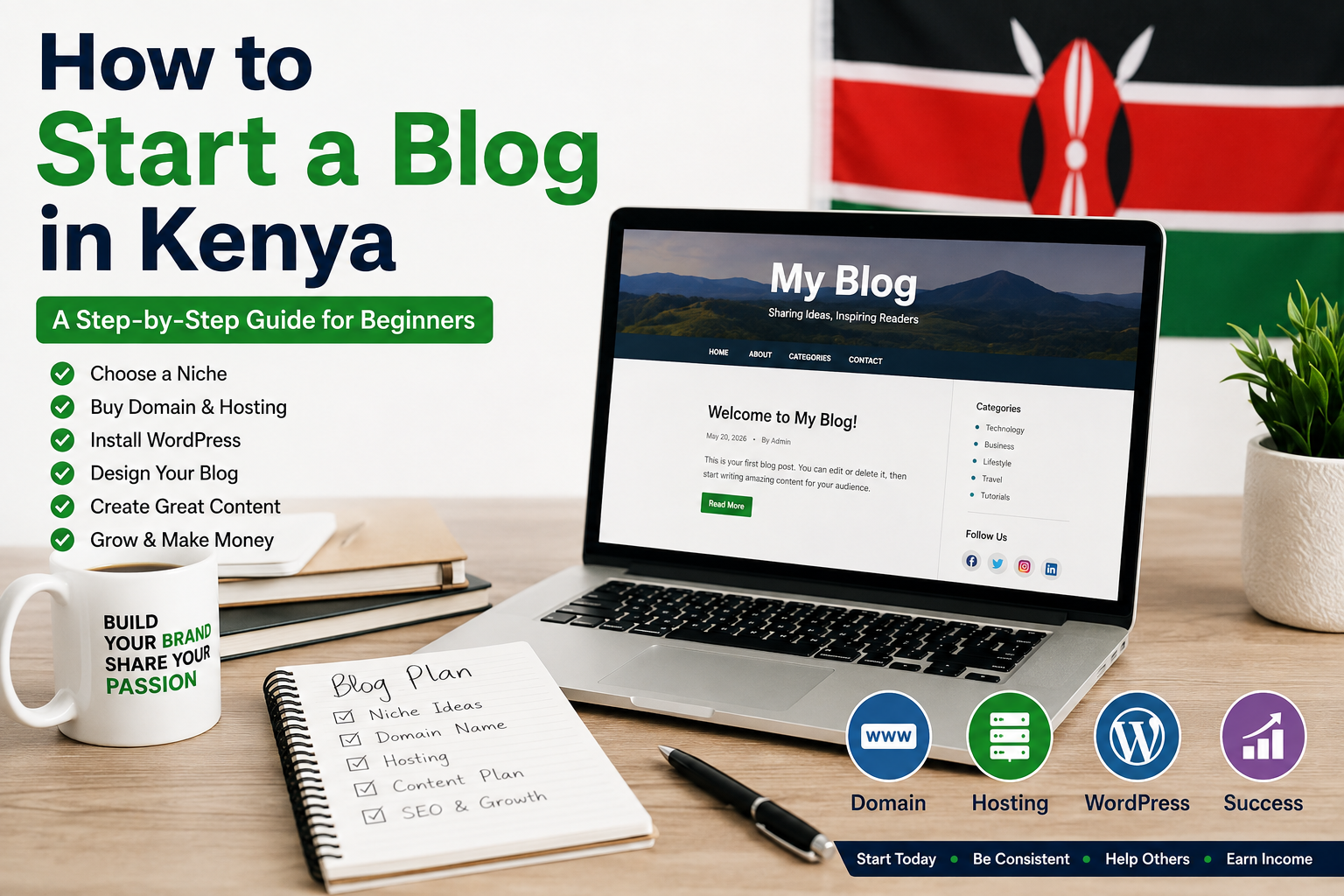

Starting a blog in Kenya is easier than it was a few years ago. You can launch a website with a domain name, web hosting and WordPress without knowing how to code.
Whether you want to write about technology, business, travel, education, agriculture, entertainment or another subject, a blog can help you build an audience, establish expertise and eventually create income.
However, starting a blog is only the first step. Building one that attracts readers requires a clear niche, useful content, search engine optimisation, consistent publishing and patience.
This guide explains how to start a blog in Kenya in 2026 and what you need to know before publishing your first article.
What Is a Blog?
A blog is a website where an individual, organisation or business regularly publishes articles and other forms of content.
Depending on the niche, a blog can publish:
- News
- How-to guides
- Reviews
- Tutorials
- Comparisons
- Opinion articles
- Educational content
- Interviews
- Research and analysis
Blogs can also become businesses through advertising, sponsored content, affiliate marketing, subscriptions, digital products and professional services.
Step 1: Choose a Clear Niche
Before buying a domain, decide what your blog will focus on.
A niche helps you build an identifiable audience and makes it easier to develop related articles over time.
Some niches that can work in Kenya include:
- Technology
- Artificial intelligence
- Smartphones
- Business
- Personal finance
- Education
- Agriculture
- Travel
- Careers
- Digital marketing
- Entertainment
- Sports
You don’t necessarily have to cover only one narrow subject. However, your topics should have a logical connection.
For example, a technology publication could cover smartphones, AI, cybersecurity, telecommunications, gadgets and electric mobility.
How to Choose a Good Niche
Ask yourself:
- Do people search for information about this topic?
- Can I consistently create useful content?
- Do I understand the subject?
- Are there businesses advertising in this industry?
- Can the niche support content for several years?
Avoid choosing a niche simply because it is trending.
Step 2: Choose a Domain Name
Your domain is the address people use to access your website.
Examples include:
- yourbrand.co.ke
- yourbrand.com
- yourbrand.africa
For a Kenyan-focused publication, a .co.ke domain can help establish a clear local identity.
Choose a domain that is:
- Short
- Easy to spell
- Easy to remember
- Professional
- Relevant to your brand
- Flexible enough to accommodate future growth
Avoid numbers, unnecessary hyphens and names that are difficult to pronounce.
Step 3: Buy Web Hosting
Web hosting stores your website’s files and makes them available on the internet.
When comparing hosting plans, look at:
- Storage
- Bandwidth
- Server performance
- Uptime
- SSL support
- Backups
- WordPress compatibility
- Customer support
- Ability to upgrade as traffic grows
Some Kenyan hosting providers support local payment methods such as M-Pesa, which can make purchasing easier.
Don’t choose a hosting package solely because it is the cheapest. Poor hosting can result in slow loading times and unreliable website performance.
Step 4: Install WordPress
For beginners, WordPress is one of the easiest ways to build a professional blog.
You don’t need to understand programming to publish articles, upload images or create pages.
WordPress allows you to:
- Publish articles
- Create categories
- Add images and videos
- Manage multiple authors
- Install SEO tools
- Add contact forms
- Connect analytics
- Build newsletters
- Add ecommerce functionality
Many hosting companies provide automatic or one-click WordPress installation.
Step 5: Choose a Fast, Mobile-Friendly Theme
Your theme controls how your website looks.
Since many Kenyan readers access websites using smartphones, mobile responsiveness should be a priority.
Look for a theme that:
- Works well on mobile devices
- Loads quickly
- Has clean navigation
- Supports categories
- Receives regular security updates
- Allows you to customise branding
- Does not include unnecessary features
Avoid filling your homepage with too many sliders, advertisements, widgets or animations.
A clean website is usually easier for both readers and search engines to navigate.
Step 6: Configure Your Website
Before publishing articles, configure the basic parts of your website.
Set up:
- Your site title
- Logo
- Favicon
- Navigation menu
- Categories
- Permalink structure
- Author profiles
- Contact information
- Social media accounts
Create a simple navigation system so visitors can quickly find important sections of your site.
Step 7: Create Important Pages
A professional blog should have more than articles.
Consider creating:
About Page
Explain who operates the website, what it covers and who the content is intended for.
Contact Page
Give readers, businesses and potential partners a way to contact you.
Privacy Policy
Explain how your website collects and uses information.
Terms and Conditions
Set out the rules governing use of your website.
Editorial Policy
Explain how you select, research and publish content.
Corrections Policy
Tell readers how factual errors are handled.
Advertising or Media Page
If you intend to work with brands, explain your advertising and partnership opportunities.
These pages also help establish transparency and credibility.
Step 8: Publish Useful Content
Your blog will not grow simply because you publish frequently.
Focus on creating content that answers questions, solves problems or provides information readers cannot easily get elsewhere.
Useful formats include:
- Step-by-step guides
- Product reviews
- Comparisons
- Original reporting
- Explainers
- Tutorials
- Interviews
- Industry analysis
For example, instead of publishing a generic article titled “Best Phones in Kenya,” you could create a more useful article such as:
“Best Smartphones Under KSh 30,000 in Kenya: Features, Prices and What to Consider.”
The second topic gives readers a clearer reason to click.
Step 9: Make Your Content Original
One of the biggest mistakes new bloggers make is copying information from other websites and rewriting it slightly.
Instead, add something of your own.
You can:
- Test products
- Interview people
- Compare information
- Add local pricing
- Explain complicated topics
- Include original photographs
- Analyse industry developments
- Provide Kenyan context
If you’re reporting news, identify the original source and add useful context rather than simply reproducing the announcement.
Step 10: Learn Basic SEO
Search engine optimisation helps search engines understand your content and can increase your chances of appearing in search results.
Important practices include:
- Researching search terms before writing
- Creating descriptive titles
- Using clear headings
- Writing useful introductions
- Adding internal links
- Optimising images
- Using descriptive image alt text
- Creating logical URLs
- Improving page speed
- Making pages mobile-friendly
Don’t write exclusively for search engines.
Your primary goal should be to create content that satisfies the reader.
Step 11: Build Topic Clusters
Instead of publishing completely unrelated articles, create groups of related content.
For example, a Kenyan technology website could build a telecommunications cluster around:
- Safaricom data bundles
- Safaricom Home Fibre
- Airtel data bundles
- Starlink in Kenya
- Starlink vs Safaricom
- Internet providers in Kenya
- Internet speeds
- Mobile network coverage
You can then connect these articles using internal links.
This gives readers more information and helps establish topical depth.
Step 12: Promote Your Articles
Don’t expect Google traffic immediately.
Promote useful articles through:
- X
- Telegram
- Email newsletters
You can also build relationships with journalists, companies, industry professionals and other publishers in your niche.
The objective isn’t simply to get clicks. Build an audience that returns to your website.
How Much Does It Cost to Start a Blog in Kenya?
The cost varies depending on the tools and hosting plan you choose.
Your basic expenses can include:
| Requirement | Typical cost |
|---|---|
| Domain name | Varies by extension/provider |
| Web hosting | Varies by hosting plan |
| WordPress | Free |
| Free WordPress theme | KSh 0 |
| Premium theme | Optional |
| SEO plugin | Free or paid |
| Logo | Free or paid |
| Email/newsletter | Free or paid |
You can start relatively cheaply using free WordPress software and a basic hosting package.
As traffic increases, you may need to spend more on hosting, performance optimisation, premium tools, writers, photography and other resources.
How Do Bloggers Make Money in Kenya?
A blog can generate income in several ways.
1. Display Advertising
Advertising networks can display advertisements to your visitors.
Revenue depends on factors such as traffic, audience location, advertising demand and the type of content you publish.
2. Sponsored Content
Companies may pay publishers to create sponsored articles, product stories or campaigns.
Sponsored content should be clearly disclosed to readers.
3. Affiliate Marketing
You can recommend products or services and potentially earn a commission when readers make qualifying purchases through your referral.
4. Digital Products
Established bloggers can sell:
- E-books
- Courses
- Templates
- Reports
- Guides
- Online resources
5. Professional Services
A blog can also act as a portfolio for services such as:
- Writing
- Consulting
- Digital marketing
- Photography
- Web development
- Research
How Long Does It Take to Make Money Blogging?
There is no guaranteed timeline.
Some websites begin generating revenue within months, while others take considerably longer.
Traffic depends on factors including:
- Content quality
- Competition
- Search demand
- SEO
- Publishing consistency
- Backlinks
- Audience engagement
- Niche
Don’t build a blog assuming that publishing ten articles will immediately generate income.
Blogging is generally a long-term project.
Common Blogging Mistakes
Publishing Too Many Unrelated Topics
A website covering technology, celebrity gossip, recipes, football and agriculture without a clear strategy can struggle to establish a strong identity.
Copying Other Websites
Copied or lightly rewritten content provides little value.
Writing Only for Keywords
An article stuffed with keywords can become difficult to read and may fail to answer the reader’s actual question.
Ignoring Mobile Users
A website that looks good on desktop but performs poorly on smartphones can lose a significant portion of its audience.
Installing Too Many Plugins
Every additional plugin can introduce maintenance, compatibility or performance issues.
Install only the tools you actually need.
Expecting Instant Traffic
Search visibility takes time.
Continue improving your content rather than abandoning the website after a few weeks.
Is Blogging Still Worth It in 2026?
Yes, but blogging has changed.
It is becoming increasingly difficult to compete by publishing generic articles that simply repeat information already available elsewhere.
Successful publishers need to provide something distinctive.
That could be:
- Original reporting
- Local expertise
- Product testing
- First-hand experience
- Expert interviews
- Data analysis
- Strong editorial opinions
- Useful local information
For Kenyan publishers, local knowledge can be a major advantage because international websites often do not provide detailed information about the Kenyan market.
Frequently Asked Questions
Do I need coding skills to start a blog?
No. Platforms such as WordPress allow beginners to create and manage websites without writing code.
Can I start a blog using my phone?
Yes. You can write and publish articles from a smartphone, although a computer is generally more convenient for editing long articles and managing a website.
Should I use a .co.ke or .com domain?
If your primary audience is Kenya, a .co.ke domain can communicate a strong local identity. A .com domain may be preferable if you intend to build a broader international brand.
How many articles should I publish each week?
There is no magic number. It is better to publish fewer, genuinely useful articles than many low-quality posts.
Can a small Kenyan blog get Google traffic?
Yes. Smaller websites can compete for search traffic when they create useful content targeting specific topics and underserved searches.
Final Thoughts
Starting a blog in Kenya in 2026 does not require a large budget or advanced technical skills. A domain, reliable hosting, WordPress and a clear content strategy are enough to get started.
The harder part is building something people actually want to read.
Choose a focused niche, research your audience, publish original and useful content, improve your SEO and continue learning from your traffic data.
Don’t focus only on how quickly you can make money.
Build a website that becomes genuinely useful to its audience. If you can consistently provide information, insights or experiences that readers value, monetisation opportunities can follow as the site grows.
