
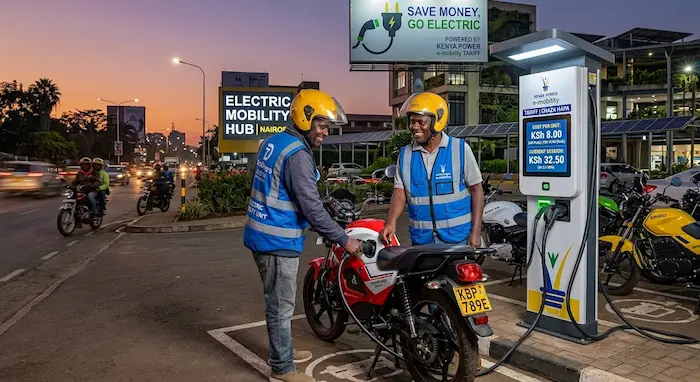

Electric motorcycles are becoming more visible on Kenyan roads, particularly among boda boda riders, delivery businesses and other commercial users.
But beyond the purchase price, one question matters to anyone considering an electric motorcycle:
How much does it actually cost to charge one?
The answer depends on the motorcycle’s battery size, electricity tariff, charging method, riding conditions and whether the rider plugs the battery into a charger or uses a battery-swapping network.
Kenya Power’s dedicated e-mobility tariff currently provides electricity at KSh 16 per kWh during peak periods and KSh 8 per kWh during off-peak periods.
However, a rider using a commercial charging station may pay a different price, while riders using battery-swapping services generally pay a swap fee rather than a simple electricity charge.
This guide explains the numbers using Kenyan examples.
Kenya’s Electric-Motorcycle Market Is Growing
Electric motorcycles are an important part of Kenya’s broader transition to electric mobility.
Kenya Power reported that more than 35,000 electric vehicles had been registered by the end of 2025, with electric two-wheelers making up the majority.
Electric motorcycles are particularly relevant to Kenya because boda boda riders and delivery operators can cover significant distances every day.
For these users, the cost of energy can have a direct impact on daily operating expenses.
That is why comparing cost per charge alone is not enough.
The more useful calculation is:
Cost per kilometre = energy cost ÷ kilometres travelled
How Kenya’s E-Mobility Electricity Tariff Works
Kenya Power has a dedicated electricity tariff for electric mobility.
As of 2026, Kenya Power says customers under the e-mobility tariff pay:
| Period | Electricity price |
|---|---|
| Peak | KSh 16 per kWh |
| Off-peak | KSh 8 per kWh |
The off-peak price is therefore half the peak rate.
This distinction is important for electric-motorcycle operators who can charge during off-peak hours.
Charging overnight, for example, can potentially reduce the electricity cost compared with charging during peak periods, provided the rider has access to a qualifying charging setup and the applicable tariff.
EPRA has previously documented the special e-mobility tariff as part of Kenya’s effort to encourage electric-vehicle adoption.
How Much Does It Cost to Charge an Electric Motorcycle?
The basic calculation is simple:
Battery capacity × electricity price = charging cost
For example, suppose an electric motorcycle has a 5 kWh battery.
At KSh 16 per kWh:
5 × KSh 16 = KSh 80
At KSh 8 per kWh:
5 × KSh 8 = KSh 40
So a theoretical full charge of a 5 kWh battery would cost approximately:
| Electricity rate | Cost for 5 kWh |
|---|---|
| KSh 16/kWh | KSh 80 |
| KSh 8/kWh | KSh 40 |
These are electricity-only calculations.
The actual amount paid can differ because of charging losses, the motorcycle’s battery size, the applicable electricity tariff and the charging provider.
Why the Cost Can Be Different in the Real World
A battery’s advertised capacity does not necessarily mean a rider will buy exactly that amount of electricity every time.
For example, a rider may arrive with 20% battery remaining rather than an empty battery.
If a 5 kWh battery is charged from 20% to 100%, the theoretical energy required would be:
5 kWh × 80% = 4 kWh
At KSh 16/kWh:
4 × KSh 16 = KSh 64
At KSh 8/kWh:
4 × KSh 8 = KSh 32
There can also be some energy loss during charging, meaning the electricity drawn from the grid can be higher than the energy actually stored in the battery.
Therefore, riders should treat simple battery-capacity calculations as estimates rather than exact electricity bills.
What About Roam Electric Motorcycles?
Roam provides a useful Kenyan example because its electric motorcycles use rechargeable batteries rather than relying entirely on battery swapping.
Roam has reported real-world rider experiences showing charging costs of around KSh 100 for one battery, with a dual-battery setup costing approximately KSh 200 for around 200 km in one rider’s account.
That example gives us another way of looking at the economics.
If a rider spends approximately KSh 200 to cover 200 km:
KSh 200 ÷ 200 km = KSh 1 per kilometre
That is a reported rider experience, not a guaranteed cost for every Roam rider.
Actual energy consumption will depend on factors such as:
- Rider and passenger weight
- Speed
- Traffic
- Road conditions
- Battery condition
- Number of batteries
- Charging efficiency
- Riding style
Roam’s newer Air V2 has also been reported with a dual-battery configuration, a claimed range of around 100–120 km and fast charging capability.
What About Spiro Electric Motorcycles?
Spiro uses a different approach.
Rather than requiring riders to wait for their own battery to recharge, the company operates a battery-swapping model.
A rider can take a depleted battery to a swapping station and exchange it for a charged battery.
TechDrivers previously reported on Spiro’s Kenyan motorcycle models, battery-swapping system and operating costs. The reported full battery-swap price is approximately KSh 290, with a range of roughly 85–100 km, depending on the motorcycle and riding conditions.
That produces an estimated energy-access cost of:
KSh 290 ÷ 85 km = KSh 3.41 per km
At 100 km:
KSh 290 ÷ 100 km = KSh 2.90 per km
So the reported swap model works out to approximately:
KSh 2.90–KSh 3.41 per kilometre
Again, this is an illustrative calculation based on reported swap pricing and range. It is not a guarantee of a rider’s actual cost.
Read our full guide:
Spiro Electric Motorcycles in Kenya: Prices, Range, Battery Swapping and Running Costs
Charging vs Battery Swapping
Electric motorcycles in Kenya are increasingly using two different energy models.
| Feature | Plug-in charging | Battery swapping |
|---|---|---|
| How it works | Recharge your battery | Exchange depleted battery |
| Waiting time | Can take minutes to hours | Usually much quicker |
| Battery ownership | Often rider-owned | May be provider-owned |
| Main cost | Electricity/charging fee | Swap fee |
| Infrastructure | Chargers | Swap stations |
| Best suited to | Riders who can charge regularly | High-mileage commercial riders |
Neither model has exactly the same economics for every rider.
A rider who can charge cheaply overnight may have very different running costs from a rider who depends on paid battery swaps.
How Much Does an Electric Motorcycle Cost Per Kilometre?
Cost per kilometre is arguably more useful than the price of a full charge.
Consider a hypothetical 5 kWh motorcycle that can travel 100 km on a full battery.
At KSh 16/kWh:
5 kWh × KSh 16 = KSh 80
Then:
KSh 80 ÷ 100 km = KSh 0.80 per km
At KSh 8/kWh:
5 kWh × KSh 8 = KSh 40
Then:
KSh 40 ÷ 100 km = KSh 0.40 per km
This demonstrates why the electricity tariff can make a major difference to operating costs.
However, the motorcycle’s actual consumption is more important than simply looking at battery size.
Two motorcycles with different battery capacities can have similar real-world running costs if their efficiency and range differ.
A Practical Example for a Kenyan Boda Boda Rider
Imagine a rider covers 150 km per day.
Suppose the motorcycle can realistically cover 100 km per full charge.
The rider would need approximately:
150 ÷ 100 = 1.5 battery charges per day
If the theoretical full-charge electricity cost is KSh 80:
1.5 × KSh 80 = KSh 120 per day
Over 26 working days:
KSh 120 × 26 = KSh 3,120 per month
This is an illustrative calculation.
Actual monthly electricity costs could be higher or lower depending on the motorcycle, charging losses, electricity tariff, daily distance and riding conditions.
What About Battery-Swap Costs?
Battery swapping changes the calculation.
Using the reported Spiro example of approximately KSh 290 per swap and a range of 85–100 km:
For a rider travelling 150 km per day, two swaps may sometimes be required depending on the motorcycle’s actual range and starting battery level.
At two swaps:
KSh 290 × 2 = KSh 580 per day
Over 26 working days:
KSh 580 × 26 = KSh 15,080
This shows why riders should compare the actual energy-access model before buying an electric motorcycle.
A motorcycle with a battery-swapping model should not be compared with a plug-in motorcycle using electricity rates alone.
Does Charging an Electric Motorcycle Cost Less Than Petrol?
Electric motorcycles can have low energy costs, but the comparison should include the complete operating picture.
A petrol motorcycle normally requires:
- Petrol
- Engine oil
- Oil filters
- Spark plugs
- Engine servicing
- Air filters
- Clutch and drivetrain maintenance
- Other engine-related repairs
An electric motorcycle does not have an internal-combustion engine, which changes its maintenance requirements.
However, electric motorcycles still have costs associated with:
- Battery replacement or degradation
- Tyres
- Brakes
- Suspension
- Electrical components
- Charging equipment
- Software and electronics
- Financing
- Insurance
- Repairs
Therefore, the correct comparison is not simply electricity versus petrol.
It is:
Total cost of operating an electric motorcycle versus total cost of operating a petrol motorcycle.
Battery Life Also Matters
The cost of charging an electric motorcycle cannot be separated completely from battery life.
The battery is one of the most expensive components of an electric motorcycle.
Roam, for example, has reported battery life of up to five years for its motorcycle batteries, with approximately 800–1,200 full charging cycles under its stated specifications.
This does not mean every battery will automatically last five years.
Usage patterns, temperature, charging behaviour and battery management can affect longevity.
For a commercial rider, battery durability can therefore have a significant effect on the motorcycle’s long-term ownership cost.
Where Can Kenyan Riders Charge Electric Motorcycles?
Kenya’s charging infrastructure is expanding.
Kenya Power has installed EV chargers at locations including Stima Plaza, Donholm, Ruaraka, Electricity House and Ragati Road, while additional charging infrastructure has been planned for other towns.
Private companies are also developing charging and battery-swapping networks.
TechDrivers’ guide to Kenya’s EV charging infrastructure covers charging locations, providers and the growing network:
EV Charging Stations in Kenya: Locations, Costs and Companies
The charging network matters because an inexpensive motorcycle becomes less practical if riders cannot conveniently access energy.
Battery Swapping Is Becoming Important in Kenya
For commercial motorcycles, charging time can translate directly into lost working time.
That is one reason battery swapping has gained attention.
Instead of waiting for a battery to charge, the rider exchanges the depleted battery for a charged one.
Companies including Spiro, Ampersand and Arc Ride have developed battery-swapping models in Kenya, while Roam has focused more heavily on plug-in charging and battery ownership.
Our detailed guide explains how the different models work:
Battery Swapping in Kenya: Companies, Costs and How It Works
What Kenyan Riders Should Check Before Buying an Electric Motorcycle
The cheapest charging cost on paper does not necessarily mean the motorcycle will be the cheapest option for you.
Before buying, check:
1. Battery capacity
Find out how many kWh the battery stores.
2. Real-world range
Do not rely only on the manufacturer’s maximum range.
Ask what range commercial riders achieve under normal Kenyan conditions.
3. Charging time
A motorcycle that requires several hours to recharge may not suit a rider working throughout the day.
4. Charging location
Check whether you can charge at home, at work or at a convenient public charging station.
5. Battery-swapping availability
If the motorcycle uses battery swapping, check how close the stations are to your regular routes.
6. Battery ownership
Find out whether the battery belongs to you or the mobility company.
7. Battery replacement cost
Ask what happens when the battery reaches the end of its useful life.
8. Maintenance
Compare servicing requirements with those of your current petrol motorcycle.
9. Financing
Look at the total repayment amount rather than only the daily or weekly payment.
10. Cost per kilometre
This is one of the most useful numbers when comparing electric motorcycles.
Why Cost Per Kilometre Matters More Than Cost Per Charge
A KSh 50 charge sounds cheaper than a KSh 100 charge.
But what if the KSh 50 charge gives you only 50 km while the KSh 100 charge gives another motorcycle 150 km?
The second motorcycle has the lower energy cost per kilometre.
For example:
Motorcycle A
KSh 50 ÷ 50 km = KSh 1/km
Motorcycle B
KSh 100 ÷ 150 km = KSh 0.67/km
Motorcycle B requires more money for a full charge but less money per kilometre.
This is why prospective buyers should ask manufacturers for real-world range and energy consumption, not just battery capacity.
Kenya’s Electric-Mobility Electricity Demand Is Growing
Electric-motorcycle charging is part of a much larger change in Kenya’s electricity market.
Kenya Power reported that the e-mobility sector consumed 8.43 million kWh in 2025, up from 2.92 million kWh in 2024 — an increase of 188%.
By June 2026, Kenya Power said cumulative EV-charging electricity revenue since July 2023 had reached KSh 382 million, while monthly revenue had reached a peak of KSh 35.25 million in February 2026.
These figures show that electric mobility is moving from a small emerging market toward a larger electricity-consuming sector.
For motorcycle riders, that growth should eventually mean more charging and battery-swapping infrastructure.
Frequently Asked Questions
How much does it cost to charge an electric motorcycle in Kenya?
The cost depends on the battery size, electricity tariff and charging method. Under Kenya Power’s e-mobility tariff, electricity is priced at KSh 16 per kWh during peak periods and KSh 8 per kWh during off-peak periods.
How much does a 5 kWh electric motorcycle battery cost to charge?
At KSh 16 per kWh, 5 kWh would theoretically cost KSh 80. At KSh 8 per kWh, it would cost KSh 40, before accounting for charging losses.
Is charging an electric motorcycle cheaper than petrol?
The energy cost can be lower, but the comparison depends on the motorcycle’s efficiency, electricity price, petrol price, maintenance, financing and battery costs.
How much does a Spiro battery swap cost in Kenya?
A full Spiro battery swap has been reported at approximately KSh 290, with the actual cost and range depending on the applicable model and service arrangement.
How far can an electric motorcycle travel on one charge?
It varies significantly by model, battery configuration, speed, rider weight, terrain and riding conditions. Some Kenyan electric motorcycles are designed for ranges around 80–120 km or more under stated conditions.
Can I charge an electric motorcycle at home?
Some electric motorcycles are designed to be charged from suitable electrical outlets. However, riders should follow the manufacturer’s charging requirements and ensure the electrical installation is appropriate.
Is battery swapping better than charging?
They solve different problems. Plug-in charging can work well for riders who can charge overnight, while battery swapping can reduce downtime for high-mileage commercial riders.
What is the cheapest way to charge an electric motorcycle?
Where the applicable tariff permits it, charging during off-peak periods under Kenya’s e-mobility tariff can reduce the electricity cost compared with peak charging.
Final Takeaway
The cost of charging an electric motorcycle in Kenya can be surprisingly low when measured purely by electricity consumption.
Kenya Power’s e-mobility tariff is currently KSh 16 per kWh during peak periods and KSh 8 per kWh during off-peak periods.
But the real cost depends on the motorcycle.
A rider should consider:
Battery size + real-world range + electricity price + charging losses + charging time + battery life + infrastructure access.
For motorcycles using battery swapping, the calculation is different because riders pay a swap fee rather than simply paying for electricity.
For a Kenyan boda boda or delivery rider, the most useful question is therefore not:
“How much does it cost to charge this motorcycle?”
It is:
“How much does it cost me to travel one kilometre?”
That figure makes it easier to compare electric motorcycles with petrol motorcycles and determine whether an electric model fits a rider’s daily business.
