
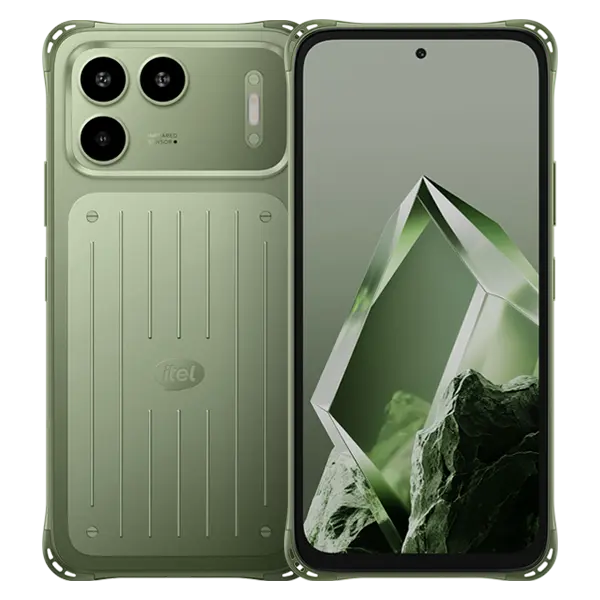

The itel Power 80 has arrived in Kenya with a very different pitch from most budget smartphones.
Instead of competing mainly on cameras, flashy design or 5G, itel is betting on something many Kenyan phone buyers actually care about: battery life and durability.
The Power 80 is officially priced at KSh 19,499 in Kenya and comes with a huge 7,000mAh battery, a 6.78-inch 120Hz display, 50MP main camera and 4G connectivity.
But the big selling point is its construction.
itel says the phone is designed to survive drops of up to 2 metres and carries IP68/IP69 protection against dust and water, alongside MIL-STD-810H and SGS durability certifications.
So, is the itel Power 80 actually worth nearly KSh 20,000?
Here’s our Kenya-focused buying guide.
itel Power 80 Price in Kenya
The recommended retail price for the itel Power 80 in Kenya is KSh 19,499.
The phone is available through itel’s official retail network and authorised retailers, although actual retailer prices can vary.
At this price, the Power 80 sits in a highly competitive part of Kenya’s smartphone market.
That means buyers shouldn’t judge it simply by its 7,000mAh battery.
You also need to consider:
- Performance
- Display quality
- Camera performance
- Charging speed
- Durability
- Software
- Storage
- 4G versus 5G
And that’s where the Power 80 becomes interesting.
itel Power 80 Specifications
| Feature | itel Power 80 |
|---|---|
| Display | 6.78-inch HD+ 120Hz |
| Resolution | 720 × 1576 |
| Processor | Unisoc T7250 |
| RAM | 4GB / 6GB physical depending on variant |
| Storage | 64GB / 128GB |
| Rear camera | 50MP |
| Front camera | 8MP |
| Battery | 7,000mAh |
| Charging | 18W USB-C |
| Network | 4G |
| OS | Android 16 / itel OS 16 |
| Water/dust protection | IP68/IP69 |
| Drop protection | Up to 2 metres |
| MicroSD | Supported |
| Headphone jack | 3.5mm |
| Fingerprint | Side-mounted |
itel’s official specifications confirm the 7,000mAh battery, 120Hz display, T7250 processor, 50MP rear camera, 8MP selfie camera and Android 16.
Design: Built for People Who Drop Phones
The Power 80’s biggest difference is its durability-focused design.
itel has built what it calls a shock-absorption cage frame into the phone rather than expecting customers to rely entirely on a third-party case.
The company says the reinforced structure is designed to distribute impact away from sensitive components.
It also uses raised edges and reinforced corners to help protect the display during drops.
That makes the Power 80 particularly interesting for people who use their phones in demanding environments.
Think:
- Construction workers
- Boda boda riders
- Delivery workers
- Farmers
- Field technicians
- Outdoor workers
- Students
- Travellers
- Parents buying phones for teenagers
For these users, durability can be more valuable than having the thinnest possible phone.
Can the itel Power 80 Really Survive a 2-Metre Drop?
itel claims the Power 80 can withstand drops from up to 2 metres, with the testing supported by itel Labs and additional durability certification from SGS.
However, buyers should understand what this means.
A 2-metre laboratory drop rating does not mean:
“You can throw the phone from a balcony and it will definitely survive.”
Real-world damage depends on:
- Drop angle
- Surface
- Impact point
- Phone condition
- Repeated drops
- Whether the screen hits first
itel itself notes that actual protection can vary depending on the circumstances.
So the durability claims are a major advantage, but they aren’t a guarantee against every type of accident.
Water and Dust Protection
This is arguably one of the Power 80’s strongest features for the price.
itel lists both IP68 and IP69 protection.
That means the phone is designed for substantially more water and dust resistance than an ordinary budget smartphone.
itel says its testing includes immersion, high-pressure water exposure and protection against fine dust.
That could be useful in Kenya, particularly for people working outdoors.
Rain shouldn’t be the same level of concern as it is with an unprotected budget phone.
But don’t deliberately treat the phone as an underwater camera simply because it has an IP rating.
Water resistance can deteriorate with wear, damage and repairs.
The 7,000mAh Battery Is the Real Star
If there’s one specification that immediately stands out, it’s the battery.
The Power 80 packs a 7,000mAh battery.
That’s substantially larger than the 5,000mAh batteries common in many smartphones.
itel says its laboratory testing produced up to:
- 67.8 days standby
- 22.6 hours video playback
- 54.2 hours calling
Those are controlled laboratory figures rather than guaranteed everyday results.
In normal use, your mileage will depend heavily on:
- Screen brightness
- Mobile network strength
- Gaming
- Video streaming
- GPS
- Background applications
- Refresh rate
- Camera use
Still, the battery capacity should make the Power 80 a strong candidate for buyers who prioritise endurance.
The Problem: 18W Charging
There’s a catch.
The huge battery charges at only 18W.
That’s not particularly fast by today’s standards.
The benefit is that you shouldn’t need to charge the phone as frequently.
The downside is that when the 7,000mAh battery finally runs low, charging it back up won’t be especially quick.
The phone does support USB-C and reverse wired charging, allowing it to supply power to other devices.
That reverse charging feature is useful if you need to give another phone or accessory some emergency power.
Display: Big and Smooth, But Only HD+
The Power 80 has a 6.78-inch display with a 120Hz refresh rate.
The 120Hz refresh rate is a welcome feature at this price.
Scrolling through:
- TikTok
- Chrome
can feel smoother than on a traditional 60Hz display.
But there is an important compromise.
The panel is HD+ rather than Full HD+.
That means the display is large and smooth, but it isn’t as sharp as some competing phones with higher-resolution screens.
If you mainly care about:
Battery + durability → Power 80 makes sense.
If you care about:
Display sharpness + multimedia → competitors may offer more.
Performance: Don’t Buy It for Heavy Gaming
The Power 80 uses the Unisoc T7250 octa-core processor.
This is a budget-focused chipset.
It’s appropriate for everyday activities such as:
- TikTok
- YouTube
- Web browsing
- M-Pesa apps
- Google Maps
- Light multitasking
But this isn’t the phone I’d recommend to someone whose main priority is demanding gaming.
Games such as PUBG Mobile, Call of Duty Mobile and other graphically intensive titles will put significantly more pressure on the hardware.
For casual gaming, it should be fine.
For serious mobile gaming, look elsewhere.
What About RAM?
This is an area where buyers need to read the specifications carefully.
itel advertises configurations that use virtual RAM expansion, sometimes described in marketing as combined RAM.
For example, its official specification lists configurations including:
- 4GB + 8GB virtual RAM
- 6GB + 12GB virtual RAM
depending on storage variant.
That does not mean the phone physically contains 12GB or 18GB of RAM.
Virtual RAM uses part of internal storage.
Real physical RAM is faster.
So when comparing the Power 80 with another phone, compare the physical RAM, not just the larger marketing number.
Camera: 50MP Sounds Good, But Manage Expectations
The rear camera is 50MP, while the selfie camera is 8MP.
The 50MP specification is respectable for a phone around KSh 20,000.
But megapixels aren’t everything.
Image quality also depends on:
- Sensor size
- Image processing
- HDR
- Night photography
- Lens quality
- Stabilisation
- Software
So don’t buy the Power 80 simply because it says “50MP.”
In daylight, it should be capable of producing usable photographs for social media and everyday documentation.
But this isn’t positioned as a camera-first smartphone.
If photography is your priority, there are better choices.
Android 16 Is a Major Positive
The Power 80 runs Android 16 with itel OS 16, according to itel’s official specifications.
That’s good news for buyers because you’re getting a current Android generation rather than purchasing an older phone with outdated software.
itel has also integrated several AI-oriented features, including writing assistance, voice assistance and translation tools.
However, buyers should still check itel’s official software-update commitment before purchasing if long-term software support is important to them.
AI Features
itel is also promoting AI capabilities on the Power 80.
These include:
- AI writing
- Voice assistance
- Translation
- Outdoor adaptive features
- Noise reduction
- AI-assisted functions
The company notes that availability of some AI features can vary by region, software version, network and third-party services.
So don’t treat every advertised AI feature as equivalent to the advanced AI systems found on flagship Samsung, Google or Apple phones.
These are useful software tools, but the phone remains a budget device.
One Interesting Feature: UltraLink
The Power 80 also has an unusual feature called UltraLink.
itel says compatible phones can make network-free calls over a theoretical range of up to 2 kilometres in open areas.
That’s potentially useful in situations where conventional mobile coverage isn’t available.
But there is an important limitation:
The other device needs to support the feature.
The company also says the actual range depends on obstacles and the environment.
So this shouldn’t be considered a replacement for Airtel, Safaricom or other mobile networks.
Is the itel Power 80 Good for Kenya?
This is where the phone becomes more compelling.
Kenyan buyers often need phones that can survive a combination of:
- Dust
- Rain
- Heat
- Long working days
- Frequent travel
- Accidental drops
- Limited access to charging
The Power 80 is almost designed around those problems.
Its combination of 7,000mAh battery + water/dust resistance + drop protection makes more practical sense for some Kenyan users than a conventional budget phone with a better-looking design.
Who Should Buy the itel Power 80?
Buy it if you:
✅ Want very long battery life
✅ Frequently drop your phone
✅ Work outdoors
✅ Need water and dust resistance
✅ Want a large 120Hz screen
✅ Mostly use WhatsApp, social media and video
✅ Want a phone around KSh 20,000
✅ Prefer durability over flagship-style cameras
Who Should NOT Buy It?
❌ Heavy gamers
❌ Photography enthusiasts
❌ Buyers who demand Full HD+ or AMOLED displays
❌ People who want 5G
❌ Users who prioritise very fast charging
❌ Buyers wanting flagship-level performance
The biggest weaknesses are the HD+ display, modest 18W charging, entry-level processor and 4G-only connectivity.
itel Power 80 vs the Competition
At around KSh 20,000, buyers should compare the Power 80 with other budget and lower-midrange phones before purchasing.
The Power 80’s advantage isn’t necessarily raw performance.
Its strongest combination is:
7,000mAh + rugged construction + IP68/IP69 + 120Hz + low price.
A competitor with a faster processor or AMOLED screen may be a better choice for an office worker or gamer.
But someone working outdoors may value the Power 80’s durability more.
That’s why this phone should be judged according to how you use your smartphone, rather than specifications alone.
Our Verdict
The itel Power 80 is not trying to be the fastest phone under KSh 20,000.
It’s trying to be the phone that survives.
At KSh 19,499, the combination of a 7,000mAh battery, 120Hz display, 50MP camera, Android 16 and serious durability protection makes it one of the more interesting budget options for Kenyan buyers who prioritise reliability.
Its weaknesses are equally clear.
The Unisoc T7250 isn’t a performance monster. The HD+ display isn’t particularly sharp for a screen this large. And 18W charging is slow compared with some competitors.
But if your biggest fear is:
“What happens when my phone falls, gets rained on or runs out of battery halfway through the day?”
the Power 80 has a compelling answer.
TechDrivers rating: 7.8/10
Best for: Battery life, durability and outdoor users
Not best for: Gaming, cameras and display quality
For a Kenyan buyer who wants a phone that can take more punishment than the average budget smartphone, the itel Power 80 deserves a place on the shortlist.
