
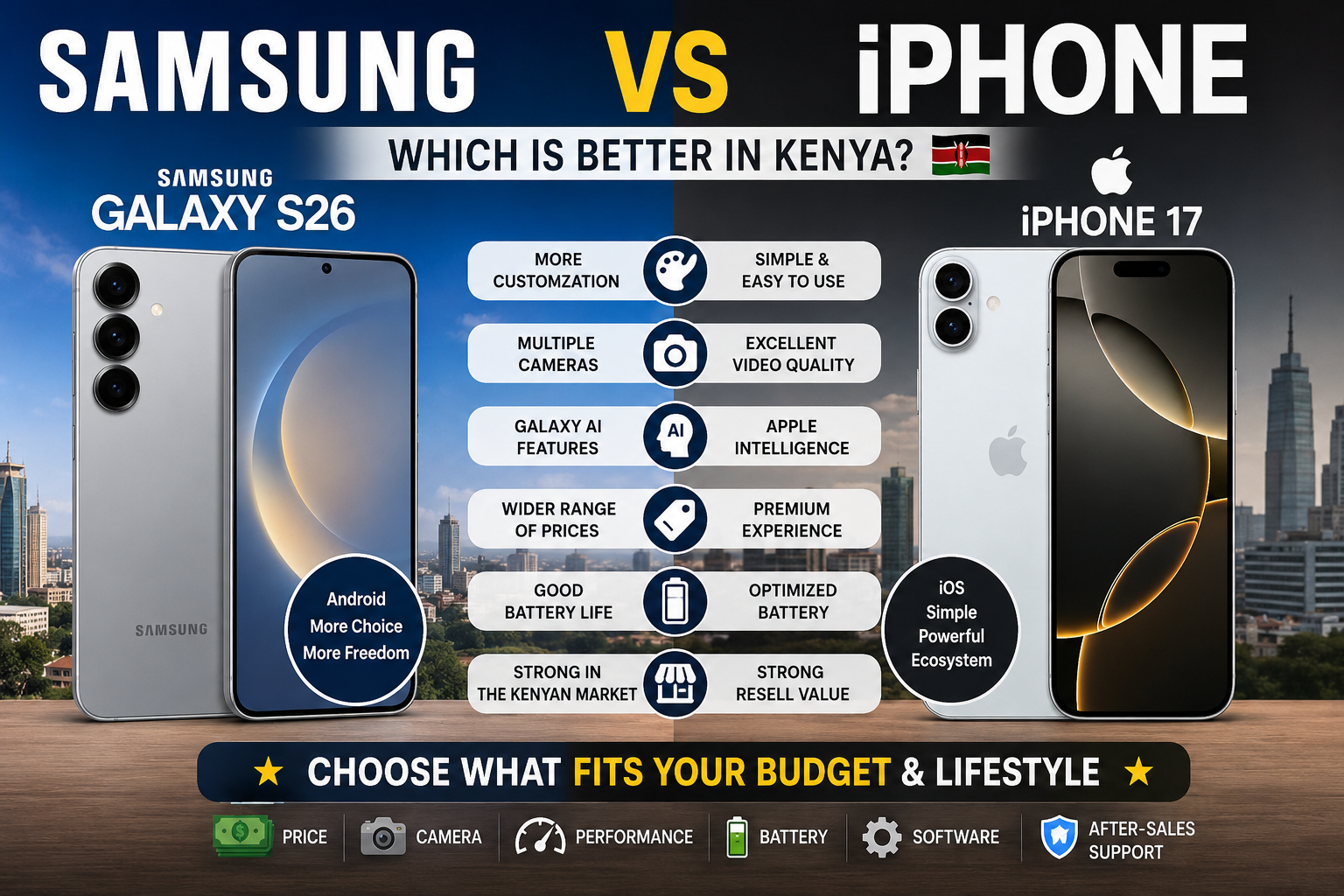

Samsung vs iPhone is one of the biggest smartphone debates among Kenyan buyers.
Both brands offer excellent cameras, premium designs, powerful processors and long software support. But they are very different ecosystems, and the better choice depends on your budget, camera needs, battery expectations, repair costs, resale value and how you use your phone.
In Kenya, the decision is also influenced by local prices, availability of genuine devices, repair networks and second-hand demand.
So, between Samsung and iPhone, which is better in Kenya in 2026?
The short answer is:
Samsung is the better choice for flexibility, features, Android freedom and value across different price ranges. iPhone is the better choice for video, ecosystem integration, performance consistency and resale value.
Let’s compare them in detail.
Samsung vs iPhone: Quick Verdict
| Category | Winner |
|---|---|
| Camera versatility | Samsung |
| Video recording | iPhone |
| Battery flexibility | Samsung |
| Performance | Tie |
| Software simplicity | iPhone |
| Customisation | Samsung |
| Display | Samsung |
| Apps and ecosystem | iPhone |
| Repair availability | Samsung |
| Resale value | iPhone |
| Choice of models | Samsung |
| Gaming | Samsung |
| Privacy/security | Tie |
| Value for money | Samsung |
| Premium experience | iPhone |
Samsung vs iPhone Prices in Kenya
Price is one of the biggest differences for Kenyan buyers.
Samsung competes across a much wider range of prices, from affordable Galaxy A-series phones to premium Galaxy S and Z models.
Apple focuses primarily on the premium market, although older iPhones and models such as the iPhone 17e make the ecosystem more accessible.
As a current reference point, one Kenyan retailer lists the iPhone 17 from KSh 126,000 for 128GB, KSh 140,000 for 256GB and KSh 170,000 for 512GB.
Samsung pricing varies significantly depending on the Galaxy model, storage and seller. Current Kenyan price listings put the Galaxy S26 range roughly from around KSh 92,000 to KSh 176,000, although buyers should verify the exact model, storage, warranty and seller before purchasing.
This creates an important advantage for Samsung.
You can find a Samsung phone at almost every major price point.
With Apple, your choices are narrower.
Winner for price and choice: Samsung
Samsung vs iPhone: Camera Comparison
Both Samsung and Apple have excellent cameras, but they approach photography differently.
The Galaxy S26 series offers a multi-camera setup designed to give users flexibility across wide, ultra-wide and telephoto photography. The Galaxy S26, for example, has a 50MP main camera, 12MP ultra-wide and 10MP telephoto camera with 3x optical zoom.
The iPhone 17 also has a strong camera system. It features a 48MP Fusion Main camera and a 48MP Fusion Ultra Wide camera, with a 2x optical-quality telephoto option.
Samsung generally gives you more flexibility when zooming and experimenting with different shooting modes.
iPhone, meanwhile, is particularly strong when you want consistent photos and excellent video without spending a lot of time changing camera settings.
For photography
Samsung: Better if you want zoom, camera flexibility and more manual control.
iPhone: Better if you want consistent point-and-shoot results.
Winner: Samsung for versatility, iPhone for consistency
iPhone vs Samsung for Video
This is where the iPhone has traditionally been extremely strong.
The iPhone 17 supports 4K Dolby Vision video recording at up to 60fps, along with advanced stabilisation and audio features.
For Kenyan content creators, journalists, influencers and business owners who regularly shoot videos for TikTok, Instagram, YouTube or LinkedIn, this can be a major advantage.
Samsung also produces excellent video, but Apple’s strength is the consistency between camera hardware, processing and software.
If your smartphone is going to double as your primary video camera, the iPhone deserves serious consideration.
Winner: iPhone
Samsung vs iPhone Battery Life
Battery performance is more complicated than simply comparing battery capacity.
Samsung provides different battery sizes depending on the Galaxy model. The Galaxy S26, for example, has a 4,300mAh battery, while the S26+ has 4,900mAh and the S26 Ultra has 5,000mAh. Samsung rates the S26 for up to 30 hours of video playback.
The iPhone 17 is rated for up to 30 hours of video playback by Apple. It can also reach up to 50% charge in approximately 20 minutes with a 40W adapter or higher.
Real-world battery life will depend on:
- Mobile network strength
- 5G usage
- Screen brightness
- Gaming
- Camera usage
- Social media
- GPS
- Hotspot use
- Battery health
For Kenya, network conditions can matter considerably. A phone constantly searching for a weak cellular signal can consume more battery than expected.
Winner: Tie, depending on model
Samsung Has the Display Advantage
Samsung has a long-standing reputation for excellent smartphone displays.
The Galaxy S26 features a 6.3-inch display, while the S26+ has a 6.7-inch display and the S26 Ultra has a 6.9-inch display.
Samsung’s AMOLED technology provides strong contrast, deep blacks and vibrant colours.
The display experience is especially important if you:
- Watch Netflix
- Watch YouTube
- Edit photos
- Play games
- Read documents
- Use your phone outdoors
Samsung’s flagship displays are among the strongest in the Android market.
Winner: Samsung
Performance: Samsung vs iPhone
Both brands are extremely powerful.
The iPhone 17 uses Apple’s A19 chip, featuring a six-core CPU, five-core GPU and 16-core Neural Engine.
Samsung’s Galaxy S26 series uses modern flagship processors and includes features designed around Galaxy AI.
For everyday tasks, most users will not notice a major performance difference.
Both phones can handle:
- TikTok
- YouTube
- Mobile banking
- Photography
- Video editing
- Gaming
- Multitasking
The difference becomes more noticeable in demanding workloads and games.
Winner: Tie
Samsung vs iPhone for Gaming
Samsung has several advantages for gamers.
Android provides more flexibility around apps, accessories, displays and gaming configurations.
Samsung’s larger flagship displays can also make gaming more immersive.
The iPhone, however, has extremely powerful processors and excellent game optimisation.
For someone who simply wants to install games and play them at high performance, both are excellent.
For users who want more freedom and customisation, Samsung is the better option.
Winner: Samsung
Software: Android vs iOS
This is probably the biggest difference between the two brands.
Samsung uses Android with Samsung’s One UI interface.
Apple uses iOS.
Samsung gives you significantly more freedom to customise your phone.
You can customise:
- Home screens
- Widgets
- Launchers
- File management
- Default applications
- Multitasking
- Notifications
- System behaviour
Apple takes a more controlled approach.
iOS is generally simpler and more consistent across supported devices.
If you want freedom, choose Samsung.
If you want simplicity, choose iPhone.
Winner: Depends on the user
Samsung vs iPhone for AI
AI has become a major smartphone selling point.
Samsung integrates Galaxy AI features into its flagship phones, while Apple integrates Apple Intelligence into supported iPhones.
Samsung’s Galaxy AI strategy includes AI-powered tools across productivity, communication and photography.
Apple’s approach is more tightly integrated into iOS and the wider Apple ecosystem.
For most Kenyan buyers, however, AI should not be the only reason to spend more money on a phone.
Look at the entire package.
Winner: Tie
Repair Costs in Kenya
This is an area where Kenyan buyers need to think beyond the purchase price.
Smartphones eventually need repairs.
Common problems include:
- Broken screens
- Damaged charging ports
- Battery degradation
- Camera damage
- Water damage
- Back glass damage
Samsung has an advantage because its phones are widely distributed in Kenya and the Galaxy ecosystem is large.
However, repair prices vary enormously depending on the model.
An affordable Galaxy A-series screen will not cost the same as a Galaxy S26 Ultra display.
iPhone repairs can also be expensive, especially for newer Pro models.
A genuine replacement display or camera module can cost a significant amount.
Important advice
Do not buy a premium smartphone based only on its purchase price.
Ask:
“How much will this phone cost me if I break the screen?”
That question can save you thousands of shillings.
Winner: Samsung for broader repair availability
Resale Value in Kenya
This is one area where the iPhone is particularly attractive.
Used iPhones have strong demand in Kenya.
Models such as the iPhone 13, iPhone 14, iPhone 15 and iPhone 16 continue to circulate heavily in the second-hand market.
That means an iPhone can retain a significant portion of its original value if it is maintained properly.
Samsung flagship phones can also have strong resale value, but Android phones generally experience more aggressive price reductions as newer models arrive.
This matters if you plan to upgrade every two or three years.
For example, if you buy a phone for KSh 120,000 and later sell it for KSh 70,000, your effective ownership cost is KSh 50,000.
The resale value therefore becomes part of the real cost of ownership.
Winner: iPhone
Which Is Easier to Sell Used in Kenya?
iPhone generally has the advantage.
There is a large market of Kenyan consumers looking for used iPhones.
But buyers should be careful.
Before buying a second-hand iPhone, check:
- Battery health
- IMEI
- Activation Lock
- Face ID
- True Tone
- Cameras
- Display
- Charging port
- Speaker
- Microphone
- Network connectivity
- Whether parts have been replaced
For Samsung, you should perform similar checks and verify the device’s IMEI and condition.
Never buy a suspiciously cheap flagship simply because the seller says it is “UK used” or “Dubai stock.”
Samsung vs iPhone for Mobile Money and Kenyan Apps
Both platforms work well with major Kenyan digital services.
You can use Android and iPhone for services such as:
- M-PESA
- Banking apps
- Mobile money
- e-commerce
- Social media
- Ride-hailing
- Streaming
- Business applications
Samsung’s Android ecosystem can provide greater flexibility for file transfers and third-party applications.
Apple provides a tightly controlled app ecosystem.
For ordinary Kenyan smartphone users, both platforms are capable.
Winner: Tie
Samsung vs iPhone for Connectivity in Kenya
Both Samsung and iPhone support modern cellular technologies, including 5G on compatible models.
The iPhone 17 supports a broad range of 5G and LTE bands, including bands used across international markets.
Samsung’s flagship devices also support extensive cellular connectivity.
However, do not assume that every imported phone will work perfectly on every Kenyan network.
Before buying an imported smartphone, verify:
- 4G bands
- 5G bands
- eSIM support
- Physical SIM configuration
- Network lock status
- Warranty coverage in Kenya
This is especially important when buying from informal importers.
Samsung vs iPhone Ecosystem
If you already own other Apple products, the iPhone becomes more attractive.
An iPhone works particularly well with:
- Mac
- Apple Watch
- AirPods
- iPad
- iCloud
Samsung has its own ecosystem around:
- Galaxy Buds
- Galaxy Watch
- Galaxy Tab
- SmartThings
- Windows integration
If your laptop is a Windows PC, Samsung can offer excellent flexibility.
If you already live inside Apple’s ecosystem, moving to Samsung may feel inconvenient.
Winner: Depends on what you already own
Which Is More Secure?
Both Samsung and Apple take smartphone security seriously.
Samsung provides long-term security updates on newer Galaxy devices. For example, Samsung lists security support for the Galaxy S26 through February 2033.
Apple also has a strong reputation for long-term software and security support.
The most important thing for Kenyan users is still basic security hygiene:
- Use a strong PIN
- Enable biometric authentication
- Keep software updated
- Enable device tracking
- Avoid installing suspicious apps
- Do not share banking passwords
- Use official app stores
- Avoid unknown public charging accessories
Winner: Tie
Which Is Better for Kenyan Content Creators?
This depends on the type of content you create.
Choose iPhone if you mainly create:
- TikTok videos
- YouTube videos
- Instagram Reels
- Interviews
- Product videos
- Business videos
- Short-form social media content
The iPhone’s video capabilities are a major strength. The iPhone 17 supports 4K Dolby Vision recording at up to 60fps.
Choose Samsung if you mainly create:
- Photos
- Zoom-heavy content
- Social media graphics
- Long-form mobile editing
- Android-focused content
Samsung gives you more flexibility with its camera system and Android ecosystem.
Which Is Better for Students in Kenya?
For students, Samsung is often the more practical choice because there are Galaxy phones available across many price levels.
You don’t need to spend over KSh 100,000 to get a capable Samsung smartphone.
Apple’s lower-cost route often involves buying an older iPhone.
If your budget is limited, consider a good mid-range Samsung rather than buying an old iPhone simply for the Apple logo.
Winner: Samsung
Which Is Better for Business Users?
Both can be excellent business phones.
Samsung may appeal more to users who need:
- Multitasking
- Large screens
- File management
- Android flexibility
- DeX
Samsung’s Galaxy S26 supports Samsung DeX, allowing compatible users to use the phone in a desktop-style environment.
iPhone is attractive for users who value:
- Security
- Reliability
- Video calls
- Apple’s ecosystem
- Long-term software support
Winner: Samsung for flexibility; iPhone for ecosystem simplicity
Samsung vs iPhone: Which Should You Buy?
The answer depends on your budget.
If your budget is below KSh 40,000
Choose Samsung.
You will have considerably more options.
KSh 40,000–70,000
Samsung is usually the better value.
Look at Galaxy A-series and upper-midrange models.
KSh 70,000–120,000
This becomes more interesting.
You can compare premium Samsung models against older or discounted iPhones.
At this price point, compare the exact models rather than simply choosing the brand.
Above KSh 120,000
This becomes a genuine Samsung vs iPhone battle.
You should compare:
- Galaxy S26/S26 Ultra
- iPhone 17/17 Pro/17 Pro Max
The iPhone 17 currently starts around KSh 126,000 from one Kenyan retailer, while Samsung Galaxy S26-series prices vary considerably by model and seller.
Should You Buy an iPhone Now or Wait?
This is particularly relevant in August 2026.
Apple has announced a major launch event for September 9, 2026, with expectations of new iPhone models.
That means buyers considering a high-end iPhone should think carefully about timing.
If you don’t need a phone immediately, waiting until the new generation is announced could give you more information about pricing and availability.
However, if you need a phone now, the iPhone 17 remains a capable option.
Final Verdict: Samsung vs iPhone in Kenya
There is no universal winner.
Samsung wins for:
- More choices
- Android flexibility
- Display technology
- Camera versatility
- Gaming
- Customisation
- Features
- Value across different budgets
iPhone wins for:
- Video
- Resale value
- Ecosystem integration
- Performance consistency
- Simplicity
- Premium software experience
Our overall score
| Category | Samsung | iPhone |
| Price/value | 9/10 | 7/10 |
| Camera | 9/10 | 9/10 |
| Video | 8.5/10 | 10/10 |
| Battery | 9/10 | 9/10 |
| Display | 10/10 | 9/10 |
| Performance | 9.5/10 | 10/10 |
| Software | 9/10 | 9/10 |
| Customisation | 10/10 | 7/10 |
| Repairs | 8.5/10 | 7/10 |
| Resale | 8/10 | 10/10 |
| Ecosystem | 9/10 | 10/10 |
| Overall | 9.1/10 | 8.9/10 |
The Bottom Line
If you want the most features and flexibility for your money, buy Samsung.
If you want excellent video, strong resale value and a tightly integrated ecosystem, buy iPhone.
For most Kenyan buyers on a limited or moderate budget, Samsung is the more practical choice because of the enormous range of Galaxy devices available.
For buyers with a premium budget who care about video creation and resale value, iPhone is extremely difficult to beat.
The smartest decision, however, is not to ask:
“Is Samsung better than iPhone?”
Instead ask:
“Which phone gives me the features I need at the price I can afford in Kenya?”
That is the comparison that matters.
