

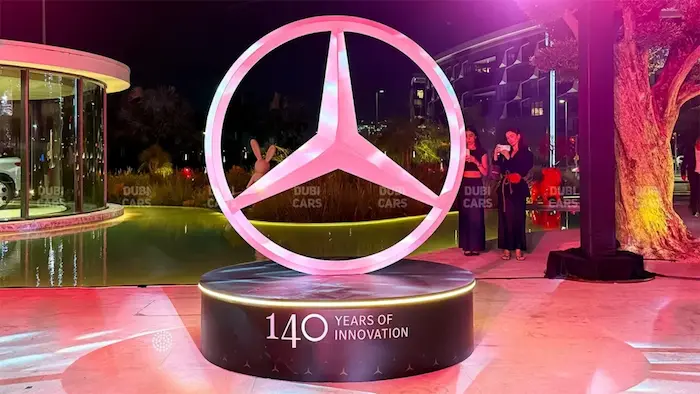

Few automotive brands can trace their technological story back to the invention of the automobile itself. Mercedes-Benz can.
In 1886, German engineer Carl Benz developed the Benz Patent-Motorwagen, a three-wheeled vehicle powered by an internal-combustion engine. Benz filed the patent for his “vehicle with gas engine” on January 29, 1886 — a document widely regarded as the birth certificate of the automobile.
In 2026, Mercedes-Benz is using the 140th anniversary to highlight how that pioneering spirit has influenced automotive technology for generations.
The Beginning: The Automobile Is Born
The story began in 1886 when Carl Benz developed a vehicle that was conceived as an integrated system rather than simply a motor attached to a carriage.
The Benz Patent-Motorwagen combined a combustion engine with a lightweight chassis and became the world’s first automobile of its kind. Around the same time, Gottlieb Daimler and Wilhelm Maybach were developing their own high-speed engine and Daimler’s motorised carriage.
These early inventions established a philosophy that would remain central to Mercedes-Benz: technology should fundamentally change the way people move.
From Mechanical Engineering to Intelligent Vehicles
Over the following decades, Mercedes-Benz continued developing technologies that influenced the automobile industry.
The company’s innovation history includes advances in vehicle dynamics, comfort, safety and electronic systems. Many of these developments were protected through patents and helped establish new standards for the automotive industry.
The transformation is particularly striking when the first Benz automobile is compared with today’s Mercedes-Benz vehicles.
The 1886 Motorwagen was a basic mechanical machine designed primarily to prove that motorised personal transportation was possible.
Modern Mercedes-Benz vehicles increasingly combine mechanical engineering with software, sensors, artificial intelligence, connectivity and electric power.
Safety Became a Major Part of Innovation
Mercedes-Benz’s technological story is not only about speed and performance.
Safety has become one of the company’s major areas of innovation, with technologies designed to help protect occupants and assist drivers.
Over the decades, automotive safety evolved from basic mechanical systems into sophisticated electronic driver-assistance technologies capable of monitoring the road, detecting potential hazards and helping drivers respond.
Mercedes-Benz describes this evolution as part of a broader journey from early technical breakthroughs to safety systems, digital assistance and automated driving.
The Shift to Electric Mobility
One of the biggest changes facing the automotive industry today is the move from traditional combustion engines to electric power.
Mercedes-Benz is investing heavily in electric mobility as it works toward a future in which vehicles are increasingly electric, intelligent and connected.
The company’s technology strategy identifies e-mobility, autonomous driving and digitalisation as important areas for the future of transportation.
This represents a major technological shift from the engineering principles that powered the original Motorwagen.
Steer-by-Wire: Redefining How Cars Are Driven
One of the latest examples of Mercedes-Benz’s technological direction is steer-by-wire.
The technology removes the traditional mechanical connection between the steering wheel and the front wheels and instead uses electronic systems to control steering.
Mercedes-Benz says the new EQS will be available with steer-by-wire technology, making it the first production vehicle from a German automaker to offer the technology. The company says it can improve manoeuvrability, parking, driving stability and steering feel.
It is a striking example of how automotive engineering has changed since 1886.
The driver of the first Benz automobile relied almost entirely on mechanical components. A future Mercedes-Benz driver may interact with a vehicle whose major functions are increasingly controlled through software and electronics.
Artificial Intelligence and Digitalisation
Modern vehicles are becoming increasingly similar to connected computers on wheels.
Mercedes-Benz is incorporating digital technologies into its vehicles and wider operations, while continuing to develop intelligent driving and mobility services.
The company says its future technology strategy involves digitalisation alongside electric mobility and autonomous driving.
This means the next generation of automotive competition will not only be about horsepower.
Software, artificial intelligence, connectivity, computing power and the ability to update vehicle functions will increasingly determine what a modern car can do.
The New S-Class Carries the Anniversary Message
Mercedes-Benz has also linked its 140th anniversary celebrations to the latest generation of the S-Class.
On January 29, 2026, the company unveiled the new S-Class as part of what it describes as the largest product launch programme in its history. Mercedes-Benz says more than 40 new models are scheduled to debut over a two-year period.
The S-Class has historically served as a showcase for Mercedes-Benz technology, making it an important symbol for the company’s anniversary year.
140 Years, 140 Places
To mark the anniversary, Mercedes-Benz launched a global “140 Years. 140 Places” journey.
Three new S-Class vehicles are travelling more than 50,000 kilometres across six continents, visiting 140 locations connected to the company’s heritage, technology and global presence. The journey is scheduled to conclude in Stuttgart in October 2026.
The campaign is designed to connect Mercedes-Benz’s historical achievements with its current technology and future ambitions.
What 140 Years of Innovation Means for the Future
The biggest lesson from Mercedes-Benz’s 140-year history may be that automotive technology never stands still.
The first automobile transformed transportation by replacing animal-powered travel with motorised mobility.
Electric vehicles are now transforming how cars are powered.
Driver-assistance systems are changing how people interact with vehicles.
Steer-by-wire is challenging traditional mechanical vehicle architecture.
And artificial intelligence and software are increasingly becoming fundamental components of modern automobiles.
Mercedes-Benz says its innovation journey stretches from the first automobile in 1886 to today’s intelligent electric vehicles.
From Motorwagen to Software-Defined Mobility
The distance between Carl Benz’s 1886 Motorwagen and today’s Mercedes-Benz vehicles is enormous.
But the underlying idea remains remarkably similar: use engineering and technology to rethink mobility.
That is what makes the company’s 140th anniversary more than a celebration of its past.
It is also a statement about where Mercedes-Benz believes the automobile is heading next — toward vehicles that are electric, intelligent, connected, increasingly automated and designed around the digital needs of their occupants.
After 140 years, Mercedes-Benz is still trying to answer the same fundamental question that began with Carl Benz:
What can technology make possible next?
