

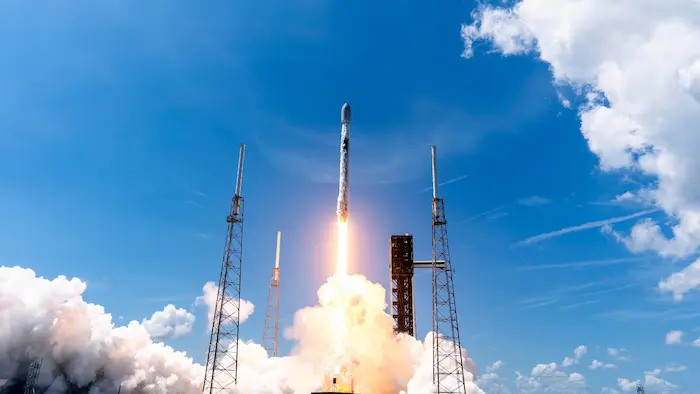
The Starlink 10-19 mission lifted off on Tuesday, August 11, 2026, from Space Launch Complex 40 at Cape Canaveral Space Force Station in Florida.
The Falcon 9 launched at 11:58:26 a.m. EDT (1558:26 UTC) and followed a northeasterly trajectory after leaving the launch pad.
29 Starlink Satellites Head to Orbit
The Falcon 9 carried 29 Starlink V2 Mini Optimized satellites, which are designed to expand SpaceX’s growing broadband internet network in low Earth orbit.
The satellites were scheduled for deployment approximately 64 minutes after liftoff, following their journey into low Earth orbit.
The latest launch highlights the speed at which SpaceX is deploying Starlink spacecraft. The company has already conducted more than 70 Starlink missions in 2026.
Falcon 9 Booster Successfully Lands Again
One of the most important parts of the mission was not just getting the satellites into space, but recovering the rocket’s first stage.
The Falcon 9 used booster B1085, which completed its 18th flight during Tuesday’s mission.
Approximately 8.5 minutes after liftoff, the booster successfully landed on SpaceX’s autonomous droneship A Shortfall of Gravitas, positioned in the Atlantic Ocean.
The successful landing demonstrates one of SpaceX’s biggest advantages in the commercial launch industry: the ability to reuse Falcon 9 boosters multiple times.
According to Spaceflight Now, the landing marked the 647th Falcon booster landing and the 163rd landing on the A Shortfall of Gravitas droneship.
A Busy Year for Falcon 9
Tuesday’s mission was the 93rd Falcon 9 launch of 2026, according to Space.com.
Of those launches, 72 had been dedicated to Starlink missions, underlining how important the satellite network has become to SpaceX’s launch schedule.
The high launch frequency also shows how SpaceX has transformed satellite deployment from occasional missions into a near-continuous operation.
Starlink Continues to Grow
Starlink has become the world’s largest satellite constellation, with more than 10,900 active satellites reported to be in orbit.
SpaceX is continuing to add satellites as it expands the availability and capacity of its broadband internet service.
The company’s long-term plans are even more ambitious. SpaceX is developing larger and more capable Starlink V3 satellites and has discussed eventually operating a constellation numbering in the tens of thousands or more.
What the Launch Means for Internet Connectivity
The continued deployment of Starlink satellites is significant because the system is designed to provide broadband internet connectivity using a large network of satellites orbiting relatively close to Earth.
Unlike traditional satellite internet systems that rely on a smaller number of satellites in higher orbits, Starlink uses a large low-Earth-orbit constellation.
This architecture can help reduce latency and provide coverage to areas where traditional terrestrial broadband infrastructure can be difficult or expensive to deploy.
For countries and communities with limited access to reliable fixed-line infrastructure, satellite connectivity could become an increasingly important part of the internet ecosystem.
SpaceX’s Reusable Rocket Strategy
The Starlink 10-19 mission also demonstrates how rocket reusability has become central to SpaceX’s operations.
Instead of discarding the Falcon 9 first stage after every launch, SpaceX lands and refurbishes the booster for future missions.
B1085’s 18th flight is another example of this approach.
Repeated booster reuse allows SpaceX to increase launch frequency while reducing the need to manufacture an entirely new first-stage rocket for every mission.
Why This Matters
The latest Starlink launch is more than another rocket launch.
It demonstrates three major trends shaping the space and technology industries:
1. Satellite internet is expanding rapidly.
More Starlink satellites mean greater network capacity and continued expansion of SpaceX’s global broadband infrastructure.
2. Rocket reusability is becoming routine.
The 18th flight of booster B1085 shows how reusable launch technology has moved from an experimental concept toward regular commercial operations.
3. Space infrastructure is becoming part of the internet infrastructure.
As satellite networks grow, access to high-speed connectivity is increasingly dependent not only on fibre and mobile networks but also on infrastructure operating hundreds of kilometres above Earth.
The Bigger Picture
SpaceX’s latest launch illustrates how quickly the satellite internet industry is evolving.
The Falcon 9’s ability to repeatedly launch and recover its first stage, combined with SpaceX’s rapid Starlink deployment schedule, gives the company a powerful platform for expanding satellite connectivity.
With more than 10,900 active Starlink satellites already in orbit and additional launches continuing, the company’s vision of a global satellite broadband network is becoming increasingly visible above Earth.
For the space industry, the question is no longer simply whether large satellite constellations are possible.
The bigger question is how large and capable these networks will become.
