

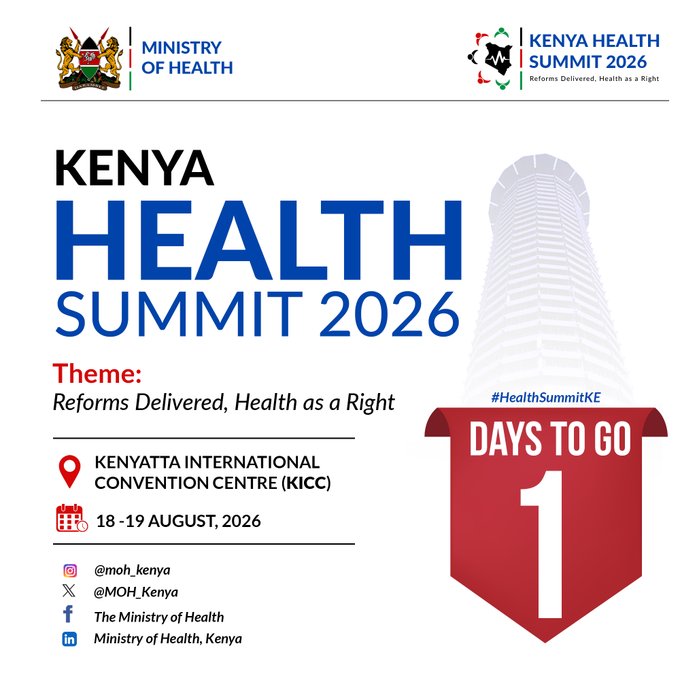
Kenya is set to host the Kenya Health Summit 2026 on August 18–19 at the Kenyatta International Convention Centre (KICC) in Nairobi, bringing together government officials, health-sector institutions, development partners, private-sector players and other stakeholders to review the country’s healthcare reforms and determine the next phase of Universal Health Coverage (UHC).
The summit, officially presented by the Ministry of Health as the Presidential National Health Summit 2026, is being held under the theme “Reform Delivered. Health as a Right.”
For technology and innovation stakeholders, one of the most important parts of the summit will be the focus on digital health, data, artificial intelligence and technology-enabled healthcare delivery.
What Is the Kenya Health Summit 2026?
The summit is designed as a national platform for assessing Kenya’s health reform journey, highlighting progress and identifying practical priorities for the next stage of healthcare transformation.
According to the official summit website, the event will bring together more than 5,000 delegates, speakers and stakeholders from Kenya and other countries.
The discussions will cover seven major areas: health financing and infrastructure, primary and community healthcare, human resources, health products and technologies, digital health and data, health security and climate resilience, and intergovernmental coordination.
The event will take place on August 18 and 19, 2026, at KICC in Nairobi.
Digital Health Will Be a Major Focus
For Kenya’s technology sector, the digital-health agenda is particularly significant.
The summit’s official programme identifies Digital Health & Data as one of its seven thematic pillars.
Discussions are expected to examine how digital solutions, interoperable health-information systems and data-driven decision-making can improve healthcare delivery across the country.
The official summit programme also highlights telemedicine, artificial intelligence and interoperable systems as part of the digital-health innovation agenda.
This could make the summit an important platform for Kenya’s growing health-tech ecosystem.
AI Could Transform Healthcare Delivery
Artificial intelligence is increasingly becoming part of healthcare discussions globally, and Kenya is also exploring how emerging technologies can support healthcare workers and improve access to services.
At the summit, AI and digital-health innovation are expected to feature among the technologies shaping the future of healthcare.
Potential applications include supporting medical decision-making, improving diagnostics, analysing health data, strengthening disease surveillance and expanding access to specialist services through digital platforms.
The challenge, however, will be ensuring that new technologies are deployed responsibly, securely and in ways that actually benefit patients.
Kenya’s Digital Health Transformation
Kenya has been moving toward a more digitally connected healthcare system as part of its wider health reforms.
The government has identified digital health systems as an important component of its Universal Health Coverage strategy.
The summit’s official programme specifically points to interoperable health information systems and data-driven decision-making as priorities.
Interoperability is important because healthcare information can otherwise remain trapped in separate systems.
A more connected digital-health ecosystem could allow authorised healthcare providers to access relevant patient information more efficiently while supporting better continuity of care.
Community Health Promoters and Digital Tools
Digital technology is also becoming increasingly important at the community level.
The Ministry of Health has highlighted the role of Community Health Promoters (CHPs) in taking healthcare services closer to households.
In Nairobi, for example, the Ministry has reported that thousands of Community Health Promoters have been equipped with health kits, medicines and smartphones to support household-level service delivery.
The wider national health agenda includes integrating digital community-health tools into last-mile service delivery.
This could allow health workers to collect information more efficiently, follow up patients and connect communities with healthcare facilities.
Universal Health Coverage Remains at the Centre
Although technology will be an important part of the discussions, the broader objective is Universal Health Coverage.
The summit is expected to examine Kenya’s progress in areas including health financing, primary healthcare and access to quality healthcare.
The official summit website says more than 31.2 million Kenyans have been registered with the Social Health Authority (SHA), presenting this as part of the country’s ongoing UHC journey.
The summit will therefore provide an opportunity for stakeholders to assess what is working, identify gaps and agree on practical actions.
Health Financing Will Be Closely Watched
Health financing is another major pillar of the summit.
Kenya’s transition toward the Social Health Authority has been one of the most significant changes in the country’s health system.
The summit will provide an opportunity for policymakers and stakeholders to discuss how health financing reforms can support sustainable and equitable healthcare.
The Ministry of Health has said preparations for the summit have focused on UHC, primary healthcare, health financing, human resources, digital health, local manufacturing, health security, governance and accountability.
Local Manufacturing and Health Technology
The summit will also look beyond software and digital platforms.
Health products and technologies are among the seven main thematic areas.
This includes local manufacturing capacity, pharmaceutical research, regulatory strengthening and securing the supply chain for essential health commodities.
For Kenya’s technology and manufacturing sectors, this creates opportunities for local innovation in medical devices, diagnostics, pharmaceutical technology and digital healthcare solutions.
Who Is Expected at the Summit?
The event is designed to bring together stakeholders from across Kenya’s healthcare ecosystem.
These include:
- National government officials
- County governments
- Healthcare professionals
- Health-sector agencies
- Development partners
- Private-sector organisations
- Technology and health innovators
- Civil society organisations
- Researchers and academic institutions
- International health organisations
The official summit website lists organisations including the World Health Organization, UNICEF, World Bank, Africa CDC, Social Health Authority, Amref Health Africa, Kenya Red Cross, PATH, KEMSA and the Digital Health Agency among partners and collaborating institutions.
What Should Kenyans Expect From the Summit?
The key question is whether the summit will produce practical actions rather than simply another set of policy discussions.
The programme includes thematic sessions, county innovation showcases and discussions involving national and international health leaders.
According to the official summit website, the closing session is expected to include commitment declarations and a Nairobi Health Declaration.
The Ministry of Health has also said the summit is intended to generate a shared framework for implementing priority health-sector actions beyond the event.
Why the Summit Matters to Kenya’s Tech Industry
The Kenya Health Summit is not only a healthcare event.
It could also become an important meeting point between technology and healthcare.
Kenya already has a growing digital economy, mobile-money ecosystem and technology startup sector. Bringing these capabilities into healthcare could create new opportunities for companies developing:
- AI-powered healthcare tools
- Telemedicine platforms
- Digital medical records
- Health-data systems
- Mobile health applications
- Remote diagnostics
- Digital insurance and health-financing solutions
- Medical devices
- Cybersecurity solutions for healthcare
However, healthcare technology also comes with significant responsibilities around data protection, cybersecurity, patient privacy, interoperability and responsible AI.
The Bigger Picture
The Kenya Health Summit 2026 comes at an important moment for the country’s healthcare system.
Kenya is attempting to combine health-financing reforms, stronger primary healthcare, digital transformation and improved access to services into a broader Universal Health Coverage agenda.
Technology could become one of the most powerful tools for achieving those objectives—but only if digital solutions are accessible, secure and designed around the needs of patients and healthcare workers.
As thousands of stakeholders gather at KICC on August 18–19, the most important measure of success will ultimately be what happens after the summit.
Can Kenya turn its health reforms, digital technologies and policy commitments into better healthcare for ordinary Kenyans?
That is the question the Kenya Health Summit 2026 will need to answer.
TechDrivers Take
For Kenya’s technology sector, the summit deserves close attention.
The combination of AI, digital health, health data, telemedicine and mobile technology could create a new wave of innovation in the country’s healthcare industry.
If the policies discussed at KICC translate into practical implementation, Kenya could strengthen its position as a regional leader in digital health and technology-driven healthcare.
The Kenya Health Summit 2026 begins tomorrow, August 18, at KICC in Nairobi.
